The Complete Guide to Amazon KDP Keyword Research
Good KDP keyword research starts before the publishing form.
Good KDP keyword research starts before the publishing form. Build a pool from reader language and market evidence, then filter for relevance, specificity, demand, competition, and distinct search intent before choosing the final seven.
Amazon changes metadata, search, and merchandising systems. This guide reflects the September 2026 workflow; the live KDP interface and current Amazon help pages remain the final authority.
What KDP Keywords Actually Are
KDP keywords are optional search metadata you add when setting up or editing a title. KDP currently lets you choose up to seven relevant words or short phrases that describe the book and reflect language customers may use when searching. The entries are not displayed on the product page.
Their job is to add search context that the title and other book details do not already communicate clearly. They are not commands that force Amazon to show a book for a query, and KDP does not publish a formula converting one keyword entry into a ranking position. Think of them as relevance evidence supplied by the publisher.
Use them to capture accurate subgenre, audience, setting, problem, outcome, trope, method, or topic language. Do not use competitor names, promotional claims, unrelated trends, or other terms that would create a misleading customer experience.
How Amazon Uses Keywords to Rank Books
KDP says relevant keywords can improve a book’s placement in Amazon search results alongside factors such as sales history and Best Sellers Rank. It does not publish an organic search formula, a keyword weight, or a guaranteed position for any phrase. Think of keywords as relevance metadata that helps Amazon understand which customer searches your book may match. The practical implication is to optimize for accurate query coverage rather than for a secret algorithm. A phrase should describe the book, represent plausible reader language, and add information that is not already obvious from the title. Once the book is eligible to appear for a search, marketplace competition and customer behavior influence what the shopper ultimately sees.
The Seven Backend Keyword Fields
KDP currently allows up to seven keyword entries. Its help pages describe keywords as words or short phrases and recommend specific, accurate language, with phrases of roughly two to three words as a useful starting point. The live interface is the authority for any field-length constraint; do not build a strategy around old character-limit folklore that KDP no longer states in its public guidance.
- Use distinct concepts across the seven entries rather than seven plural or spelling variants.
- Do not repeat generic information such as ‘book’ or terms already covered clearly in the title.
- Avoid competitor names, unrelated terms, sales-rank claims, promotions, Amazon program names, and other prohibited metadata.
- Keep a record of the exact set used at launch so later changes can be evaluated.
Why Long-Tail Keywords Outperform Broad Ones
A long-tail keyword is a relatively specific multi-word search phrase, such as “amateur sleuth cozy mystery set in an English village,” rather than a broad term such as “mystery.” Specific phrases can be useful because they express a clearer reader need and make it easier to judge whether your book is genuinely relevant to the query. Do not assume that a longer phrase automatically has meaningful demand or easier competition; treat specificity, relevance, demand evidence, and the actual result set as separate questions. The strongest long-tail phrases describe the book accurately while reflecting language a plausible buyer would use. For a deeper selection framework, see our guide to long-tail KDP keywords.
How to Research Keywords
Effective keyword research combines several methods. No single method gives you the complete picture , the best keyword sets come from using multiple research approaches and synthesizing what you find. The primary methods, covered in detail in the sections below, are: Amazon’s own autocomplete search; competitor keyword analysis; keyword research tools; reader language research (reading reviews of comparable books); and category browsing to understand what terms readers use to navigate to your type of book.
Using Amazon Autocomplete
Amazon autocomplete is a useful free source of phrase ideas because it shows the suggestions Amazon is currently surfacing as a shopper types. Start with a relevant seed such as a subgenre, problem, audience, or topic, then record the suggestions that genuinely describe your book.
Do not treat a suggestion as an official monthly search count. Amazon does not publish the exact demand represented by autocomplete. Validate important phrases by checking the live results page, comparing close books, using estimated demand data where available, and reviewing your own advertising search-term evidence after launch.
For a repeatable collection process, use the dedicated Amazon autocomplete keyword guide. Use it to expand the candidate pool first, then return to this guide for the final filtering decision.
analyzing Competitor Keywords
A competitor’s literal seven KDP keyword entries are hidden. What you can study is public and estimated evidence: title and subtitle language, categories, positioning, the queries where a comparable book appears, reviews, and research-tool outputs. Use those signals to build hypotheses about reader language rather than claiming to have copied hidden metadata.
Choose five to ten books that compete for the same shopper, not simply the biggest books in a broad category. Record recurring language and the searches where several close comparables appear. Then look for gaps where your book is an unusually strong fit or where the current results satisfy a different intent.
The competitor keyword research guide covers the evidence levels and limitations in more detail. Keep the distinction between observed search behavior and inferred backend metadata visible in your notes.
Keyword Research Tools
Research tools can speed up candidate generation and market comparison, but their search figures and difficulty scores should be treated as estimates unless Amazon publishes the underlying number. The useful question is whether a tool improves a decision, not whether it produces the largest list.
- Amazon autocomplete: free language discovery with no official volume or difficulty metric.
- Publisher Rocket: paid desktop research suite with keyword, category, competition, Reverse ASIN, and ads features; its official September 2026 price is $199 one time.
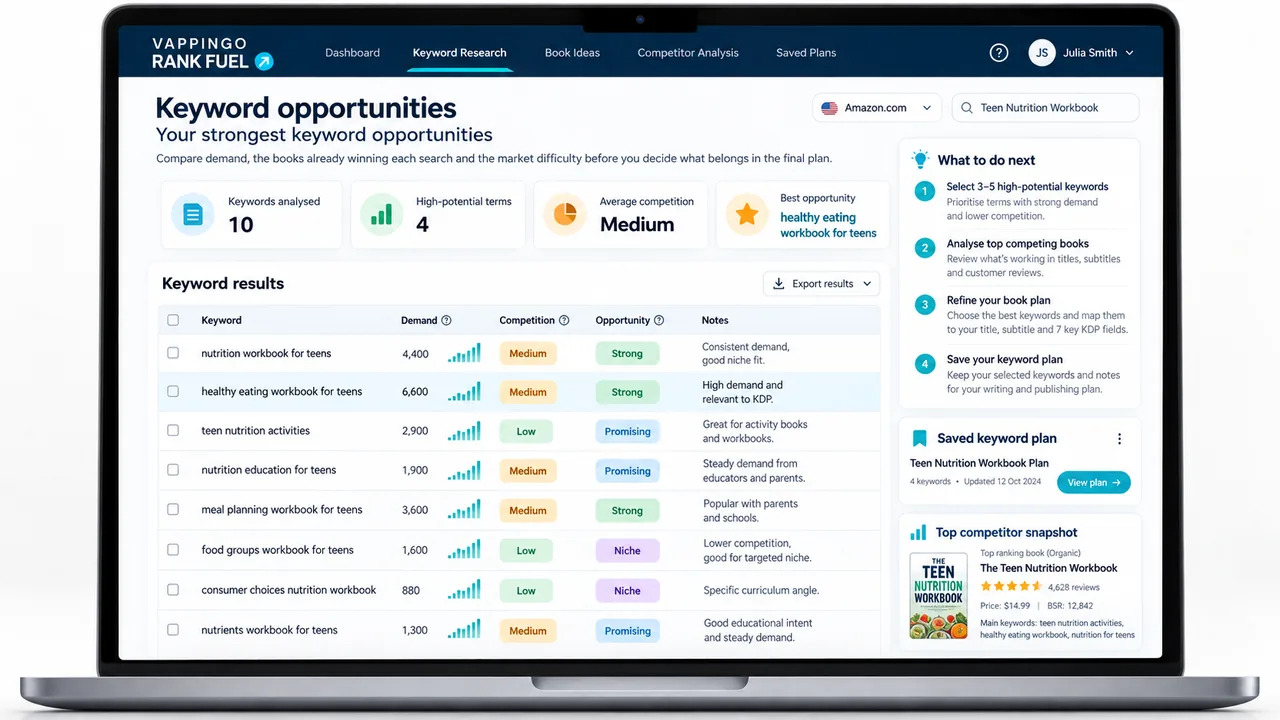
- KDP Rank Fuel: book-centered workflow that connects Keyword Research with competitor, listing, category, and performance tools; current search figures are explicitly presented as estimates.
For a full comparison, see KDP keyword research tools compared. Choose a tool according to the decision you need to improve rather than the number of phrases it can generate.
Keywords for Fiction
Fiction keyword research usually works best when you combine several dimensions: subgenre, setting or period, trope, protagonist type, tone, and reader expectation. A romance might combine “small town,” “second chance,” and “slow burn”; a mystery might combine “British village,” “amateur sleuth,” and “cozy.” The point is not to stuff every possible descriptor into the seven entries. Build a pool, then choose phrases that cover meaningfully different search angles. The seven-keyword selection guide shows how to turn that pool into a final set, while the long-tail keyword guide goes deeper on specificity.
Keywords for nonfiction
nonfiction keyword research focuses on the specific problems readers are trying to solve, the methods they are searching for, and the audience identifiers that describe who they are. “How to stop procrastinating,” “overcoming anxiety without medication,” “pricing strategy for freelancers” , readers search for solutions to specific problems. Your keywords should reflect the problem your book solves in the exact language your readers use. “Cognitive behavioral therapy anxiety,” “Stoic philosophy daily practice,” “zero-based budgeting guide” , readers who have researched their problem often search by methodology. “Productivity for ADHD adults,” “investing for beginners UK,” “weight loss for women over 50” , audience identifiers attract highly targeted readers whose specific situation your book addresses. “How to write a novel in 90 days,” “double your freelance income,” “learn to meditate beginners” , outcome-focused searches capture readers who know what they want to achieve.
Choosing Your Final Seven
After research, you will have a list of candidate keywords. Selecting the best seven involves balancing two factors: relevance (does this keyword accurately describe my book?) and opportunity (is there a realistic chance of ranking for it?). A useful framework for final selection:
- Two or three high-specificity phrases that describe your book’s exact niche with precision , these are your best chances of ranking quickly
- Two or three mid-competition phrases that are more broadly searched but still specific to your subgenre , these build discoverability over time
- One or two audience or mood qualifiers that capture reader intent rather than genre classification
Avoid entries that are vague, inaccurate, repetitive, or prohibited. KDP specifically warns against unrelated information, other authors or books, sales-rank claims, promotional terms, HTML, and other metadata that does not belong in the keyword fields. Before publishing, check the current rules rather than relying on an old keyword list. Our guide to prohibited KDP keywords summarizes the practical traps to avoid.
Keywords in Your Description
Do not treat the description as an eighth keyword field. KDP’s current description restrictions prohibit keyword or book-tag phrase lists, while its keyword help tells authors to put relevant search metadata in the dedicated keyword entries. Write the description for the shopper and use natural genre, audience, problem, and outcome language only where it improves the sales copy. If keyword research reveals that readers call your topic something different from the wording in your manuscript, that insight can still improve the description. Use the reader’s vocabulary because it makes the copy clearer, not because you are trying to stuff a search phrase into another field. See our guide to using search language in book descriptions for the policy-safe distinction.
Tracking and Updating Keywords
Keywords are not something you need to change on a fixed calendar. Reader language, competing books, trends, advertising data, and your own positioning can all change, but frequent metadata edits without a reason make it harder to tell what actually helped. Revisit the seven entries when you have evidence of a problem or a better opportunity: for example, important search visibility has weakened, ad search-term data reveals a more relevant phrase, the market has shifted, or your current entries no longer describe how readers talk about the book. Keep a dated change log and change a small number of entries at a time where possible. The KDP keyword research checklist gives you a repeatable review process.
Common Keyword Mistakes
The most frequently made keyword errors across all KDP publishing experience levels: Most of them come from treating the fields as a place to maximize volume rather than a limited set of relevance signals.
- Single-word keywords. “Mystery,” “romance,” “thriller” , these generate enormous competition and zero targeted traffic. Never use single-word keywords unless they are extremely specific proper nouns.
- Repeating obvious metadata without a purpose. Do not automatically duplicate words from the title, subtitle, or category labels simply to fill space. Use the seven keyword entries to add relevant search language that the visible metadata does not already express well. A repeated word can still be justified inside a genuinely useful phrase, but repetition by itself is not a strategy.
- Targeting only the most popular searches. The most popular keywords are the most competitive. A book with no sales history cannot rank for “romance” against established bestsellers. Start with specific, achievable terms.
- Never updating keywords after launch. The keyword set you chose before publication is a starting hypothesis. Update it as you learn which searches your book is actually appearing in and converting from.
- Treating the description as another backend keyword field. KDP separates the reader-facing description from the dedicated keyword metadata, and its current description rules prohibit keyword or book-tag phrase lists. Write the description to explain and sell the book accurately; keep deliberate search metadata in the keyword fields.
For a fuller audit, see our guide to common KDP keyword mistakes. Once the metadata is attracting the right readers, the manuscript still has to reward the click. Vappingo’s manuscript proofreading service provides the human quality-control step for authors who want the finished book to match the professionalism of the listing.
A repeatable keyword research worksheet
Create one row per candidate phrase and score it on five questions: Does it accurately describe the book? What reader intent does it represent? What evidence suggests shoppers use this language? What does the live results page look like? What distinct information does it add beyond the title and the other six entries? Keep notes rather than just a numeric score. The worksheet becomes more valuable after publication. Add ad search-term results, rank observations, sales direction, and change dates. Over time you build evidence about your own market instead of relying on universal thresholds that may never have applied to your book. The written rationale is often more useful than a score because it preserves what you believed at the time of the decision.
An Evidence Hierarchy for Keyword Decisions
Not all keyword evidence deserves the same confidence. Start with direct facts about the book: genre, subject, audience, setting, problem, method, trope, and outcome. Next comes observable market evidence such as current Amazon suggestions, the books that appear for a query, advertising search-term reports from your own campaigns, and the language readers use in reviews. Third-party search estimates and difficulty scores are useful after that because they help compare candidates, but they remain modeled data rather than official Amazon totals.
Keep inference at the bottom of the hierarchy. A competitor appearing for a phrase does not reveal which hidden keyword entry they used, and a phrase absent from autocomplete is not proof that nobody searches it. When two sources disagree, prefer the interpretation that is easiest to verify and least likely to misrepresent the book. This approach slows down overconfident decisions while still letting you act on useful evidence.
The hierarchy also makes future updates easier. When a keyword stops looking attractive, you can see whether the original choice was based on strong reader evidence, a vendor estimate, or a temporary market observation. Replace weak assumptions first and preserve strong, still-relevant signals unless new evidence gives you a better alternative.
Frequently Asked Questions
How many KDP keywords can I add?
KDP currently allows up to seven keyword entries for a title. Use accurate words or short phrases that represent plausible customer searches.
Does KDP require a fixed character target in every keyword entry?
KDP’s current public keyword guidance emphasizes relevance and short, specific phrases rather than a strategy of filling every field to an old character target. Use the live KDP interface for any technical limit.
Can I use competitor author names as keywords?
KDP prohibits misleading or unauthorized references to other authors, books, brands, sales rank, promotions, and unrelated content. Use compliant reader language instead.
Do keyword tools show exact Amazon search volume?
Treat third-party search figures as estimates unless Amazon explicitly publishes them. They are useful for relative comparison, not as exact official totals.
How often should I change KDP keywords?
There is no required refresh schedule. Change them when new research or performance evidence gives you a clear reason, and keep a record of what changed.
Put the Evidence Into Practice
The strongest publishing workflow is easy to defend later: each metadata choice has a clear reason, each estimate is labeled as an estimate, and each change is recorded so you can learn from the result. That discipline survives platform changes better than any secret-algorithm shortcut.
KDP Rank Fuel connects book-centered keyword, competitor, category, listing, advertising, and performance workflows. Treat search figures and scores as research aids, and verify important decisions against the live Amazon market.
Vappingo provides professional manuscript proofreading by qualified human editors for self-publishing authors.