How to Choose Your 7 KDP Keywords
The difficult part of KDP keyword research is not finding seven phrases.
The difficult part of KDP keyword research is not finding seven phrases. It is rejecting plausible-looking phrases until the final set represents the strongest mix of relevance, specificity, evidence, and distinct intent.
Amazon changes metadata, search, and merchandising systems. This guide reflects the September 2026 workflow; the live KDP interface and current Amazon help pages remain the final authority.
The Selection Process Overview
Choosing your seven keywords is not a single decision , it is the end point of a process. That process has three phases: Treat the seven entries as the final shortlist produced by your research, not as seven blanks to fill from memory.
- Research: Generate a pool of candidate keyword phrases through Amazon autocomplete, competitor analysis, and reader language research. Aim for at least 20-30 candidate phrases before you start selecting.
- Filter: Reduce your pool using three criteria , relevance, specificity, and competition , until you have around ten strong contenders.
- Select and balance: Choose seven from your ten contenders, ensuring your final set covers different aspects of your book’s searchability rather than seven variations of the same phrase.
The entire process should take 30-60 minutes for a new book. This is time well spent , keyword choices made in five minutes at the publishing interface tend to be generic, unconsidered, and significantly less effective than choices made through a deliberate research process.
Building Your Research Pool
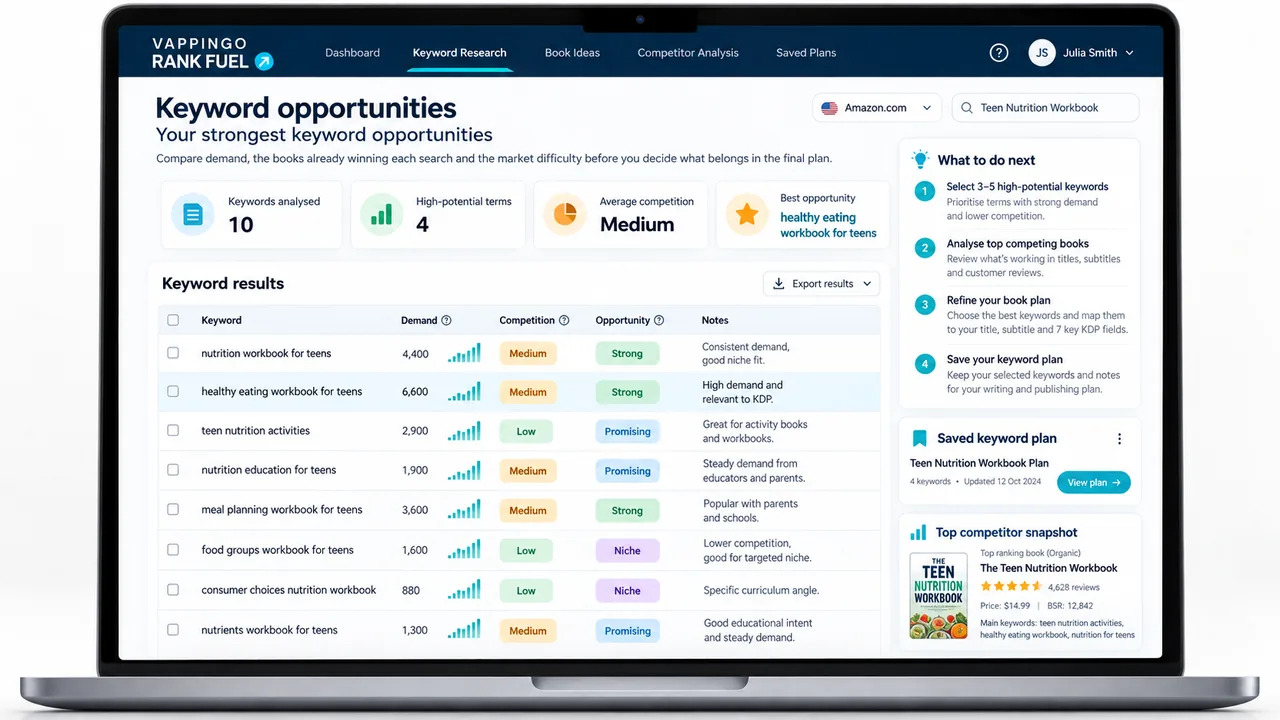
Build the candidate pool before opening KDP. Start with Amazon autocomplete suggestions, close comparable books, reader reviews, your own advertising search-term reports if available, and research tools that provide estimated demand or competitor evidence. Keep the source beside each phrase so you remember why it entered the pool.
A practical starting pool might contain 20 to 40 candidates, but there is no required number. The goal is enough variety to compare several distinct search intents without creating a list so large that relevance becomes an afterthought.
Filter 2: Specificity
From the relevance-filtered pool, prefer phrases that identify a clearer reader need or book type. Specificity can come from subgenre, setting, audience, problem, method, trope, or outcome. The point is not to make a phrase as long as possible; it is to remove ambiguity while preserving language a shopper could plausibly use.
Compare “mystery” with “small-town bakery cozy mystery.” The second phrase narrows the intent and gives you a more focused competitive set to inspect. That closer fit may produce more qualified traffic, but do not assume a specific organic conversion rate or ranking advantage. Validate demand and results-page context separately.
Filter 3: Competition
Competition is not a single number. Search a candidate phrase and inspect the books that dominate the results: how closely they match the query, whether major publishers or entrenched series control the page, how strong their packaging is, and whether your book offers a credible alternative. BSR, reviews, price, and publication history can add context, but none is a standalone ‘difficulty score.’ A phrase can be attractive even when strong books rank for it if your book is an unusually close fit. Conversely, a weak-looking result page can still be a poor opportunity if the phrase has little buyer demand. Treat competition and demand as separate questions and keep relevance as the non-negotiable first filter.
Balancing Your Final Seven
Once you have ten or so strong candidates, your final selection should balance coverage across different search intents: The aim is to cover different ways a qualified reader may describe the same book without repeating one concept seven times. A balanced set is easier to defend because every entry has a different purpose.
- At least one highly specific long-tail phrase that accurately nails your exact niche
- At least one setting or period descriptor if that is relevant to your genre
- At least one character type or protagonist descriptor
- At least one mood or tone phrase
- At least one phrase that captures a secondary audience or variant search pattern
Seven phrases that are all slight variations of the same term (“cozy mystery,” “cozy mystery,” “cozy mysteries,” “cozy mystery novel”) provide far less coverage than seven phrases that approach your book’s searchability from different angles. Variety in the search intents you target is as important as the quality of individual phrases.
Choosing Keywords for Fiction
Fiction keyword selection should prioritize: Treat the list below as research dimensions, not a rigid field-by-field formula.
- Subgenre specificity first , the most precise description of your fiction subgenre
- Setting and period , where and when matters enormously in reader search behavior
- Tropes (especially for romance) , readers actively search by trope; include your key tropes
- Protagonist type , amateur sleuth, ex-special forces, reluctant witch , character types drive significant search volume in genre fiction
- Mood , “heartwarming,” “dark,” “funny” , mood qualifiers attract readers whose expectation matches your book
Genre changes the vocabulary buyers use, but the selection principle stays the same: choose phrases that describe this book accurately, cover different reader intents, and earn their place in the final seven. For additional methods, use the long-tail keyword guide to improve specificity and the Amazon autocomplete guide to collect more candidate language. Use both as research inputs rather than as lists to copy wholesale.
Choosing Keywords for nonfiction
nonfiction keyword selection should prioritize:
- Problem-based phrases , the specific problem your book solves, in reader language
- Methodology phrases , the approach or system you use, if readers search for it
- Audience identifiers , who specifically this is for (ADHD adults, first-time investors, freelance designers)
- Outcome phrases , what the reader achieves by reading your book
- Subject-specific terminology , the precise vocabulary of your niche that informed readers use
When to Revisit Your Choices
There is no required three-month or six-month keyword refresh. Revisit the set when you have new evidence: ad search-term reports, persistent rank movement, a repositioned cover or subtitle, a new edition, changing reader language, or a better understanding of the books actually competing for the same shopper. If a keyword set is supporting steady discovery, leave it alone simply because a calendar reminder fired. When you do change keywords, record the old set, the new set, the date, and the reason. Avoid changing several other listing variables at the same time. Controlled changes make it easier to learn whether the new search coverage helped.
Use a final-seven decision table
Before publishing, place the finalists in a table with columns for relevance, specificity, demand evidence, competitive context, and unique intent. Add a final “why this earns a slot” sentence. If you cannot explain a phrase in one sentence, it probably does not deserve one of the seven entries. The table is also a rollback plan. If you later replace a keyword, you still know what was removed and why, which prevents endless cycling through phrases with no record of what worked.
Frequently Asked Questions
How many KDP keywords can I add?
KDP currently allows up to seven keyword entries for a title. Use accurate words or short phrases that represent plausible customer searches.
Does KDP require a fixed character target in every keyword entry?
KDP’s current public keyword guidance emphasizes relevance and short, specific phrases rather than a strategy of filling every field to an old character target. Use the live KDP interface for any technical limit.
Can I use competitor author names as keywords?
KDP prohibits misleading or unauthorized references to other authors, books, brands, sales rank, promotions, and unrelated content. Use compliant reader language instead.
Do keyword tools show exact Amazon search volume?
Treat third-party search figures as estimates unless Amazon explicitly publishes them. They are useful for relative comparison, not as exact official totals.
How often should I change KDP keywords?
There is no required refresh schedule. Change them when new research or performance evidence gives you a clear reason, and keep a record of what changed.
Put the Evidence Into Practice
The strongest publishing workflow is easy to defend later: each metadata choice has a clear reason, each estimate is labeled as an estimate, and each change is recorded so you can learn from the result. That discipline survives platform changes better than any secret-algorithm shortcut.
KDP Rank Fuel connects book-centered keyword, competitor, category, listing, advertising, and performance workflows. Treat search figures and scores as research aids, and verify important decisions against the live Amazon market.
Vappingo provides professional manuscript proofreading by qualified human editors for self-publishing authors.