How Many Sales Does It Take to Reach #1 in a KDP Category?
Two categories can fit the same book perfectly and still have completely different competitive bars.
If you’re trying to work out how many sales it takes to reach #1 in an Amazon KDP category, you’ll find plenty of neat answers online. Five sales a day. Twenty. Fifty. They sound useful because they give you something concrete to aim for. The problem is that none of those numbers works across every category.
The one thing many articles fail to point out is this: Amazon category rank is relative. You are not trying to cross a fixed sales threshold; you are trying to outperform the other books in that particular category. A quiet specialist category can, therefore, have a much lower bar than a busy category dominated by established authors, major publishers, or heavily promoted new releases.
That does not make sales estimates useless. It changes what they are useful for. Instead of asking
How many sales do I need to reach #1?
The better question is:
What level of sales activity does this category appear to require, and is that realistic for my book?
This guide shows you how to answer that question properly, including how to read estimated #1 and Top 10 sales thresholds, why one bestseller can distort the picture, and how to compare categories without simply chasing the easiest badge.
How Many Sales Does It Take to Reach #1 in a KDP Category?
There is no fixed number of sales that guarantees a #1 Amazon KDP category rank. A book that appears in the number one position is currently performing more strongly than the other eligible books in that category according to Amazon’s ranking system. As such, the bar changes with the market.
A quiet specialist category can require far less activity than a large commercial category full of established authors, major publishers, heavily promoted new releases, or long-running bestsellers. The same book can, therefore, look highly competitive in one relevant category and barely visible in another.
Amazon says rankings are updated at least once per day, although changes can take up to two days to appear. It also says rankings are relative, which is why one day’s sales cannot be treated as a permanent category threshold. See Amazon’s Sales Ranking guidance.
Why Fixed Daily-Sales Rules Are Misleading
Fixed-number advice is attractive because it turns a messy marketplace into an easy target. If a blog post says that twelve sales a day is enough for #1 in a small category, an author can build a launch plan around twelve. The problem is that the books you are competing against do not agree to stay still.
If several strong titles launch or run promotions at the same time, the competitive bar can rise quickly. When a category quietens down, the same level of activity can produce a much stronger position. Amazon also notes that one sale can have a much larger effect on a lower-volume book than on a highly popular title, which is another reason universal rules break down.
Historical activity complicates the picture further. Recent activity carries more weight, but Amazon also considers past activity, so two books receiving the same number of new orders do not necessarily move in exactly the same way.
There is also an important language point. Amazon describes the ranking input as customer activity, not as a public daily-sales counter. Any third-party estimate that translates rank patterns into likely sales should therefore be treated as a research estimate, not as a figure supplied by Amazon.
What an Estimated Category Sales Threshold Can Tell You
An estimated threshold becomes useful when it is used for comparison rather than prediction. If three categories all fit the book and one appears to require materially less activity to reach the leading positions, that tells you something about relative difficulty.
The estimate can also help eliminate unrealistic targets. A category can be completely accurate for the book but so competitive that a new indie title has little chance of reaching the top positions without a very strong launch or existing audience. That does not make the category wrong; it simply changes the role it should play in the strategy.
This is why analyzing competition in a KDP category is more useful than choosing from category names alone. The category label tells you where the book belongs. The competitive field tells you what it may take to become visible there.
The estimate is most useful when categories are compared side by side
If Category A appears to require far less sales activity than Category B, the conclusion is not that a precise number will guarantee #1. The useful conclusion is that Category A currently looks more reachable, assuming the book fits both categories equally well.
Why the Top 10 Bar Matters Alongside #1
Authors naturally focus on #1 because it is the clearest outcome. A stronger category analysis also asks what it appears to take to compete in the Top 10.
That wider view can reveal whether the number-one book is an outlier. If the apparent gap between #1 and the rest of the leading books is very large, one exceptional bestseller may be making the category look harder than the broader field actually is. If both the #1 and Top 10 bars are high, the category is signaling deeper competition.
Top 10 can also be a more realistic commercial objective. A category where a book can remain visible among the leaders may be more useful than a tiny category where #1 is achievable for a short period but few relevant readers browse.
Start With Relevance Before You Compare Difficulty
A low competitive threshold cannot rescue a poor category choice. Amazon currently allows authors to choose up to three categories during title setup, based on the book’s primary audience and marketplace, and warns against categories that are unrelated to the book’s central content or selected to mislead customers.
So relevance is the gatekeeper. If a reader browsing the category would reasonably expect to find a book like yours there, keep it on the shortlist. If the fit is strained, discard it even if the competition looks easy.
Your primary marketplace also matters because category availability can vary. Amazon requires authors to select a primary marketplace before choosing categories, so comparisons should be made against the edition and store you are actually targeting. The wider process is covered in our guide to choosing the best Amazon KDP categories.
Use Five Checks to Compare KDP Categories
Once a category is genuinely relevant, five checks are enough to turn a long list of possible placements into a useful shortlist.
- Fit: Would the right reader expect to find this book here?
- Estimated #1 bar: How much daily sales activity does the current top position appear to require?
- Estimated Top 10 bar: How difficult is the wider leading group, not just the current winner?
- Competitive field: Are the top positions dominated by major publishers, established brands, or unusually strong titles?
- Practical opportunity: Does the combination of relevance and difficulty fit the book’s realistic sales potential?
The order matters. Fit comes first because market evidence only helps after you know the category belongs on the shortlist. Difficulty comes second because two equally accurate categories can offer very different routes to visibility.
A Worked Example: Three Categories, Three Different Bars
Imagine a nonfiction book that fits three category paths equally well. The author now needs to decide which placements look commercially realistic rather than simply which names sound most appealing.
The smallest #1 number is not automatically the best choice
The figures below are invented to demonstrate the decision process. They are not current Amazon data or live Rank Fuel results.
| Candidate | Est. daily sales to #1 | Est. daily sales to Top 10 | Publisher presence | How to read it |
|---|---|---|---|---|
| Category A | 9 | 3 | Low | Reachable, but only useful if the category attracts the right readers. |
| Category B | 28 | 10 | Moderate | More demanding, but potentially a stronger balance of reader fit and realistic visibility. |
| Category C | 95 | 34 | High | A tougher field that needs stronger launch momentum or an established audience. |
The obvious reaction is to choose Category A because nine is the smallest number. That can be right, but only after checking the audience and the books already ranking there. If Category B reaches a much more useful pool of readers and its Top 10 bar is realistic for the launch, it may be the stronger strategic choice.
Category C is not automatically a bad selection either. It may be the clearest core shelf for the book and therefore worth using even if #1 is unlikely in the short term. Three category choices do not all have to perform exactly the same job.
Where KDP Rank Fuel Category Research Helps
This analysis can be done manually, but it becomes slow when several categories are being compared. You need to identify accurate category paths, inspect the leading books, judge the strength of the field, and avoid letting one unusual bestseller distort the picture.
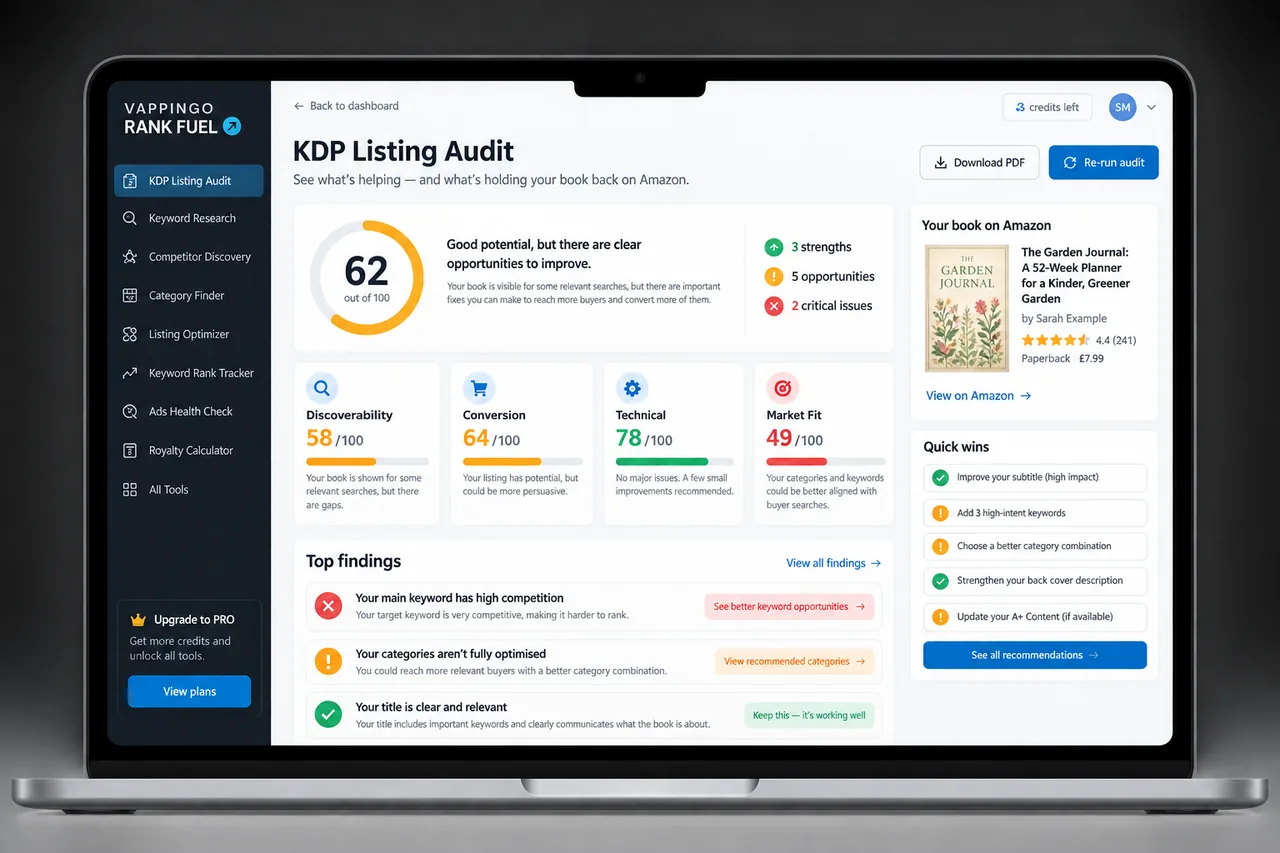
Category Finder helps with the first step by finding Amazon KDP category paths. Category Research handles the deeper comparison: it accepts a category path and returns a directional assessment of the sales bar, Top 10 bar, publisher mix, competitive landscape, and overall opportunity.
The current tool is designed as a comparative research aid. Its estimates are not Amazon ranking factors and they do not guarantee that a particular number of sales will produce a particular position. Their value is that the same set of signals can be applied across several candidate categories instead of relying on one rule of thumb.
Frequently Asked Questions
Can one sale get a KDP book to #1 in a category?
In a very low-activity category, a small amount of new customer activity can produce a large rank movement. Amazon specifically notes that one sale can affect a lower-volume book much more than a highly popular one. That still does not create a universal rule because the outcome depends on the surrounding competition and the book’s activity history.
How often does Amazon update category rankings?
Amazon says Best Sellers and Category Ranks are updated at least once per day, although changes can take up to two days to appear. That delay makes same-hour conclusions unreliable, particularly during launches and promotions.
Is Amazon Best Sellers Rank the same as category rank?
They describe different competitive contexts. Best Sellers Rank reflects a book’s position within the relevant Amazon store, while Category Rank reflects its position among books in a particular Best Seller Category list. Both are based on customer activity relative to other books.
How many KDP categories can I choose?
KDP currently allows authors to choose up to three categories during title setup, based on the book’s primary audience and marketplace. Amazon can also rank a book in up to three Best Seller Category lists based on customer activity.
Should I always choose the category with the lowest estimated sales threshold?
No. The category must first be accurate for the book and useful for the intended reader. After that, compare the estimated #1 and Top 10 bars, the books already competing there, and the wider market context. A low threshold is valuable only when the category also makes editorial and commercial sense.
How accurate are KDP category sales estimates?
They should be treated as directional estimates. Amazon does not publish a formula that converts a given category position into an exact daily-sales number, so third-party tools model likely activity from observable marketplace patterns. Estimates are most useful for comparing relative difficulty, not predicting an exact future rank.
Choose the Category You Can Compete in and Belong in
The useful answer to “How many sales do I need to reach #1?” is not one universal number. It is a comparison between the book’s realistic momentum and the current competitive bar in a category that genuinely fits.
Start with relevance, then look at the estimated #1 threshold, the Top 10 threshold, and the books controlling the leading positions. If the category passes all of those checks, there is a defensible reason to target it. If the only attraction is an apparently easy badge, keep researching.
For a broader look at how category position relates to Amazon rank, see KDP Bestseller Rank and Categories. When the next decision is which category offers the most realistic route to visibility, research the category in KDP Rank Fuel and compare the evidence before you publish.