Long-Tail KDP Keywords: When Specific Beats Broad
Long-tail keywords can give a book a closer match to a specific buyer need, especially when the title does not yet have enough history to compete broadly.
Long-tail keywords can give a book a closer match to a specific buyer need, especially when the title does not yet have enough history to compete broadly. Specificity helps only when the phrase has real relevance and enough demand to matter.
Amazon changes metadata, search, and merchandising systems. This guide reflects the September 2026 workflow; the live KDP interface and current Amazon help pages remain the final authority.
What Long-Tail Keywords Are
In search marketing, a “long-tail keyword” is a specific, multi-word search phrase as opposed to a broad, short “head” keyword. The terminology comes from the shape of a search volume distribution curve , a small number of very high-volume head keywords at the left, and a long tail of lower-volume but far more numerous specific phrases extending to the right. For KDP authors:
- Head keyword: “mystery” , enormous search volume, enormous competition, essentially impossible to rank for as a new book
- Mid-tail keyword: “cozy mystery” , moderate search volume, high competition, difficult to rank for without established sales history
- Long-tail keyword: “amateur sleuth cozy mystery retired teacher English village” , lower absolute search volume, minimal competition, very achievable to rank for
The paradox that surprises most new authors: the long-tail phrase generates more useful traffic than the head keyword, even though it has lower absolute search volume. This is because the traffic it generates is targeted, converting, and satisfied with what it finds.
Why Long-Tail Keywords Outperform Broad Keywords for Most KDP Authors
Long-tail phrases are often more useful for smaller or newer books because they describe a narrower buying intent. That does not mean every long phrase has demand, or that long-tail terms automatically ‘outperform’ broad ones. The advantage appears when a specific phrase is both genuinely searched and unusually well matched to the book. Broad terms can still matter for established books, large categories, or advertising discovery. The practical strategy is to build a portfolio: several precise phrases that describe the book tightly, plus broader concepts where there is evidence your book can compete.
Advantage 1: Competition
Specific queries usually return a more focused competitive set than head terms such as mystery or self help. That can make it easier to judge whether your cover, price, reviews, and positioning belong on the same results page. Do not rely on made-up monthly search counts or promises such as ‘rank fifth and you will sell X copies.’ Amazon does not publish those conversion tables for KDP organic search. Use relative evidence instead: compare the relevance and strength of the top results, use estimated demand from research tools as directional data, and test promising phrases in metadata or ads where appropriate.
Advantage 2: Conversion Rate
A very specific query can indicate clearer intent. Someone searching for a small-town bakery cozy mystery has expressed more preference than someone searching for mystery. If your book matches that intent, the traffic is more qualified. That is a customer-behavior argument, not a guarantee that Amazon assigns a special organic conversion bonus to long-tail keywords. The most useful measure is fit: does the search describe the book closely enough that a shopper who clicks is likely to feel they found what they asked for?
Advantage 3: Reader Quality
Specific searches can also improve expectation matching. Readers who know the trope, setting, audience, or problem they want are less likely to be surprised by a book that accurately signals those traits. Better expectation matching can support reviews, lower dissatisfaction, and make advertising spend more efficient, but do not treat it as a hidden Amazon ranking formula.
Finding the Right Long-Tail Phrases
Build long-tail phrases by combining real dimensions of the book: subgenre plus setting, trope plus character type, problem plus audience, method plus outcome, or topic plus experience level. Amazon autocomplete can help surface wording, but it is suggestion evidence rather than an official search-volume feed.
Progress from a broad seed to more precise variants and record only phrases that remain accurate. Then check the live results page and, where useful, estimated market data. A phrase that is very specific but has no meaningful demand is not automatically better than a broader term.
For the full collection workflow, see how to find KDP keywords with Amazon autocomplete.
Long-Tail Examples by Genre
“retired teacher amateur sleuth English village mystery” / “bakery cozy mystery small town female protagonist” / “1920s country house mystery amateur detective humorous” “small town enemies to lovers contemporary romance” / “Scottish Highlands romance second chance slow burn” / “office romance forced proximity workplace grumpy sunshine” “female detective psychological thriller unreliable narrator” / “ex-military thriller fast-paced government conspiracy” / “domestic suspense marriage secrets psychological” “female mage academy fantasy slow burn romance” / “dark fantasy anti-hero redemption arc series” / “portal fantasy chosen one subversion humorous” “productivity system ADHD adults executive function” / “freelance pricing strategy raise rates without losing clients” / “intermittent fasting women over 50 beginner guide” These are examples of how specificity can be constructed from genuine book attributes, not suggested phrases to paste into KDP unchanged.
When Broader Keywords Make Sense
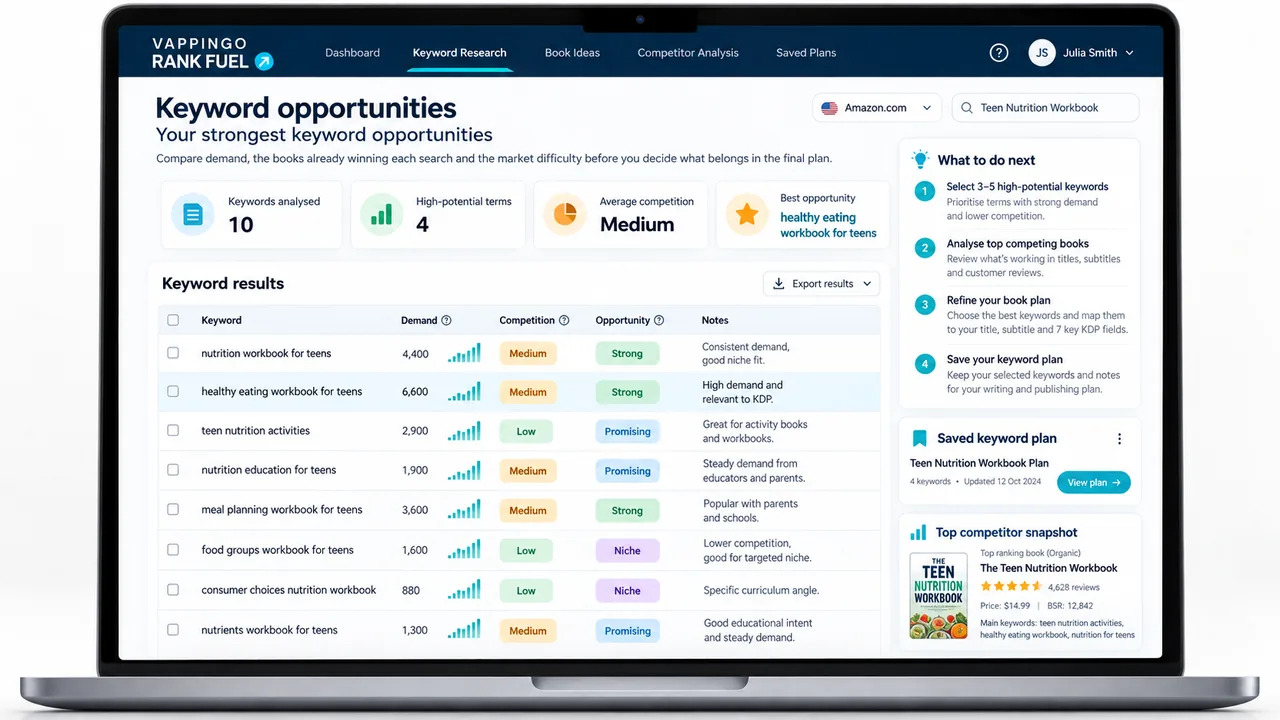
There are circumstances where a broader phrase deserves consideration. A mature title with established sales and visibility may have enough evidence to justify testing a broader query, and a genuinely narrow niche can have useful broad phrases because the overall market is small. Even then, do not assume a broad phrase is valuable just because it sounds important. Inspect relevance, the books currently appearing for the query, and any demand evidence you can obtain. Your visible title and subtitle have separate reader-facing and metadata roles, so do not rewrite them merely to chase an unverified weighting theory. If a broad genre label belongs naturally in the subtitle, it should be there because it accurately positions the book for readers. KDP Rank Fuel can help generate keyword ideas at different levels of specificity and compare the evidence around them, while you make the final relevance decision. Once those searches bring readers in, Vappingo’s manuscript proofreading service helps ensure the manuscript itself earns their confidence.
Build long-tail phrases from real dimensions
Instead of adding random modifiers, combine dimensions that genuinely define the book: subgenre plus setting, problem plus audience, method plus outcome, trope plus character type, or topic plus experience level. Then remove any word that makes the phrase less accurate simply to make it longer. A good long-tail phrase should feel like a compressed buyer brief. If the resulting search would bring a reader who wants a different book, the specificity has become false precision rather than useful targeting.
Frequently Asked Questions
How many KDP keywords can I add?
KDP currently allows up to seven keyword entries for a title. Use accurate words or short phrases that represent plausible customer searches.
Does KDP require a fixed character target in every keyword entry?
KDP’s current public keyword guidance emphasizes relevance and short, specific phrases rather than a strategy of filling every field to an old character target. Use the live KDP interface for any technical limit.
Can I use competitor author names as keywords?
KDP prohibits misleading or unauthorized references to other authors, books, brands, sales rank, promotions, and unrelated content. Use compliant reader language instead.
Do keyword tools show exact Amazon search volume?
Treat third-party search figures as estimates unless Amazon explicitly publishes them. They are useful for relative comparison, not as exact official totals.
How often should I change KDP keywords?
There is no required refresh schedule. Change them when new research or performance evidence gives you a clear reason, and keep a record of what changed.
Put the Evidence Into Practice
The strongest publishing workflow is easy to defend later: each metadata choice has a clear reason, each estimate is labeled as an estimate, and each change is recorded so you can learn from the result. That discipline survives platform changes better than any secret-algorithm shortcut.
KDP Rank Fuel connects book-centered keyword, competitor, category, listing, advertising, and performance workflows. Treat search figures and scores as research aids, and verify important decisions against the live Amazon market.
Vappingo provides professional manuscript proofreading by qualified human editors for self-publishing authors.