What Are KDP Keywords? A Plain-English Guide for Authors
KDP keywords are optional search metadata that help Amazon understand which customer searches may be relevant to a book.
KDP keywords are optional search metadata that help Amazon understand which customer searches may be relevant to a book. They are important, but they are only one layer of discoverability and they do not guarantee a rank or sale.
Amazon changes metadata, search, and merchandising systems. This guide reflects the September 2026 workflow; the live KDP interface and current Amazon help pages remain the final authority.
What KDP Keywords Are
KDP keywords are optional words or short phrases that help Amazon understand which customer searches may be relevant to your book. KDP currently allows up to seven keyword entries. They are metadata, not visible tags on the product page, and they should accurately describe the book.
A keyword does not guarantee that the book will rank for a query. KDP says relevant keywords can improve placement in search results alongside factors such as sales history and Best Sellers Rank. The safest mental model is additional relevance information rather than a direct ranking instruction.
Where Keywords Live in KDP
You add or change keywords in the Book Details area for the title. The live KDP interface provides the current entry controls and should be treated as the authority for any technical input limit. KDP’s public guidance emphasizes relevance, specific wording, and short phrases rather than a strategy of filling every field to a fixed character target.
Use the seven entries to cover distinct reader language. A single concise phrase can be more useful than a packed string of loosely related words if it communicates a clear search intent.
How Amazon Uses Your Keywords
KDP says relevant keywords help make a book easier to find and can improve placement in Amazon search results alongside factors such as sales history and Best Sellers Rank. It does not tell authors that a keyword guarantees indexing, a particular position, or a fixed ranking boost. The useful mental model is eligibility plus competition. Accurate keywords give Amazon more information about searches your book may fit. The actual result page is then shaped by Amazon-controlled systems and marketplace behavior. Your job is to provide clear, compliant search metadata and a listing that genuinely satisfies the reader who clicks.
Keywords vs Categories
Keywords and categories are both metadata , both affect discoverability , but they work differently and serve different functions. determine where your book appears in Amazon’s browse structure. They place your book in a browsable hierarchy (Books > Mystery > cozy Mysteries > British Detectives) where readers can find it without searching. Categories also determine which bestseller lists your book can appear on , a significant visibility benefit if you can achieve a top-ranking position in your category. determine what searches your book appears in. They address the reader who types something specific into the search bar rather than browsing the category structure. Both matter. A book with excellent keywords but poor category placement will miss the organic discovery that category browsing provides. A book with excellent category placement but poor keywords will miss the search-driven traffic that is often the largest source of organic sales. For the detailed explanation of the difference, see our article on
Keywords vs Title and Subtitle
The title and subtitle are customer-facing book details and must match the actual title information on the cover. KDP describes titles as a frequently used search attribute, but it does not publish a table showing that title text receives a particular multiple of backend keyword weight.
Do not distort a title or subtitle to chase a phrase. Use the title fields for the real title and use the keyword entries to add relevant search language that does not belong naturally in the title. This keeps the listing compliant and gives each metadata field a clear job.
Why They Matter for Sales
Keywords matter because discoverability is a prerequisite for sales, not because a keyword itself creates a sale. A relevant search can put the book in front of the right shopper; the cover, title, price, description, reviews, sample, and book itself then influence the purchase decision. This separation helps diagnose problems correctly: weak impressions call for discovery work, while strong traffic with weak orders points toward conversion or product-market fit.
A simple test for every keyword
Imagine a shopper types the candidate phrase and your book appears. Would the shopper immediately understand why? If the answer is yes, the phrase passes the relevance test. If the answer requires explaining that the book is only loosely related, remove it. Relevance is also the safest policy standard because KDP prohibits misleading metadata. Then ask whether the phrase adds something useful. A keyword that merely repeats the exact title may consume an opportunity to cover audience, setting, trope, problem, method, or outcome language that the title does not contain.
Frequently Asked Questions
How many KDP keywords can I add?
KDP currently allows up to seven keyword entries for a title. Use accurate words or short phrases that represent plausible customer searches.
Does KDP require a fixed character target in every keyword entry?
KDP’s current public keyword guidance emphasizes relevance and short, specific phrases rather than a strategy of filling every field to an old character target. Use the live KDP interface for any technical limit.
Can I use competitor author names as keywords?
KDP prohibits misleading or unauthorized references to other authors, books, brands, sales rank, promotions, and unrelated content. Use compliant reader language instead.
Do keyword tools show exact Amazon search volume?
Treat third-party search figures as estimates unless Amazon explicitly publishes them. They are useful for relative comparison, not as exact official totals.
How often should I change KDP keywords?
There is no required refresh schedule. Change them when new research or performance evidence gives you a clear reason, and keep a record of what changed.
Decision Journal: What to Record
A useful research process leaves an audit trail. Record the phrase or copy change you considered, the evidence that supported it, the marketplace you checked, the competing books or customer language you reviewed, and the exact reason the idea was accepted or rejected. This is especially important when several people work on the same catalog because it prevents an estimate or inference from being repeated later as if Amazon had published it.
For a live book, add the date of any metadata change and the observations you plan to watch afterward. Keep search visibility, advertising evidence, sales direction, and listing-conversion questions separate. A change in one metric does not automatically prove a cause, but a clean record helps you build better hypotheses over time. The aim is not to create more administration. It is to avoid losing the reasoning behind decisions once the market moves or the KDP interface changes.
Use the same journal when you decide not to change anything. Stable performance is evidence too. If a keyword, description, or positioning choice still fits the reader and there is no stronger evidence for a replacement, leaving it alone can be the most disciplined optimization decision.
Put the Evidence Into Practice
The strongest publishing workflow is easy to defend later: each metadata choice has a clear reason, each estimate is labeled as an estimate, and each change is recorded so you can learn from the result. That discipline survives platform changes better than any secret-algorithm shortcut.
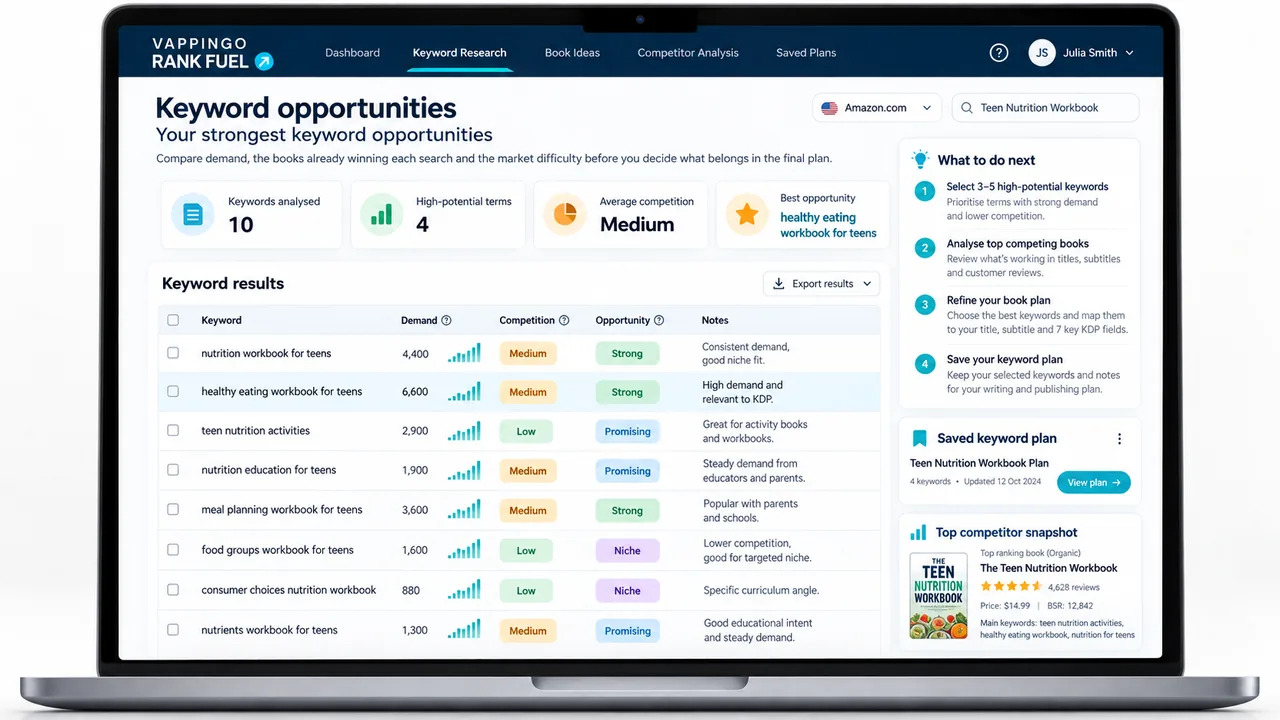
KDP Rank Fuel connects book-centered keyword, competitor, category, listing, advertising, and performance workflows. Treat search figures and scores as research aids, and verify important decisions against the live Amazon market.
Vappingo provides professional manuscript proofreading by qualified human editors for self-publishing authors.