Has Your Old KDP Book Stopped Selling? Here’s What to Fix First
An older KDP book that stopped selling is not automatically dead. Compare what changed in rankings, competition, conversion, price, ads, and demand before deciding how to revive it.
A book that never sold leaves you wondering whether the idea was ever good. A book that used to sell gives you a much better clue: at some point, the buying path worked.
Amazon showed it. Shoppers clicked it. Enough of them bought, borrowed or responded to the ads to create momentum. Then something changed. Search positions slipped, sales became patchy, ad clicks grew more expensive or competitors started looking like the easier choice.
That is why an old KDP book stopped selling problem should not begin with a rewrite. The book may not be broken. The market around it may have moved, a keyword may have weakened, the cover may have aged badly beside newer competitors or the listing may still be attracting traffic but converting less of it.
The useful question is, therefore, not “How do I revive this old book?” It is “What changed between the period when buyers chose it and now?” Find that first, and you can protect what still works instead of rebuilding the entire listing from guesswork.
The Quick Answer: Do Not Revive an Old KDP Book by Guessing
Do not revive an older book by changing everything that is editable. Start by identifying which part of the sales chain weakened. The evidence usually points toward one of six areas:
- visibility: fewer buyers are seeing the book,
- click-through: buyers see it but choose other books,
- conversion: buyers open the page but do not purchase,
- competition: newer books now look like easier choices,
- market demand: the niche itself is weaker or more seasonal,
- ad efficiency: your paid traffic is no longer profitable.
Those problems can look identical in the sales dashboard and require completely different fixes. Lost rankings call for search analysis. Falling click-through points toward the search-result package. Clicks without purchases point toward conversion. Rising ad costs may be a traffic-quality problem, a listing problem or both. Protect the parts that still work by diagnosing the decline before you edit.
An older book rarely stops selling for no reason. Something changed in the listing, the competitive set, the search landscape, the advertising, buyer expectations or the market itself.
Why Old KDP Books Stop Selling
The uncomfortable truth about an older listing is that it can stand still while everything around it changes. Search language evolves, competitors accumulate reviews, cover styles move, prices shift and new books teach buyers to expect more.
A listing that converted well a year ago can, therefore, lose ground without becoming objectively “bad.” The comparison changed. More books may now answer the search more clearly, newer covers may make yours look dated or the market may have moved toward a different format, reader or price point.
That is why older KDP books need deliberate review rather than constant panic-editing. The book may be exactly the same; the buyer’s alternatives are not.
When a book stops selling, the question is not only: What is wrong with my book? The better question is:
What changed around my book? If competitor books have started overtaking yours, you may also want to read Why Are Competitor KDP Books Selling When Yours Looks Just as Good?.
What Not to Do First
A sales drop creates pressure to do something visible: slash the price, rewrite the description, swap every keyword or increase the ad budget. The danger is that a dramatic change can destroy useful evidence before you understand what the evidence was telling you.
- rewriting the title without checking current keyword positions,
- changing all backend keywords at once,
- lowering the price before comparing value against competitors,
- increasing ad spend before checking whether the listing still converts,
- changing categories without reviewing the competitive context,
- rewriting the description without knowing whether traffic is the problem,
- assuming the book idea is dead before checking whether demand still exists.
The goal is not to avoid changes. The goal is to make the right changes in the right order. If you are worried about damaging existing rankings, read Scared to Rewrite Your KDP Listing in Case You Lose Rankings?.
Ten Reasons an Older KDP Book Loses Sales
The ten causes below are not ten instructions to change the book. They are ten hypotheses to test. The aim is to find the one that best explains the decline before you touch the rest of the listing.
1. Your Keyword Rankings Have Slipped
An older book can lose sales simply because it no longer appears where buyers used to find it. Nothing on the listing has to change for a competitor to move above you and take a larger share of the search traffic.
Track your important search phrases before assuming the book has lost demand. Ask:
- Which keywords used to bring visibility?
- Where does the book rank for them now?
- Which competitors have moved above you?
- Has the search result page changed?
- Does the book still match the intent behind those phrases?
The Keyword Rank Tracker can show whether lost sales line up with lost search position, which is a much safer starting point than assuming the listing suddenly became bad.
2. Competitor Listings Have Improved
Your book may not have become worse. The books around it may have become better. A stronger cover, clearer subtitle, deeper review history or sharper price can make yesterday’s perfectly acceptable listing look like the harder choice today.
- a clearer title,
- a more specific subtitle,
- a stronger cover,
- more reviews,
- a sharper description,
- better sample pages,
- a more attractive price,
- more ad visibility,
- stronger category placement.
If buyers are now seeing your book beside stronger alternatives, your old listing may no longer feel like the easiest choice. This is why competitor review should be part of any old-book revival.
3. The Cover Has Started to Look Dated
A cover does not age in isolation; it ages beside the market. Typography, color, illustration style and category conventions can all shift until a design that once looked current begins to signal “older option” at thumbnail size.
Maybe newer books use cleaner typography. Maybe buyers now expect a different visual style. Maybe your title is hard to read at thumbnail size beside more modern covers. Maybe the cover still looks pleasant, but it does not communicate the book fast enough.
Check your cover in search results, not in isolation. Ask:
- Does it still look current beside top competitors?
- Is the title readable at thumbnail size?
- Does it communicate the format, genre, reader, or benefit quickly?
- Does it still match buyer expectations in the niche?
If the cover is losing click-through, rewriting the description will not solve the first broken gate. Test the search-result package before you spend time on conversion copy.
4. The Title or Subtitle No Longer Matches How Buyers Search
Search language and buyer expectations move. A broad title or keyword-heavy subtitle that once worked may now feel vague beside competitors that explain the reader, use case or outcome more clearly.
Check whether your title and subtitle still answer the buyer’s first questions:
- What is this book?
- Who is it for?
- What format is it?
- What problem, desire, or use case does it serve?
- Why should I open this listing?
If the title or subtitle is weak, the book may still get impressions but fewer clicks. For title and subtitle help, see KDP Title Mistakes That Stop Buyers Clicking and How to Write a KDP Subtitle That Helps Amazon and Readers.
5. The Description Still Reads Like an Older Listing
Older descriptions often reveal the priorities of the launch period: explain the contents, get the metadata finished and publish. Years later, that same copy may still be accurate while newer competitors are doing a much better job of selling the buyer’s problem, outcome and reason to choose.
Old descriptions often need a conversion refresh. Look for:
- a weak opening,
- too much summary,
- not enough buyer benefit,
- unclear reader fit,
- generic phrases,
- features without “so what?”,
- no strong final reason to buy.
If your book still gets traffic but sales have faded, the description may be one of the safest places to improve first. Read Why Your KDP Book Description Is Not Selling Your Book for a deeper guide.
6. Your Reviews No Longer Give the Same Advantage
Fifteen positive reviews can feel reassuring when the surrounding books have five or ten. The same fifteen can look thin when the new competitive set has accumulated hundreds. Your reviews did not disappear; their persuasive weight changed.
If competitors have more proof, your listing has to compensate with clearer positioning, stronger description copy, better sample pages, and a more obvious reason to choose your book. You may not be able to close the review gap quickly, but you can reduce the buyer’s uncertainty.
7. Your Price Position Has Become Less Competitive
A price can remain exactly the same and become less competitive. New entrants may offer more pages, stronger interiors, lower prices or clearer value, leaving your book in a weaker position even though its own economics have not changed.
- page count,
- format,
- interior quality,
- review count,
- cover quality,
- buyer promise,
- sample pages,
- description strength.
If the book is more expensive, the value needs to be obvious. If it is cheaper and still not selling, the issue may not be price.
8. Your Backend Keywords Are Out of Date
Backend keywords are easy to forget because buyers never see them. That also makes them easy to leave untouched long after the phrases have become broad, duplicated, outdated or poorly matched to the way shoppers now search.
- Are these phrases still relevant?
- Are they too broad?
- Are they duplicated?
- Do they describe the book, or do they match real buyer searches?
- Do they cover audience, format, problem, use case, and long-tail intent?
- Do they support the way buyers search now?
If your keyword boxes have not been reviewed in months or years, they may be quietly limiting the book’s reach. Read Are You Wasting Your 7 KDP Keyword Boxes? for a full backend keyword framework.
9. Your Ads Are Still Running on Old Assumptions
An ad campaign can keep running long after the assumptions behind it have expired. Keywords become more expensive, broad targets drift, competitors bid more aggressively and a listing that once converted the clicks may no longer do so.
The keywords that once converted may no longer work. Broad targets may have become expensive. Competitors may now outbid or outconvert you. Product placements may be sending poorer traffic. Your listing may no longer convert the clicks you are paying for.
If ads used to work and now do not, check:
- which terms are spending,
- which terms still convert,
- whether broad targets are wasting budget,
- whether clicks are relevant,
- whether the product page still supports the ad promise,
- whether the listing needs improvement before scaling traffic again.
If the campaign still gets clicks but sales have disappeared, read Why Your Amazon Ads Are Getting Clicks But No Book Sales before increasing the budget.
10. Market Demand Has Changed
Sometimes the listing is not the main problem at all. Demand can be seasonal, trends can fade and once-open niches can become crowded enough that the whole market produces less opportunity for the same product.
Before rewriting everything, ask whether demand still exists. Look at:
- current competitor BSRs,
- review growth in the niche,
- new books entering the market,
- keyword search interest,
- seasonality,
- category movement,
- ad performance across similar titles.
If demand still exists, the book may be revivable. If demand has weakened, you may need to reposition, bundle, update, or shift effort to a stronger opportunity.
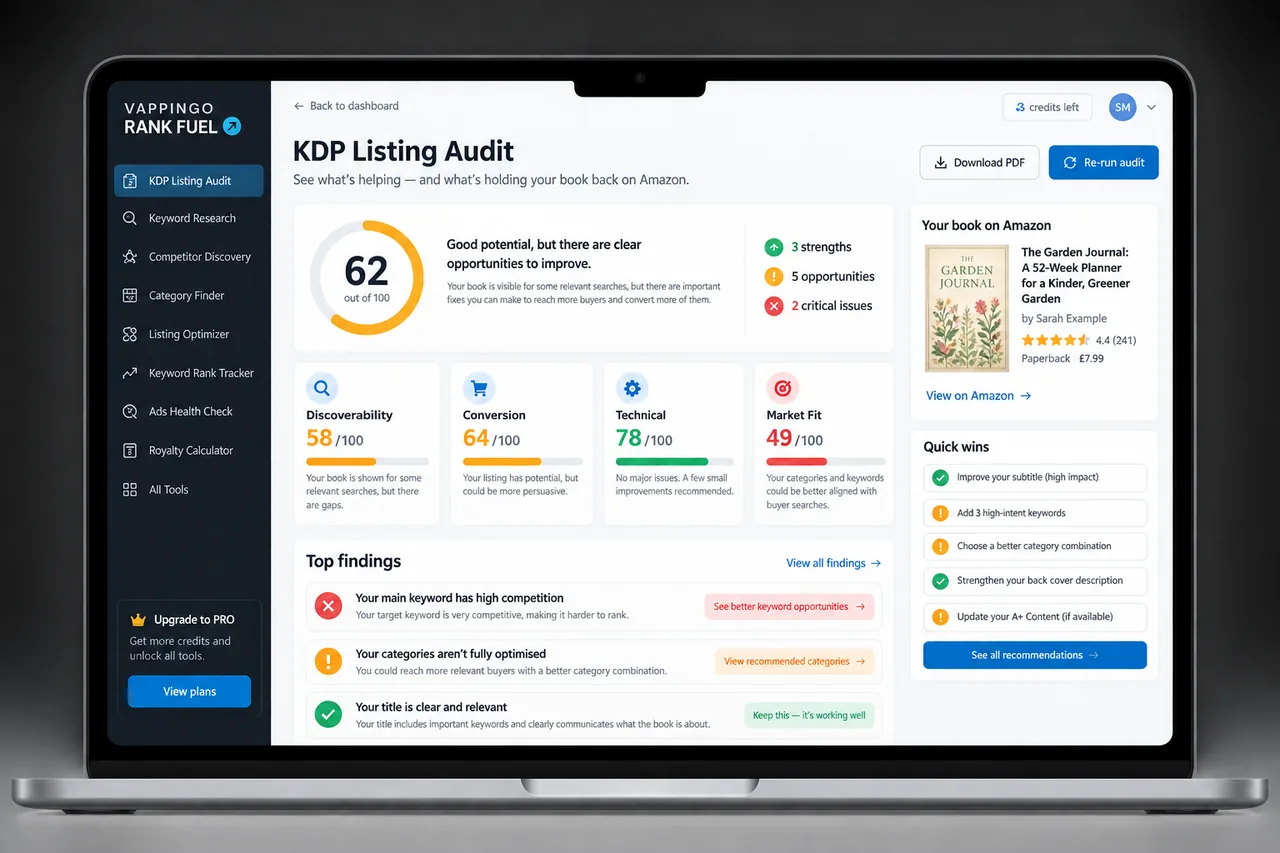
If you are unsure whether the niche still has room, tools such as the Keyword Research and Competitor Discovery can help you review the market before investing more time. If you are not sure where the old listing is leaking, start with a listing audit.
Symptom Table: What Your Sales Drop May Mean
Start with the metric that changed. A fall in impressions tells a different story from steady impressions with fewer clicks, and both are different from stable clicks with falling sales.
| What changed? | Likely problem | Check first |
|---|---|---|
| Impressions dropped | Lost visibility or keyword ranking | Keyword positions, categories, search demand, competitor movement. |
| Impressions stayed, clicks dropped | Search-result appeal weakened | Cover, title, subtitle, price, reviews, competitor covers. |
| Clicks stayed, sales dropped | Conversion problem | Description, buyer promise, Look Inside, price, proof, competitor comparison. |
| Ads spend more but sell less | Traffic quality or listing conversion issue | Search terms, ad targets, listing match, product page strength. |
| Competitors overtook you | Competitive gap widened | Reviews, cover, title, subtitle, price, sample, category fit. |
The Old-Book Revival Plan
A revival should feel more like diagnosis than renovation. Capture the current evidence, identify the broken gate and make the smallest change capable of testing your explanation.
Step 1: Capture the current baseline
Before editing anything, record the book as it exists now: sales, BSR, category position, keyword rankings, ad performance, price, review count and current listing copy. Without a baseline, improvement becomes guesswork.
Step 2: Identify what dropped
Work out whether the decline began with visibility, click-through, conversion or ad efficiency. The point is to turn “sales are down” into a more specific problem.
Step 3: Compare against current competitors
Do not compare the book with the market you remember from launch. Compare it with the books buyers see today and note what has changed in covers, reviews, pricing, positioning and product standard.
Step 4: Audit the visible listing
Now review the cover, title, subtitle, description, price, reviews and sample as one buyer-facing package. Ask whether the listing still makes the choice easy enough in the current competitive set.
Step 5: Refresh the safest high-impact areas first
Start with editable elements that can address the diagnosed problem without forcing a new edition. Description, backend keywords, categories, price, cover and advertising can often be tested while the title and subtitle remain useful diagnostic evidence.
Step 6: Update keywords deliberately
Replace duplicated, stale or poor-fit backend terms, but protect phrases that still bring useful visibility. A revival should recover lost search opportunity without throwing away the rankings that survived.
Step 7: Rework ads only after the listing is stronger
Do not keep paying to prove that the old landing page converts poorly. Strengthen the listing first, then test paid traffic again with cleaner targets and a clear baseline.
The “What Changed?” Test
Before editing the listing, ask one question:
What changed since this book was selling?
If competitors changed, compare the market. If rankings changed, investigate the searches. If buyers still click but no longer buy, audit conversion. If the ads changed, review the traffic and landing-page fit. The first useful edit should follow the change that best explains the decline.
Which Rank Fuel Tools Fit This Problem?
Rank Fuel is most useful here when each tool tests a hypothesis about the decline. Start with the question that would change your next action rather than running every report against the book.
| Tool | Use it when… |
|---|---|
| Keyword Rank Tracker | See whether lost sales line up with lost search positions instead of assuming the listing suddenly became bad. |
| Keyword Trends | Spot keyword opportunities that are gaining or losing traction around the book. |
| Competitor Discovery | Compare the book against the competitors winning the same shoppers now, not the market you remember. |
| Listing Audit | Check whether the live page has become less persuasive or less aligned with the current market. |
| Listing Optimizer | Strengthen editable listing copy after the diagnosis points to a conversion problem. |
Final Thought: A Slow Old Book May Need a Tune-Up, Not a Funeral
When an old KDP book stopped selling, the most valuable fact is that it sold before. That history gives you something a failed launch does not: evidence that the buyer, search and product once connected.
The job is to work out what broke that connection. Maybe the rankings slipped. Maybe the competition improved. Maybe the cover aged, the price lost its edge, the keywords drifted or the market itself weakened.
Once you know, change the smallest part that can plausibly restore the path and watch what happens. A slow old book may need a tune-up. It does not automatically need a funeral.
Want to find out whether the listing is now the weak link? Run your KDP Listing Audit.