Why Your Low-Content KDP Book Is Not Selling
Low-content books still need demand, positioning, a clear use case, and a reason to choose them. Diagnose what is missing before you make another variation of the same idea.
A low-content book can be perfectly usable and still be almost impossible to sell.
The cover looks pleasant. The interior works. The title describes what it is. You upload it, wait for the first sales and then watch competing planners, journals and log books move while yours sits still. That is the frustrating part: nothing is obviously wrong, yet the buyer still has no reason to choose it.
Low-content publishing lowers the production barrier, but it does not lower the buyer’s standard for making a choice. When dozens of products solve roughly the same job, the decision shifts onto specificity: who the book is for, when they will use it, what makes the format more useful and why this version feels better suited than the one beside it.
If your low-content KDP book is not selling, do not assume the answer is simply more keywords, more covers or more variants. First find out whether the problem is demand, positioning, traffic fit, product quality, conversion or economics. The twelve checks below are designed to show you where the buying reason has broken down.
The Quick Answer: Your Low-Content Book May Not Give Buyers a Strong Enough Reason to Choose It
The hardest low-content books to sell are the ones that give the buyer nothing meaningful to choose on. When the product is generic, the decision collapses onto cover, price, reviews and familiarity, which puts a new title at an immediate disadvantage.
A book can therefore be technically fine and commercially weak at the same time. The interior may function, the cover may look attractive and the title may be accurate, while the listing still fails to make the right shopper think, This one is for me.
A low-content book needs a clear reason to exist. That reason might be:
- a specific buyer,
- a specific use case,
- a specific problem,
- a specific gift occasion,
- a better interior format,
- a stronger design style,
- a clearer keyword fit,
- a more convincing buyer promise.
If the product can only be described as “a notebook,” “a planner” or “a journal,” the buyer has too many substitutes. The job is to make the reason to choose visible before the product gets lost among interchangeable alternatives.
Low-content does not mean low-strategy. The simpler the product, the more clearly the listing has to explain why this version deserves the purchase.
Why Low-Content KDP Is Harder Than It Looks
Low-content KDP is difficult precisely because the barrier to entry is low. When many publishers can produce a similar planner, journal or notebook, buyers gain more choice without gaining more attention. A book that looks interchangeable can disappear even when the niche itself has demand.
- blank journals,
- lined notebooks,
- gratitude journals,
- planners,
- log books,
- habit trackers,
- reading journals,
- fitness trackers,
- budget planners,
- guest books,
In these markets, buyers often compare quickly. They look at the cover, title, subtitle, price, reviews, sample pages, and whether the book feels made for them.
A generic book can disappear because it has nothing specific to compete on. The good news is that low-content books do not need to be complicated to sell. But they do need to be clearly positioned.
What Buyers Are Really Buying
The buyer is rarely paying for blank or lightly structured pages alone. They are buying what those pages help them do: plan meals, track a hobby, remember appointments, record progress, organize a routine or give somebody a gift that feels personal rather than generic.
- a gift that feels personal,
- a planner that makes life feel organized,
- a log book that saves time,
- a journal that supports a habit,
- a tracker that helps them see progress,
- a notebook that fits a hobby, job, identity, or occasion.
That means the listing needs to sell the use, not just the object. “Lined notebook” is an object.
“A funny fishing notebook for dads who keep a record of catches, weather, bait, and best spots” is a use case. “Planner” is an object.
“A simple weekly meal planner for busy families who want to reduce food waste and stop deciding dinner at 5 p.m.” is a use case. The more clearly the book connects to a buyer moment, the easier it is to sell.
Twelve Reasons Your Low-Content KDP Book Is Not Selling
Most stalled low-content books do not have one dramatic flaw. They have a chain of smaller weaknesses that make the buyer’s decision easier for a competitor. These are the twelve places I would check first.
1. The Book Is Too Generic
Generic is the default failure mode in low-content publishing. A lined journal, blank notebook or daily planner can be perfectly functional while giving the shopper almost nothing distinctive to compare.
- lined journal,
- blank notebook,
- daily planner,
- gratitude journal,
- fitness log,
- password log book,
Those are not bad products, but they are broad. Buyers searching those phrases will see many options. To compete, your book needs a sharper angle:
- who it is for,
- what situation it serves,
- what makes it easier, funnier, prettier, calmer, clearer, more practical, or more giftable,
- why this version is better suited than the next one.
If the same listing could describe hundreds of competing books, the product is not yet specific enough to make the buyer’s choice easier.
2. There Is Not Enough Buyer Demand
Some niches sound clever enough to feel commercially promising, but originality is not the same as demand. A very specific audience can still be too small, too hard to reach or simply not accustomed to buying this kind of product on Amazon.
- Are similar books selling?
- Do competitors have recent reviews?
- Are there books with healthy BSRs?
- Are buyers searching for the phrases you are targeting?
- Is the niche seasonal or evergreen?
If demand is weak, listing optimization can only do so much. The Keyword Research, Competitor Discovery, and BSR Estimator can help you check whether a niche looks worth pursuing before you create more books.
3. The Niche Is Too Competitive for a Weak Listing
Demand can be healthy and the opportunity still be poor. In a crowded niche, a generic new listing has to compete against stronger covers, deeper review histories, better-known products and sellers who can afford to price or advertise aggressively.
- many similar books,
- strong covers,
- high review counts,
- low prices,
- clearer subtitles,
- well-established books,
- strong seasonal sellers,
- ads from competitors.
If your book enters a crowded niche with a generic title, weak subtitle, average cover, and no reviews, it may be invisible. You either need a stronger angle or a less crowded keyword path.
4. Your Keywords Are Too Broad or Too Weak
Broad words such as journal, planner or log book describe the product but reveal very little about the buying moment. The result is often traffic that is large, competitive and poorly matched.
- journal,
- notebook,
- planner,
- log book,
- coloring book,
- puzzle book.
The problem is that broad phrases are vague and competitive. Better keyword thinking usually includes:
- buyer identity,
- use case,
- occasion,
- format,
- age group,
- theme,
- problem solved,
- long-tail search phrase.
A keyword such as “reading journal” is clearer than “journal.” A phrase like “reading journal for book lovers” is clearer again. A phrase like “reading journal for women book club gift” targets a more specific buying moment. For more help, read Why Your KDP Keywords Are Not Bringing Buyers to Your Book.
5. Your 7 KDP Keyword Boxes Are Wasted
Seven backend fields do not create seven useful discovery routes when they all repeat the same idea. A cluster of near-identical phrases can leave the listing dependent on one broad intent while ignoring the buyer, use case, occasion and format.
- notebook,
- lined notebook,
- journal notebook,
- notebook journal,
- lined journal notebook.
That does not cover enough buyer intent. Instead, the boxes should usually cover different search paths:
- main product type,
- buyer or audience,
- use case,
- theme or niche,
- gift occasion,
- format or feature,
- long-tail variation.
If all seven boxes point to the same broad idea, your hidden search space is not working hard enough. Read Are You Wasting Your 7 KDP Keyword Boxes? for a fuller backend keyword framework.
6. The Cover Looks Nice but Does Not Sell the Use Case
A low-content cover has to communicate more than taste. At thumbnail size, it should help the shopper recognize the purpose, audience, mood or gift angle before they have to investigate further.
A nice floral cover may look attractive, but if it does not signal the purpose, audience, mood, gift angle, or niche, it may blend in with thousands of other books. Ask:
- Can buyers understand the book at thumbnail size?
- Does the cover match the niche?
- Does it signal the right buyer?
- Does it make the book feel giftable, useful, relaxing, practical, funny, premium, or child-friendly?
- Does it look stronger than competitor covers?
Because the interior is often simple, the cover carries a disproportionate share of the click decision. Attractive is useful; instantly relevant is better.
7. The Title Is Too Flat
My Journal, Daily Planner and Fishing Log Book are understandable titles, but clarity alone may leave the book indistinguishable from dozens of others. The title and subtitle need to make the specific buying reason easier to see.
- the specific buyer,
- the use case,
- the theme,
- the benefit,
- the format,
- the occasion,
- the tone or style.
The title does not need to become long and stuffed. But the title and subtitle together should make the book feel more specific than a blank template. If your title is not earning clicks, read KDP Title Mistakes That Stop Buyers Clicking.
8. The Description Does Not Explain Why This Low-Content Book Is Worth Buying
Low-content descriptions often become inventories: page count, trim size, lines, sections and a generic “great gift” claim. Those facts can be useful, but they do not explain why this particular product fits the buyer’s life better than the alternatives.
- This notebook has 120 lined pages.
- This planner helps you organize your day.
- This log book is perfect for recording information.
- This journal makes a great gift.
Those lines may be true, but they do not create much desire. A stronger description explains:
- who the book is for,
- what situation it solves,
- how the interior is useful,
- why the format helps,
- why it makes a good gift,
- what makes it easier, clearer, funnier, calmer, prettier, or more practical than alternatives.
For low-content books, the description needs to sell the experience and use case, not just the page count. Read Why Your KDP Book Description Is Not Selling Your Book if your description is mostly a contents summary.
9. The Interior Is Too Basic to Compete
A simple interior can work when the cover, niche or gift angle is doing enough commercial work. In many planner, journal and log-book markets, though, buyers expect the pages themselves to solve a problem more thoughtfully than a generic template does.
- prompts,
- trackers,
- sections,
- indexes,
- guided pages,
- useful layouts,
- clear instructions,
- better organization,
- large print,
If the sample reveals an interior that feels thin beside competing products, the problem is not simply the listing. The product itself may need more value.
10. The Look Inside Sample Does Not Reassure Buyers
The sample is where the promise meets the product. A convincing cover and description can earn the click, but repetitive pages, cramped spacing or a confusing layout can undo that work as soon as the buyer looks inside.
Check whether the sample proves the book is useful. Ask:
- Does the sample show the strongest layout?
- Does it confirm the promise in the description?
- Does it look clean and professional?
- Is it easy to understand how to use the book?
- Would a buyer feel reassured after opening it?
If the product page promises one experience and the sample shows another, conversion is likely to suffer.
11. The Gift Angle Is Too Weak
Giftability becomes persuasive when the buyer can picture the recipient and occasion. “Makes a great gift” is too generic to do that work on its own.
But “makes a great gift” is not enough on its own. Be more specific:
- gift for gardeners,
- gift for new moms,
- gift for teachers,
- gift for book lovers,
- stocking filler,
- birthday gift,
- retirement gift,
- travel gift,
- gift for someone starting a new hobby.
If gifting is part of the buying path, the title, subtitle, cover, description and keywords should make the recipient or occasion obvious enough to recognize quickly.
12. The Price or Royalty Does Not Make Sense
Low-content economics can be unforgiving. A price high enough to protect the royalty can make the book look expensive beside similar products, while a low price can leave too little margin to support advertising or promotion.
- what similar books cost,
- how many pages they include,
- whether they are color or black and white,
- their review count,
- their perceived value,
- your print cost and royalty,
- whether paid ads can realistically work at that margin.
The Royalty Calculator can help you check whether your pricing leaves enough room for profit. If you are not sure whether your low-content listing is the bottleneck, start with a listing audit.
Symptom Table: Why Your Low-Content Book Is Not Selling
Start with the symptom you can observe. The same book can fail because nobody sees it, because the wrong people see it, or because the listing and interior do not finish the sale. Each pattern points to a different first check.
| What you see | Likely issue | Check first |
|---|---|---|
| Almost no impressions | Weak niche demand, poor keywords, or poor category fit | Niche demand, keyword quality, categories, backend boxes. |
| Impressions but few clicks | The book does not stand out in search | Cover, title, subtitle, reviews, price, competitor comparison. |
| Clicks but no sales | The product page or sample is not convincing buyers | Description, buyer promise, Look Inside, interior value, price. |
| Ads spend but do not convert | Poor traffic fit or weak listing conversion | Search terms, keyword intent, price, listing strength, royalty margin. |
| Competitors sell but yours does not | They give buyers a clearer reason to choose | Positioning, cover, subtitle, reviews, sample, niche angle. |
What to Fix First
Do not make ten more variants until you understand why this one stalled. Repeating the same product logic at scale only multiplies the same problem across a catalog.
Step 1: Check whether the niche has demand
First establish that buyers are actually purchasing similar products. If the niche itself is weak, polishing the listing cannot create a market that is not there.
Step 2: Check whether the niche is too competitive
If demand exists, look at the wall between your book and the visible leaders. Strong reviews, polished covers and entrenched listings may mean the market needs a sharper angle rather than another generic entrant.
Step 3: Clarify the buyer and use case
Stop selling “a journal.” Sell a product for a particular person, moment, hobby, routine, gift or problem. Specificity gives the rest of the listing something to say.
Step 4: Strengthen the cover, title, and subtitle
These elements decide whether shoppers notice the book and understand it quickly enough to click. Make the use case legible at thumbnail size and the positioning clear in the search result.
Step 5: Rewrite the description around buyer value
Explain who the book is for, what job it helps them do, how the interior supports that job and why this version deserves the purchase.
Step 6: Check the Look Inside sample
Make sure the sample proves the promise. If the interior feels generic, confusing or underdeveloped, fix the product before trying to write around the weakness.
Step 7: Review pricing and profit before ads
Before buying traffic, make sure the royalty and likely conversion rate can support it. Paid clicks cannot rescue economics that were weak before the campaign began.
The “Why This One?” Test
Put the book beside three strong alternatives and ask one question:
Why would the right buyer choose mine?
If the answer is only “because it is nice,” the positioning is still too generic. A stronger answer usually names the buyer, use case, gift angle, format advantage or design reason that makes this version the better fit.
Which Rank Fuel Tools Fit This Problem?
Rank Fuel works best when the tool follows the diagnosis. Use the smallest workflow that tells you whether the failure sits in the market, the buyer search, the competitive set, the listing or the economics.
| Tool | Use it when… |
|---|---|
| Rank Fuel Radar | Test whether a book idea has enough buyer demand and a realistic route to sales before making more variants. |
| Keyword Research | Find Amazon.com searches that match the buyer and product rather than relying on broad topic terms. |
| Competitor Discovery | Find the books competing for the same shopper and compare the standard you need to beat. |
| BSR Sales Estimator | Use BSR as directional evidence of how competing books may be selling. |
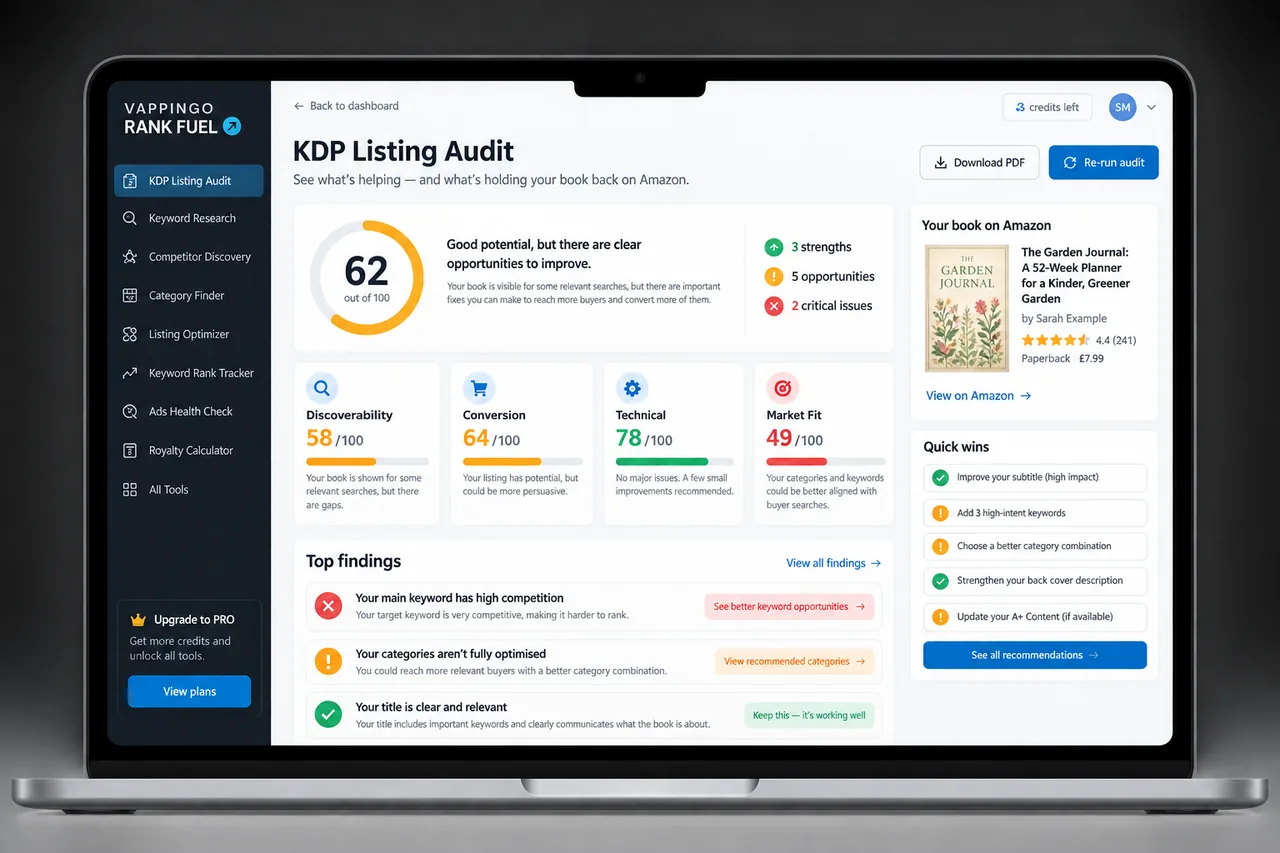
| Listing Audit | Diagnose a live low-content listing when the niche appears viable but the book is not converting. |
Final Thought: Low-Content Books Still Need a Real Reason to Exist
A low-content book can be simple. What it cannot afford to be is interchangeable.
The buyer needs a reason to choose it, Amazon needs enough relevance to show it, the interior has to support the promise and the price has to leave enough room for the business to work.
If your low-content KDP book is not selling, do not answer by making another generic version. Find the missing reason to buy first.
Not sure whether the listing is the bottleneck? Run your KDP Listing Audit.