Scared to Rewrite Your KDP Listing in Case You Lose Rankings?
A live KDP listing can need work without needing demolition. Learn what Amazon lets you edit, what to protect, and how to improve a weak listing without making random changes.
The most difficult KDP listing to change is often the one that is doing just enough to make you afraid of touching it.
It ranks for a few phrases. It gets some impressions. Maybe it sells occasionally. That creates a strange kind of paralysis: the listing is clearly not working well enough, but every possible improvement feels like a threat to the little visibility you already have.
If you want to rewrite a KDP listing without losing rankings, the answer is not to freeze the page in place. It is to separate the signals worth protecting from the elements that are failing to earn the click or sale.
That means recording the baseline, diagnosing the broken part of the buying path and changing one layer at a time where possible. The goal is not to preserve the old listing. It is to preserve the parts that still help while removing the parts that hold the book back.
The Quick Answer: Do Not Rewrite Everything at Once
If you are scared that a rewrite will damage existing rankings, do not respond by leaving everything untouched. Make the rewrite controlled enough that you know what you are protecting, what you are changing and what result you expect.
- change the title, subtitle, description, keywords, categories, price, and ads all at once,
- remove phrases that are already bringing relevant visibility,
- rewrite without knowing which part of the listing is weak,
- make changes without recording the date,
- judge results too quickly,
- fix a visibility problem as if it were a conversion problem, or the other way round.
A safer rewrite protects the phrases and positioning already bringing useful visibility, then improves the elements that are clearly leaking clicks or sales. Ranking is only valuable when the traffic is relevant and the listing can convert it.
The goal is not to preserve a weak listing because it has some ranking. The goal is to improve the weak parts without destroying the signals already helping Amazon and buyers understand the book.
Why Authors Freeze When a Listing Needs Fixing
The fear usually begins when a book has enough life to feel worth protecting but not enough performance to feel successful. A completely dead listing is easy to rebuild. A half-working one is psychologically much harder.
- the book gets a few impressions,
- it ranks for some keywords,
- it sells occasionally,
- it has a little ad data,
- it appears in some searches,
- but it does not convert well enough to grow.
That middle ground is where authors get stuck. The book appears for some searches, gathers occasional clicks or sales and produces just enough data to make a rewrite feel risky, even though the current conversion rate is not strong enough to grow.
This is exactly where diagnosis matters most. If the book already has visibility but buyers are not choosing it, the answer may be a stronger description, clearer buyer promise, better cover-message fit, more convincing price position or a sharper comparison against competitors rather than a wholesale rebuild. If you are facing that exact problem, read My KDP Book Is Ranking for Keywords But Getting No Sales.
What Not to Change Blindly
Not every listing element carries the same risk. Some define the book’s search identity or buyer expectation more directly, while others can be improved with less disruption. The point is not to label anything untouchable; it is to understand the consequence before you edit.
| Listing element | Why it matters | Rewrite risk |
|---|---|---|
| Title | It affects buyer understanding, keyword relevance, and click-through. | Higher. Change only with a clear reason. |
| Subtitle | It clarifies audience, format, benefit, and search fit. | Medium to high. Improve carefully. |
| Description | It influences conversion once buyers reach the page. | Lower, if the title and keyword promise stay consistent. |
| Backend keywords | They support discoverability and relevance. | Medium. Avoid removing working phrases without a plan. |
| Categories | They affect competitive context and browsing relevance. | Medium. Change only if the current category fit is weak. |
| Price | It affects buyer friction and competitive position. | Medium. Track price changes separately. |
The description is often the best place to start because it can improve conversion without changing the core search identity of the book. But if the title or subtitle is clearly confusing buyers, you may still need to fix it.
For title-specific issues, read KDP Title Mistakes That Stop Buyers Clicking. For subtitle issues, read How to Write a KDP Subtitle That Helps Amazon and Readers.
How to Rewrite a KDP Listing More Safely
A safer rewrite starts by turning vague fear into evidence. Capture what the book is doing now, identify the bottleneck and then make the smallest change capable of testing your diagnosis.
1. Record the Baseline Before You Touch Anything
Before touching the listing, record the version you are trying to improve. Capture the title, subtitle, description, backend keywords, categories, price, keyword positions, recent sales and ad data, plus the date of the planned change.
- current title and subtitle,
- current description,
- current backend keywords,
- current categories,
- current price,
- current keyword positions if you track them,
- recent impressions, clicks, sales, page reads, and ad data,
- current bestseller rank and category rank,
- date of the planned change.
This gives you a reference point. Without it, every later judgment becomes guesswork. The Keyword Rank Tracker can help you monitor important phrases before and after listing changes.
2. Diagnose the Bottleneck Before Rewriting
Low sales are not a diagnosis. Work out whether the failure begins with visibility, click-through or conversion before deciding which part of the listing deserves attention.
If the book has almost no impressions, you may have a visibility problem. Rewriting the description will not fix that on its own.
If the book gets impressions but few clicks, you may have a click-through problem. The cover, title, subtitle, reviews, price, or search-result fit may be more important than the description.
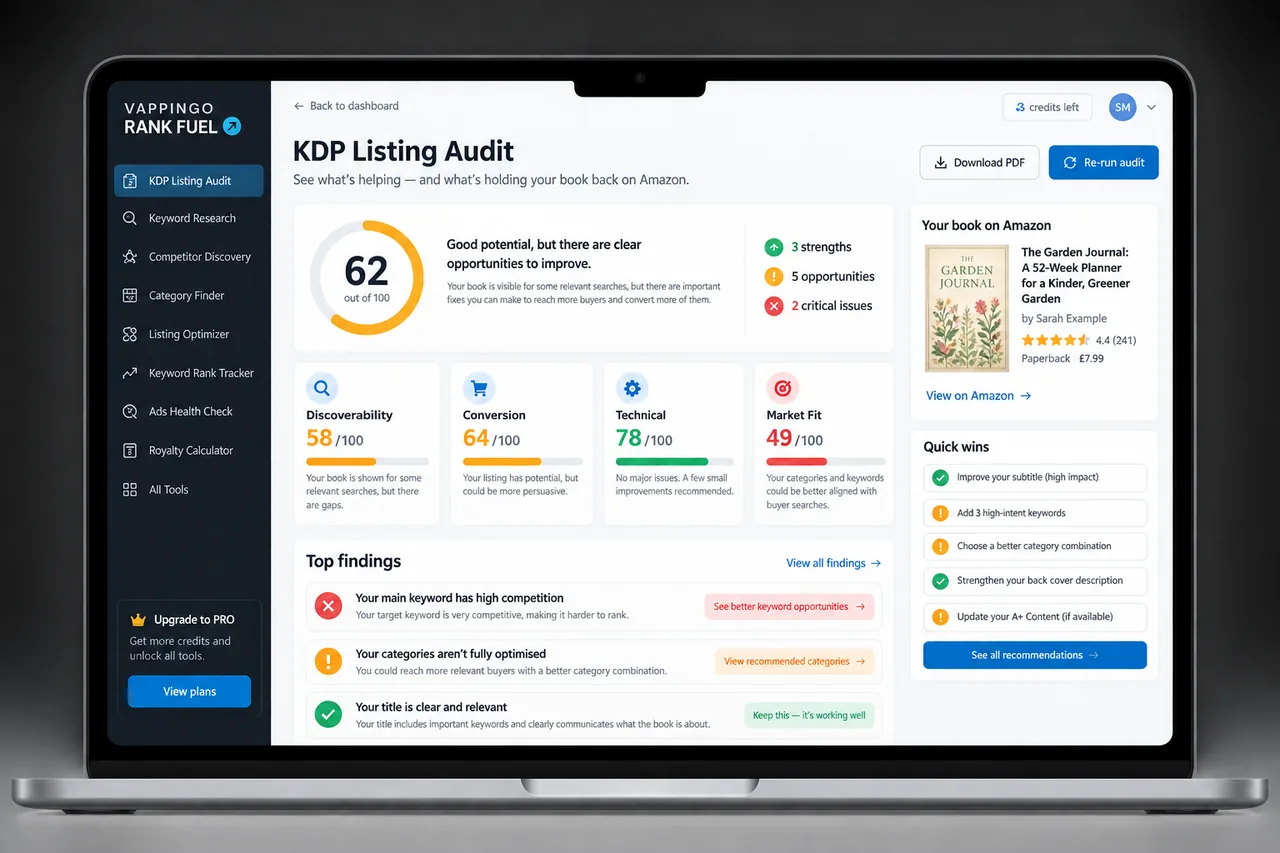
If the book gets clicks but no sales, you may have a conversion problem. The description, buyer promise, Look Inside sample, price, proof, or competitor comparison may be the issue. This is where a listing audit is useful because it helps you identify whether the title, subtitle, description, and buyer promise are doing enough work before you start changing things.
3. Keep the Signals That Are Already Working
If the book already ranks for a valuable phrase, treat that phrase as evidence. Do not casually remove the language supporting it unless the replacement is better aligned with the buyer and you understand the trade-off.
That does not mean you should stuff the listing with repeated keywords. It means you should understand which words are central to the book’s search identity. Protect:
- the main buyer phrase,
- the audience or level,
- the format,
- the core topic,
- the strongest use case,
- any phrase that already brings relevant visibility.
You can improve clarity and conversion without stripping away the phrases that help Amazon and buyers understand the book.
4. Change One Layer at a Time Where Possible
Changing every editable element at once may feel decisive, but it destroys your ability to learn. A layered rewrite gives you a much better chance of seeing whether the description, keywords, price, categories or advertising actually changed the result.
- improve the description first,
- then refine the subtitle if needed,
- then update backend keywords,
- then adjust ads once the listing is stronger,
- then consider price or category changes if the data supports it.
Sometimes a listing is so weak that a full rebuild is necessary. But if the listing already has rankings, controlled changes are usually easier to understand.
5. Improve the Description Without Changing the Search Identity
The description is often the safest place to begin when visibility exists but conversion is weak. You can strengthen the buyer promise, benefits and fit without changing the title, subtitle or core search identity.
- open with the buyer’s problem, goal, or desire,
- clarify who the book is for,
- turn features into benefits,
- make the buyer promise specific,
- show why the book is a good fit,
- make the purchase decision easier.
If your description currently reads like a summary, rewriting it can help the listing sell without making the book harder for Amazon to understand. For a deeper description guide, read Why Your KDP Book Description Is Not Selling Your Book.
6. Fix the Subtitle if It Is Wasting Space
A weak subtitle can waste valuable clarification space, but live-title restrictions matter. If the subtitle is editable, strengthen the audience, format, level, use case or benefit. If it is locked, treat the weakness as diagnostic evidence and improve the surrounding editable elements first.
- audience,
- format,
- level,
- use case,
- benefit,
- natural keyword phrase.
If the live title or subtitle is weak, treat that as a diagnosis rather than assuming you can simply rewrite it. On most published books those fields are locked, so strengthen editable areas first; if the locked metadata is the central problem, evaluate whether a new edition is worth the disruption.
7. Treat Title Changes as a Bigger Decision
A title change is a bigger decision because it can alter both buyer understanding and the search identity of the book. It may be justified when the existing title is genuinely confusing, generic, poorly matched or aimed at the wrong audience, but frustration alone is not enough reason.
- buyers cannot tell what the book is,
- the title attracts the wrong audience,
- the title does not match the niche,
- the title is too generic to compete,
- the title is stuffed with keywords and looks low quality,
- the title misses the main buyer phrase completely.
If a title change is serious enough to justify a new edition, protect the underlying buyer promise and make sure the new title remains consistent with the cover, description, categories, and advertising strategy.
8. Update Backend Keywords Carefully
Backend keyword changes are useful when the seven fields are duplicated, vague or poorly matched to current buyer intent. The safer approach is to preserve phrases linked to real visibility while replacing weaker terms with distinct search paths.
First, identify what each keyword box is supposed to do. Does it cover audience, format, problem, use case, level, niche, or long-tail search intent?
If all seven boxes are variations of the same phrase, you probably have space to improve. If some phrases are already connected to real visibility, preserve the strongest ones while replacing weaker duplicates. For more on this, read Are You Wasting Your 7 KDP Keyword Boxes?.
What to Change First
If the book already has some useful visibility, start with the elements most likely to improve conversion without unnecessarily disturbing the search identity. This is a priority order, not a rigid rule.
| Priority | What to review | Why this comes first |
|---|---|---|
| 1 | Description | Often improves conversion without disrupting the main search identity. |
| 2 | Subtitle | Can add clarity, audience, format, and benefit without replacing the whole title. |
| 3 | Backend keywords | Can improve search coverage if boxes are duplicated or poorly matched. |
| 4 | Ad targeting | Paid traffic works better once the page is ready to convert. |
| 5 | Title | Important, but more disruptive. Change when the current title is clearly wrong. |
| 6 | Categories or price | Useful when competitive context or buyer friction is clearly the issue. |
This order is not universal. A terrible title may need fixing before anything else. A wildly wrong price may need immediate attention. But for many underperforming listings with some ranking, this sequence reduces guesswork.
How to Track Listing Changes After a Rewrite
Tracking matters because listing changes create noise. Without a change log, a normal day-to-day fluctuation can look like proof that the rewrite worked or failed when the evidence is still too weak.
- date of change,
- what was changed,
- why it was changed,
- keywords you want to monitor,
- baseline rank or visibility,
- baseline sales, clicks, and ad data,
- notes on competitor changes or seasonal factors.
After the change, monitor:
- keyword ranking movement,
- impressions,
- click-through,
- sales,
- page reads, if relevant,
- ad conversion,
- category rank,
- review changes.
Do not judge a rewrite only by one metric. A description change may improve conversion without increasing impressions. A keyword change may increase impressions but reduce conversion if it brings poorer traffic. A title change may affect click-through and search relevance at the same time. You need to know which outcome you are trying to improve.
Use a Rank Tracker Before You Rewrite
If ranking loss is the fear stopping you from editing, replace memory with a baseline. Track the phrases that matter before the rewrite so you can see what actually happens afterward.
Before rewriting your listing, choose the keywords you most want to protect. These might include the phrases your book already ranks for, the terms that bring ad clicks, or the searches most closely connected to your ideal buyer.
Then monitor what happens after each change. If rankings hold steady but sales improve, the rewrite may have strengthened conversion. If rankings fall after a major title or keyword change, you can see which phrase was affected and respond more carefully. The Keyword Rank Tracker helps you see whether your book gains, holds, or loses position for the phrases that matter most after a listing update.
The “Protect and Improve” Test
Before changing any listing element, ask two questions:
- What is this element currently helping Amazon or the buyer understand?
- How can I improve the weak part without losing that useful signal?
A good rewrite does more than make the copy sound better. It protects what works and fixes what leaks sales.
Rewrite Risk Diagnostic
Use the table below to judge how aggressive the rewrite needs to be. The more useful visibility and sales evidence the listing already has, the more carefully you should isolate the weak element before changing the rest.
| Your situation | Rewrite risk | Best next step |
|---|---|---|
| No impressions, no rankings, no sales | Lower | Rebuild title, subtitle, keywords, and description around better search intent. |
| Some rankings but very few clicks | Medium | Review cover, title, subtitle, price, and search-result appeal. |
| Clicks but no sales | Medium | Improve description, buyer promise, proof, and Look Inside alignment. |
| Ranking for a valuable phrase but not converting | Medium to high | Protect the phrase, improve conversion elements first. |
| Steady sales but weak profit from ads | Medium | Audit listing and ad targeting before changing the title. |
Which Rank Fuel Tools Fit This Problem?
Rank Fuel works best here when the tools help you protect useful evidence before you edit. Start with the uncertainty that would change your next action: where the book ranks, where the listing leaks or which search language is already working.
| Tool | Use it when… |
|---|---|
| Listing Audit | Diagnose whether the problem is visibility, click-through, or conversion before you change the wrong part of the listing. |
| Listing Optimizer | Strengthen editable live-listing copy and positioning while leaving Amazon-locked title and subtitle untouched. |
| Keyword Rank Tracker | Record current keyword positions and watch whether visibility improves or slips after a controlled update. |
| Book Keyword Spy | See which Amazon searches already bring shoppers to competing books before replacing useful search language. |
Final Thought: A Weak Listing Is Already Costing You
Being careful with a listing that already ranks is sensible. Treating every existing signal as sacred is not.
If the book appears for useful searches but the title, description, price, sample or buyer promise fails to turn that visibility into enough sales, leaving the listing untouched has a cost too.
The safer answer is to diagnose first, protect the evidence that still works and make controlled changes to the part that does not. That is how you rewrite a KDP listing without losing rankings blindly in the process.
Want to improve the listing without guessing what to change?Run your KDP Listing Audit.