Are the First 150 Words of Your Amazon Book Description Losing Buyers?
Your description can contain strong selling points and still lose the buyer before they reach them.
Your KDP book description may contain exactly the sentence that would convince the right buyer to purchase. The problem is that they may leave before they ever reach it.
The Quick Answer: Your Opening Should Confirm the Buyer, Problem, and Promise Fast
The first 150 words should answer three questions fast enough that the buyer never has to hunt for the relevance:
- Is this book for me?
- Does it solve the problem, desire, or use case that brought me here?
- Why should I keep reading instead of going back to the search results?
If those answers are clear, the rest of the description gets an interested reader instead of a skeptical browser. A strong opening does not merely introduce the book; it earns the next few seconds of attention.
The first lines should not warm up slowly. They should make the buyer feel understood, show the book’s value and pull them deeper into the listing.
Why the Opening Matters So Much
A buyer who has clicked through to the product page is interested, but not committed. They may already have several competing books open, and one tap takes them straight back to the search results. The opening has to turn that fragile interest into a reason to stay.
- your book has few reviews,
- competitors have stronger proof,
- you are running Amazon ads,
- your price is higher than nearby books,
- the buyer is comparing several similar options,
- your title or subtitle needs extra clarification,
- your book has a specific use case that must be explained quickly.
If your whole description is struggling, read
Why Your KDP Book Description Is Not Selling Your Book
.
What Buyers Need in the First Few Lines
The opening is not a literary preface. It is the point where the buyer checks whether the book matches the reason they clicked. In the first few lines, they need enough information to understand:
- what kind of book this is,
- who it is for,
- what problem, goal, desire, or situation it serves,
- why this book is useful, enjoyable, reassuring, or worth choosing,
- whether it matches the search that brought them there.
The exact opening depends on the type of book. A workbook, gift book, nonfiction guide, and journal can all need a different first emphasis even when the same relevance principles apply.
| Book type | Opening should quickly show… |
|---|---|
| Workbook or revision book | Level, learner, topic, practice purpose, confidence or progress benefit. |
| Puzzle book | Puzzle type, difficulty, audience, print size, relaxation or challenge angle. |
| Journal or planner | Buyer, use case, routine, problem solved, format advantage. |
| Children’s book | Age range, tone, theme, reading experience, parent or child appeal. |
| Nonfiction guide | Problem, reader, outcome, credibility, practical value. |
The emphasis changes by book type, but the principle does not: remove uncertainty early enough that the buyer feels confident continuing.
Ten Opening-Description Mistakes That Lose Buyers
Most weak openings do not fail because of one dramatic mistake. They lose momentum through small choices that delay relevance, blur the buyer or make the copy sound interchangeable with every other listing.
1. Starting Too Slowly
Many descriptions begin with background the author cares about before they reach the reason the buyer clicked. Phrases such as “This book was created to help readers…” or “Inside this book, you will find…” are not always wrong, but they spend valuable opening space before the value has arrived.
- “This book was created to help readers…”
- “Inside this book, you will find…”
- “Welcome to a carefully designed collection of…”
- “In today’s busy world…”
These openings are not always wrong, but they often delay the value. A stronger opening gets to the buyer’s situation faster. Instead of warming up, start where the buyer already is: their problem, goal, frustration, desire, or search intent.
2. Talking About the Book Before the Buyer
Opening with the contents can make the description feel like an inventory. This book contains 50 worksheets covering fractions, decimals, percentages, geometry and algebra tells the shopper what is inside, but not why that matters to them.
This book contains 50 worksheets covering fractions, decimals, percentages, geometry, and algebra.
That tells the buyer what is inside, but not why it matters.
A buyer-led opening might start with the parent or student problem:
Not sure which Year 8 math topics are secure and which ones still need work?
Now the listing is connected to a real reason to buy. Features matter, but they work better after the buyer understands the need.
3. Using a Generic Hook
Generic hooks sound energetic because they are designed to work almost anywhere. That is also their weakness. “Are you ready to transform your life?” and “Discover the ultimate guide…” create noise without telling the buyer why this particular book belongs in their hands.
- “Are you ready to transform your life?”
- “Looking for the perfect gift?”
- “Discover the ultimate guide…”
- “This book is perfect for anyone who…”
The problem is not that these phrases are always bad. The problem is that they could apply to almost anything.
A stronger hook is specific to the buyer and the book. Specific beats dramatic.
4. Failing to Name the Reader
If the book is meant for a defined reader, make that clear early. A parent buying for a ten-year-old, a beginner choosing a first guide and an experienced hobbyist looking for a challenge do not want to spend the opening working out whether the book was meant for them.
- children’s books,
- school workbooks,
- exam resources,
- beginner guides,
- journals,
- planners,
- puzzle books,
- activity books,
- self-help books.
If buyers are not sure whether the book is for adults, children, beginners, parents, teachers, teens, hobbyists, or advanced users, they may not risk buying. The first 150 words should reduce uncertainty, not create it.
5. Listing Features Without Benefits
Features become persuasive when the buyer can see what they change. “100 puzzles, answer keys and three difficulty levels” is information. The benefit is the relaxing challenge, the progression and the reassurance that help is available when needed.
Includes 100 puzzles, answer keys, and three difficulty levels.
A stronger opening connects those features to the experience:
Enjoy screen-free puzzle time without getting stuck too soon. With 100 puzzles, three difficulty levels, and answer keys included, this collection gives adults a relaxing challenge they can dip into whenever they need a break.
Same features. More reason to buy.
In the opening, do not just state what the book includes. Show why it helps.
6. Stuffing Keywords Into the First Lines
Search relevance matters, but the opening still has to sound like persuasive human copy. Repeating a phrase such as “large print cryptogram puzzle book for adults” several times may signal the topic while simultaneously making the listing feel cheap or mechanical.
Why Your KDP Keywords Are Not Bringing Buyers to Your Book
.
7. Opening With the Wrong Problem
A description can identify a genuine problem and still choose the wrong one to lead with. The best opening starts with the problem, desire or situation most likely to have triggered the purchase search, not simply the first benefit the author thought of.
8. Giving No Reason This Book Is Different
If the opening could be pasted onto every competing book in the category, it is not yet doing enough. The buyer needs a visible reason to keep reading this listing rather than returning to the search results.
- clearer structure,
- better for beginners,
- large print,
- progressive difficulty,
- full answer keys,
- short daily practice,
- specific age range,
- specific use case,
- calmer design,
- funny tone,
- more practical layout.
You do not need to attack competitors. You do need to make your value visible.
9. Trying to Say Everything at Once
The opposite mistake is trying to prove everything immediately. A first paragraph crammed with every feature, audience, format, benefit and keyword creates work for the buyer instead of clarity.
- the main buyer problem,
- the core promise,
- the most important reader,
- the most compelling use case,
- the strongest reason to keep reading.
You can add detail later. The opening should create momentum.
10. Not Leading Into the Rest of the Description
A good opening creates momentum into the rest of the description. It should leave the buyer naturally wanting to know what is included, how the book works and why the promise is credible.
- what is inside,
- how the book works,
- what makes it useful,
- whether it suits them,
- why it is worth choosing.
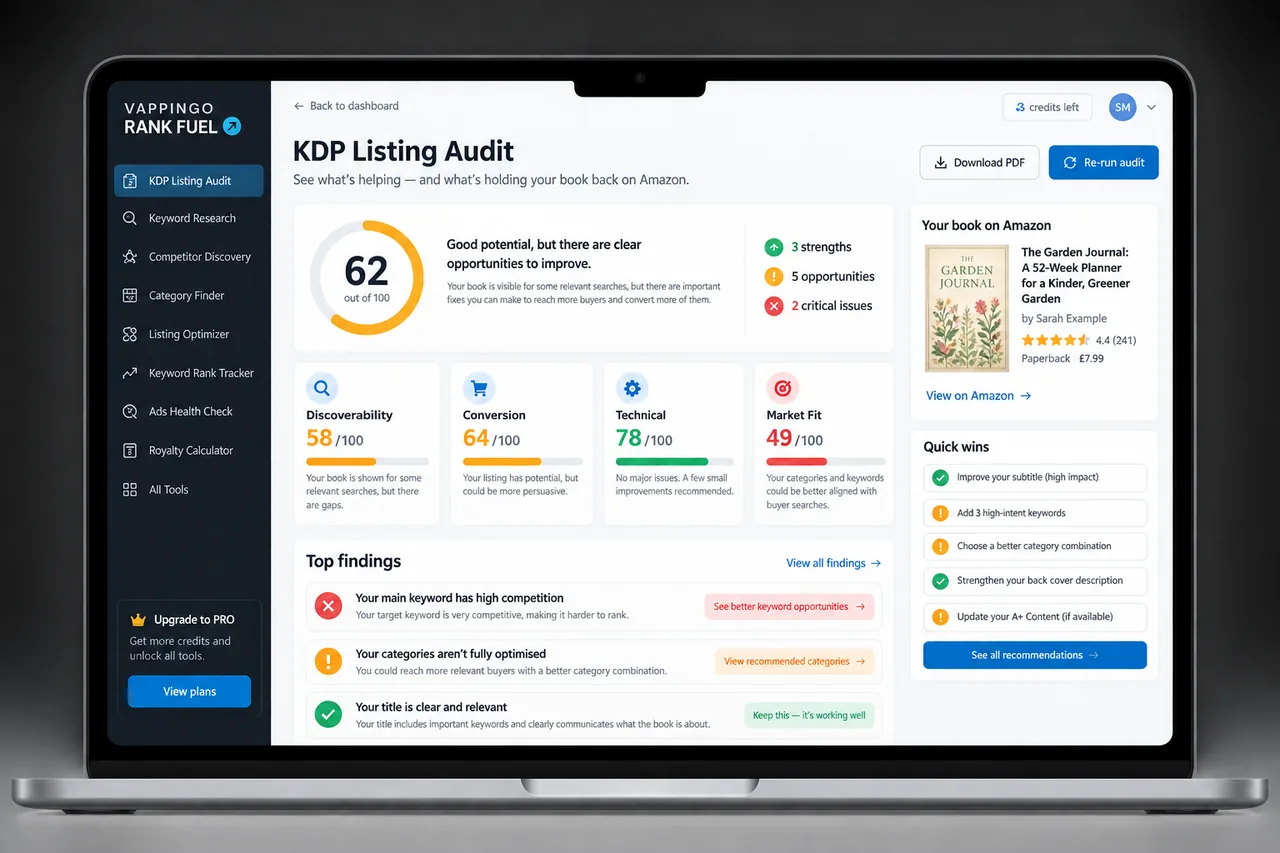
If the opening hooks but does not transition, the description may feel disjointed. The first 150 words should create the question that the rest of the listing answers. If you are unsure whether your description is losing buyers early, start with a listing audit.
Weak vs Stronger Description Openings
The examples below show the difference between describing the book and entering the buyer’s decision. They are opening directions, not complete descriptions.
| Weak opening | Why it loses buyers | Stronger direction |
|---|---|---|
| This book contains 50 math worksheets for Year 8 students. | It states the feature but not the parent or student problem. | Not sure which Year 8 math skills are secure and which ones still need work? This book helps students check, practice, and build confidence across the key topics. |
| This is a beautiful gratitude journal with 120 pages. | It is generic and does not show the use case. | Build a calmer daily habit with a simple gratitude journal designed for people who want a few quiet minutes to reflect without complicated prompts. |
| This puzzle book includes cryptograms and solutions. | It does not sell the experience or reader fit. | Looking for a relaxing screen-free challenge? This large print cryptogram book gives adults satisfying puzzles, helpful difficulty progression, and solutions when you need them. |
| This guide teaches you everything you need to know about self-publishing. | It is too broad and lacks a clear reader. | Publishing your first book on Amazon can feel overwhelming. This beginner-friendly guide breaks the process into clear steps so you can move from idea to live listing with less guesswork. |
A Simple Formula for the First 150 Words
You do not need to force every description into the same template, but the five-part sequence below is a useful way to make sure the buyer gets the important information before attention drops away.
1. Start with the buyer’s situation
Open where the buyer already is: the problem, goal, desire or use case that caused them to search. That creates immediate recognition instead of asking them to wait for relevance.
- “Not sure which math topics your child still needs to practice?”
- “Looking for a relaxing puzzle book that is easy to read and satisfying to solve?”
- “Trying to build a simple weekly planning habit without overcomplicating your life?”
2. Confirm the book type and reader
Make it obvious what the product is and who it is for. This reduces the risk that the buyer has to interpret the listing before deciding whether it fits.
3. State the core benefit
Explain what changes for the buyer when they use, read, solve, practice or gift the book. The benefit is the reason the features matter.
4. Give one reason to believe
Add one concrete feature that supports the promise: progressive difficulty, answer keys, large print, short daily pages, structured sections, beginner-friendly explanations or another meaningful format advantage.
5. Lead into the details
Finish the opening by creating a natural reason to continue. The next part of the description should feel like the answer to a question the opening has just created.
The “Would I Keep Reading?” Test
Read only the first 150 words of the description and ask:
Do these lines make the buyer feel understood, show what the book offers, and create a reason to continue?
If the answer is no, the description may be losing buyers before its strongest selling points appear.
Opening Diagnostic Table
When the first 150 words feel weak, diagnose the specific friction rather than rewriting everything at once. The table below links the symptom to the buyer reaction it is likely to create.
| If your opening… | The buyer may think… | Fix it by… |
|---|---|---|
| Starts with background | “Get to the point.” | Opening with the buyer’s problem, goal, or use case. |
| Lists features only | “So what?” | Connecting each feature to a buyer benefit. |
| Does not name the reader | “Is this for me?” | Clarifying audience, age, level, experience, or use case. |
| Sounds like every competitor | “I’ll keep comparing.” | Adding a specific reason this book is worth choosing. |
| Uses awkward keyword stuffing | “This feels low quality.” | Using important phrases naturally inside persuasive copy. |
| Tries to say everything | “This is too much to process.” | Choosing one strong entry point and saving details for later. |
Which Rank Fuel Tools Fit This Problem?
Rank Fuel works best when the tool follows the diagnosis. If the opening is the weak point, use the smallest workflow that tells you whether the problem is the description itself, the buyer language feeding it or the wider listing.
| Tool | Use it when… |
|---|---|
| Listing Audit | Check whether the description is one of the real conversion leaks before rewriting it in isolation. |
| Listing Optimizer | Strengthen the editable description and buyer promise on a live listing. |
| Listing Generator | Build a complete description and listing from the buyer backward before publication. |
| Keyword Research | Use buyer-search evidence to understand the language that belongs naturally in the listing without stuffing phrases. |
Final Thought: Do Not Bury the Reason to Buy
Your description can contain an excellent reason to buy and still fail if that reason appears after the buyer has already left. The opening has to earn the attention that lets the rest of the copy work.
Want to know whether your description is losing buyers before they reach the best parts?Run your KDP Listing Audit now
Use the first 150 words to make the reader, problem and promise unmistakable. Do not apologize, warm up slowly or hide the value beneath a list of features. Make the buyer think, This is for me. This understands what I need. I want to know more.