Why Your KDP Book Description Is Not Selling Your Book
A book description is not an inventory of what is inside. Learn how to turn features into buyer value, strengthen the opening, and make the listing easier to choose.
This book contains 50 Year 8 math tests, examples and answers.
Help your child spot math gaps before they become bigger problems, with 50 short Year 8 skills checks and clear answers that make progress easy to see.
Both versions describe the same product. The difference is that the second one interprets the contents for the buyer. It tells the parent what the tests are for, why the answers matter and what problem the book is designed to solve.
That distinction is at the heart of many cases where a KDP book description is not selling. Authors naturally describe the book they created. Buyers are making a different decision: Is this the right answer to what I came here looking for? The description has to bridge that gap.
Why Is My KDP Book Description Not Selling?
A KDP book description can be accurate, polished and still fail to sell because accuracy is not the same thing as persuasion. The buyer needs to understand what the book is, why it matters to them and why this version is worth choosing.
That does not require hype. It requires relevance. A strong description connects the contents to the reason the shopper searched in the first place.
Why should I care?
Why this book?
If those answers stay vague, a shopper can reach the page, understand the contents and still leave without feeling any reason to buy.
What Does a KDP Book Description Need to Do?
By the time someone reaches the description, the cover, title, subtitle, price and reviews have already done enough to earn attention. The description now has a different job: reduce the remaining uncertainty.
The shopper is trying to work out whether the book fits their need, level, use case or taste; whether the promise feels useful; and whether the product looks credible enough to justify the purchase.
A parent looking for a Year 8 math workbook may already know that the book contains tests and answers. What they still need to know is whether those tests will help identify gaps, whether the practice feels manageable and whether they can check progress without planning lessons from scratch.
A description that only repeats the table of contents leaves those questions unanswered. A description that interprets the contents for the buyer makes the value easier to see.
What KDP Description Mistakes Stop Sales?
The eight problems below are diagnosis checks. A weak conversion rate does not automatically mean all eight are present, and it does not mean the description is always the only problem. The aim is to identify the exact point where the copy stops helping the buyer move forward.
1. Is My KDP Description Just Summarizing the Book?
A summary tells the shopper what is inside. Sales copy explains why those contents matter. The same feature can do both jobs depending on how it is framed.
The stronger lines do not invent new features. They translate the existing features into consequences the buyer can value.
2. Why Does the Opening of My KDP Description Matter?
The opening has to justify the next line. If it begins with generic explanation, the shopper may leave before the strongest selling point appears.
Weak: This book contains 50 Year 8 math tests covering number, algebra, geometry and statistics.
Stronger: Worried that small math gaps are turning into bigger problems? These 50 short Year 8 skills checks help you see exactly where more practice is needed.
The second opening starts with the buyer’s concern and then introduces the book as the answer. That is usually more persuasive than making the shopper wait for the reason the contents matter. For a fuller opening framework, see How to Write an Amazon Book Description.
3. Who Is My KDP Book Description Written For?
A description becomes easier to buy from when the reader recognizes themselves in it. This is especially important when age, level, experience, role or use case affects whether the book is suitable.
Beginner or advanced
Parent or teacher
Self-study
Revision
Gifting
Travel
Daily practice
The description does not need to list every possible buyer. It needs to confirm the important fit. If the shopper is left wondering whether the book is really for someone like them, that uncertainty can be enough to lose the sale.
4. Should My KDP Description Focus on Features or Benefits?
Features tell the shopper what the product contains. Benefits explain why those features improve the experience. Strong descriptions usually need both.
| Feature | What it means to the buyer |
|---|---|
| Answer keys | Parents and students can check progress without another resource. |
| Short daily exercises | Practice feels manageable instead of overwhelming. |
| Large-print puzzles | The book is easier to read and more comfortable to use. |
| Step-by-step chapters | Readers can build confidence gradually rather than being thrown in at the deep end. |
The feature gives the claim substance. The benefit gives the feature a reason to matter.
5. Why Does Generic KDP Description Copy Fail?
Generic praise sounds safe because it is positive. It is also easy to ignore because almost any competing book can say the same thing.
A must-have guide, perfect for beginners, fun for all ages and packed with useful information do not tell the shopper what makes the book useful, beginner-friendly or fun.
Specificity is more persuasive. Instead of saying the book is easy to use, explain what makes it easy. Instead of saying it is ideal for beginners, show how the structure removes beginner friction. Instead of saying it is fun, describe the kind of experience the buyer can expect.
6. Should I Put Keywords in My KDP Book Description?
Use natural search language when it genuinely belongs in the copy, but do not make the description carry the whole keyword strategy. Buyers notice when phrases are repeated for an algorithm rather than for meaning.
The test is whether the wording would still sound useful if search optimization did not exist. If a phrase clarifies the reader, problem, outcome or format, it may strengthen both relevance and persuasion. If it exists only to repeat a query, it is probably weakening the copy.
Book Keyword Spy and Keyword Research can identify buyer language. The description still has to turn that language into natural selling copy.
7. How Should I Format a KDP Book Description?
Most shoppers scan before they commit to reading. Structure, therefore, should help them find the promise, fit and strongest benefits without forcing them through one dense block of text.
Use short paragraphs where the idea changes. Use bullets when several benefits genuinely belong together. Use bold emphasis sparingly for orientation. The goal is not to decorate the description; it is to make the sales argument easier to follow.
8. How Do I Build Trust in a KDP Book Description?
Trust does not require grand claims. It often comes from specificity. A description feels more credible when it accurately describes the reader, explains the structure, makes realistic promises and uses concrete details rather than vague praise.
For a newer book with few reviews, the description has to carry more of that reassurance. The cover, title, subtitle, sample and description need to tell the same story. If the copy claims beginner-friendly, large print, exam-focused or quick daily practice, the rest of the listing should make the claim easy to verify.
How Can I Audit My KDP Book Description?
A weak description often looks fine to the author because the author already knows what every sentence means. An audit helps separate the description itself from the knowledge you bring to it.
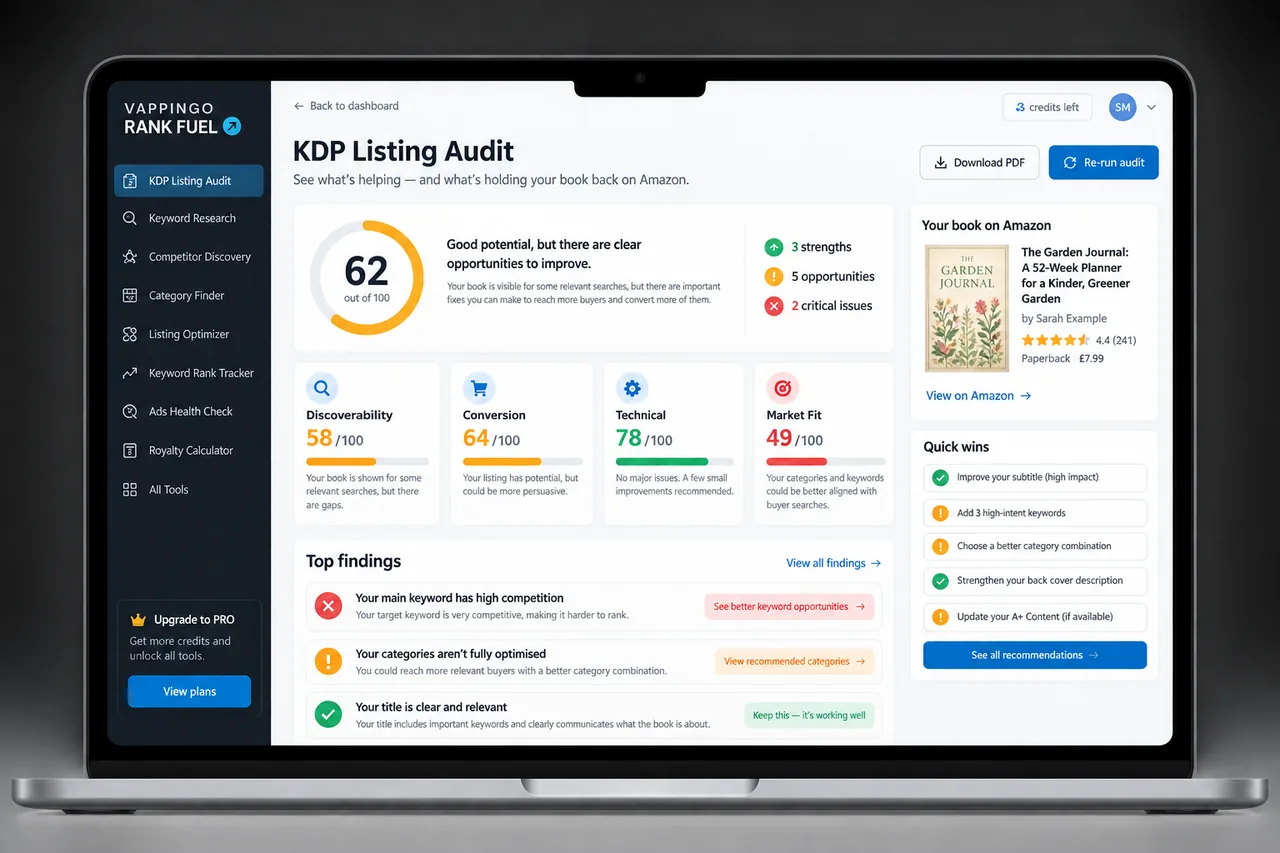
Watch how the listing audit works
The demo shows how the audit reviews the listing and surfaces areas that may be weakening the title, subtitle, description or buyer promise.
Once you have seen the process, run the current listing through the audit below and use the result to decide whether the description is genuinely the weak point.
What Does a Strong KDP Book Description Look Like?
A stronger description does not simply sound more polished. It makes the buying decision easier in a deliberate sequence.
Start where the buyer already is
Open with the problem, desire, frustration, curiosity or outcome that brought the shopper to Amazon. The book should enter the description as the answer, not as the subject of a contents summary.
Make the promise specific
Explain what the buyer can reasonably expect to gain: clearer practice, a satisfying challenge, easier progress, useful guidance, a particular emotional experience or another concrete payoff.
Confirm the fit
Show the level, age, use case, reader or format that matters. The buyer should not have to infer whether the book suits them.
Translate features into outcomes
Keep the details that prove what the book contains, but connect the important ones to buyer value.
Remove uncertainty before the end
Finish with a clear sense of why this book is a sensible choice. The final lines do not need pressure. They need confidence.
What Does Weak vs Strong KDP Description Copy Look Like?
The difference is easiest to see when the facts stay the same but the buyer meaning changes.
| Explains | Sells the relevance |
|---|---|
| This book contains 50 math tests covering number, algebra, geometry and statistics. | Help your child spot math gaps before they become bigger problems with 50 short skills checks across number, algebra, geometry and statistics. |
| Includes answers at the back of the book. | Clear answers make it easy to check progress and see which topics need more practice. |
| A fun puzzle book for adults. | A relaxing, screen-free puzzle book for adults who enjoy a satisfying challenge without tiny print or overcomplicated instructions. |
The stronger versions are not better because they are longer. They make the consequence of each feature easier to understand.
How Do I Fix a KDP Description That Is Not Converting?
Do not rewrite every sentence at once. Work through the sales argument in the order the shopper encounters it.
Step 1: Rewrite the opening
Start with the buyer’s problem, desire, outcome or experience rather than a flat explanation of the book.
Step 2: Clarify the fit
Make the reader, age, level, use case or niche obvious enough that the right shopper can recognize themselves quickly.
Step 3: Turn features into reasons to care
Keep the important details, but explain what those details make easier, better, clearer or more enjoyable.
Step 4: Remove generic filler
Replace vague praise with evidence or specificity. If a claim could describe almost every competing book, it is not doing much work.
Step 5: Rebuild the ending
Finish by reinforcing the payoff and fit. Do not simply stop after the contents have been listed.
The “So What?” Test
Read each feature sentence and ask, “So what?”
It includes exercises. So what? They make practice possible.
It includes answers. So what? Progress becomes easier to check.
It includes short chapters. So what? The book fits more easily into a busy routine.
If the copy cannot answer that question, it may be explaining the book without selling the value of the book.
Which Rank Fuel Solutions Can Help Me Improve a KDP Description?
Use the solution that answers the next decision. Description work is most useful when diagnosis, buyer language and the wider listing stay attached to the same book.
| Solution | Use it when… |
|---|---|
| Listing Audit | You need to confirm whether the description is genuinely one of the conversion leaks before rewriting it in isolation. |
| Listing Optimizer | You have a live listing and want to improve the editable description, positioning and buyer promise. |
| Listing Generator | You are still pre-publication and want the title, subtitle and description to work together from the start. |
| Keyword Research | You need real buyer-search language that can inform the description without turning it into keyword-stuffed copy. |
Frequently Asked Questions About KDP Book Descriptions
Why is my KDP book description not selling?
The description may be summarizing the book instead of explaining why the contents matter to the buyer. It can also underperform when the opening is weak, the reader is unclear, the benefits are buried, the copy is generic, the structure is hard to scan or the listing does not build enough trust.
What should a KDP book description include?
Include an opening that connects with the buyer’s reason for searching, a clear reader or use case, the main promise, important features translated into benefits and enough detail to make the purchase feel credible and relevant.
How long should an Amazon book description be?
Long enough to answer the buyer’s important questions without burying the sales argument. The right length depends on the book type and purchase decision. Clarity and relevance matter more than reaching a particular word count.
Should I use bullet points in my KDP description?
Use bullets when they make several buyer-relevant benefits easier to scan. Do not use them simply to create formatting. A bullet should still explain why the point matters.
Should I use keywords in my KDP book description?
Use natural buyer language where it fits the copy, but do not turn the description into a repeated list of search phrases. The description still needs to sound useful and persuasive to a human shopper.
Should I rewrite my KDP description if my book gets views but no sales?
Possibly. If the traffic is relevant and buyers reach the product page but do not purchase, the description is one important conversion element to review. Check the wider listing too, including price, reviews, cover, subtitle and sample.
Can AI write a KDP book description?
AI can help draft or improve the copy, but the result still needs accurate product details, clear positioning, real buyer understanding and a natural sales message. Generic AI copy will not solve weak market fit or unclear positioning.
How Do I Know My KDP Description Is Doing Its Job?
A good description makes the book easier to buy. It does not need to shout, overpromise or sound like a hard-sell advertisement.
If the KDP book description only explains what is inside, the shopper still has to work out why those things matter. When the copy connects the contents to the buyer’s problem, goal, desire or experience, the value becomes easier to see.
The description has done its job when the right buyer understands not just what the book contains, but why this particular book is worth choosing.