How to Write a KDP Subtitle That Helps Amazon and Readers
A strong KDP subtitle adds information the title cannot carry alone. Use it to clarify the reader, outcome, format, level, use case, or promise before publication.
What should you put in a KDP subtitle when every extra word has to earn its place?
A title may already tell the shopper what the book is about. The subtitle gets one more chance to make the offer specific: who it is for, what it helps with, what format to expect, how it is different or which natural search language matters.
The danger is treating that line as spare metadata. A subtitle can look busy while adding almost no useful information, or sound so optimized that it makes the book feel less trustworthy.
The aim is, therefore, not to make the subtitle longer. It is to make the KDP subtitle more useful than the title on its own.
What Should I Put in My KDP Subtitle?
A strong KDP subtitle adds the most important information the title has not already supplied. That may be the reader, outcome, format, level, use case, positioning angle or a natural search phrase.
The useful test is simple: what does the buyer still need to know before this book feels relevant? The subtitle should answer that question, not repeat the title in slightly different words or absorb every keyword that did not fit elsewhere.
Clarify the outcome
Signal format or level
Carry natural search language
Differentiate the book
What Does a KDP Subtitle Actually Do?
A subtitle sits in an unusually valuable position. It appears beside the title at the exact moment the shopper is trying to work out what the book is, who it is for and whether it deserves a click.
For practical books, workbooks, puzzle books, educational titles and nonfiction, the subtitle often turns an interesting title into a usable buying proposition. A broad title can become specific. A topic can become a reader. A concept can become an outcome.
Title: The Confidence Gap
Subtitle: A Practical Workbook for Teen Girls to Build Self-Belief Through Short Daily Exercises
The title creates interest. The subtitle tells the shopper who the book is for, what format to expect and what the book is designed to help with.
This is why a subtitle can affect both search relevance and click-through. It gives Amazon more context, but it also gives the buyer more certainty. For title-specific problems, read KDP Title Mistakes That Stop Buyers Clicking.
KDP Title vs Subtitle: What’s the Difference?
The title and subtitle should behave like a pair, not two competing headlines. The title usually carries the identity of the book. The subtitle earns its place by adding the detail that makes the identity commercially useful.
If the title is already literal and specific, the subtitle can spend more of its space on benefit, audience or differentiation. If the title is abstract, the subtitle has to carry more explanation. The question is not how many words you can fit in. It is what useful information is still missing.
Can I Change My KDP Subtitle After Publishing?
Sometimes, but the window is limited. For Kindle eBooks, the subtitle is locked after publication. For paperback and hardcover books, Amazon currently allows the title, subtitle or primary author name to be edited within 72 hours of the initial publication date after the book is no longer In Review. After that, those fields are locked and a new edition is required.
That makes subtitle work a genuine pre-publication decision rather than ordinary live-listing copy. Descriptions, keywords and categories can be refined later. The subtitle deserves more care because a weak choice is much harder to reverse.
What Makes a Good KDP Subtitle?
A good subtitle does not need to perform every possible job. It needs to perform the right job for this title and this buyer. The five checks below help identify which information deserves the space.
1. Who Is the Book For?
Audience language is valuable when suitability affects the purchase. A Year 8 workbook, beginner guide, large-print puzzle book and professional handbook can all be about the same broad subject while serving completely different buyers.
Beginners
Parents and homeschoolers
Busy adults
First-time KDP authors
KS3 students
Small business owners
Use an audience cue only when it is genuinely true. The value comes from reducing uncertainty, not from attaching a demographic label to the book.
2. What Outcome Should the Subtitle Promise?
The subtitle should help the shopper understand why the book matters. That does not mean making a dramatic promise. It means translating the contents into a reason to care.
Compare 50 Mixed-Skills Tests with 50 Short Mixed-Skills Tests to Build Year 8 Math Confidence. The first describes what is inside. The second tells the buyer what those tests are meant to achieve.
The same principle applies beyond workbooks. A puzzle book can promise relaxing screen-free downtime. A publishing guide can promise a clearer route from idea to launch. A journal can promise a five-minute habit that fits a busy day. For more on this distinction, read Why Your KDP Book Description Is Not Selling Your Book.
3. Should My KDP Subtitle Name the Book Format?
Often, yes, when the format changes what the buyer expects. A shopper looking for a workbook is not necessarily looking for a general guide. Someone searching for a planner may not want a journal full of prompts. A puzzle buyer may care whether the book contains cryptograms, word searches or mixed puzzles.
If the format is central to the purchase, naming it in the subtitle can remove a question before it becomes a reason not to click. If the cover and title already make the format completely obvious, that space may be more useful for audience, level or outcome instead.
4. Should I Put Keywords in My KDP Subtitle?
Yes, when the phrase belongs there naturally. A subtitle is valuable search metadata, but it is still buyer-facing copy. Search language should clarify the book rather than turn the line into a keyword dump.
The stronger version still carries useful search context, but it reads like a subtitle a human would trust. Book Keyword Spy can show the search territory around competing books, while Keyword Research helps identify buyer searches worth considering before the subtitle is finalized.
5. How Can a Subtitle Position My Book Against Competitors?
A subtitle can explain why this version of the idea exists. That matters in markets where dozens of books share the same broad topic.
A puzzle book can be large print with three-level hints. A revision guide can be short daily practice for reluctant learners. A self-publishing guide can be for first-time KDP authors. Those details are not decoration. They change the comparison the shopper is making.
The best differentiator is one the product can prove. If the subtitle says quick-start, beginner-friendly, exam-focused or large print, the interior should make that claim feel obvious.
What KDP Subtitle Formulas Actually Work?
There is no universal subtitle formula, but a small number of structures are useful because they force you to decide what the buyer still needs to know. Treat these as prompts, not templates that must be copied literally.
| Goal | Structure | Example |
|---|---|---|
| Audience + outcome | For [reader] who want to [outcome] | A Step-by-Step Guide for New Self-Publishers Who Want to Launch With Confidence |
| Format + audience + topic | A [format] for [reader] covering [topic] | A Year 8 Math Workbook for KS3 Students Covering Number, Algebra, Geometry, and Data |
| Benefit + format | [Benefit] with [format] | Build Confidence With 50 Short Mixed-Skills Checks and Clear Answers |
| Problem + solution | Solve [problem] with [approach] | Stop Guessing What to Practice With Short Tests That Reveal Math Gaps Fast |
| Keyword + differentiator | [Keyword phrase] with [specific differentiator] | Large-Print Cryptogram Puzzles With Three-Level Hints and Full Solutions |
| Topic + level + use case | [Topic] for [level] to use in [situation] | Beginner Spanish Practice for Adults to Use at Home, on Holiday, or in Short Daily Sessions |
The “Still Need to Know” Test
Read the title on its own, then ask:
What does the buyer still need to know before deciding whether this book is relevant?
That missing information is usually the strongest candidate for the subtitle: reader, level, format, outcome, use case, search phrase or differentiator.
What KDP Subtitle Mistakes Should I Avoid?
Most subtitle problems are not grammar problems. They are decision problems: the line repeats information, sounds optimized instead of useful, or spends its limited attention on something the buyer does not need.
1. Should I Repeat Words From My KDP Title?
Some overlap can be natural, but repeating the entire idea in slightly different words rarely helps. Easy Sudoku: Simple Sudoku Puzzles for Easy Sudoku Fun uses a lot of space to tell the shopper almost nothing new.
Treat repetition as an efficiency question. If the same word is needed in a natural phrase, keep it. If the subtitle is simply restating the title, use the space to add audience, difficulty, format, benefit or another useful distinction.
2. How Much Keyword Stuffing Is Too Much?
The line is crossed when search language begins to damage readability, trust or meaning. Buyers may never use the phrase “keyword stuffing,” but they notice when a subtitle feels assembled for an algorithm rather than written for them.
A useful practical test is to read the subtitle aloud. If it sounds like a sequence of search terms rather than a coherent promise, the search optimization has started to work against the sale.
3. Why Do Vague KDP Subtitles Get Ignored?
Subtitles such as A Helpful Guide for Everyone or Everything You Need to Know sound positive but leave the important questions unanswered. Who is the reader? What kind of help? What level? What result?
Specificity gives the shopper something to match against their own need. Vague copy asks them to do that interpretation themselves, and another listing may make the decision easier.
4. Can a KDP Subtitle Try to Do Too Much?
Yes. A subtitle becomes cluttered when it tries to carry the audience, every topic, every benefit, every keyword, every age range and every selling point at once.
If removing one phrase makes the subtitle clearer without changing the buyer’s understanding of the book, that phrase probably did not earn its place.
5. Can My KDP Subtitle Promise Something the Book Doesn’t Deliver?
It can, and that is one of the fastest ways to turn stronger click-through into weaker conversion. If the subtitle says beginner-friendly, the interior should feel beginner-friendly. If it promises exam-style practice, the exercises should support that promise. If it says large print, the sample should prove it immediately.
The subtitle sets expectations before the shopper opens the page. The book has to meet those expectations after the purchase.
6. Should My KDP Subtitle Include the Use Case?
Include the use case when it is part of why the book gets bought. Revision, homeschooling, bedtime, travel, gifting, daily practice, screen-free entertainment and quick reference can all be stronger buying cues than the subject alone.
For example, Spanish for Beginners identifies a reader level. Beginner Spanish Practice for Adults to Use at Home, on Holiday, or in Short Daily Sessions also tells the buyer how the book fits into real life. That added context can make the offer feel much more specific.
What Do Strong KDP Subtitle Examples Look Like?
The stronger versions below are not better simply because they are longer. They reduce uncertainty by adding the information the weak version leaves out.
| Weak subtitle | What is missing | Stronger direction |
|---|---|---|
| A Fun Book for Kids | Age, format, topic and benefit | Screen-Free Word Puzzles for Ages 8-12 With Hints and Solutions |
| A Complete Guide to Publishing | Reader and practical scope | A Practical Step-by-Step Guide for First-Time KDP Authors |
| Math Practice Book | Level, curriculum and outcome | Year 8 Math Skills Checks to Build Confidence Across the KS3 Curriculum |
| Daily Journal | Type of journal and use case | A Simple 5-Minute Gratitude Journal for Busy Adults |
| Puzzles for Adults | Difficulty, format and differentiator | Large-Print Cryptogram Puzzles With Three-Level Hints and Full Solutions |
How Do I Improve a KDP Subtitle Before Publishing?
Because the subtitle becomes difficult to change after publication, treat the rewrite as part of the product-definition process rather than a last-minute metadata task.
Step 1: Read the title on its own
Write down what the title already communicates: topic, reader, promise, genre, format or emotional hook. Do not make the subtitle spend space repeating information that is already obvious.
Step 2: Identify the buyer’s next question
Choose the most important missing information. For one book that will be the reader. For another it will be the outcome, level, format, use case or differentiator.
Step 3: Check the search environment
Look at the books appearing for the searches you want to enter. Study what their titles and subtitles make clear quickly. The goal is not to copy them. It is to understand what buyers in that search environment expect to know.
Step 4: Write three genuinely different versions
Try one that emphasizes the reader, one that emphasizes the outcome and one that emphasizes format, search language or positioning. Comparing distinct approaches is more useful than making tiny wording changes to the same idea.
Step 5: Read each version aloud
Remove anything that sounds robotic, vague or overloaded. The final subtitle should sound like natural publishing copy, not a list of phrases selected by a keyword tool.
Step 6: Check the whole listing promise
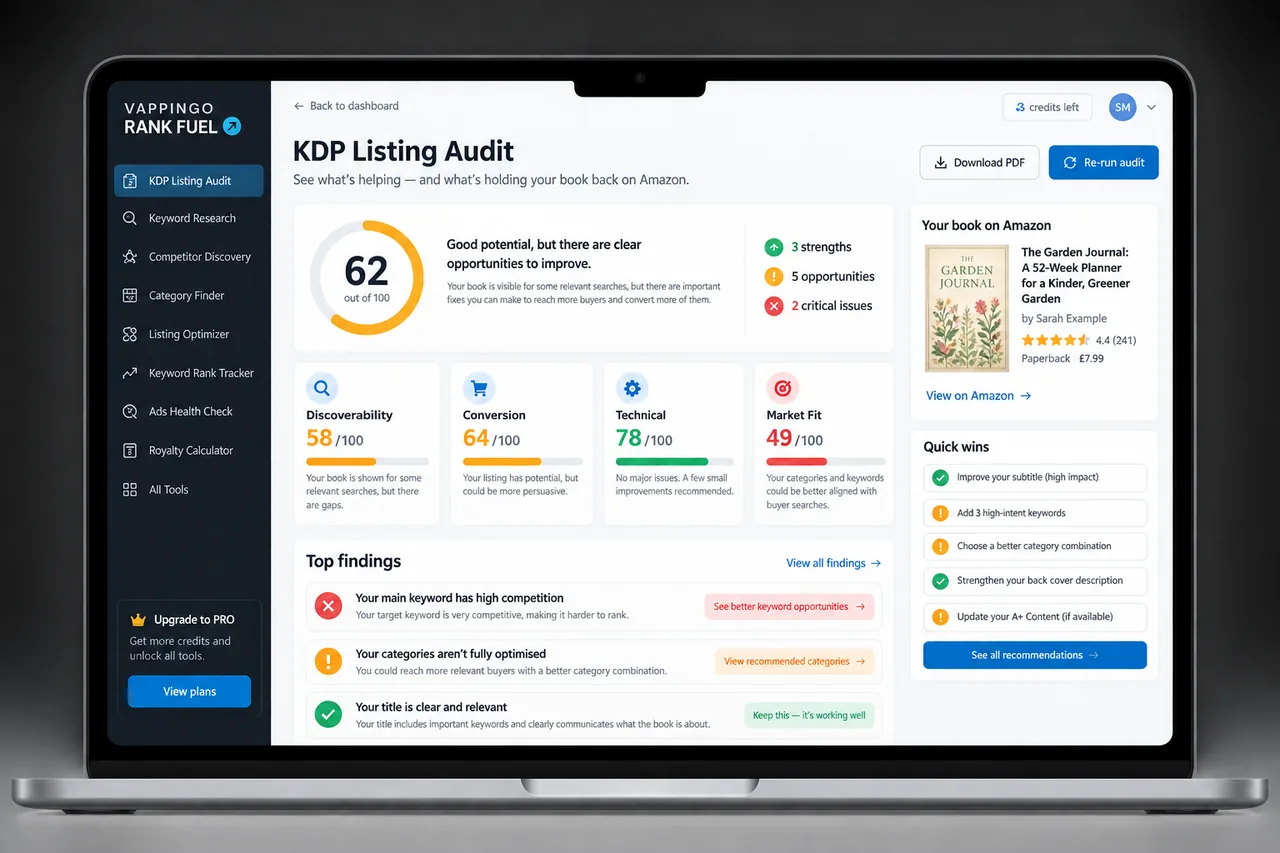
The subtitle should agree with the cover, description, keywords, category and interior. If the subtitle makes a promise, the listing and sample should prove it. Before publishing, run the whole listing through the audit so you are not optimizing one field in isolation.
Which Rank Fuel Solutions Can Help Me Improve a KDP Subtitle?
Use the solution that answers the decision you are making now. Subtitle work is strongest when keyword research, competitor evidence and the rest of the listing stay connected to the same book.
| Solution | Use it when… |
|---|---|
| Listing Audit | You want to diagnose whether the current title/subtitle pairing weakens clarity, even when a live subtitle is already locked. |
| Listing Generator | You are still pre-publication and want the title, subtitle and description to work together from the start. |
| Keyword Research | You need real buyer-search language that can inform the subtitle without turning it into keyword stuffing. |
| Competitor Discovery | You want to see the books Amazon places around your market and understand what those listings communicate near the title. |
Frequently Asked Questions About KDP Subtitles
What should I put in my KDP subtitle?
Add the most important information the title is missing. That may be the reader, benefit, format, level, use case, positioning angle or a natural keyword phrase. The subtitle should make the book clearer rather than simply repeat the title.
Should my KDP subtitle include keywords?
Yes, when the search phrase fits naturally and accurately describes the book. A subtitle can support search relevance, but buyer clarity comes first. Avoid strings of disconnected keywords.
How long should a KDP subtitle be?
Long enough to add useful clarity, but no longer than necessary. There is no single ideal word count. A shorter subtitle that clearly identifies the reader and benefit can be stronger than a long line trying to carry every keyword and selling point.
Can I change my KDP subtitle after publishing?
Kindle eBook subtitles are locked after publication. For paperback and hardcover books, Amazon currently allows title and subtitle edits within 72 hours of initial publication after the title is no longer In Review. After that, a new edition is required.
Can a weak subtitle hurt KDP sales?
Yes. A weak subtitle can reduce click-through if it leaves the book vague, looks keyword-stuffed or fails to show who the book is for. It can also hurt conversion if it creates a promise the description or interior does not support.
Can I use the same words in my title and subtitle?
Yes, when the repetition is necessary for a natural phrase. Avoid repeating the same idea purely because the words are important. The subtitle should normally add information the title has not already supplied.
How Do I Know My KDP Subtitle Is Doing Its Job?
A good subtitle makes the book easier to understand and easier to choose. That is the standard that matters.
If the title already communicates the topic, use the subtitle to add the reader, outcome, format, level, use case or differentiation the buyer still needs. If a natural search phrase helps communicate that information, use it. If a word is present only because there was room for another keyword, remove it.
The subtitle has earned its space when the shopper understands more after reading it than they did after reading the title alone.