Your KDP Listing Looks Fine, So Why Is Nobody Buying?
A KDP listing does not have to look bad to lose sales. Learn how to spot the small conversion leaks that make another book feel easier to choose.
The hardest KDP listing to fix is often the one that looks perfectly respectable.
The cover is decent. The title makes sense. The subtitle is relevant. The description explains the book. The price is defensible. Nothing jumps out as obviously broken, which leaves you staring at the sales dashboard wondering what on earth you are supposed to change.
If your KDP listing looks fine but nobody is buying, the problem may be smaller and more commercial than a glaring mistake. The listing can be clear without being specific, accurate without being persuasive, attractive without being competitive and relevant to the topic without matching the buyer’s actual search.
Amazon shoppers are not grading the page for competence. They are comparing it with the books beside it and asking, often in seconds, Which one feels like the easiest, safest, most relevant choice? A listing can pass the “looks fine” test and still lose that comparison.
The Quick Answer: Your Listing May Be Acceptable, but Not Persuasive
When a listing looks acceptable but does not sell, the problem is usually not one dramatic error. It is a collection of small frictions that make another book easier to understand, trust or choose.
- clear enough to understand, but not specific enough to choose,
- relevant to the topic, but not matched to buyer intent,
- well written, but not benefit-led,
- visually acceptable, but weak beside competitors,
- accurate, but not compelling,
- informative, but not reassuring enough to overcome price, review, or sample-page doubts.
That is why a quick glance at your own page is not enough. You already know what the book means. The buyer does not. The useful test is how the listing performs in context, beside the alternatives competing for the same click.
A KDP listing does not need to be bad to lose sales. It only needs to be less clear, less relevant, less reassuring or less compelling than the books around it.
Why “Fine” Is Not Enough on Amazon
On Amazon, “fine” is a relative judgment. Your book is not being assessed on its own; it is being compared with the other covers, promises, prices, reviews and samples visible in the same buying session.
A shopper can move through several options in seconds. Before opening the product page properly, they may already have compared the cover, title, subtitle, price, review count, format and apparent promise.
The listing, therefore, has to do more than avoid mistakes. It has to reduce the effort involved in choosing.
A “fine” listing may still fail if a competitor listing is sharper. For example:
- Your title may be accurate, but the competitor’s title is clearer.
- Your subtitle may include keywords, but the competitor’s subtitle names the buyer more directly.
- Your description may explain the book, but the competitor’s description explains the benefit.
- Your cover may look nice, but the competitor’s cover communicates faster at thumbnail size.
- Your price may seem fair, but the competitor’s listing justifies its value better.
- Your book may be better inside, but the competitor’s Look Inside sample reassures buyers faster.
That is why a listing can look fine and still lose. If you are specifically comparing your book with others in the niche, read Why Are Competitor KDP Books Selling When Yours Looks Just as Good?.
Author View vs Buyer View
The author and the buyer are looking at the same page with completely different information. You bring months of context. The shopper brings a thumbnail, a few lines of metadata and a decision they can abandon at any moment.
You know the reason the book exists, the target reader, the effort behind it and the value hidden inside. The buyer only knows what the listing manages to communicate quickly enough.
That gap is where many “fine” listings fail: the author supplies the missing context automatically, while the shopper simply moves on.
| Author sees | Buyer asks |
|---|---|
| A book full of useful content | Is this the exact book I need? |
| A title that makes sense once you know the book | Do I understand this fast enough to click? |
| A description that explains the contents | Why should I choose this one? |
| A fair price | Does this look worth it compared with the other options? |
| A book that deserves a chance | Do I trust this enough to buy now? |
That gap between author view and buyer view is where many “fine” listings fail.
Ten Hidden Reasons a KDP Listing Can Look Fine but Not Sell
The ten problems below are easy to miss because none of them has to make the page look obviously poor. Each one simply adds enough friction for a nearby competitor to become the easier decision.
1. The Buyer Is Not Obvious Enough
A listing can describe the subject accurately and still leave the buyer wondering whether the book is meant for them. That uncertainty matters most in markets where age, level, role or use case strongly affects the purchase.
- Is this for my age group?
- Is this for my level?
- Is this for parents, teachers, students, beginners, adults, children, or professionals?
- Is this for my use case?
If the reader fit is only implied, some buyers will not take the risk. A listing that “looks fine” may still be too vague about who the book is for.
2. The Buyer Promise Is Too Soft
Features tell the shopper what is inside. The buyer promise explains why those features matter. When the listing stops at page count, exercises, puzzles, prompts or answer keys, it leaves the shopper to work out the benefit alone.
- 50 exercises,
- 100 puzzles,
- step-by-step chapters,
- answer keys,
- large print,
- writing prompts,
- activities for children.
Those features may be useful, but the buyer needs to understand the benefit. The stronger the match is, the less work the shopper has to do to understand why the product belongs in the search.
Do the exercises build confidence? Do the puzzles offer relaxing screen-free entertainment? Do the answer keys help parents check progress? Does the large print make the book easier to use? Do the prompts reduce blank-page anxiety?
If the listing never answers so what?, it can look complete while still leaving the buyer unconvinced.
3. The Listing Sounds Like Every Other Book
Generic copy feels safe because it is difficult to disagree with. It is also easy to ignore. Phrases such as perfect for beginners, easy to use and must-have resource can sound polished while saying almost nothing that distinguishes the product.
- perfect for beginners,
- fun for all ages,
- easy to use,
- packed with helpful information,
- an essential guide,
- a must-have resource,
- great for kids and adults.
Those lines are not always wrong, but they rarely make a book stand out. A stronger listing is specific. It tells buyers exactly what kind of beginner, what kind of fun, what kind of help, what kind of practice, what kind of reader, and what kind of result. If your listing could describe hundreds of other books, it may not give buyers enough reason to choose yours.
4. The Listing Does Not Match the Search That Brought the Buyer
A listing can be perfectly reasonable for the topic and still be a poor answer to the search that produced the impression. If the shopper searches for something specific and the page answers only the broader subject, relevance leaks away.
Search intent matters. Ask:
- What phrase would make this book feel like the obvious answer?
- Does my title support that phrase?
- Does my subtitle reinforce it?
- Does my description prove the match?
- Does the cover visually support it?
If the search and the listing do not line up, buyers may click and leave. For keyword-specific issues, read Why Your KDP Keywords Are Not Bringing Buyers to Your Book.
5. The Title and Subtitle Are Clear to You, Not to a Stranger
The title and subtitle can feel obvious to the author because you already understand the product. A stranger gets no such advantage. If the book type, reader, level or use case takes too long to decode, the click can disappear before the description matters.
- What kind of book is this?
- Who is it for?
- What topic does it cover?
- What format is it?
- What benefit or experience does it offer?
If those answers only become clear after reading the full description, the listing may be losing buyers earlier. For deeper help, see KDP Title Mistakes That Stop Buyers Clicking and How to Write a KDP Subtitle That Helps Amazon and Readers.
6. The Description Explains the Book but Does Not Sell It
An accurate description can still be commercially weak when it reads like a contents note. The buyer does not only need to know what is included; they need to understand why those contents solve the problem, deliver the experience or justify choosing this book.
But it may not create desire. A description should help the buyer feel that the book is relevant, useful, enjoyable, trustworthy, and worth choosing. It should connect the book’s contents to the buyer’s problem, goal, need, or desire.
If your description reads like a contents summary, it may not be doing enough selling work. Read Why Your KDP Book Description Is Not Selling Your Book for a full breakdown.
7. The Listing Does Not Overcome the Proof Gap
Low review counts create a proof gap. A well-established competitor can rely on hundreds of buyers to reassure the next shopper. A newer book has to compensate with clearer positioning, stronger copy, a better sample and a more convincing product presentation.
- a clearer title,
- a more specific subtitle,
- a sharper description,
- a stronger sample,
- a professional cover,
- a well-justified price,
- a clear buyer promise.
A listing with little social proof cannot afford to make the buyer work hard to understand the value.
8. The Price Feels Slightly Hard to Justify
A price can be objectively fair and still feel difficult to justify beside the alternatives. The question is not whether you know the book is worth the money; it is whether the listing makes that value obvious before the shopper compares elsewhere.
If nearby competitors have more reviews, clearer promises, stronger covers, more obvious value, or lower prices, your listing may need to work harder to justify the purchase. That does not always mean lowering the price.
It may mean explaining the value better. Before changing price, ask:
- Does the description explain why the book is worth this price?
- Does the sample support the value?
- Does the cover look professional enough?
- Do competitors offer more obvious proof?
- Would a buyer understand what makes this book different?
9. The Look Inside Sample Does Not Seal the Decision
The product page can win the click and still lose the sale inside the sample. If Look Inside feels thin, confusing, slow or weaker than the promise, the hidden conversion leak sits beyond the listing copy.
- shows strong pages early enough,
- matches the promise in the listing,
- is easy to read and use,
- looks professional,
- reassures the buyer that the book is what they expected.
If the sample feels thin, confusing, slow, mismatched, or weaker than the promise, buyers may leave even if the listing looked acceptable. The sample has to confirm the promise the listing made, especially when the buyer has little other evidence about the interior.
10. There Is No Clear Reason to Choose This Book Over Another
This is the most important test of all. A listing can avoid every obvious mistake and still fail because it never answers the competitive question: why this book instead of the next one?
Why this book? Not why the topic matters. Not why the book exists. Not why you made it.
Why should this buyer choose this book over the next one? The answer might be:
- clearer for beginners,
- better for a specific age group,
- more structured,
- large print,
- shorter daily practice,
- more relaxing,
- more challenging,
- better for parents,
- better for travel,
- more confidence-building,
- more comprehensive,
- easier to use.
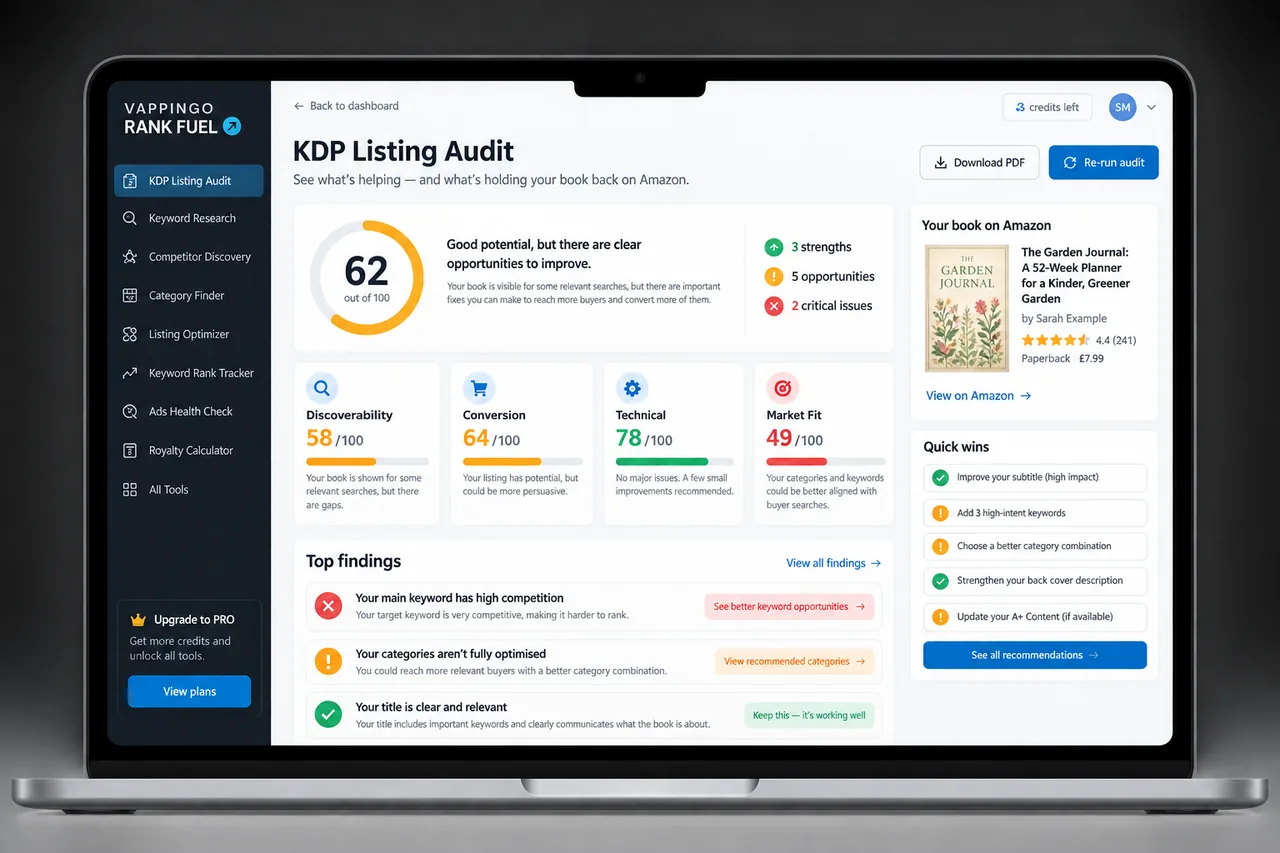
If the listing does not make the reason obvious, buyers may choose a competitor that does. If several of these problems sound familiar, do not guess which one matters most. Start with a listing audit.
Symptom Map: What “Looks Fine but No Sales” Usually Means
Start with the behavior you can observe. Impressions without clicks, clicks without sales and paid clicks without orders all point to different places in the buying path.
| What you see | What it may mean | Check first |
|---|---|---|
| Impressions but few clicks | The book is not standing out in search results. | Cover, title, subtitle, price, reviews, search fit. |
| Clicks but no sales | The product page is not convincing buyers. | Description, buyer promise, proof, price, Look Inside. |
| Ads get clicks but no orders | Traffic may be wrong, or the listing may not convert. | Search terms, ad targeting, listing promise. |
| Competitors sell but yours does not | They may make the buying decision easier. | Positioning, reviews, title, subtitle, description, sample. |
| Ranking for keywords but no sales | Visibility exists, but conversion is weak. | Buyer intent, description, price, competitor comparison. |
How to Audit a KDP Listing That Looks Fine
When nothing looks obviously wrong, the audit has to create distance between what you know as the author and what the shopper can actually see. Work through the page in the same order the buyer encounters it.
Step 1: View the listing in search results, not just on the product page
Start where the click is won or lost. Search the target phrase and compare your book with the nearby alternatives at thumbnail size. Does it look relevant, current and easy to understand before you open the page?
Step 2: Ask what the buyer understands in five seconds
Strip away your author knowledge. In five seconds, can a stranger identify what the book is, who it is for and why it might be useful? If not, the listing is asking the buyer to do too much interpretation.
Step 3: Compare the buyer promise against competitors
Open three competing books and compare the promise, not just the polish. Which listing gives the shopper the clearest reason to believe that this particular book fits the need?
Step 4: Read the description for benefits, not features
Highlight the features, then ask whether the copy explains why each one matters. A feature that never reaches a buyer benefit is information rather than persuasion.
Step 5: Check whether the sample supports the promise
The Look Inside sample should prove the product page was telling the truth. If the strongest value is invisible, buried or contradicted by the sample, the sale can disappear after the click.
Step 6: Decide whether the issue is visibility, click-through, or conversion
Do not fix all three gates at once. If the book is not being seen, investigate visibility. If it is seen but ignored, work on the search-result package. If shoppers click and still do not buy, investigate conversion.
The “Fine Is Not a Reason to Buy” Test
Look at the listing beside three real competitors and ask:
What is the clearest reason a buyer should choose this book instead of the next one?
If the answer is not visible in the title, subtitle, description, sample or positioning, the listing may be perfectly acceptable and still not persuasive enough to win.
Which Rank Fuel Tools Fit This Problem?
Rank Fuel works best when the tool follows the diagnosis. Use the smallest workflow that tells you whether the hidden leak sits in the listing, the competitive set or the search language bringing the shopper to the page.
| Tool | Use it when… |
|---|---|
| Listing Audit | Diagnose the weak point when the page looks acceptable but the buying path is not working. |
| Listing Optimizer | Improve editable live-listing copy, benefits, and positioning after you know where the conversion leak is. |
| Competitor Discovery | Make sure you are comparing your book with the titles competing for the same shopper. |
| Book Keyword Spy | Check whether the search language around competing books matches the buyer you are actually trying to reach. |
Final Thought: “Fine” Does Not Mean Ready to Sell
If your KDP listing looks fine but nobody is buying, stop asking whether the page is technically acceptable. Ask whether it makes the book easier to choose than the alternatives.
It can be accurate but not persuasive, clear but not specific, attractive but not competitive or relevant to the subject while still missing the buyer’s real search intent.
That does not mean the book is doomed. It means the listing needs to be judged from the shopper’s side of the screen, where every extra second of uncertainty makes another book easier to choose.
Find the friction that makes the decision harder, then remove that friction first.
Want to see where the listing may be leaking buyers?Run your KDP Listing Audit.