KDP Title Mistakes That Stop Buyers Clicking
Your KDP title has to earn attention quickly. Learn the nine mistakes that make a book harder to understand, trust, and click in a crowded Amazon result.
Imagine a parent searching Amazon for a Year 8 math workbook. One result is called Bright Minds. Another is called Year 8 Math Practice. The first may be more memorable, but the second tells the shopper what they are looking at before they have to think.
Now imagine Bright Minds appears with a subtitle such as A Year 8 Math Workbook for KS3 Students to Build Confidence Through Short Daily Practice. Suddenly, the abstract title has enough support to work. The problem was never that clever titles are bad. It was that the buyer needed the missing context quickly.
That distinction explains many KDP title mistakes. A title can be meaningful, original and technically relevant while still making the shopper work harder than the competing books beside it.
The aim, therefore, is not to make every title literal. It is to make sure the title, subtitle and cover give the right buyer enough clarity, relevance or curiosity to earn the click.
Why Is My KDP Book Title Not Getting Clicks?
If a book is getting impressions but few clicks, the title may be part of the problem. A strong title helps the shopper understand what the book is, who it is for or why it deserves attention before they have to work for that information.
The most common KDP title mistakes are not mysterious. Titles become too vague, too generic, too clever, too stuffed with search terms or too dependent on a subtitle that never quite explains the book.
Too generic
Too clever
Keyword stuffed
Wrong reader signal
Weak promise
Why Does a KDP Book Title Matter So Much?
On Amazon, the title is part of a comparison that happens before the shopper ever reaches the description. They see the cover, title, subtitle, review count, price and competing books at almost the same time.
The title does not have to close the sale. It has to earn the next step. The shopper needs enough confidence to think, this looks relevant enough to open.
A title can sound perfectly reasonable when it is sitting alone in a manuscript or KDP form. Put it beside eight competing books, however, and the weakness can become obvious: another title explains the reader faster, another signals the outcome more clearly, and another simply looks easier to understand.
If buyers are seeing the book but not moving deeper into the listing, the problem may sit above the product page: title, subtitle, cover, price, reviews or search-result fit. See My KDP Book Is Getting Views But No Sales for the broader diagnosis.
Can I Change My KDP Book Title After Publishing?
Sometimes, but the window is limited. For Kindle eBooks, the title is locked after publication. For paperback and hardcover books, Amazon currently allows title edits within 72 hours of initial publication after the book is no longer In Review. After that, changing the title requires a new edition.
That makes title work a pre-publication decision in a way that descriptions, keywords and categories are not. If the title is still being developed, it is worth testing the search environment and the buyer interpretation before publication makes the choice much harder to undo.
What KDP Title Mistakes Stop Buyers Clicking?
The nine problems below are diagnosis checks, not nine instructions to rewrite the title. A book may have one serious title problem or none at all. The job is to find the specific point where the title makes the shopper hesitate.
1. Is My KDP Title Too Clever or Unclear?
Clever titles can work extremely well in fiction, memoir, humor, gift books and narrative nonfiction. The problem begins when the title relies on context the shopper does not have.
An author knows the backstory behind a phrase. A stranger sees a few words beside a thumbnail and several alternatives. If the title is abstract, the subtitle and cover need to make the book easy to place quickly. If all three are vague, the shopper has to guess, and Amazon gives them plenty of easier choices.
2. Is My KDP Book Title Too Generic?
Generic titles feel safe because nobody can misunderstand them. Unfortunately, they can also disappear into a crowded result page.
The stronger examples do not simply add more words. Each one gives the shopper a faster way to recognize the reader, level, use case or benefit. That is the kind of specificity that earns its place.
3. Should I Put Keywords in My KDP Book Title?
Yes, when they belong naturally in the title and help the shopper understand the book. Problems start when search phrases are treated as ingredients that must all be squeezed into the same line.
Math Workbook for Year 8 Math Practice KS3 Math Revision Algebra Geometry Fractions Tests for Ages 12-13 contains plenty of searchable language, but it reads like metadata rather than a polished title.
The title still has to look trustworthy. Use keyword research to understand buyer language, then choose the words that actually improve the title rather than the words that merely fit. Book Keyword Spy and Keyword Research can help identify the search territory before the title is finalized.
Where Should Your Main KDP Keyword Go?
There is no KDP rule that says your main keyword has to be your book title. Amazon says the title field should contain the actual title shown on the cover, and it specifically warns against stuffing titles with repeated generic keywords. Its keyword guidance also says not to waste backend keyword space repeating information that is already covered elsewhere in the book metadata. The practical question is, therefore, not “Can I get the keyword into the title?” but “Does this phrase make the title clearer and more useful to the right buyer?” Amazon’s metadata guidelines and keyword guidance both support that distinction.
| Book type | Best approach | Why |
|---|---|---|
| Practical nonfiction, workbooks, activity books and reference titles | Use the main descriptive search phrase in the title or subtitle when it reads naturally and accurately describes the book. | The phrase can help the shopper understand the subject, level, format or use case immediately. |
| Fiction, memoir and branded series | Do not force a generic search phrase into the title simply because it has demand. Let the title carry identity, tone or recognition; use the subtitle only when it genuinely belongs to the published title, and use backend keywords for additional relevant search language. | A keyword-led title can weaken the book’s promise if buyers in that market expect a distinctive title rather than a literal product label. |
| Already-published books | Do not treat the title like an editable keyword field. Check the listing, backend keywords, categories and other changeable signals before considering a title change. | A published title is a much bigger intervention than changing search metadata, and it should not be changed merely to insert a phrase. |
One useful efficiency rule: if an important phrase is already present naturally in the title or subtitle, do not automatically repeat it in a backend keyword field. Use that space for other relevant buyer language instead.
4. Should My KDP Title Say Who the Book Is For?
Not every title needs an explicit audience label, but the listing package needs to make suitability obvious when the reader matters to the purchase. That is especially important for school workbooks, children’s books, revision guides, journals, puzzle books, beginner guides and professional nonfiction.
A title aimed at “everyone” often gives nobody a strong reason to stop. If the audience would naturally search by age, level, experience or use case, decide whether that information belongs in the title, subtitle or cover.
5. Should a KDP Book Title Promise an Outcome?
Often, especially for practical nonfiction, workbooks and self-help. A title that names only the topic can be accurate without giving the shopper a reason to care.
Algebra Practice tells the buyer what the book contains. A title or title/subtitle combination that signals confidence, exam readiness, short daily practice or a clear progression tells them why that practice may be worth buying.
The promise does not have to be dramatic. It has to be credible, specific and supported by the book.
6. Does My KDP Title Match the Genre or Category?
Every Amazon search carries expectations. A cozy mystery should not sound like a corporate leadership book. A Year 8 workbook should not sound like a general puzzle book. A gratitude journal should not sound like a textbook.
Matching the market does not mean copying the market. It means understanding the language buyers already associate with the type of book they are trying to find. Competitor Discovery is useful here because it shows the books your title has to sit beside, not just the title you like in isolation.
7. How Long Should a KDP Book Title Be?
There is no useful universal word count that makes a title good. The practical question is whether the shopper can scan it quickly and understand the main idea without untangling a sentence.
Some nonfiction, educational and activity books genuinely need descriptive titles. When the line becomes overloaded with audience, format, outcome and search terms, however, the subtitle is usually the better place for the extra detail.
A title can be long and still clear. It becomes a problem when length makes the hierarchy disappear.
8. Should My KDP Title Rely on the Subtitle?
It can, as long as the subtitle actually does the clarification work. An abstract or memorable title is not automatically a problem if the subtitle immediately tells the shopper what kind of book it is and why it matters.
Title: Bright Minds
Weak subtitle: A Fun and Helpful Book for Learning
Stronger direction: A Year 8 Math Workbook for KS3 Students to Build Confidence Through Short Daily Practice
The title can create identity while the subtitle supplies reader, format, level and outcome. If both parts stay vague, the shopper never gets the missing explanation. See How to Write a KDP Subtitle That Helps Amazon and Readers.
9. Does My Book Title Make Sense to Buyers or Just to Me?
This is the most difficult title problem for an author to see because familiarity fills in the missing information automatically. You know the concept, reader, tone and reason the words were chosen. The shopper does not.
Strip that context away. If a stranger saw only the cover and title in a result page, what would they think the book was about? If the answer depends on information available only inside the manuscript or description, the title may be serving the author more than the buyer.
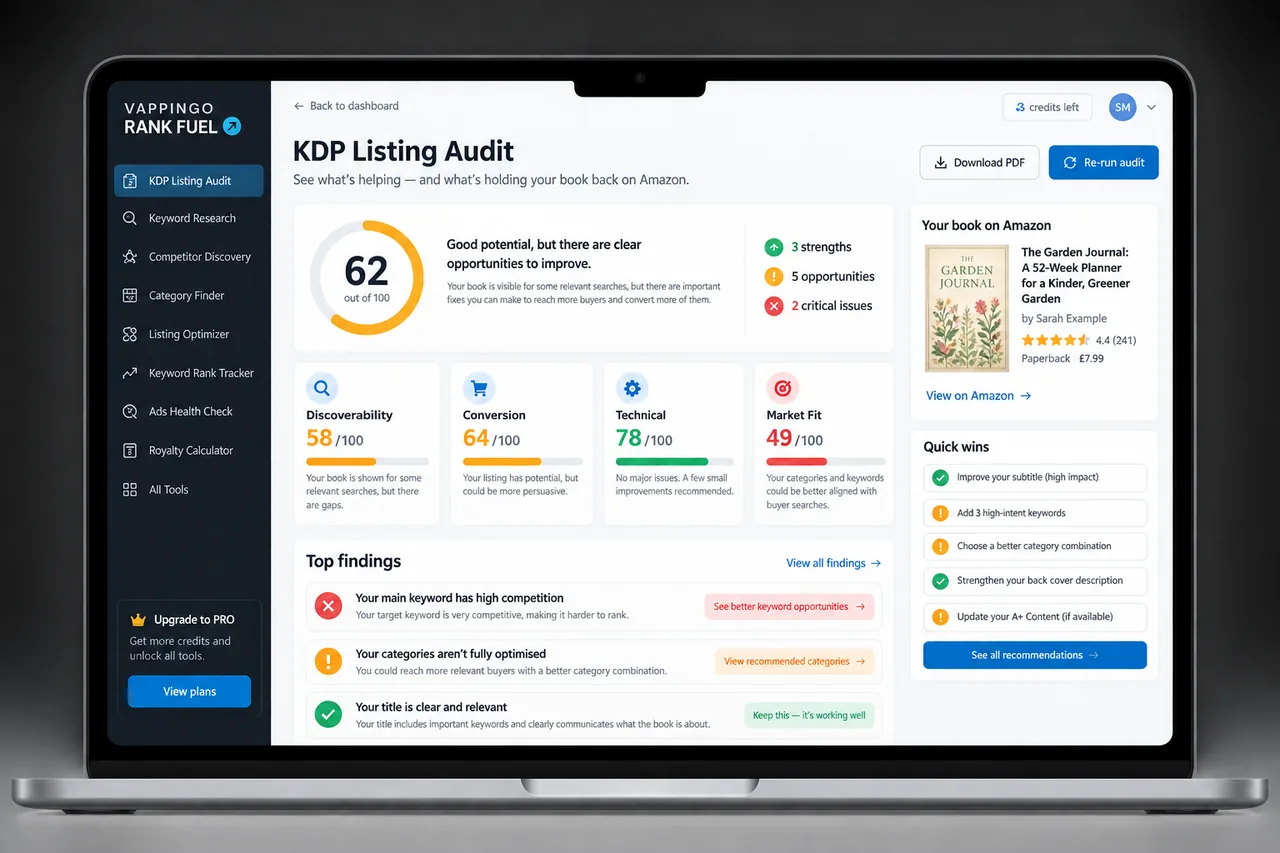
If several of these problems sound familiar, run the listing through the audit before deciding the title itself is the only thing that needs rebuilding.
How Can I Test a KDP Book Title Before Publishing?
A title should be tested as part of a buying decision, not judged as a sentence on its own. Four simple tests expose different weaknesses.
The five-second test
Show the cover and title to someone unfamiliar with the book. Can they identify the topic and likely reader after five seconds?
The search-result test
Place the title beside the books ranking for the target search. Does it feel relevant, clear and competitive in that exact environment?
The “would I click?” test
Imagine you are the shopper. Does the title create enough confidence or curiosity to justify opening the listing?
The promise test
Can you identify what the buyer expects to get: knowledge, practice, confidence, entertainment, relief, challenge or another clear experience?
The “Stranger on Amazon” Rule
Your title does not have to explain the whole book. It does have to give a stranger enough information to understand why the book may be relevant.
If the title only makes sense after somebody has already read the description, it is probably asking the click to happen too early.
What Makes a Good KDP Book Title?
A stronger title makes one or two important things easy to understand. Which things matter most depends on the market.
| A strong title can… | Why that helps |
|---|---|
| Signal the topic | The shopper can place the book immediately. |
| Signal the reader | The right buyer recognizes that the book is meant for them. |
| Suggest the outcome | The topic becomes a reason to care. |
| Signal genre or format | The book fits the shopper’s expectations more quickly. |
| Work naturally with the subtitle | The title can stay clean while the subtitle adds specificity and search context. |
A fiction title, workbook title, puzzle title and business title will solve this problem differently. The common requirement is that the right buyer can make sense of the book quickly enough to keep moving toward the purchase.
How Do I Fix a Weak KDP Book Title?
Do not begin by brainstorming clever alternatives. First decide what the existing title is failing to communicate.
Step 1: Decide the title’s main job
Does the title most need to communicate the topic, reader, promise, genre, age group, use case or emotional hook? Trying to make every one of those fit usually creates clutter.
Step 2: Move secondary detail into the subtitle
If the title is overloaded, give the subtitle some of the work. A cleaner title plus a specific subtitle is often easier to scan than one line carrying the whole positioning strategy.
Step 3: Remove words that do not change the buyer’s understanding
Cut filler, vague praise, repeated ideas and keyword clutter. Every remaining word should help identify the book, position it or create a reason to look closer.
Step 4: Compare the title in the real search environment
Look at the books appearing for the target searches. The question is not whether your title sounds good on its own. It is whether it communicates effectively beside the alternatives.
Step 5: Recheck the whole listing promise
A title works with the subtitle, cover, description, categories, keywords, reviews and price. If the title changes, make sure the rest of the listing still tells the same story.
Which Rank Fuel Solutions Can Help Me Improve a KDP Title?
Use the solution that answers the next uncertainty. Title decisions are strongest when search evidence, competitor context and listing diagnosis stay attached to the same book.
| Solution | Use it when… |
|---|---|
| Listing Audit | You need to diagnose whether the title is actually creating the clarity problem on an existing listing. |
| Listing Generator | You are still pre-publication and want the title, subtitle and description to work together from the start. |
| Keyword Research | You want buyer-search language that can inform the title naturally without turning it into a keyword list. |
| Competitor Discovery | You want to see how books competing for the same shopper communicate topic, audience and promise. |
Frequently Asked Questions About KDP Book Titles
Why is my KDP title not getting clicks?
The title may be unclear, generic, poorly matched to the reader or genre, overloaded with keywords, or dependent on a subtitle that does not explain the book. The cover and wider search-result presentation can also be responsible, so diagnose the whole first impression rather than assuming the title is the only problem.
Should my KDP title include keywords?
Yes, when they fit naturally and help buyers understand the book. Do not force every important search phrase into the title. A clear title that uses buyer language naturally is stronger than a line that reads like keyword metadata.
Is a clever book title bad for Amazon KDP?
No. Clever or abstract titles can work, particularly in fiction and narrative books. They need enough support from the subtitle and cover for a stranger to understand what kind of book they are looking at.
How long should a KDP book title be?
There is no single ideal length. The title should be long enough to communicate the core idea and short enough to scan easily. When extra audience, format, benefit or search detail makes the title hard to read, move that information into the subtitle.
Can I change my KDP title after publishing?
Kindle eBook titles are locked after publication. Paperback and hardcover titles currently have a limited 72-hour editing window after initial publication once the book is no longer In Review. After that, changing the title requires a new edition.
Should I copy title styles from bestselling books?
Study the patterns, but do not copy the titles. Look at how successful books communicate genre, reader, promise, specificity and search fit, then decide what your own title needs to make clear.
How Do I Know My KDP Title Is Strong Enough?
A good KDP title does not have to explain everything. It has to make the right shopper understand enough to take the next step.
If the book is getting impressions but not clicks, do not assume the description is the only problem. The decision may be happening before the shopper ever reaches it. Look at the title in the actual search environment, beside the cover, subtitle and competing books.
Clarity earns the chance to be clever. Relevance earns the click.