KDP Listing Audit Checklist: 12 Things to Fix Before Amazon Ads
Paid traffic magnifies what already happens on the product page. Use this 12-point KDP listing checklist before you increase bids or launch more Sponsored Products campaigns.
An Amazon ad can do its job perfectly and still lose you money.
It can put the book in front of the right shopper, win the click and deliver that shopper to the product page. At that point, the campaign has done what you paid it to do. If the page does not make the purchase feel worthwhile, the money disappears after the click.
That is why it makes sense to audit your KDP listing before running Amazon ads. You need to know whether the weakness sits in the targeting, the search-result presentation or the product page before you spend more to amplify it.
This 12-point audit follows that buying path in order, so the next change comes from the evidence rather than from the assumption that more traffic will fix the problem.
Should I Audit My KDP Listing Before Running Amazon Ads?
Before buying more traffic, check three things in order: are you targeting the right shopper, does the book earn the click, and can the product page convert that visit? Ads can help with the first stage. They cannot repair the second or third stage for you.
Why Can Amazon Ads Get Clicks but Still Lose Money?
When an ad campaign gets traffic but few sales, authors often change bids and targets first. Sometimes that is exactly right. But a paid click can also expose a product-page weakness that was already there: the shopper expected a different book, the description did not hold them, the price comparison felt poor or the sample reduced confidence.
Ask one question before spending more: If I sent 100 additional qualified shoppers to this page today, would I be confident the page could close a reasonable share of them? If the answer is uncertain, diagnose the listing first. These guides can also help: My KDP Book Is Getting Views But No Sales and My KDP Book Is Ranking for Keywords But Getting No Sales.
How Does a KDP Listing Audit Work?
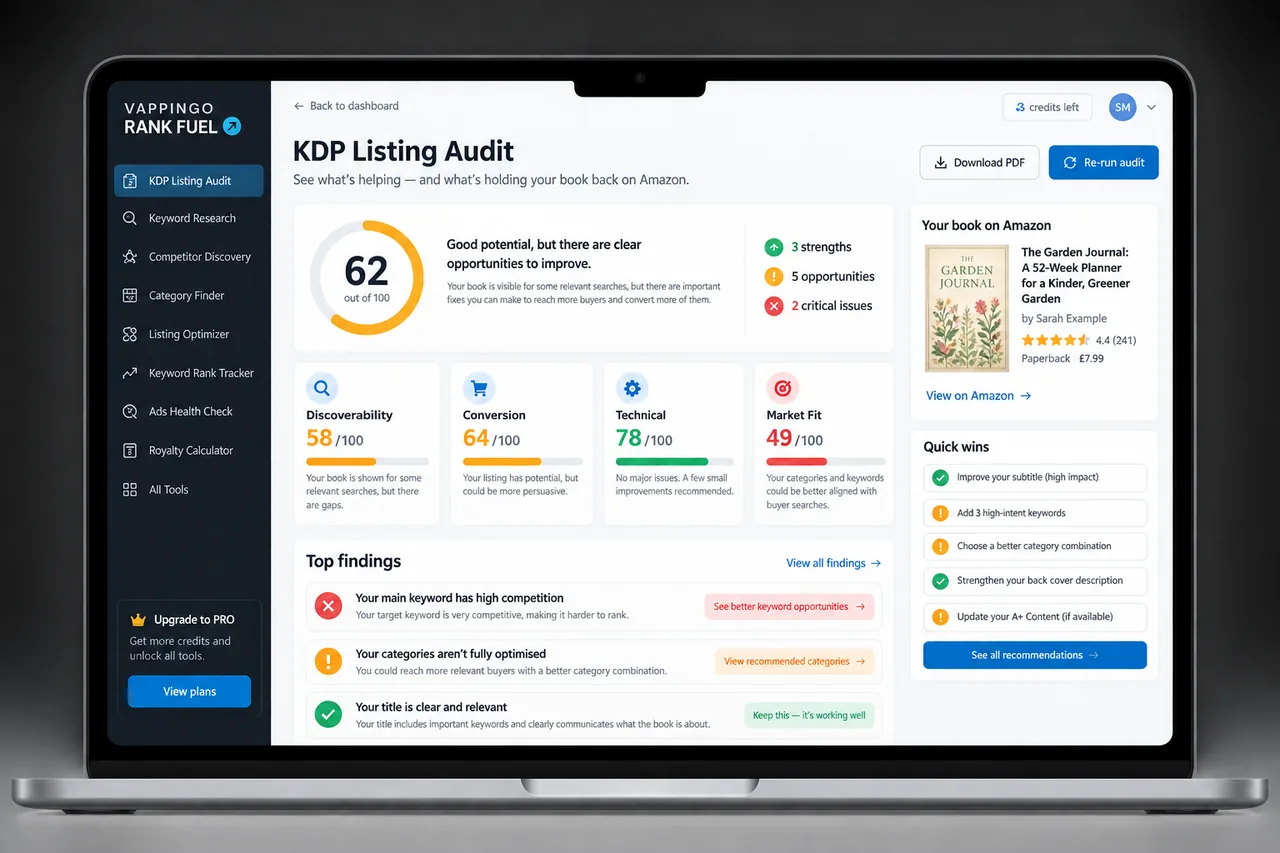
You can work through all 12 checks manually. If you want the quickest starting point, run the existing listing through the audit first and use the result to decide which part of the buying path deserves attention.
Watch how the listing audit works
The demo shows how the audit surfaces weaknesses in the listing before those weaknesses start consuming paid clicks.
Once you have seen how it works, run the listing through the audit below and use the result as the baseline for the checklist.
How Do I Know if My KDP Listing Is Ready for Amazon Ads?
The 12 checks fall into three gates. If the listing fails an earlier gate, there is little value in polishing a later one first.
Checks 1-2
Does the book belong in the searches and category context you are about to pay for?
Checks 3-5
Can the cover, title and subtitle make the shopper choose this result?
Checks 6-12
Once the shopper lands on the page, does the offer feel clear, credible and worth buying?
Why Is My KDP Book Getting the Wrong Traffic?
Start with the traffic. There is no point optimizing the product page for shoppers who were never a good fit for the book.
1. Are My Amazon Ads Targeting the Right Keywords?
Before running ads, look at the searches you intend to target and ask whether the book is an obvious match. A loose topical relationship is not enough. Paid traffic becomes expensive when the phrase contains several different buyer intents and your book serves only one of them.
- Does this keyword describe the exact type of book?
- Would a buyer searching this phrase expect a book like mine?
- Are the top-ranking books genuinely similar?
- Does my title, subtitle, and cover match the search intent?
Keyword Research and the competition research tools help you test whether the search has the right buyer intent and whether the book has a realistic route into that market before you attach ad spend to it.
2. Are My KDP Categories Right for My Book?
Categories shape the comparison set around the book. If the nearby titles serve a different reader, format, promise or price point, your listing can look misplaced before the shopper reads a word of the description.
- Do the bestselling books in this category look like mine?
- Are buyers in this category likely to want this type of book?
- Does my listing match the category’s expectations?
- Am I competing against books with a completely different level of proof, reviews, or production quality?
If the category fit is weak, ads may bring traffic into a context where your book does not feel like the obvious choice. Use the Category Finder or Category Research tools if you need to review category options before scaling traffic.
Why Is My KDP Book Getting Impressions but No Clicks?
Once the traffic is relevant, ask whether the book can win the click in a crowded search result.
If impressions are arriving but clicks are weak, the problem is usually in the search-result presentation rather than the ad delivery itself. My KDP Book Has Impressions But No Clicks.
3. Is My KDP Book Cover Good Enough to Get Clicks?
In sponsored placements and search results, the cover has to work small. The question is not whether it looks attractive at full size. It is whether the shopper can recognize the book type, read the important information and trust the positioning quickly enough to click.
- Can the buyer understand the book type quickly?
- Is the main title readable at thumbnail size?
- Does the cover match the niche without looking identical to competitors?
- Does it feel credible next to top-selling books?
- Does it support the promise made by the title and subtitle?
If the cover is losing the click, rewriting the description will not fix the ad performance because buyers may not reach the product page.
4. Is My KDP Book Title Costing Me Clicks?
The title does not need to explain everything, but it does need to orient the shopper fast enough to justify the click. Cleverness becomes expensive when the reader has to decode what the book is.
If your title is weak, ads may increase impressions without increasing clicks. For more help, read KDP Title Mistakes That Stop Buyers Clicking.
5. What Should I Put in My KDP Subtitle?
The subtitle should earn its space by adding something the title has not already made clear: audience, level, format, scope, use case, outcome or natural search language. Repetition without new information weakens both clarity and positioning.
- Does the subtitle clarify who the book is for?
- Does it explain the benefit or outcome?
- Does it include useful search language naturally?
- Does it make the listing sound more specific?
- Does it avoid keyword stuffing?
If the subtitle is vague, ads may attract people who still do not understand why the book is relevant. Read How to Write a KDP Subtitle That Helps Amazon and Readers for a deeper subtitle framework.
Why Is My KDP Book Getting Clicks but No Sales?
If the right shopper is clicking, the diagnosis moves to the product page. These checks determine whether interest survives long enough to become a sale.
If the right shoppers are clicking but not buying, diagnose the product page before increasing the budget. Amazon Ads Are Getting Clicks But No Book Sales.
6. Why Is My KDP Book Description Not Converting?
A paid click arrives with momentum. The description opening should not waste it. If the first lines are generic, feature-led or slow to reveal why the book matters, the shopper can leave before the strongest selling point ever appears.
“Is math practice turning into a battle after school?”
“Help your child build Year 8 math confidence in 10 focused minutes a day.”
“Your child needs more practice, but another dense workbook is the last thing they want to open.”
Those openings are not always wrong, but they often waste the chance to connect with the buyer’s problem, goal, fear, curiosity, or desire. Before ads, rewrite the opening so it speaks to the reason someone searched in the first place.
7. Does My KDP Listing Make the Buyer Benefit Clear?
The buyer promise is the answer to a simple question: what changes for me if I choose this book? It can be practical, emotional, educational or entertaining, but it needs to be specific enough to make the purchase feel worthwhile.
For one book, that may mean easier daily practice without overwhelm; for another, relaxing screen-free entertainment, clearer exam preparation, a sustainable habit or a particular emotional escape. The wording changes, but the principle does not: the shopper should understand the payoff.
If buyers cannot tell what they will get from the book, they are less likely to buy. Before ads, make the promise specific, believable, and aligned with the book itself.
8. Should My KDP Description Focus on Features or Benefits?
Features matter only when the shopper understands why they improve the experience. “50 activities” is information. “50 short activities that fit easily into a daily routine” gives the feature a reason to matter.
| Feature | Why it matters to the buyer |
|---|---|
| 50 short activities | Practice feels manageable and easy to fit into a routine. |
| Answer keys included | Parents or students can check progress without extra resources. |
| Large print | The book is easier and more comfortable to use. |
| Step-by-step structure | Readers can build confidence gradually. |
Before ads, turn important features into reasons to buy. For a fuller description framework, read Why Your KDP Book Description Is Not Selling Your Book.
9. How Should I Price My KDP Book Against Competitors?
Price only makes sense in context. A $12.99 workbook may feel expensive beside a $7.99 competitor, but that does not automatically mean the cheaper book is the better offer. If your book has more pages, a clearer structure, better examples, stronger presentation or a more useful format, the higher price can be completely defensible.
The problem starts when the listing asks the shopper to pay more without making the additional value obvious. In that situation, lowering the price may improve conversion, but it may also hide a positioning problem that would be better solved by strengthening the title, description, sample or visual presentation.
Book A: $8.99, 80 pages, generic cover, limited description.
Book B: $12.99, 160 pages, clearer outcome, stronger sample, more structured exercises.
A shopper may still choose Book B. The price gap becomes a problem only when the listing fails to explain why the extra cost is justified.
10. Can a KDP Book Sell With Few Reviews?
Limited reviews create friction because they remove one of the easiest reassurance signals from the page. A shopper comparing two similar books may simply feel safer choosing the one that already has 300 ratings rather than the one with six.
That does not mean a newer book cannot advertise successfully. It means the rest of the listing has to work harder. The cover needs to look deliberate, the subtitle needs to be specific, the description needs to sound confident and the sample needs to confirm that the interior is as good as the promise. When social proof is weak, every other trust signal carries more weight.
Think of it from the shopper’s side. If there are not yet enough reviews to answer the question, “Has this worked for people like me?”, the listing needs to answer a different question very clearly: “Does this look like exactly the book I came here to find?”
11. Does Amazon Look Inside Help Sell More Books?
Look Inside is where the promise meets the product. A shopper can like the cover, understand the subtitle and feel persuaded by the description, then open the sample and change their mind within seconds.
Does the opening immediately look polished, readable and consistent with the cover?
Does the sample show enough substance for the shopper to understand what they are paying for?
Does the interior deliver the level, format and experience the listing suggested?
If the answer to any of those is no, the ad is not necessarily the problem. The shopper may simply be reaching the first point where they can properly inspect the product and deciding that the promise and the interior do not match closely enough.
12. Why Are Competitor KDP Books Outselling Mine?
Amazon shoppers do not judge your listing against an abstract standard of “good.” They judge it against the other books visible in the same session. A competitor can win with a weaker book if its page makes the decision easier.
If a similar book keeps winning the sale, compare the buying path rather than assuming the competitor has the better product. Why Competitor KDP Books Are Selling While Yours Is Not.
The lesson is not to copy the competitor. It is to identify the exact point where their page reduces uncertainty faster than yours. That is the gap worth fixing before you pay to send more shoppers into the comparison.
Is My KDP Listing Ready for Amazon Ads?
Use the score as a readiness check, not as a promise of ad performance. The lower the score, the more likely paid traffic is to amplify an unresolved weakness.
| Score | What it means | What to do next |
|---|---|---|
| 0-4 checks passed | The listing is not ready for paid traffic. | Fix the listing before running ads. |
| 5-8 checks passed | The listing may convert, but there are likely leaks. | Run a small test only after fixing the weakest areas. |
| 9-12 checks passed | The listing is much more ad-ready. | Start testing ads carefully and track performance. |
Would My KDP Listing Convert 100 Qualified Visitors?
Before increasing the budget, ask:
Would I feel confident sending 100 qualified paid visitors to this page today?
If the answer is no, identify the weak stage first. More traffic is not the next experiment until you know what the traffic is being sent into.
Which KDP Tools Can Help Me Fix My Listing?
Once you know which gate is weak, use the tool that answers that next decision. Rank Fuel is most useful when the research, listing fix and ad work stay attached to the same book rather than becoming separate exercises.
| Solution | Use it when… |
|---|---|
| Listing Audit | Find the biggest listing leak before you spend more on paid traffic. |
| Listing Optimizer | Improve editable live-listing copy and positioning when the page needs conversion work. |
| Keyword Research | Check Amazon.com buyer intent and market evidence before you commit budget to weak search territory. |
| Competitor Discovery | Compare the book with the titles competing for the same shopper. |
| Amazon Ads Generator | Build campaigns after the listing and targeting strategy are ready. |
| Ads Weekly Coach | Turn campaign reports into clearer weekly decisions once traffic starts arriving. |
Frequently Asked Questions
Should I run Amazon ads if my KDP book is not selling?
Ads can test or scale traffic, but first check whether the targeting, click-through signals and product page are strong enough to make that traffic useful. A weak listing can turn additional clicks into additional cost without solving the underlying problem.
What should I fix before running KDP ads?
Before running KDP ads, check your title, subtitle, cover, description, keywords, category fit, price, reviews, Look Inside sample, and competitive positioning. The listing should clearly explain what the book is, who it is for, and why buyers should choose it.
Why are my Amazon ads getting clicks but no sales?
Your ads may be getting clicks but no sales because the traffic is poorly targeted, the listing does not match the keyword, the description is not persuasive, the price or reviews create hesitation, or the Look Inside sample does not support the promise.
Can a better book description improve ad results?
Yes. If buyers click an ad and reach the product page, the description can influence whether they continue toward purchase. A stronger description can improve clarity, trust, buyer relevance, and conversion potential.
Should I lower my book price before running ads?
Not automatically. Compare your price with competing books and check whether the listing explains the value clearly. A lower price will not fix unclear positioning, weak copy, poor targeting, or a cover that does not earn clicks.
Should I change keywords before running ads?
Check keyword quality before running ads. Targeting broad or poorly matched keywords can create impressions and clicks without sales. Choose keywords that closely match what the book actually offers.
How do I know if my KDP listing is ready for ads?
A listing is more ad-ready when it passes all three gates: the targeting fits the book, the search-result presentation can earn the click, and the product page gives the right shopper a clear reason to buy. The 12 checks in this guide help you find the weakest gate.
Should I Fix My KDP Listing Before Spending More on Ads?
Amazon ads are valuable when the page is ready for the traffic. They are expensive when they are used to avoid diagnosing the page.
So audit your KDP listing before running Amazon ads. Check the targeting first, then the click-through signals, then the product-page conversion. Fix the earliest weak gate and only then decide whether more traffic is the right next move.
Want to find the weak point before you spend more? Run the KDP Listing Audit.