Why High Search Volume Can Still Be a Bad KDP Keyword
A high-volume KDP keyword can attract plenty of searches and still be commercially useless. Learn how to test buyer intent, format fit, sales evidence and competition before targeting it.
A high-volume KDP keyword can look almost irresistible. Thousands of estimated monthly searches suggest attention, demand and, by implication, buyers; it is easy to look at the largest number in a keyword list and assume that you have found the biggest opportunity.
That is where keyword research often goes wrong. Search volume tells you that people search a phrase. It does not tell you that those people want the type of book you intend to sell, that they are willing to pay for it, or that the books already appearing for the search are converting that attention into meaningful sales. The practical question is therefore not “Which keyword gets the most searches?” It is “Which search is most likely to end with someone buying the kind of book I plan to publish?”
High-Volume KDP Keywords: Search Volume Is Only the First Filter
A commercially useful KDP keyword needs more than demand. The search also has to express a recognizable buyer need, fit the product format you are actually publishing, show evidence that shoppers buy relevant books and leave you with a realistic route into the market.
A phrase can fail at any of those stages, which is why a large number in the search-volume column should start your investigation rather than end it. A broad topic can mix several different intentions, a highly commercial phrase can point shoppers toward a product that is not a book at all, and a seemingly relevant query can be dominated by people looking for a free printable or online tool. Even a strong book-buying query may be a poor target if page one gives you little evidence that another book can realistically compete.
Volume → Intent → Format → Sales proof → Winnability
Think of search volume as the door into the investigation, not the verdict you get at the end of it.
Search Volume Measures Attention, Not Sales
Rank Fuel uses estimated Amazon search-volume data to compare keyword demand. That makes the figure useful as comparative evidence, but it should still be treated as an estimate rather than a shopper count published by Amazon itself. If you need the broader foundation first, KDP Keyword Search Volume: How Much Is Enough? explains how to interpret the number before you move on to the commercial tests in this article.
This distinction matters because even a perfectly measured number of searches would not tell you what happens after the search. A shopper can search, browse, compare, abandon, switch product type, click a free option, buy a competitor or decide they wanted something else entirely.
Search volume answers one narrow but useful question: is there meaningful attention around this phrase? The commercial question comes next, and it is the one that matters for your book: does enough of that attention belong to people who plausibly want the product you plan to publish?
Amazon’s own KDP guidance points in the same direction. It allows publishers to choose up to seven keywords that relate to the content of the book and specifically advises avoiding vague terms. A vague phrase may have a large audience while giving Amazon and the publisher very little clarity about the product the shopper expects to find. See Amazon KDP’s current keyword guidance.
If you want the demand side in more depth, read KDP Keyword Search Volume: How Much Is Actually Enough?. The article you are reading now starts where that one leaves off: what happens when the volume looks attractive but the commercial logic does not.
Problem 1: The Search Is Ambiguous
Broad keywords often combine several different shopper intentions inside one apparently impressive number. The phrase can be completely relevant to your subject and still be too vague to tell you whether the shopper wants a book.
Take dog training. As a publisher, you can look at that phrase and see an obvious nonfiction book topic, while the shopper using the same words may be looking for clickers, treats, leads, training pads, collars, equipment or a book. The topic fits, but the product expectation is so mixed that the headline search volume tells you very little about demand for your particular format.
Now compare that with puppy training workbook. The shopper is still interested in dog training, but the wording gives you much more information because it points toward a book-like format and a practical way of using it.
This is why a smaller, clearer search can be commercially more useful than a larger ambiguous one. You are not trying to own the biggest audience in the abstract; you are trying to find the part of that audience whose search already points toward the product you can realistically create and sell.
Problem 2: The Shopper Wants the Wrong Format
Some keywords have clear intent but point toward a format that KDP cannot satisfy well. This is especially easy to miss when the phrase contains the exact topic you want to publish.
Consider searches such as budget spreadsheet, printable preschool worksheets, online crossword puzzles or meditation app. All four can represent genuine needs and genuine commercial activity, but none automatically proves that the shopper wants a paperback, hardcover or Kindle product.
The word printable is particularly revealing. A shopper using it can be signalling that they want an immediate digital file they can print at home. A bound workbook may still be attractive to some people, but you should not treat the entire search volume as evidence for a physical book.
The same logic works in reverse. Terms such as journal, workbook, word search book, planner and activity book give much stronger product-format clues because the search itself describes something that fits a recognizable publishing format.
The question is simple: if you showed the shopper your proposed book, would it feel like a natural answer to the search they typed? If you need a long explanation to connect the phrase with the product, the keyword probably has weaker format fit than its headline volume suggests.
Problem 3: The Shopper Expects a Free Alternative
Another keyword can attract plenty of attention because people strongly want the outcome, while still being commercially weak for a paid book. The easiest examples contain words such as free, printable or online.
Free coloring pages, printable word searches, free meal plan template and crossword puzzles online all signal demand for an activity, but the wording also tells you something about the delivery mechanism or price the shopper expects. That extra clue can completely change the commercial value of the traffic.
The issue is not limited to keywords that literally contain the word free. Some tasks have abundant free substitutes. If the shopper can satisfy the need instantly with a calculator, generator, web tool, downloadable sheet or app, the physical book needs to offer a reason to pay: convenience, depth, structure, portability, a giftable format, better design or a more complete experience.
That gives you another useful rule: high interest in a topic is not the same as willingness to pay for your format. A strong KDP opportunity exists where the book is not merely relevant to the problem but is a credible way of solving it for the shopper.
Problem 4: The Shopper Will Spend, but Not Necessarily on Your Book
Buyer intent itself has layers. A shopper can be clearly ready to spend money while still giving weak evidence of book demand.
Take gift for new mum. That is a commercial search. The shopper may be looking for jewellery, skincare, a hamper, clothing, keepsakes, mugs, personalised products or books. The search shows willingness to buy something, but it does not yet show strong KDP-specific intent.
Compare that with new mum journal gift. Now the commercial intent remains, while the expected product is much closer to a book. This is why KDP keyword research works better when you separate two questions that are easy to blur together: is the shopper willing to spend money, and are they looking to spend it on a book like yours?
| Type of intent | Question |
|---|---|
| General buyer intent | Does this person appear ready to spend money? |
| KDP buyer intent | Does this person appear ready to buy a book or book-like product? |
A keyword can score highly on the first and weakly on the second. That is one reason raw search volume can mislead publishers who do not inspect what the words actually imply.
Problem 5: The Page-One Books Do Not Support the Volume Story
Even after a keyword passes the intent and format checks, the search results still need to support the commercial story. Suppose a keyword shows strong estimated search demand and appears to describe exactly the type of book you plan to create. Now inspect the relevant books that currently win visibility for that search. If several directly relevant titles show meaningful customer activity and credible estimated sales, the market gives you additional evidence that the query converts into book buying.
If the relevant books remain weak despite apparently strong search volume, do not immediately conclude that the search-volume estimate is wrong. Treat the mismatch as a diagnostic warning. The phrase may attract a large mixed audience, another product type may capture much of the demand, one dominant title may absorb an unusual share of activity, or the visible books may simply be poor matches for the underlying shopper need.
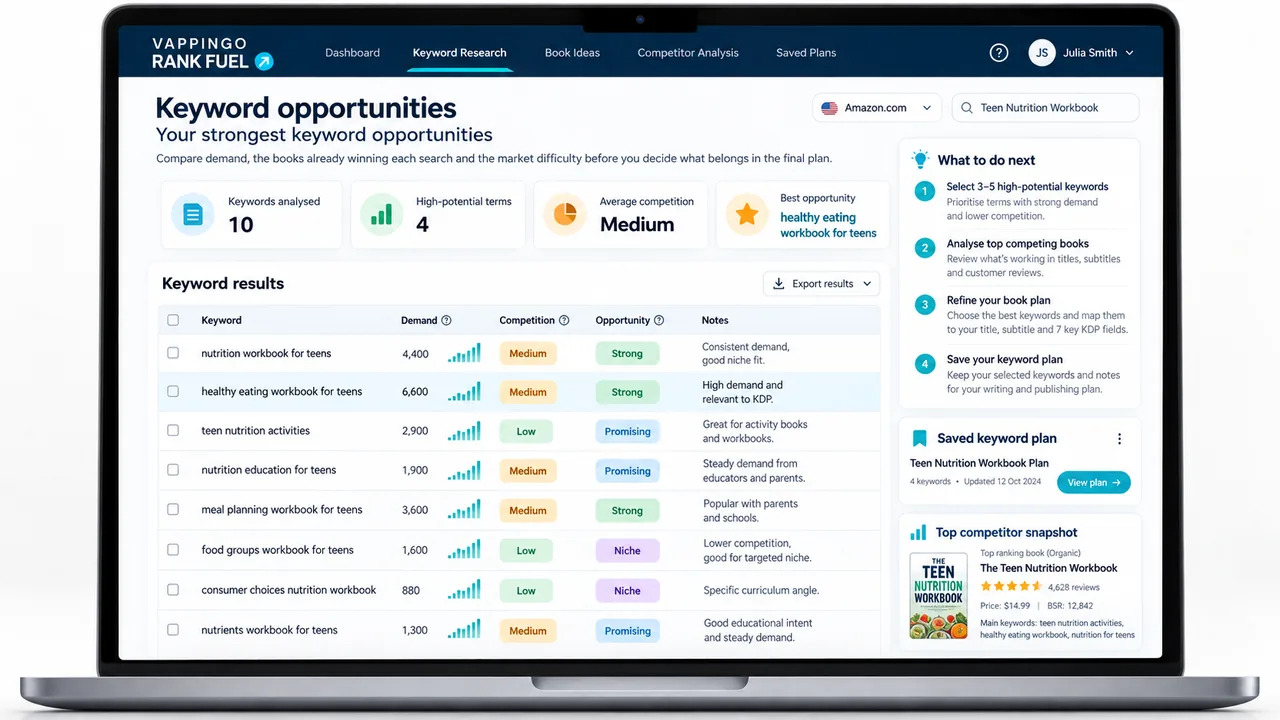
This is where you need to move beyond the search-volume column and inspect the market behind the phrase. Rank Fuel’s current Keyword Research workflow does this in the same research run: it confirms Amazon search demand, then adds market evidence such as competition, average reviews, average price, estimated monthly sales and estimated earning activity for the strongest keyword opportunities.
The sales figures should be read as estimates, not Amazon-reported unit sales. The purpose is comparison: does the market behavior broadly support the idea that this search contains commercially useful demand?
The same principle appeared in What Review Counts Really Tell You About KDP Competition. A small competition number is not automatically attractive if the books are barely selling. Here, the mirror image is true: a large search-volume number is not automatically attractive if the relevant books give weak evidence that searchers become buyers.
If one exceptional title is doing most of the work, read One Bestseller Is Not a Market. If the whole first page looks formidable, use How to Analyze Amazon KDP Competition Before Publishing to separate real demand from a market you may struggle to enter.
The Five-Step Commercial Keyword Test
Rather than asking one metric to make the publishing decision, move the keyword through five checks. The framework is deliberately sequential because a phrase that fails early does not deserve expensive or time-consuming market research later.
| Stage | Question | What passing looks like |
|---|---|---|
| 1. Demand | Is there meaningful estimated search activity? | Enough attention to justify further research. |
| 2. Intent | What is the shopper actually trying to buy or achieve? | The query describes a need your book can plausibly satisfy. |
| 3. Format | Does a KDP product fit the expected solution? | A book, workbook, planner, journal or similar format feels natural. |
| 4. Sales proof | Are relevant visible books showing credible activity? | Several direct competitors provide supporting market evidence. |
| 5. Winnability | Can a strong new book realistically gain visibility? | The competitive set leaves a plausible route into the market. |
There is no universal pass mark for any one row. The purpose is to explain why a keyword deserves more attention, rather than declaring it good because one number is large.
If a phrase has demand but weak intent, refine the language. If it has excellent intent but almost no estimated demand, broaden carefully. If it passes both but the page-one market is formidable, look for a nearby angle with the same buyer need and a more accessible competitive set.
Target, Refine or Reject
Keyword research becomes easier when every phrase does not have to fit into a crude good-or-bad bucket. A more useful decision is to give each candidate one of three outcomes.
Target
The keyword shows useful estimated demand, clear KDP buyer intent, strong product-format fit, supporting sales evidence and a market that deserves serious consideration. It is still not a guarantee of sales, but it has passed enough commercial checks to justify deeper research.
Refine
The underlying demand looks interesting, but the phrase is too broad, too ambiguous or poorly matched to the proposed format. The opportunity may still exist if you move toward a clearer audience, use case or book type.
For example, dog puzzles could lead toward dog word search book, dog activity book for kids or another phrase that tells you more about what the buyer expects. The right refinement depends on the book you actually intend to make.
Reject
The volume may be genuine, but the dominant intent is fundamentally wrong for the product. A phrase centred on a free online tool, downloadable template or unrelated product category does not become a good KDP keyword simply because thousands of people search it.
This is the point where saying no to traffic becomes commercially valuable. Every weak keyword you reject before production saves time, advertising spend and listing space later.
How Rank Fuel Checks High-Volume Keywords Now
Rank Fuel’s keyword research workflow has changed. The older standalone Keyword Competition Checker route has been consolidated into the current Keyword Research workspace, so you can compare demand with market difficulty in the same research run instead of treating competition as a separate score. The current workflow also starts with the book or idea you are researching, which gives the keyword evidence some much-needed context.
Step 1: Describe the book or idea
Tell Rank Fuel what you are considering publishing, including the subject, audience, age or level and format where those details matter. The research is designed to keep those defining constraints in view rather than drifting toward a broader phrase simply because the broader phrase has more volume.
That matters for exactly the reason discussed above. If your idea is a Year 8 math workbook, math may be a bigger search market, but it is not automatically a better description of the shopper you need.
Step 2: Find relevant Amazon buyer searches
Rank Fuel then identifies buyer-search phrases that fit the book and compares their estimated demand. The current research route is focused on Amazon.com, so treat the results as US-market evidence rather than assuming the same demand applies in every Amazon marketplace.
This stage is where broad phrases often lose their shine. A large term can be outperformed by a smaller phrase that preserves the subject, audience and format much more clearly.
Step 3: Add market evidence
The workflow does not stop when it finds volume. It compares the strongest keyword opportunities against market evidence such as review levels, pricing, estimated sales activity and competition. Rank Fuel also calculates an Opportunity Score that brings demand and competition evidence together, so the search-volume number is only one part of the assessment rather than the score you are expected to chase.
The useful result is not a declaration that a keyword is “good”. It is a shortlist that lets you compare phrases on both sides of the commercial equation: how much demand appears to exist, and how difficult or attractive the book market behind that demand looks.
A Keyword Research run currently uses 3 credits. Rank Fuel includes an initial research opportunity for new users, while additional research is part of the Pro workflow. If you are checking an idea before you write the book, use that first run on a reasonably complete description of the audience, subject and format rather than a one-word topic.
Worked Example: A Gardening Word-Search Book
Suppose you want to publish a large-print word-search book about gardening for older adults. The early keyword list may contain several phrases that look relevant on the surface:
| Keyword idea | What it tells you | Main problem to investigate |
|---|---|---|
| gardening | Large topic | Almost no product or audience clarity. |
| gardening games | Activity intent | Could mean apps, online games, card games or books. |
| garden puzzles | Theme + puzzle need | Puzzle format and audience remain unclear. |
| gardening word search | Theme + clear puzzle format | Audience and accessibility still open. |
| large print gardening word search for seniors | Theme + format + accessibility + audience | Now validate demand and competition. |
The longest phrase is not automatically the winner. Its advantage is that the commercial meaning is much clearer. If estimated demand becomes too small at that level of specificity, you can move back toward gardening word search or another broader version and compare the trade-off.
Then inspect the page-one market as a buyer would. Are the visible products really word-search books, are several relevant titles showing meaningful activity, and are newer books managing to appear beside established competitors? You are looking for evidence that a well-designed large-print product has room to gain visibility, not simply for a reassuring competition number.
The aim is to find the point where search demand and product expectation overlap cleanly. That is far more useful than choosing the broadest term simply because its volume is larger.
When a Lower-Volume Keyword Can Be Stronger
A lower-volume keyword is not automatically better than a high-volume one. The useful comparison is whether the smaller audience is substantially more relevant.
A lower-volume phrase becomes interesting when it brings several advantages together: clearer book intent, stronger format fit, a recognizable audience, evidence that relevant books sell and a more accessible competitive set. In that situation, you are trading some raw attention for a larger share of commercially useful attention.
That does not mean you should automatically choose the longest phrase available. The useful target is the point where specificity improves intent without shrinking demand into irrelevance. How Specific Should a KDP Keyword Be? looks at that trade-off in detail.
This is why the strongest KDP keyword is rarely defined by volume alone. You do not need every person searching the topic; you need enough of the right people to find the book, recognize that it matches what they wanted and choose it over the alternatives. That leaves you with a much more useful rule than “pick the biggest number”:
Useful demand beats raw demand.
A keyword is valuable because the right people search it with the right buying intention, not because the search-volume number is large.
Frequently Asked Questions About High-Volume KDP Keywords
Does high Amazon search volume mean a KDP keyword will sell?
No. Search volume indicates estimated search activity, not purchases. A high-volume phrase can still have weak book-buying intent, poor format fit, mixed product expectations or little supporting sales evidence among the books currently ranking for it. Use volume as a demand signal, then check intent and the live market.
Why can a KDP keyword have search volume but weak sales?
The search can contain several intentions, point toward another product type, attract people looking for free or digital alternatives, or concentrate activity in one unusually strong title. Weak sales among relevant page-one books do not prove the keyword has no demand, but they are a reason to investigate what the searchers actually want.
What is buyer intent in KDP keyword research?
Buyer intent describes how strongly a phrase suggests that the shopper wants a product like the one you plan to publish. For KDP, the strongest version is not simply willingness to spend money, but willingness to buy a book or book-like format that satisfies the stated need.
How can I tell whether an Amazon keyword is really a book search?
Read the wording first, then inspect the search results. Terms such as workbook, journal, planner, word search book or activity book give clearer format clues than broad topics. The result page should then show whether directly relevant books are visible and whether several appear to attract meaningful customer activity.
Is a lower-volume KDP keyword sometimes better?
Yes, when the lower-volume phrase has substantially clearer buyer intent, stronger product-format fit and a more accessible market. Lower volume is not an advantage by itself. It becomes useful when the smaller audience is more closely aligned with the book you can actually sell.
How accurate are Amazon keyword search-volume estimates?
Treat them as estimates. Search-volume figures are best used to compare candidate phrases alongside relevance, buyer intent and market evidence rather than as exact Amazon-reported shopper counts.
How many KDP backend keywords can I add?
Amazon KDP currently allows up to seven keywords that relate to the content of the book and advises publishers to avoid vague keywords. That makes the quality of each phrase important: the goal is useful coverage of relevant buyer searches, not filling the fields with the seven largest numbers you can find.
Should I target a keyword if the page-one books have low estimated sales?
Not without understanding why. Low estimated sales across several directly relevant books can indicate weak commercially useful demand, but it can also reflect poor products, mismatched results or demand going elsewhere. Treat the pattern as a warning that deserves investigation rather than an automatic rejection rule. Compare the result with several relevant books and nearby buyer-intent searches before deciding.
Stop Chasing Searches That Do Not Belong to Your Book
A large search-volume number is attractive because it feels concrete. It gives the impression that the market has already answered the hardest question. In reality, it has answered only the first one: people are looking. Your job is to determine what they are looking for, whether a KDP product fits that need, whether relevant books are turning the attention into sales and whether a strong new book has a realistic route into the market. The strongest keyword is therefore not necessarily the phrase with the largest crowd; it is the phrase where enough search demand overlaps with the right buyer, the right product expectation and a market you can realistically serve.
Do not ask which keyword gets the most searches. Ask which search is most likely to end with someone buying the book you intend to make.
If you have a book idea or keyword in mind, run it through KDP Rank Fuel Keyword Research. Start with a clear description of the book, then compare the demand and market evidence behind the strongest searches before you decide what deserves a place in the listing. If the book is already live and your keywords still are not bringing buyers, move to the KDP keyword troubleshooting guide rather than treating higher search volume as the automatic fix.