My KDP Book Is Ranking for Keywords but Getting No Sales
Ranking for a keyword does not automatically create sales. Diagnose whether the problem is buyer intent, ranking position, the click, or the listing after the shopper arrives.
Your Year 8 workbook appears for “math workbook”, a broad search serving many ages, formats and purposes.
The same book appears for “KS3 Year 8 math practice tests with answers”, which closely matches the actual product.
Both are keyword rankings. They do not carry the same commercial meaning. Ranking A may be bringing a mixed audience. Ranking B gives you a much cleaner reason to ask why the sale is not following.
That distinction is the starting point when a KDP book is ranking for keywords but not selling. The ranking is evidence, but it is not the whole diagnosis.
Why Is My KDP Book Ranking for Keywords but Not Selling?
If your KDP book is ranking for keywords but not selling, do not assume the keywords failed. A ranking tells you that Amazon is placing the book somewhere in the results for a search. It does not tell you how many shoppers saw that result, whether they clicked it, or why they chose another book.
The diagnosis usually comes down to three questions:
Is the book appearing strongly and consistently enough for a meaningful search?
Does the search describe a shopper who genuinely wants this kind of book?
When the right shopper finds the book, does the listing make it easier to choose than the alternatives?
Those are different problems. A weak ranking needs visibility work. A poorly matched keyword needs better targeting. A strong ranking for the right search with no sales gives you a better reason to investigate the product page and competitive offer.
What Does Ranking for a KDP Keyword Actually Prove?
Amazon says search-result order is determined automatically and can change as multiple factors change. Relevant keywords can help placement, alongside factors such as sales history and Amazon Best Sellers Rank, but Amazon does not guarantee a book will appear near the top.
A keyword-rank snapshot is, therefore, useful evidence of placement. It is not a complete sales funnel.
Your book ranks for a broad phrase such as “math workbook”, but the search serves several ages, levels and buyer needs.
Your Year 8 practice book ranks for “KS3 Year 8 math practice tests”, where the reader, level and format closely match the product.
The second ranking gives you much cleaner evidence. If sales still do not follow, the search-result package, offer or product page deserves closer inspection.
Can KDP Authors See Organic Search Impressions or Clicks?
Not through standard KDP Reports. KDP Reports shows data such as orders, estimated royalties and Kindle Edition Normalized Pages read. It does not provide a general report of organic Amazon search impressions or clicks for your book.
This changes how the article should be used. For organic rankings, diagnose from ranking strength, search relevance, competing listings, sales results and the product page. If Amazon Ads is producing measurable impressions and clicks, use the separate Amazon Ads clicks-but-no-sales diagnostic.
How Much Does KDP Keyword Ranking Position Matter?
Position matters, but there is no universal threshold where a ranking suddenly becomes “commercial.” Amazon’s own search guidance says result order changes automatically as multiple factors change, so a single snapshot should not be treated as fixed visibility.
Use position as a relative signal:
| What you observe | What it tells you |
|---|---|
| The book ranks near the top for a highly relevant search | You have stronger evidence that search placement is not the only problem. |
| The book appears much lower for the same search | Visibility may still be too weak to judge conversion confidently. |
| The position moves substantially between snapshots | Treat the ranking as volatile and follow the trend rather than one number. |
| The book ranks only for its exact title or unusually specific wording | That may show indexing without proving useful discoverability. |
Rank Fuel’s Keyword Rank Tracker stores baseline and later snapshots so the trend is easier to judge than repeated manual searches.
Why Can a KDP Book Rank for Keywords and Still Not Sell?
The nine causes below sit at different points between search placement and purchase. They are not nine changes to make at once. Use them to identify the earliest weak point supported by the evidence you have.
1. Is the Keyword Bringing the Right KDP Buyer?
A phrase can describe the topic accurately while still being too broad to describe the buyer. Journal, “puzzle book” and “math workbook” can each lead to several very different purchases.
The specific phrase is not automatically better because it is longer. It is better when it matches the product and the purchase more closely.
2. Could I Be Ranking for a Low-Demand KDP Keyword?
Yes. Easy placement is not proof of strong demand. A phrase can be relevant and relatively easy to rank for because only a small number of shoppers use it.
Do not diagnose low demand from one crude threshold such as review count or BSR. Instead, look at several kinds of evidence together: estimated search activity, how coherent the result set is, whether multiple comparable books show meaningful customer activity and whether the phrase connects to related searches with the same buyer.
The KDP Keyword Search Volume guide explains why a smaller phrase can still be commercially stronger when the demand and fit are better.
3. Is My KDP Keyword Ranking Too Weak or Unstable to Judge?
A ranking that appears briefly or fluctuates widely is different from sustained strong placement. Amazon says search results can change automatically as underlying factors change, so one manual check is not enough to prove durable visibility.
Use repeated snapshots. If the book moves from a strong position to much lower placement and back again, treat the ranking itself as part of the problem. If it holds relatively well for a highly relevant term and sales still remain weak, the diagnosis moves farther down the buying path.
4. Are Competing KDP Books Easier to Choose From the Search Results?
Your book can rank beside a competitor and still lose the decision before the shopper opens either description. Cover, title, subtitle, price, reviews and visible format cues are compared together.
Generic title, unclear audience and a cover that could belong to several adjacent niches.
The reader, format and outcome are obvious at thumbnail size, so the shopper understands the fit faster.
The question is not whether your book looks “good.” It is whether the nearby books make the purchase easier to understand and trust.
For the deeper comparison, see Why Competitor KDP Books Are Selling While Yours Is Not.
5. Does My KDP Title or Subtitle Confirm the Keyword Promise?
If the search is highly specific, the title/subtitle combination should usually make the match easy to confirm. A reader searching for a Year 8 workbook should not have to infer the school level from the description.
Search: “guided anxiety journal for women”
Title only: “The Calm Path”
Title + subtitle: “The Calm Path: A Guided Anxiety Journal for Women”
The abstract title can still work, but the subtitle supplies the missing category and reader context.
See KDP Title Mistakes That Stop Buyers Clicking and How to Write a KDP Subtitle That Helps Amazon and Readers.
6. Are Price and Reviews Weakening the Offer?
Ranking puts the book into a comparison. It does not remove the comparison. A shopper can find the book relevant and still prefer a neighboring title with more proof, a more convincing package or a price that feels easier to justify.
Your book: $13.99, 18 reviews, clear niche fit.
Nearby competitor: $10.99, 420 reviews, similarly clear niche fit.
Your book can still win, but the listing has to make the additional value visible. Ranking does not cancel the trust and price gap.
Do not lower the price automatically. First ask whether the product page makes the current price feel defensible.
7. Is My KDP Book Description Failing to Convert Relevant Shoppers?
If the ranking appears strong for a well-matched search, the description becomes a more plausible weak point. It has to do more than summarize the contents. It has to help the shopper decide whether this specific book is worth choosing.
For the full diagnosis, see Why Your KDP Book Description Is Not Selling Your Book.
8. Is Look Inside Undermining the KDP Listing?
The sample is where the shopper can test whether the listing promise matches the actual book. If the first pages look thin, difficult, cluttered or inconsistent with the cover and description, the sale can fail after every earlier stage worked.
Does the interior look professional and easy to use?
Does the sample deliver the level, format and experience the listing advertised?
Can the shopper see enough substance to understand why the book is worth buying?
If Look Inside weakens confidence, further keyword optimization cannot repair the product experience.
9. Am I Ranking for the Wrong Reader Even When the Keyword Looks Relevant?
This is subtler than a completely irrelevant keyword. The phrase can describe the subject accurately while attracting a different age, level, format preference or use case.
For example, “handwriting practice book” may fit a preschool workbook, an adult handwriting-improvement book or a dysgraphia-support resource. The topic overlaps. The buyers do not.
Compare the books ranking around you and ask whether they serve the same person in the same situation. If not, the ranking may be real while the commercial fit remains weak.
How Do I Diagnose a KDP Book That Ranks but Does Not Sell?
Start with what you can actually observe, then move down the chain.
| Evidence | Most useful interpretation | First check |
|---|---|---|
| The book ranks for broad or mixed-intent phrases | Buyer fit may be weak | Compare the search with the exact reader, level, format and use case. |
| The book ranks, but the position is weak or volatile | Visibility itself may still be insufficient | Track several snapshots before blaming conversion. |
| The book ranks strongly for a highly relevant phrase | Listing and competitive offer deserve more scrutiny | Compare cover, title, subtitle, price, reviews, description and sample. |
| The listing is strong, but nearby books dominate trust or value | The problem may be positioning rather than metadata | Identify the specific advantage buyers see in competing books. |
| Amazon Ads also gets relevant clicks but no sales | You now have measurable evidence of a later-stage conversion problem | Use the Ads clicks-but-no-sales diagnostic and audit the detail page. |
What Should I Fix First When My KDP Book Ranks but Does Not Sell?
Work from the earliest uncertainty to the latest. That keeps the next change tied to evidence.
Step 1: Confirm the ranking itself
Record the keyword, marketplace, position and date. One isolated manual search is weaker evidence than a trend across several snapshots.
Step 2: Confirm buyer fit
Ask whether the people using the phrase are likely to want this exact reader level, format, genre and use case.
Step 3: Compare the search-result package
Look at the cover, title, subtitle, price, reviews and visible format beside the books competing for the same shopper.
Step 4: Audit the product page
If the ranking is strong and the search fit is good, inspect the description, value proposition, price, proof and Look Inside.
Step 5: Protect what is already working
If you change editable metadata, record the current ranking baseline first and preserve important search territory deliberately rather than replacing all seven keyword boxes at once.
Step 6: Measure the result before making the next change
Allow Amazon to process the update, then compare ranking movement and sales over a sensible period for the book. Avoid inventing a universal waiting period because metadata processing and sales volume vary by title and change type.
What Should I Avoid When a KDP Book Is Ranking but Not Selling?
Do not assume every ranking is valuable. A ranking for the wrong buyer or a weak-demand phrase can look impressive without contributing much commercially.
Do not claim you have organic “impressions but no clicks” unless you actually have a source for those metrics. Standard KDP Reports does not provide that organic search funnel.
Do not use one universal BSR or review threshold as proof of demand. Compare genuinely similar books and treat BSR as directional evidence.
Do not change every keyword, the description, price and cover at the same time. If you alter everything together, the next result tells you very little about which change mattered.
Do not chase broader keywords simply because they have more estimated searches. Search demand only helps when the buyer and book fit.
Which Rank Fuel Solutions Help When a KDP Book Ranks but Does Not Sell?
Use the solution that answers the next uncertainty. The ranking history, keyword research and listing work should stay attached to the same book.
| Solution | Use it when… |
|---|---|
| Keyword Rank Tracker | You need a baseline and later snapshots to see whether important Amazon.com keyword positions are holding, climbing or slipping. |
| Book Keyword Spy | You want to inspect the search territory around competing books and identify buyer language worth comparing with your own rankings. |
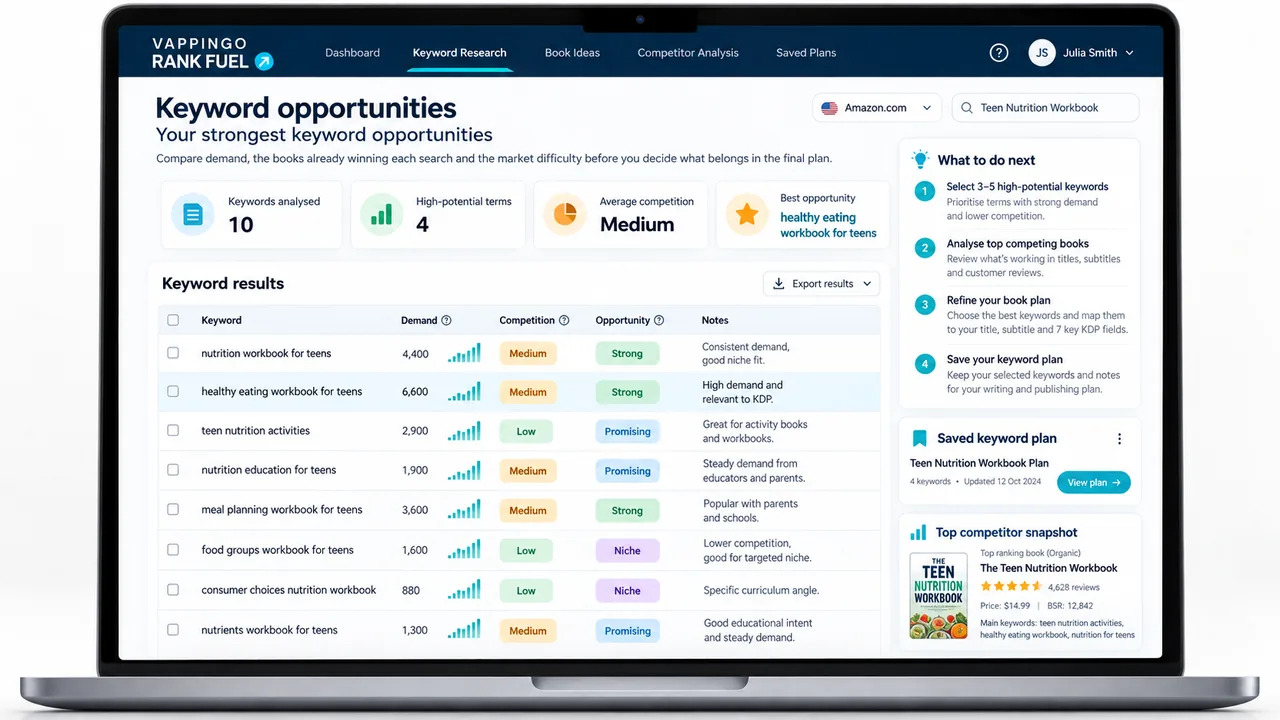
| Keyword Research | You need to compare estimated demand, buyer fit and market strength before deciding which rankings are worth protecting. |
| Listing Audit | The ranking looks useful and you need to identify whether the live listing is creating a conversion problem. |
| Listing Optimizer | You want to improve the editable description and keyword boxes while protecting searches where the book already has useful visibility. |
Frequently Asked Questions About KDP Rankings Without Sales
Why is my KDP book ranking for keywords but not selling?
The ranking may be too weak or volatile, the keyword may attract the wrong buyer or have weak demand, or the listing may be losing relevant shoppers on the search-result comparison or product page.
Does ranking for a KDP keyword guarantee sales?
No. Amazon says relevant keywords can influence search placement, but result order also depends on other factors and changes automatically. Ranking only establishes that the book is being placed for the search, not that shoppers will choose it.
Can I see how many organic Amazon shoppers clicked my KDP book?
Standard KDP Reports does not provide a general organic search-impression and click report. It reports items such as orders, royalties and KENP reads. Amazon Ads provides separate ad impression and click metrics when you are advertising.
What ranking position is good enough for KDP sales?
There is no universal position that guarantees useful visibility or sales. Search result order changes and different searches have different demand and competitive environments. Use position, stability, relevance and sales outcomes together.
Can a KDP book rank for the wrong keywords?
Yes. A keyword can be topically relevant but attract a different reader, level, format or use case from the book you sell. That creates a real ranking with weak commercial fit. If the books appearing around your search footprint also look wrong, use Competitor Discovery to diagnose whether your listing is sending mixed relevance signals.
Should I replace all seven KDP keywords if the book is not selling?
No. If the book already has useful rankings, capture a baseline and decide which search territory deserves protecting. Amazon allows up to seven keywords or short phrases, and changing all of them at once can make it harder to learn which change helped or hurt.
Should I lower the price if my KDP book ranks but does not sell?
Not automatically. Compare the price with the books competing for the same shopper and ask whether your product page makes the current value clear. Price will not repair a poorly matched keyword or weak product experience.
What Should I Do Next if My KDP Rankings Are Not Producing Sales?
Ranking is useful evidence because it narrows the problem. The book is entering at least some relevant search territory. The next task is to decide whether that territory is commercially useful and whether the listing can convert the shopper it attracts.
If your KDP book is ranking for keywords but not selling, record the rankings first. Then check buyer fit, competitive presentation and the product page in that order. Protect the searches that deserve protecting and change only what the evidence gives you a reason to change.
The goal is not to rank for more phrases. It is to rank for searches that bring a buyer your book can actually win.