My KDP Book Is Getting Views but No Sales: What to Fix First
If shoppers are seeing your KDP book but not buying, visibility is only part of the problem. Find the friction between the search result, product page, and purchase.
Twenty clicks came from broad searches that only loosely fit the book.
Twenty clicks came from highly relevant searches, but the detail page still produced no attributed sale.
The number looks identical. The diagnosis is not. Campaign A points first toward targeting. Campaign B gives you a much stronger reason to investigate the product page, price, proof, sample or timing.
That is the useful way to approach Amazon Ads getting clicks but no book sales: not as one advertising problem, but as evidence that the buying path is breaking somewhere after the impression.
Why Are My Amazon Ads Getting Clicks but No Book Sales?
If your Amazon Ads are getting clicks but no book sales, separate the problem into three questions: did the ad attract the right reader, did the book page make the value clear, and have you allowed enough time and data to judge the result?
Sponsored Products are cost-per-click ads. A shopper clicks the ad and is sent to the book’s detail page. That means a click is useful evidence: the ad earned attention. It does not tell you why the shopper left without buying.
Ask
Did the click come from a search term or product target that genuinely fits this book?
Ask
Once the reader arrived, did the listing give them enough reason to buy rather than return to the results?
Ask
Is there enough data, and has enough time passed, to call the traffic or listing a failure?
Do not solve all three with the same response. Raising bids will not repair a weak description, and rewriting the description will not make an irrelevant search term valuable.
Can KDP Authors See Book Page Views?
Not as a general KDP reporting metric. KDP Reports is built around orders, royalties and Kindle Unlimited reading data rather than ordinary product-page visits.
Amazon Ads is different. In the Ads console, authors can measure advertising activity such as impressions, clicks, spend and ad-attributed sales. Sponsored Products reporting can also show performance by targets and search terms.
This article is, therefore, specifically about a measurable Ads problem: paid clicks that are not producing attributed book sales.
What Does an Amazon Ads Click Actually Tell Me?
A Sponsored Products click tells you that the ad was shown and a shopper chose to open the advertised book’s detail page. Because Sponsored Products uses cost-per-click pricing, that is also the point at which the traffic starts costing you money.
What it does not tell you is why the shopper clicked. They may have been an excellent fit, a loose fit, curious about the cover, comparing prices or exploring a product page that appeared beside another book.
A shopper searches math workbook, wants GCSE revision and clicks an ad for a Year 8 practice book.
A shopper searches Year 8 math revision workbook, clicks your Year 8 book and still does not buy.
The second click is much stronger evidence of a conversion problem. The first may simply be telling you that the targeting was too broad.
How Long Should I Wait for Amazon Ads Sales to Appear?
Do not assume every click with no immediate sale is a failed click. Amazon’s current Sponsored Products attribution guidance gives authors a 14-day click attribution window. A qualifying purchase can, therefore, be attributed after the day of the click rather than appearing instantly.
That does not mean you should ignore obvious waste for two weeks. It means very early results need context. A handful of recent clicks with no sale is different from a sustained pattern of relevant clicks, meaningful spend and no attributed purchases.
Why Do Amazon Ads Get Clicks but No Sales?
The eight causes below sit at different points in the ad-to-purchase path. Start with the evidence closest to the click before changing the whole campaign or listing.
1. Are My Amazon Ads Search Terms Attracting the Wrong Readers?
Keyword targeting can be relevant at a broad topic level while still attracting the wrong buyer. A reader searching puzzle book may want large-print word searches, cryptograms, Sudoku, children’s activities or a gift book. One keyword can hide several different purchase intentions.
The useful evidence lives in the search terms shoppers actually used, not only the keyword you added to the campaign. Amazon’s Sponsored Products Search Term Report is designed for exactly this purpose and includes search terms that produced at least one ad click.
Campaign keyword: math workbook
Clicked search term: GCSE math workbook higher tier
Your product: Year 8 KS3 practice workbook
The campaign got a click. The book did not get a good buyer.
Use search-term evidence to decide which phrases deserve tighter targeting, which should be watched and which genuinely do not fit the book.
2. Are My Product Targets Sending the Wrong Shoppers?
Product targeting can fail for the same reason keyword targeting fails: the neighboring book looks related to you, but the shopper buying it wants something different.
Compare the targeted ASIN with your own book as a buyer would. Look at reader age, genre, difficulty, format, price, review strength, promise and visual positioning. A competitor can be topically similar and commercially wrong.
If the targeted product attracts a different type of reader, the click is not evidence that your product page failed. It may be evidence that the placement was never a good match.
3. Does the Amazon Ad Promise Match the Book Detail Page?
A Sponsored Products ad gets the shopper to the detail page. The page then has to confirm that the click was sensible.
If the search term suggested a beginner workbook but the subtitle sounds advanced, if the cover suggests one age group but the description speaks to another, or if the ad placement created an expectation the page does not support, the shopper has a reason to return to the results.
The issue is not that the ad needs more persuasive copy. Sponsored Products sends the shopper to the book page; the listing has to finish the argument.
4. Is My KDP Book Description Losing Paid Clicks?
Once a paid shopper reaches the page, a description that simply summarizes the contents can become an expensive weakness. The reader already knows enough to click. Now they need a reason to choose this book rather than go back.
The strongest description usually confirms the fit, makes the main benefit clear, translates important features into buyer value and reduces the uncertainty that remains after the cover and title.
If this is the weak point, see How to Rewrite a Failing Book Description and How to Write an Amazon Book Description.
5. Are Price and Reviews Making the Paid Click Harder to Convert?
Paid traffic still lands in a live Amazon comparison. A shopper can like the premise and then hesitate because a nearby book has far more reviews, a lower price or a more obvious value proposition.
Your book: $14.99, 14 reviews, 120 pages.
Nearby competitor: $10.99, 480 reviews, 160 pages.
Your book can still win, but the listing has to make the difference worth paying for. If the additional value is invisible, the ad has simply paid to put the shopper into an unfavorable comparison.
Do not automatically lower the price. First ask whether the page explains why the current price makes sense.
6. Is Look Inside Undoing the Sale After the Click?
Look Inside is often the first time the shopper can test the listing’s promise against the actual product. A polished ad and strong description can get the reader this far and still lose the sale if the sample feels weak.
Does the interior look professional and easy to use?
Does the sample deliver the level, format and experience promised by the listing?
Can the reader see enough substance to understand what they are buying?
If the sample weakens confidence, campaign optimization cannot repair the product experience.
7. Are the Ads Getting Sales Too Expensively?
“Clicks but no sales” is only one ad problem. A campaign can also generate sales and still be economically poor if the cost of acquiring them is too high for the royalty the book earns.
Separate conversion from profitability. First ask whether clicks become attributed sales at all. Then compare the advertising cost with the economics of the book and the objective of the campaign.
Amazon Ads Generator calculates a break-even ACoS from the book’s price and royalty so the starting bids and budget can be judged against a real profit line rather than a generic target.
8. Am I Judging My Amazon Ads Too Early?
Yes, possibly. One search term with a few clicks and no sale is not automatically bad, and one early sale does not automatically make a target good.
Look at the age of the clicks, the 14-day attribution window for authors, total spend, targeting fit and whether the sample is large enough to show a pattern. Amazon Ads data is most useful when comparable time periods are reviewed consistently rather than when every click triggers a change.
This is also why the Search Term, Targeting and Campaign reports are more useful together than one isolated number. They help separate a campaign-level budget problem from a target-level relevance problem or a book-page conversion problem.
How Do I Diagnose Amazon Ads Clicks With No Sales?
Start with the pattern you can actually observe in the Ads console, then choose the first action that tests the most likely cause.
| What you see | What it may mean | Best first check |
|---|---|---|
| Impressions but almost no clicks | The ad is being shown, but the book is not winning the search-result comparison. | Review cover, title, subtitle, price, reviews and targeting fit. |
| Clicks from obviously mismatched search terms | The targeting is bringing the wrong reader. | Review Search Term Report data and tighten or exclude poor-fit traffic. |
| Relevant clicks, no attributed sales | The listing or product offer may not be converting. | Audit the detail page, price, reviews and Look Inside. |
| Recent clicks, no sales yet | The data may still be immature. | Check click dates and attribution timing before reacting. |
| Attributed sales, but spend is too high | The campaign converts but may not meet the book’s economic goal. | Compare ACoS/ROAS with your break-even point and campaign objective. |
What Should I Fix First When Amazon Ads Get Clicks but No Sales?
Work in the same order the paid shopper experiences the journey.
Step 1: Inspect the clicked search terms and targets
Confirm that the traffic genuinely belongs with the book. If the searches or ASINs are poor fits, fix the targeting before rewriting the page.
Step 2: Check the age and volume of the data
Do not judge a recent or tiny sample as though it were a settled result. Account for Amazon’s attribution window and the amount of spend involved.
Step 3: Audit the detail page
If relevant readers are clicking, look at the title, subtitle, description, price, reviews, A+ Content where present and Look Inside as one buying experience.
Step 4: Fix the clearest conversion leak
Improve the specific weakness the evidence supports. Do not rebuild the entire listing merely because one campaign has a poor week.
Step 5: Review the campaign again on a consistent cadence
Compare equivalent periods and track whether the relevant metrics move. The next change should follow the new evidence.
Can My KDP Listing Pass the Paid-Click Test?
Imagine you have just paid for the next 100 relevant clicks.
Would you feel confident sending all 100 shoppers to this exact product page today?
If the answer is no, identify what makes you hesitate: targeting, title/subtitle fit, description, proof, price, sample or positioning. That is a stronger next action than simply raising the daily budget.
Which Rank Fuel Solutions Help When Amazon Ads Get Clicks but No Sales?
Use the solution that matches the part of the funnel you are diagnosing. Ad data, listing work and buyer research should stay attached to the same book.
| Solution | Use it when… |
|---|---|
| Ads Weekly Coach | You have Search Term, Targeting or Campaign reports and need prioritized actions rather than isolated metrics. |
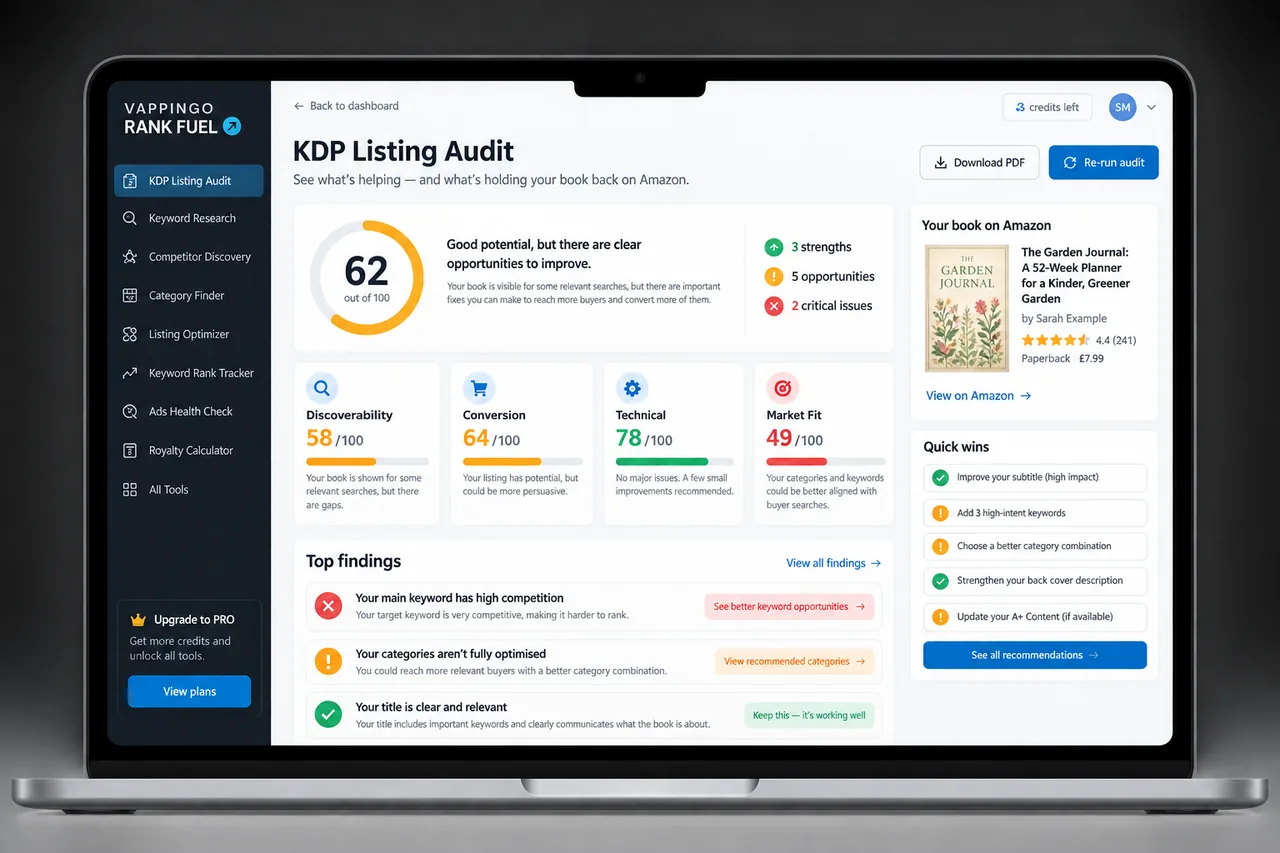
| Listing Audit | Relevant clicks are arriving and you need to identify whether the product page is the conversion leak. |
| Listing Optimizer | The live description, positioning or keyword strategy needs improvement after diagnosis. |
| Keyword Research | You need stronger buyer-search language before adding or replacing campaign targets. |
| Amazon Ads Generator | You need a structured Sponsored Products campaign plan with clearer targeting roles and book-specific break-even economics. |
Frequently Asked Questions About Amazon Ads Clicks but No Sales
Why are my Amazon Ads getting clicks but no book sales?
The clicks may be coming from poorly matched searches or product targets, the book detail page may not be converting relevant readers, or the data may still be too recent or too limited to judge. Diagnose targeting, listing conversion and attribution timing separately.
Can KDP authors see book page views?
KDP Reports does not provide a general product-page-view metric for ordinary book traffic. Amazon Ads provides advertising metrics such as impressions, clicks and attributed sales in the Ads console.
How long does Amazon Ads take to attribute a book sale?
Amazon’s current Sponsored Products attribution guidance gives authors a 14-day click lookback window. A sale can, therefore, be attributed after the day the shopper clicked the ad.
Should I pause a keyword after a few clicks with no sale?
Not automatically. Consider the quality of the clicked search terms, spend, book economics, timing and amount of data. A tiny sample is not enough to prove a target is bad.
How do I find which Amazon search terms are wasting ad spend?
Use the Sponsored Products Search Term Report or the Search terms area in Campaign Manager. Review the shopper searches that produced clicks and compare them with the book’s actual reader, format, level and promise.
Can a weak KDP listing make Amazon Ads unprofitable?
Yes. Amazon states that a strong detail page can help convert clicks into a sale. If relevant paid traffic reaches a weak product page, more clicks can increase spend without solving the conversion problem.
Should I raise my Amazon Ads bids if I get clicks but no sales?
Usually not as the first response. Higher bids can buy more traffic, but they do not fix poor targeting or a weak detail page. Diagnose the no-sale clicks before scaling.
What Should I Do With Amazon Ads Clicks That Do Not Convert?
Clicks are useful because they narrow the diagnosis. The ad earned enough interest to send a shopper to the book page and, with Sponsored Products, that click cost money.
If your Amazon Ads are getting clicks but no book sales, do not treat every click as the same failure. Check the clicked search terms and targets. Check the age of the data. Then audit the product page the relevant reader actually saw.
The goal is not to eliminate every no-sale click. It is to stop paying repeatedly for the same preventable reason not to buy.