Semantic Search and KDP Listings: Where Your Keywords Actually Belong
Amazon search can use keywords, book details, and book text, but Amazon does not publish an A10 semantic-copy formula. Learn how to separate search metadata from reader-focused listing copy.
You have found a keyword you want your book to rank for. So you put it in the subtitle. Then you squeeze it into the first sentence of the description. Then you use it again a few lines later, just to make sure Amazon gets the message.
At some point, the listing stops sounding like a book you would want to buy and starts sounding like somebody trying very hard to rank a book. That is the real problem with keyword stuffing.
It makes the listing worse for the person who has to read it. There are plenty of articles claiming Amazon’s “A10 semantic layer” now detects this behavior, assigns a relevance score and actively downgrades listings that sound over-optimized. The old version of this article made those claims too.
Amazon does not publicly document that system for KDP. But you do not need an invented algorithm rule to reach the same practical conclusion.
The Quick Answer: Write the Description for the Reader and Use the Keyword Fields for Keywords
Amazon gives you different parts of the listing for different jobs. Your keywords and categories help Amazon understand where the book belongs and how readers might find it.
Your title, subtitle and other book details describe the actual product. Your book description is there to help an interested shopper decide whether they want to read the book.
Amazon’s own KDP guidance tells you to make that description simple, compelling and professional. It also restricts keyword/tag phrases in the description. So the sensible strategy is not to turn the description into another backend keyword box.
What Amazon Actually Says About KDP Search
Amazon is deliberately vague about its search-ranking system. Its current KDP help pages say search results are dynamic and can be influenced by factors such as sales history, availability, how long the item has been listed and popularity.
Amazon also says search results can be determined by information that is not visible on the search-results page, including:
- keywords;
- book details;
- the text of the book itself.
That last point is useful because it tells you Amazon is working with more information than the exact phrase you can see in a title. What Amazon does not tell KDP authors is that there is a measurable “semantic coherence score”, that keyword density used to be rewarded under A9, or that repeating a phrase three times now triggers an A10 suppression.
Those may sound plausible. They are not claims we can verify from Amazon’s current documentation. If you want Amazon’s current wording, see its How to Find Your Book on Amazon and Search Results guidance.
So Where Does Semantic Search Fit?
Semantic search simply means trying to understand what a searcher means rather than relying only on exact word matching. That is a real and well-established search concept.
Amazon also uses increasingly sophisticated AI throughout its shopping experience. But that broad fact does not give us permission to invent a KDP-specific scoring formula.
For you, the useful takeaway is much simpler. If somebody searches for: cozy mystery set in a bakery you want every part of the book’s positioning to make sense for that shopper.
The cover should look like the kind of cozy mystery they expect. The categories should be relevant. The keyword choices should fit. The description should make the setting, tone and premise clear. The book itself should actually deliver that experience.
That is what I mean by writing with semantic consistency. It is not a secret Amazon score. It is simply making sure the whole listing tells the same truthful story about the book.
Why Keyword Stuffing Is Still a Bad Idea
Suppose your target phrase is small town cozy mystery. You could write: The same idea can be expressed naturally without turning the description into a repeated search phrase.
A small town cozy mystery for readers who love small town cozy mystery books
This small town cozy mystery follows an amateur sleuth in a cozy small town…
The problem is obvious before an algorithm enters the conversation. It sounds dreadful.
It wastes the tiny amount of attention you have from somebody who is deciding whether to click away. It tells the reader almost nothing specific about the story. And it makes the book look as though the metadata came first and the writing second.
Amazon’s own description guidance points in the opposite direction. Keep it simple. Focus on the main plot, theme or idea. Make it compelling and professional.
There is another important detail: Amazon’s current description restrictions explicitly reject “keywords or book tags phrases” in the description. So even without a documented semantic-ranking penalty, mechanical keyword strings do not belong there.
What Is Your Amazon Book Description Actually For?
Your description has one big job:
Help the right reader decide that this is the book they want. For fiction, that usually means quickly establishing the reading experience.
Who are we following? What has happened? What problem or desire drives the story? What are the stakes? What kind of tone should the reader expect?
For non-fiction, the questions are different. What problem does the reader have? Who is the book for? What will they be able to do, understand or change after reading it? Why should they trust this particular approach?
A good description answers those questions in natural language. Search research still matters. It can tell you how the market describes the problem, trope or outcome.
But the research should improve your understanding of the reader. It should not turn the copy into a bag of keywords.
What Natural Fiction Copy Looks Like
Imagine you have written a cozy mystery about a pastry chef who finds a body behind her bakery. You do not need this: The problem is readability and persuasion, not a published Amazon keyword-density penalty.
Cozy mystery bakery amateur sleuth small town murder mystery
Those may all be useful research concepts. They are not a description.
You could instead write something like:
Mara expected the village baking competition to be brutal. She did not expect to find the favourite to win dead behind her bakery.
Now the police are asking questions, half the village has a motive, and Mara has three days to clear her name before the competition she spent a year preparing for becomes the least of her problems.
The reader can infer a lot very quickly. Small community. Amateur investigation. Bakery setting. Murder. Lightly comic voice. A contained mystery.
You have communicated the product without reading out the metadata. That is stronger copy whether Amazon uses advanced semantic matching, simple field indexing, shopper behavior or some combination of all three.
What Natural Non-Fiction Copy Looks Like
Non-fiction descriptions often fail in a different way. They become vague. “Transform your finances and achieve the life you deserve” sounds positive, but it tells the reader very little. Specificity is much more useful:
Stop wondering where your salary went
This practical guide shows you how to split your income across bills, spending and savings automatically, build an emergency fund and make everyday money decisions without starting a new spreadsheet every Sunday night.
Now the reader knows the problem, the mechanism and the likely outcome. That specificity also tends to produce the kind of vocabulary your real buyers use because you are describing the actual job the book performs. For a fuller framework, see How to Write an Amazon Book Description.
Where Should Your Search Keywords Go?
KDP gives you seven dedicated keyword boxes. Use them.
Amazon says you can add up to seven relevant keywords or short phrases to improve discoverability. It also tells you to choose accurate terms and think like a reader.
That is where search vocabulary can do its technical job without making the public description unpleasant to read. The old version of this article linked to our old “249-byte” guide. We have now corrected that article too. KDP does not use one shared 249-byte keyword field. It uses seven separate keyword boxes.
Read the updated guide here: KDP Backend Keyword Limit: 7 Boxes of 50 Characters, Not 249 Bytes. If you are choosing the actual terms, use KDP Keyword Search Volume and How to Tell If a KDP Keyword Is Too Competitive to check demand and page-one reality before you commit.
Keep the Whole Listing Consistent
This is the part worth saving from the old “semantic search” idea. Your listing works better when all its parts point toward the same reader and the same product.
Imagine your keywords target “gentle cozy mystery”, your cover looks like a cozy mystery, and the description promises a warm village puzzle. Then the opening pages are a graphic serial-killer thriller.
You have a positioning problem. Amazon’s quality guidance explicitly warns against metadata that creates inaccurate search results or impairs a reader’s ability to make a good buying decision.
So check the listing as one system:
- Cover: Does it signal the right genre and reader?
- Title and subtitle: Do they accurately identify the book?
- Categories: Is this genuinely where the book belongs?
- Keyword boxes: Would somebody using these searches be pleased to find the book?
- Description: Does it make the right reader want to continue?
- Read Sample: Does the actual book deliver what the listing promised?
Our revised Amazon Read Sample guide takes that last step further. It focuses on what shoppers actually encounter after the listing earns the click.
What Rank Fuel’s Listing Generator Actually Does
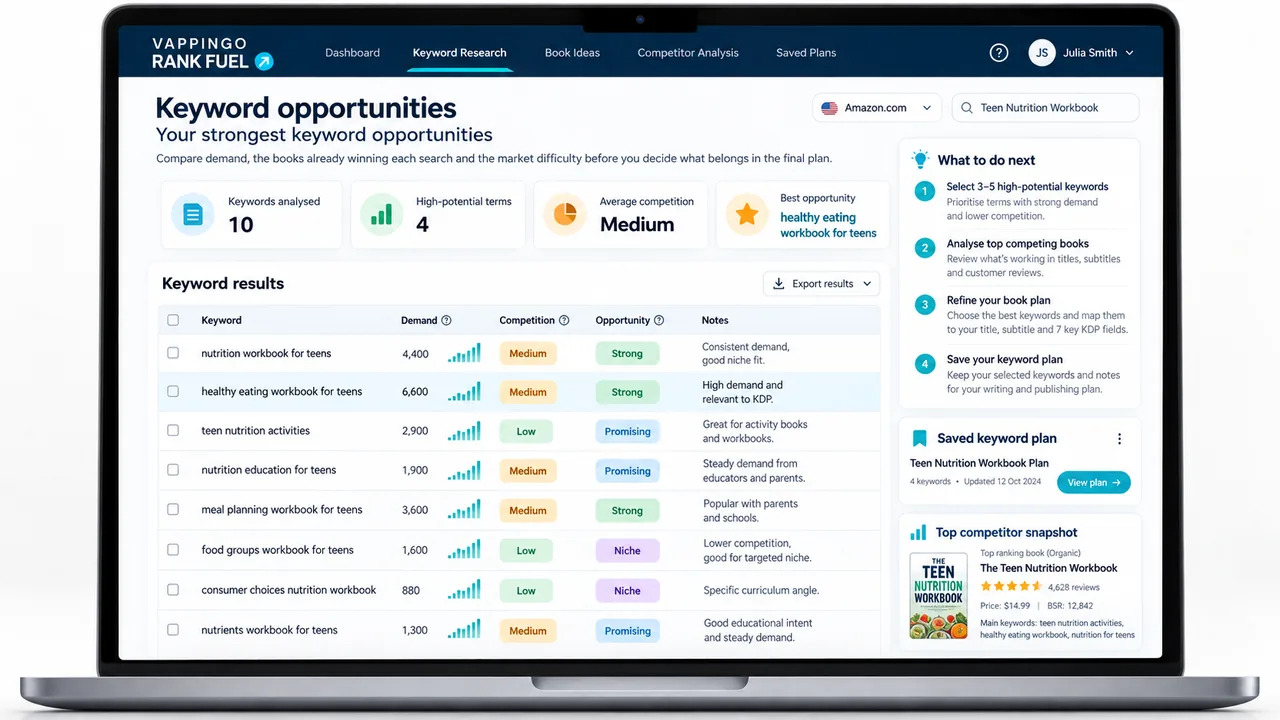
I checked this section against the current Rank Fuel code rather than keeping the old “A10 semantic copy” wording. The Listing Generator currently takes your book information and produces: Those outputs are designed to keep the research and visible listing aligned around the same book.
- 100+ keyword ideas;
- an optimized title;
- an optimized subtitle;
- a book description;
- all seven KDP keyword boxes;
- category recommendations.
The value is that the research and the public-facing copy sit in the same workflow. That does not mean Rank Fuel has access to a secret Amazon semantic score.
It means it can use the book information and target-search evidence to build a coherent listing, then keep the keyword boxes separate from the description that has to persuade a human reader. That is a much more defensible claim.
What Does the Listing Optimizer Actually Change?
The current Pro Listing Optimizer works from an existing listing and selected target keywords. It can produce an improved description and revised keyword boxes while preserving keywords the book already ranks strongly for.
Again, the job is not “repair your A10 semantic score”. The job is: Improve the listing around the searches you actually want to compete for without casually throwing away visibility you already have. If you are not sure what is wrong with the listing in the first place, start with a KDP Listing Audit rather than rewriting everything at once.
How Can You Tell Whether a Description Rewrite Helped?
Be careful here. The old article said you could watch a conversion rate in your KDP dashboard and expect keyword rankings to improve within 30 days.
That was too confident. KDP does not give you a simple universal product-page conversion-rate metric for organic book traffic.
What you can monitor includes:
- orders and royalties in KDP Reports;
- keyword positions through a rank tracker;
- advertising impressions, clicks, orders and conversion-related metrics if you run Amazon Ads;
- whether the book begins appearing for additional relevant searches;
- whether customer feedback suggests the listing is attracting the wrong reader.
Rank Fuel’s current Keyword Rank Tracker stores snapshots of your Amazon positions. Keyword Trends gives you a broader view of whether the book’s search footprint is expanding, holding or slipping over time.
Do not expect one description change to prove causation. Amazon search positions move for many reasons, and sales can change because of price, reviews, ads, seasonality, competition or visibility elsewhere.
Make one meaningful change where possible, give it enough time to generate data, and look at the whole pattern. If your book already appears for relevant searches but the traffic still does not turn into buyers, read Why Your KDP Keywords Are Not Bringing Buyers.
The Listing Mistakes I Would Remove First
If your description currently looks as though it was written for a search engine, start here:
For the practical field-by-field version of this argument, use the KDP listing optimization guide. If the hidden keyword fields are the immediate problem, the seven KDP keyword boxes guide explains the current limit and what belongs there.
- Repeated exact-match phrases: say the idea naturally once.
- Keyword-chain subtitles: your subtitle must match the actual book and Amazon’s metadata rules.
- Generic hype: replace “unmissable”, “life-changing” and “the best” with something specific.
- Reader mismatch: make sure the tone and promise fit the book buyers will actually receive.
- Backend vocabulary in public copy: keep clunky search terms in the dedicated keyword fields when they do not belong naturally in the description.
- Changing everything together: diagnose before you rewrite the title, description, keywords and categories in one go.
You are not trying to sound “semantic”. You are trying to make it immediately obvious what the book is, who it is for and why that reader should care.
Frequently Asked Questions About Semantic Search and KDP Listings
Does Amazon KDP use semantic search?
Amazon uses sophisticated search and AI systems across its marketplace, and KDP says search can draw on keywords, book details and the text of the book. Amazon does not publicly document a specific KDP “semantic relevance score” or explain an A10 NLP formula for book descriptions, so treat detailed claims about those mechanisms cautiously.
Does keyword stuffing hurt Amazon book rankings?
Amazon does not publish a KDP rule saying a particular keyword density triggers a ranking penalty. Keyword stuffing is still a bad strategy because Amazon restricts keyword/tag phrases in descriptions, inaccurate metadata can create quality problems, and repetitive copy is poor sales copy for the reader.
Should I put my main keyword in my Amazon book description?
If the wording belongs naturally in the description, there is no need to avoid a relevant phrase. Do not force exact-match terms into sentences for density. Use the description to sell the book and the seven KDP keyword boxes for dedicated search vocabulary.
Does Amazon read the text inside my book for search?
Amazon’s current KDP search guidance says search results can be determined by information including keywords, book details and the text of each book. It does not publish the weighting given to each source.
What should a KDP book description include?
Amazon recommends keeping the description simple, compelling and professional and focusing on the main plot, theme or idea. For fiction, establish the hook, conflict and reading experience. For non-fiction, make the reader’s problem, outcome and approach clear.
Where should I put KDP keywords?
KDP gives you up to seven keyword boxes specifically for relevant keywords and short phrases. Use those fields for search vocabulary rather than turning the public description into a list of search terms.
Can Rank Fuel measure an Amazon semantic score?
No. Amazon does not publish a KDP semantic-relevance score for external tools to read. Rank Fuel can analyze your listing, keyword targets, competitor evidence and ranking positions, but it should not be described as reading a secret Amazon A10 score.
How do I know whether my listing needs rewriting?
Start by separating visibility from conversion. If the book is not appearing for relevant searches, investigate keywords and competition. If it is visible but not selling, look at the cover, description, price, reviews, Read Sample and reader fit before assuming the keyword strategy is the problem.
The Rule to Keep
You do not need to write your Amazon description for an imaginary A10 robot. You need accurate metadata that helps Amazon understand the book and persuasive copy that helps a reader decide to buy it. Those two goals work together when the whole listing tells the truth about the same book.
Use keywords to find the reader. Use the description to win the reader.
If every part of the listing points to the same book and the same audience, you have a much stronger foundation than any keyword-density trick can give you.