How Much KDP Keyword Search Volume Is Enough? The Number Means Less Than You Think
There is no universal KDP search-volume threshold.
vg-modern-guide
What if the keyword with the biggest search number is the one most likely to waste your time?
That sounds backwards because KDP keyword research trains you to notice volume. A phrase with 18,000 estimated monthly searches feels more valuable than one with 480, so it is tempting to treat the largest number as the biggest opportunity. But those searches only matter if the people behind them want a book like yours and your book has a realistic chance of being seen.
| Keyword | Estimated monthly searches |
|---|---|
| self help | 18,000 |
| ADHD productivity | 2,400 |
| ADHD productivity workbook for adults | 480 |
Look at the three phrases above. If volume were the only thing that mattered, self help would win easily. The problem is that those 18,000 searches could include people looking for confidence, grief support, relationship advice, money help, motivation, memoirs or dozens of other things that have very little to do with an ADHD productivity workbook. The 480-search phrase is much smaller, but if it describes the book precisely, leads to realistic competitors and gives you a plausible route to visibility, those 480 searches can be far more useful than 18,000 searches you will never convert. Search volume tells you how much demand may exist. It does not tell you how much of that demand your book can actually reach.
The Quick Answer: Stop Looking for a Magic Number
KDP keyword advice often tries to solve the search-volume question with a simple threshold:
- Never target anything below 1,000 monthly searches.
- 500 searches is the minimum worth considering.
- Always choose the highest-volume phrase.
- Anything below 100 searches is useless.
The appeal is obvious. A fixed number would make keyword selection wonderfully simple. The problem is that a specialist professional guide, a children’s workbook, a puzzle book, a romance novel and a broad self-help title do not need the same level of search demand to support a worthwhile opportunity.
What matters is how useful that demand is to this particular book. Five factors change the meaning of the number:
- Intent: What is the shopper actually trying to find?
- Relevance: How closely does your book satisfy that search?
- Competition: Can your book realistically gain a visible position?
- Conversion: If the shopper sees the book, are they likely to click and buy?
- Breadth: Is this one useful phrase within a larger relevant keyword footprint?
Amazon’s own KDP guidance focuses on relevance rather than prescribing search-volume thresholds. It recommends using up to seven keywords or short phrases that accurately reflect the book and the language customers use when searching. Amazon also recommends testing prospective terms in Amazon search before publishing and revising them if the results are irrelevant or unsatisfactory. See Amazon’s current KDP keyword guidance.
What KDP Search Volume Actually Tells You
Search volume is one of the easiest KDP numbers to over-trust because it looks so concrete. If one keyword shows 5,000 estimated searches and another shows 500, the first appears to offer ten times the opportunity. What the number actually gives you is much narrower: an estimate of how often that phrase is searched over a given period.
That is useful evidence, but it is not a sales forecast. The estimate does not tell you how much of the demand your book will capture, or whether any of it will become sales. In particular, it cannot tell you:
- how many searchers will see your book;
- which position your book could reach;
- how many searchers will click;
- how many will purchase;
- which format they want;
- whether they are actually shopping for a book like yours;
- how much of the traffic is controlled by established titles; or
- whether the keyword will be profitable.
Search volume is demand data, not sales data
Commercial value depends on demand × relevance × achievable visibility × conversion. This is not a literal Amazon formula. It is a better way to think about the value of a keyword than treating search volume as a standalone score.
This is why search volume should never be read on its own. A useful market check puts estimated demand beside relevance, page-one competition, pricing, review depth and evidence that several books are attracting buyers. How to Analyze Amazon KDP Competition Before Publishing shows how to combine those signals.
Why 500 Searches Can Beat 5,000
Would you rather compete for 5,000 searches you are unlikely to reach, or 500 searches where your book has a genuine chance of appearing near the top? That is the trade-off hidden by search-volume comparisons. On the number alone, Keyword A below looks unbeatable; once relevance and competition enter the picture, the smaller market can become much more attractive.
Keyword A: 5,000 estimated searches per month
- Broad buyer intent
- Multiple possible interpretations
- First page dominated by strong established books
- Your likely ranking position is well beyond page one
- Your book only partially matches the search
Keyword B: 500 estimated searches per month
- Clear buyer intent
- Exact product fit
- Accessible first-page competition
- Several comparable books already selling
- A realistic path toward page-one visibility
Keyword A has ten times the theoretical demand, but you do not receive ten times the traffic because you do not own those 5,000 searches. You compete for a share of them, and that share depends heavily on relevance and ranking position. Available demand matters more than theoretical demand. A smaller market where your book can become visible may therefore be more commercially useful than a giant market where it remains buried. This is the natural companion to our guide Is This KDP Keyword Too Competitive? 7 Signs to Check Before You Target It, which looks at the other half of the equation: how difficult it may be to earn that visibility.
The Four Types of KDP Search Volume
A search-volume number becomes much more informative once you pair it with buyer intent. Two phrases can attract exactly the same number of searches and still represent completely different commercial opportunities, simply because one tells you what the shopper wants and the other barely narrows the problem at all.
| Weak buyer intent | Strong buyer intent | |
|---|---|---|
| High volume | Potential traffic trap | Potentially excellent if competition is accessible |
| Low volume | Usually weak | Potentially valuable long-tail opportunity |
1. High volume + weak intent
Take a phrase such as anxiety. There may be substantial interest, but the shopper could want a memoir, a practical workbook, a book for parents, a guide for teenagers, an academic psychology text, meditation exercises, or a children’s book.
Verdict: useful topic signal, weak foundation for a specific KDP targeting decision.
2. High volume + strong intent
Now consider anxiety workbook for teens. The product, audience, and need are much clearer.
Verdict: potentially excellent, provided the competitive landscape gives a new book a realistic route in.
3. Low volume + strong intent
Consider social anxiety workbook for teenage girls. The audience is smaller, but the search is highly specific.
If your book matches that need closely and the competition is reasonable, this can be a valuable phrase within a larger keyword strategy.
Verdict: do not dismiss simply because the raw volume is lower.
4. Low volume + weak intent
Low demand combined with vague intent gives you very little to work with.
Verdict: normally a low-priority term unless it plays a very specific supporting role.
Why Buyer Intent Changes Everything
Buyer intent is where a large audience starts becoming a useful audience. Compare the progression below. Each step narrows the search, but the real benefit is not the extra words; it is that you can increasingly picture the person searching and the product that would satisfy them.
- running
- running training
- 5k running plan
- 5k training plan for beginners
As the phrase becomes more specific, you learn more about what the searcher is trying to accomplish. That can sharpen product relevance, audience clarity, cover positioning, title and subtitle decisions, description copy and the likelihood that the person who sees the book is genuinely interested in it. There is a limit, though. Longer does not automatically mean better. A phrase such as 5k running training book for beginner women over 40 UK may describe an extraordinarily precise customer while attracting virtually no meaningful searches. The goal is to find the point where specificity improves buyer intent without shrinking demand to irrelevance.
Ask what the phrase means before asking how big it is
A useful keyword should reveal something about the buyer, product, audience or outcome. If you are still deciding how narrow to go, How Specific Should a KDP Keyword Be? explains how to find the point where extra detail improves intent without shrinking demand into irrelevance.
Search Volume Does Not Matter If You Rank #87
Keyword A: 10,000 estimated searches, your book ranks #87.
Keyword B: 800 estimated searches, your book ranks #3.
The larger search market sounds more impressive, but much of that demand is effectively inaccessible if buyers never scroll far enough to see your book. You do not own the search volume. You compete for a share of it. That is why competitor keyword research can be more useful than collecting high-volume phrases in isolation. The KDP competitor research guide explains how ranking position and estimated search demand can be examined together to identify the keywords that are actually producing visibility for live books.
Search Volume Does Not Matter If Buyers Do Not Click
Reaching a visible position solves only one part of the problem. A shopper can see your book and still ignore it. Search volume therefore sits at the top of a much longer commercial journey: Search → impression → click → product page → purchase.
Keyword A
A large search number can disappear quickly
1,000 monthly searches → 200 useful impressions → 8 clicks → 0 sales
Keyword B
For Keyword B, imagine 300 monthly searches leading to 160 useful impressions, 32 clicks and 6 sales. The keyword is much smaller, yet in this example it is far more commercially useful because the traffic is better qualified. The shoppers recognize the product, see their problem reflected in the title, respond to the cover, understand the promised outcome and are closer to making a purchase. This is where keyword strategy meets listing conversion. If you are getting visibility but shoppers are not buying, see Why Is My KDP Book Not Selling?.
Is 100 Monthly Searches Too Low for a KDP Keyword?
One hundred estimated monthly searches can look too small to bother with, especially when other keywords show four- or five-figure demand. Sometimes it is too small. But if those 100 searches come from exactly the people your book is designed for, the competition is accessible and you can rank near the top, dismissing the phrase purely because of volume can mean throwing away highly qualified traffic.
- buyer intent is extremely strong;
- the phrase closely matches your book;
- competition is accessible;
- you can rank very highly;
- the traffic converts well;
- the book ranks for many related phrases; or
- one customer can lead to further purchases elsewhere in your catalog.
However, one 100-search phrase usually should not be the sole evidence supporting an entire publishing decision unless the economics of the book make a very small audience worthwhile.
There is a major difference between one keyword with 100 relevant searches and a book that ranks across twenty closely related, high-intent phrases that each attract modest demand.
The second can create a meaningful combined search footprint.
Is 1,000 Monthly Searches Good for a KDP Keyword?
One thousand estimated monthly searches sounds reassuringly substantial, but even that number can describe four very different situations. A book ranking #2 for a tightly matched phrase has a very different opportunity from one buried at #72, even though the search-volume figure is identical.
| 1,000-search scenario | Interpretation |
|---|---|
| Rank #2 + strong intent | Potentially excellent visibility |
| Rank #72 | Large theoretical demand, limited current visibility |
| Wrong or mixed buyer intent | Traffic may be poorly qualified |
| Page one dominated by entrenched brands | Demand exists, but access may be difficult |
So is 1,000 good?
It can be. The better question is whether those 1,000 searches represent relevant demand you can realistically reach.
When High Search Volume Is Actually a Warning
Sometimes a huge search number is not a green light. It is a clue that the keyword is still too broad. The more meanings, product types and buyer needs hidden inside a phrase, the less confidently you can assume that a large audience is actually an audience for your book.
Build a Keyword Portfolio, Not Seven “Winners”
Your seven backend keyword fields do not need seven blockbuster search numbers. In fact, chasing seven versions of the biggest phrase can leave the book dependent on the same broad, competitive traffic source. A stronger set gives the right reader several different ways to find you.
Anchor keywords
Anchor keywords broadly establish what the book is about. They give the rest of the keyword set a clear subject and product context.
Buyer-intent keywords
Buyer-intent keywords closely resemble searches made by someone looking for the type of product you sell. They are often more commercially useful than broad topic phrases because the shopper’s purpose is clearer.
Audience keywords
Audience keywords identify who the book is for. They become especially useful when age, level, profession or life stage changes what the buyer expects from the product.
Problem or outcome keywords
Problem or outcome keywords describe what the reader wants to solve, learn, achieve or experience. They connect the search to the reason the purchase is being considered.
Long-tail opportunities
More specific phrases with smaller demand but potentially stronger relevance or more accessible competition.
The final keyword set should therefore cover different routes through which the right reader may discover the book, not seven slight variations of the same high-volume phrase.
Our guide to choosing your seven KDP backend keywords without guessing explains how to move from a larger candidate pool to a balanced final selection.
A Better Way to Judge KDP Search Volume
Before a search-volume figure earns a place in your keyword strategy, make it survive five questions. The aim is to find out whether the demand is useful to this book, not whether the number looks impressive in isolation.
1. Is there enough search activity to matter?
The volume does not need to be enormous, but there should be enough potential demand to justify targeting the phrase in the context of your book and wider keyword footprint. A very small phrase can still matter when it is one of several closely related routes into the same market.
2. Does the phrase reveal buyer intent?
Does it sound like somebody looking for your kind of book, or does it simply describe a broad topic? The more clearly the phrase implies a purchase need, audience or format, the more useful the volume becomes.
3. Is your book an exact enough fit?
If the shopper typed the phrase and saw your cover, would the book feel like a satisfying answer to the search? Relevance should be obvious enough that the shopper does not need to reinterpret the query to make your book fit.
4. Can you realistically gain useful visibility?
Check page-one competition rather than assuming high demand means accessible demand. A large market can be commercially weak for you when the books receiving the meaningful visibility are entrenched and difficult to displace.
5. What happens after the click?
Does your cover, title, subtitle, price, review profile, sample and description give the shopper enough reason to buy? Search volume creates an opportunity to be considered, but the listing still has to turn that attention into a click and a sale.
A Bigger Number Is Not Always a Better Keyword
Big audience, weak opportunity
- Broad or mixed intent
- Massive page-one competition
- Likely ranking outside meaningful visibility
- Only partial product fit
- Low expected share of the available searches
Smaller audience, stronger opportunity
- Defined buyer
- Clear product format
- Strong relevance
- Accessible competition
- Realistic page-one potential
- Greater chance of useful clicks and conversions
The contrast below is the simplest way to remember the principle. A 5,000-search keyword can look like the prize until you ask whether the buyer intent is mixed, the first page is dominated by entrenched books and your likely ranking leaves you almost invisible. A 500-search phrase can become much more valuable when the opposite is true.
How to Judge Search Volume in KDP Rank Fuel
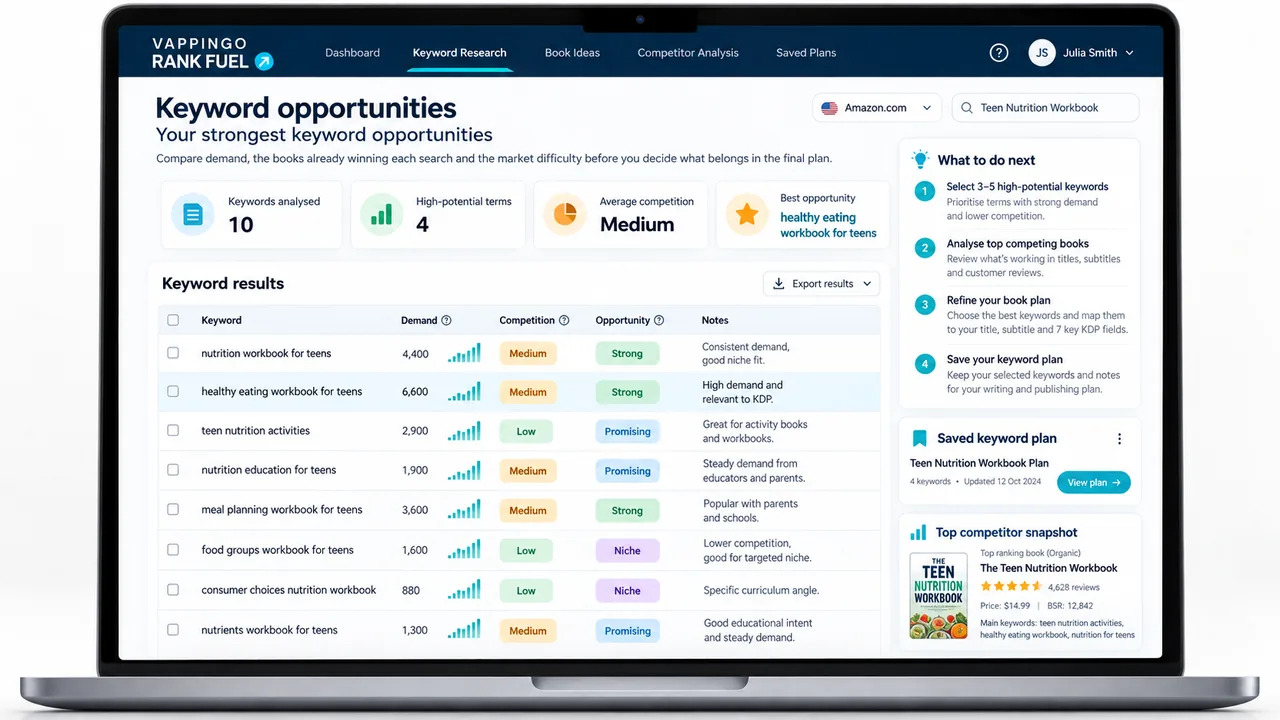
KDP Rank Fuel’s current Keyword Research workflow starts with the book rather than asking you to chase the biggest number. Describe the subject, audience, age or level, format and use case where those details matter, and Rank Fuel identifies relevant Amazon buyer searches so you can compare estimated demand with the market behind it.
1. Start with fit
Look first at whether the search actually describes the book. A broad phrase can have impressive demand while representing several different products or audiences. A smaller phrase can be more useful when the buyer, format and need are much clearer.
2. Compare demand with the market behind it
The current Keyword Research results bring estimated monthly searches into the same decision as competition and broader market evidence. That makes it easier to spot the difference between a large search you are unlikely to access and a smaller market where the book has a more realistic route to visibility.
The current research route is focused on Amazon.com (US). Your first Keyword Research run costs 3 credits; further research is part of Rank Fuel Pro.
3. Use competitor research when you need a live example
If a keyword market looks promising, Book Keyword Spy lets you inspect the search footprint around a strong competing book. It is currently a Pro feature and uses 2 credits per lookup. Read ranking position and estimated demand together, then investigate only the phrases that genuinely fit your own book.
Frequently Asked Questions About KDP Keyword Search Volume
How much KDP keyword search volume is good?
There is no universal minimum. A good search-volume level depends on buyer intent, relevance, competition, likely ranking position, conversion, and how the keyword fits within the book’s wider search footprint. A smaller, highly relevant and accessible keyword can be more valuable than a much larger broad term.
Is 100 Amazon searches per month enough for a KDP keyword?
It can be. One hundred estimated monthly searches is a small market, but the phrase may still be useful if intent is strong, competition is accessible, and your book can rank highly. It is usually more persuasive as one part of a broader keyword portfolio than as the sole basis for a publishing decision.
Is 1,000 monthly searches good for a KDP keyword?
Potentially. One thousand relevant searches can be commercially useful when your book closely matches the query and has a realistic path to visible rankings. The same 1,000 searches may be of little practical value if your book ranks far down the results or the search intent is wrong.
Should I always target the highest-volume KDP keywords?
No. Very high-volume terms are often broader and more competitive. prioritize keywords where demand, relevance, competition, and achievable visibility work together rather than automatically selecting the biggest number.
Are low-volume long-tail KDP keywords worth using?
Yes, when they represent strong buyer intent and a close product match. Long-tail keywords can be particularly useful when they are easier to rank for and form part of a larger group of related searches.
How accurate are Amazon KDP keyword search-volume estimates?
Treat third-party search-volume figures as estimates rather than exact counts of Amazon shoppers. They are most useful for comparing relative demand between candidate keywords, particularly when combined with current competition, rankings, and sales indicators.
What matters more: search volume or competition?
Neither should be used alone. Search volume tells you about potential demand; competition tells you how difficult it may be to access that demand. The strongest opportunities normally have a useful balance of both, alongside strong relevance and buyer intent.
Should all seven KDP backend keywords have high search volume?
No. Your seven keyword fields can cover different search intentions, including broader anchor terms, specific buyer-intent searches, audience phrases, outcome phrases, and long-tail opportunities. Relevance and coverage matter more than forcing every field to contain a high-volume term.
Final Thought: Do Not Chase Searches You Cannot Turn Into Sales
The keyword with the largest search number is not automatically the keyword with the largest commercial opportunity. What matters is the portion of that demand your book can realistically reach and convert. A smaller phrase that puts the right book in front of the right buyer can outperform a giant market where the book remains buried or poorly matched.
So when a search-volume figure catches your eye, do not stop at the number. Ask who is searching, whether the book fits, what page one looks like, where you could realistically rank and what would make a shopper click once they see you. The goal is not to find the most searches. It is to find enough relevant demand that your book has a realistic chance of turning visibility into sales.
Not sure which search deserves deeper research? Run the book through KDP Rank Fuel Keyword Research, compare the strongest buyer-search opportunities and investigate the market before you commit your metadata or publishing plan. You can also explore the full Amazon KDP tools suite for keyword research, competitor intelligence, listing optimization, category research, rank tracking and Amazon Ads.