How to Choose the Best Amazon KDP Categories in 2026
Choose KDP categories using accurate fit, primary marketplace, format, live competition evidence, and current three-category rules without relying on obsolete support-request tactics.
Choose KDP categories using accurate fit, primary marketplace, format, live competition evidence, and current three-category rules without relying on obsolete support-request tactics. The strongest choices can be explained in reader terms and supported with live marketplace evidence, rather than by a promise of a badge or a fixed sales threshold.
Amazon changes metadata, taxonomy, and merchandising systems. This article reflects the September 2026 workflow, but the live KDP interface and help pages remain the final authority.
How KDP Categories Work in 2026
KDP currently lets authors choose up to three categories during setup. Choose categories that accurately describe the book for its primary audience, format, and primary marketplace. Amazon notes that category availability can differ by marketplace and format, and updates can take up to 72 hours to appear. See the current KDP category guidance.
The three selected categories are inputs you control; the category-rank labels Amazon displays are outputs Amazon controls. A book can show up to three Best Seller Category ranks on its detail page, and Amazon says customer activity influences which ranks are shown. Do not multiply the selected categories by format and then treat the result as a guaranteed number of public ranking placements.
Category taxonomy is also dynamic. Availability differs by marketplace and format, and Amazon can update store categories over time. That makes live verification more useful than an old spreadsheet of browse nodes. Keep the category names and comparable-book evidence you used when you made the choice so later changes can be audited rather than guessed at.
Ghost Categories: Verify Before You Trust the Path
Authors use “ghost category” informally for a path that appears in old tools or discussions but is difficult to browse, unavailable for a particular format or marketplace, stale after taxonomy changes, or simply poor at creating useful discovery. There is no stable public percentage of categories that are ghosts, and a questionable path does not automatically mean literal zero visibility.
Verify a category before treating it as valuable. Check whether it is selectable in the live KDP interface for the correct format and marketplace, whether relevant current books appear in that area, and whether the category produces a meaningful browse or ranking context. If the evidence is weak, choose a more defensible category rather than chasing an apparently easy rank.
Duplicate Categories and Wasted Slots
The current limit makes each of the three choices important, but “duplicate” should be judged by reader intent rather than by whether two category names share a parent. Two closely related categories can still serve distinct shopping paths if both accurately describe the book. The problem is selecting three labels that represent effectively the same audience while ignoring another important dimension of the book.
A useful three-category set often balances the primary genre or subject with one or two accurate narrower contexts. Map each category to a specific reader route, then remove any choice you cannot explain without repeating the rationale for another slot.
How to Research Categories Properly
Start with accuracy, then evaluate opportunity. Search the live KDP selector and Amazon store for categories that genuinely describe the book. For each candidate, inspect current comparable titles, their relevance, price range, review context, format mix, and category ranks over more than one observation where possible.
Rank is relative, so do not convert one BSR snapshot into a guaranteed copies-per-day target. Amazon says rank reflects customer activity relative to other books and uses both recent and historical activity, with recent activity weighted more heavily. Use estimates as directional evidence and compare several candidates rather than pretending the number is exact. See Amazon’s ranking guidance.
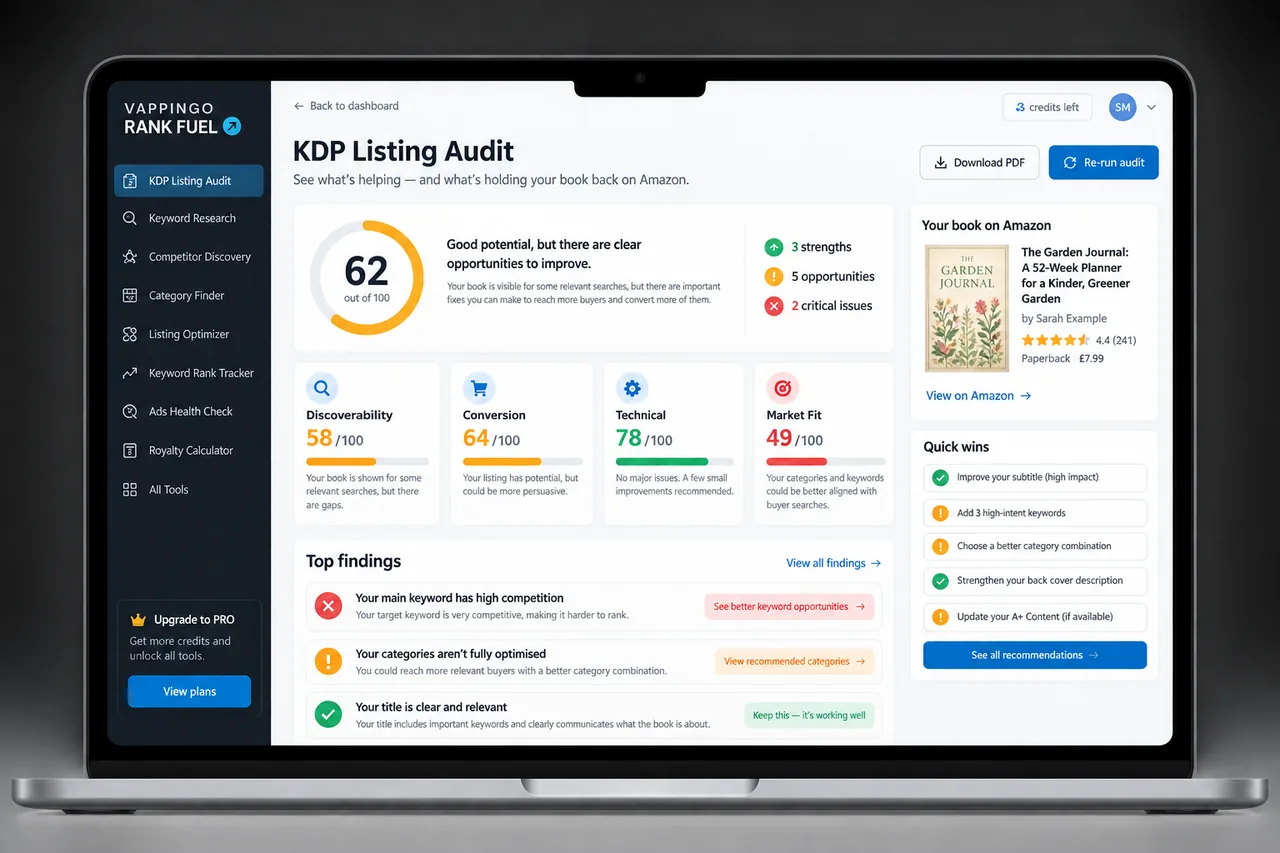
For a faster first pass, KDP Rank Fuel currently offers a free Category Finder and Pro Category Research. Treat estimated sales/competition outputs as research aids rather than Amazon-published thresholds.
Choosing Your Three Categories
Score each candidate on four questions: Is it accurate? Does the right reader recognize this as their shelf? Is the competition plausible for this title? Does it add a distinct route compared with the other two choices? Accuracy is the gate; opportunity only matters after the category passes that test.
For a new title, one category can reflect the broad commercial identity while another captures a more specific subgenre, audience, problem, or format use case. The third can cover another genuine dimension of the book. Do not force diversity for its own sake, and do not select a tiny irrelevant category merely because its top books have weak ranks.
Ebook vs Paperback: Using Both Formats Strategically
Category availability can differ by format, so review the selector for each edition rather than copying category names mechanically. The audience may also behave differently by format: a workbook, giftable journal, reference book, or illustrated title can have different physical-book browsing patterns from its Kindle edition.
Linked formats do not give you permission to miscategorize one edition to manufacture more ranking surfaces. Keep each edition accurate. When you compare performance, remember that Amazon’s ranking guidance says Books category ranks can aggregate activity across linked formats assigned to the category, while Kindle and Audible lists are format-specific.
How Keywords and Categories Work Together
KDP says categories and keywords work together to help Amazon understand where to shelve a book, but it does not publish a stable keyword-to-category “unlock” map. Choose categories directly in the current KDP workflow, then use the seven keyword fields for genuine reader searches that add specificity beyond the selected labels. See KDP category guidance.
Alignment still matters. If the category says cozy mystery and the keyword fields describe hard-boiled crime, the metadata tells an incoherent story. If the categories establish cozy mystery while the keywords add British village, retired amateur detective, culinary mystery, and other accurate reader language, the two layers complement one another without duplication.
When Amazon Moves Your Book
Amazon controls its store taxonomy and can change how a book is surfaced. If a category disappears, changes name, or no longer seems useful, verify the live KDP selector and the book detail page before assuming a penalty or algorithm event. Taxonomy maintenance is a more ordinary explanation than a hidden punishment.
When you update a category, record the date and allow the change time to propagate. KDP says category updates can take up to 72 hours to display. Compare the new state only after that window, and avoid making several metadata changes at once if you want the result to be interpretable.
BISAC Codes in 2026
BISAC remains an important publishing-industry subject taxonomy, especially in metadata workflows beyond Amazon. KDP authors, though, choose Amazon store categories directly. Do not assume the category selector exposes a precise one-to-one BISAC mapping or that changing a BISAC code elsewhere will deterministically move the book into a specific Amazon node. See the current BISAC Subject Headings.
If you distribute beyond KDP, maintain both classifications deliberately: choose the best Amazon categories in KDP and assign accurate BISAC codes where your distributor, ISBN metadata, or retail feed asks for them. The vocabularies overlap conceptually but serve different systems.
Bestseller Badges and Category Rank
Category rank is relative to other books and can move even when your own activity is unchanged. Amazon can display up to three Best Seller Category ranks, and no public formula tells you exactly how many daily sales guarantee a particular position or badge. Treat estimated sales thresholds as planning ranges only. See Amazon’s rank guidance.
A badge can be useful social proof when Amazon displays it, but it should not dictate category choice. A tiny irrelevant category may look easier on paper while sending the wrong signal to readers and creating metadata risk. The stronger strategy is accurate placement where a meaningful audience can actually discover the book.
Updating Your Categories
Update categories when the current set is inaccurate, the taxonomy has changed, the book’s positioning has changed, or new evidence shows that another accurate category offers a better route to the right reader. Do not rotate categories simply because a calendar says it is time to “refresh the algorithm.”
Before changing anything, save the current categories, relevant ranks, date, price, and major promotion context. Change one meaningful variable where possible, allow up to 72 hours for category updates to appear, then watch the new state over enough time to distinguish a stable result from ordinary rank volatility.
Full Category Strategy by Goal
| Goal | Category priority | What to avoid |
|---|---|---|
| Launch a new title | Accurate fit plus realistic competition | Irrelevant “easy badge” categories |
| Build a series | Consistent reader promise with book-level accuracy | Assuming categories create the series relationship |
| Improve a backlist title | Audit stale taxonomy and weak-fit slots | Changing multiple metadata fields at once |
| Expand internationally | Research the live marketplace and format | Copying US categories without verification |
The category strategy should be explainable in reader terms. If the only argument for a category is that it looks easy to rank in, it is not strong enough. Relevance, discoverability, and competition belong in the same decision.
A Worked Three-Category Example
Imagine a British village cozy mystery featuring a retired postmistress and a gardening-club murder. A broad mystery category may be accurate but highly competitive; a cozy mystery category may capture the central reader promise; a more specific amateur-sleuth or setting-related category may add another useful path if it exists in the live selector and accurately fits. The decision is not “pick the three easiest.” It is to compare the accurate options, understand the reader represented by each, and choose the combination with the strongest balance of fit and opportunity.
KDP Rank Fuel can support keyword, category, rank, and market research. Its scores and estimates are research aids; Amazon does not publish the proprietary formulas behind search placement or exact sales thresholds.
Metadata can help the right reader find a book, but the listing and manuscript still have to earn trust. Vappingo provides professional manuscript proofreading by qualified human editors.
Start With the Primary Marketplace, Not a Universal Category Map
KDP asks you to choose a primary marketplace, and category availability can vary by marketplace and format. That means a category plan copied from an Amazon.com screenshot is not automatically valid for Amazon.co.uk, Amazon.de, or another store. Research the marketplace that matters most for the edition you are editing, then confirm the live options in KDP before you build a launch plan around them.
The practical implication is simple: record the marketplace beside every category decision. If an ebook and paperback show different available paths, treat that as a normal taxonomy difference rather than evidence that one edition is “missing” a placement. For international editions, repeat the research instead of translating a US category name and assuming the same hierarchy exists elsewhere.
Separate Author-Selected Categories From the Ranks Amazon Displays
Your three selections are metadata inputs. The Best Sellers Rank section on a product page is an Amazon merchandising output, and the two should not be treated as a one-to-one ledger. Amazon can display category ranks based on its current taxonomy and customer activity, so the three ranks you see publicly may not mirror the three labels you chose in KDP.
This distinction prevents a common diagnosis error. If a selected category does not appear immediately in the public rank block, first allow the normal update window and check the live category path. Do not keep changing metadata every few hours in an attempt to force the public display. KDP says category updates can take up to 72 hours, and sales-rank display after category changes can take longer.
Compare Competition With Ranges, Not Magic Sales Thresholds
Category competition is useful evidence, but Amazon does not publish a universal formula that converts a category position into an exact number of daily sales. BSR is relative to other books and changes with recent and historical customer activity, so any sales estimate inferred from rank should be treated as a range rather than an Amazon fact.
A better comparison uses several signals together: the overall BSR of multiple books near the top of the category, how established those books are, price and format, review context, whether the list is dominated by major releases, and whether the category genuinely matches your reader. Repeat the observation on more than one day if the decision matters. This gives you a more stable picture than a single screenshot or a table claiming that rank X always requires Y sales.
Use Comparable Books as Evidence, Not as Metadata to Copy
Comparable books are valuable because they reveal the language, positioning, formats, prices, and visible category neighborhoods readers already understand. Choose comparables that genuinely compete for the same reader rather than simply selecting the biggest books in the broad genre. Five close matches usually teach you more than twenty famous but loosely related titles.
When you inspect them, separate observation from imitation. A competitor appearing in a category does not prove that the same category is available to you, was manually selected by that publisher, or will produce the same rank outcome for your book. Use the pattern to generate candidate categories, then verify each candidate in your own live KDP workflow and test it against the content of your book.
Keep a Category Decision Log Before You Change a Live Book
For a published title, save the current state before editing: the three selected categories, primary marketplace, format, date, price, relevant promotion or advertising activity, overall BSR, and any useful displayed category ranks. Add one sentence explaining why each current category was chosen. This baseline turns a later change into something you can evaluate rather than a vague memory of what used to happen.
Change categories when there is a defensible reason, such as a taxonomy change, a poor reader fit, a new edition or repositioning, or stronger evidence that another accurate category offers a better route to discovery. Where possible, avoid changing keywords, description, price, cover, and categories at the same time. Fewer simultaneous variables make it much easier to understand what changed after the update.
Know When a Category Is Good Enough to Leave Alone
Authors often over-optimize categories because rank numbers are visible and therefore feel controllable. A category does not need to produce a permanent top-ten rank to be useful. If it accurately represents the book, places it beside relevant titles, and contributes to qualified discovery without creating metadata risk, it may already be doing its job.
Use an evidence threshold for changes. A brief dip in rank, a competitor launch, or one quiet sales week is rarely enough on its own. Look for persistent mismatch, a clearly better accurate category, or a structural change in Amazon’s taxonomy. Resisting unnecessary edits protects the learning you have accumulated and keeps category management focused on readers rather than on chasing daily fluctuations.
A Practical Three-Category Worksheet
For each candidate, write down the exact live category path, the reader it represents, three close comparable books, the observable competition level, and the reason your book belongs there. Then score the candidate qualitatively on fit, discoverability potential, and confidence in the evidence. The point is not to manufacture a proprietary number; it is to make your reasoning visible enough that you can challenge it before publishing.
Choose the final three only after you can explain the trade-off. One slot may be the clearest core-genre fit even if competition is strong. Another may represent a more specific subgenre or reader need. A third may give the book a distinct but still accurate discovery path. If two candidates lead to essentially the same reader and the same browse neighborhood, use the spare slot for genuinely different coverage rather than duplicating the idea.
Audit the Live Browse Experience, Not Just the KDP Label
A category name in the KDP selector is only the beginning of the check. Open Amazon in the relevant marketplace and inspect how readers actually encounter the category: the breadcrumb wording, the neighboring books, the visible bestseller list, and whether the page still represents the reader you had in mind. Taxonomy labels can persist while merchandising changes, so a live browse check protects you from building a strategy around an old screenshot or a category path that no longer behaves as expected.
Look especially at the first two pages of books. Are they genuinely comparable to yours, or has the category drifted toward a different audience? Are the leading titles all children’s books, textbooks, translations, or another format that changes the competitive picture? A category can be technically accurate yet commercially unhelpful if the shoppers browsing it are not the people most likely to buy your edition. Record what you see, not only the category name.
Build Different Category Strategies for Launch, Backlist, and Series Books
A new release needs enough accuracy to reach the right reader while still giving the book realistic opportunities to become visible. A mature backlist title has a different advantage: it comes with sales history, reviews, search-term evidence, and perhaps advertising data that can reveal which reader segments are actually responding. Use that accumulated evidence when reviewing categories rather than treating every title as if it were launching from zero.
Series books need another layer of discipline. Keep each volume accurate to its own content and reader promise, while using KDP’s explicit series metadata to connect the books. Shared categories can make the catalog feel coherent, but they do not create the series relationship and should not be forced when a later volume legitimately shifts setting, audience, or subgenre. The goal is a consistent reader journey without sacrificing book-level accuracy.
Use Multiple Formats as Extra Evidence, Not as a Category Multiplier
Kindle, paperback, and hardcover editions can present different category options, and the best choices do not always match perfectly across formats. That does not mean every format automatically gives you a fixed multiple of independent browse placements. Treat each edition as its own metadata decision inside Amazon’s current taxonomy, then verify how the linked editions appear to shoppers on the shared detail page.
Format can also change competition. A category that is crowded with inexpensive Kindle titles may look very different in print, while a premium hardcover market may be dominated by traditionally published books. When you publish more than one format, compare the evidence separately before deciding whether to mirror the same category idea or use a different accurate path. The reader should still recognize the same book, but the competitive environment can differ.
Turn Category Research Into a Repeatable Evidence File
For every serious title, keep a simple category research file rather than relying on memory. Include the date, marketplace, format, candidate path, three to five comparable books, the relevant visible ranks, and any notes about pricing, reviews, publisher mix, or unusual bestseller activity. If you use an estimation tool, record that it is an estimate and save the assumptions that informed the decision. This makes later audits much faster and prevents old conclusions from being treated as permanent facts.
The file also helps when Amazon changes the taxonomy. Instead of starting again, you can compare the old path with the new options and see which reader need you were originally trying to serve. That is especially useful for long-running series and evergreen nonfiction, where the category label may change while the underlying audience remains stable. Good category management is less about remembering secret tricks and more about preserving the reasoning behind each choice.
Five Category Decisions That Should Trigger a Recheck
Recheck your categories when the book’s positioning changes materially, when Amazon restructures the taxonomy, when a new edition targets a different audience, when persistent sales/search evidence suggests the current browse neighborhood is wrong, or when a category is no longer available in the relevant marketplace. Those are structural reasons to revisit metadata. A single bad sales day, a temporary rank drop, or another author entering the list is not.
Before acting, ask one final question: what reader problem does this change solve? If the answer is only “the other category looks easier,” the evidence is incomplete. A lower-competition category that misrepresents the book can create poor-fit discovery and metadata risk. The best change is one you can defend simultaneously on accuracy, reader intent, and market opportunity, with enough time after publication to judge the result fairly.
Review the Result After Publication
After the category update has had time to propagate, compare the new state with the baseline you saved before the change. Look at the live browse path, displayed category ranks, overall BSR, and any relevant sales or advertising context together. A category choice should be judged over a useful observation window, because relative ranks move when competing books gain or lose activity even if your own sales are unchanged.
Document what you learned before making another edit. If the new category is accurate but produces no obvious short-term lift, that does not automatically mean it failed; it may still represent the correct reader neighborhood. If the change clearly produces poor-fit placement or reveals that the taxonomy behaves differently from expected, record that evidence and choose the next accurate alternative. This creates a repeatable process rather than a sequence of reactive category swaps.
Frequently Asked Questions
How many KDP categories can I choose?
KDP currently lets authors choose up to three categories. Availability can vary by marketplace and format, and category updates can take up to 72 hours to appear.
Do my three selected categories equal the three category ranks shown on Amazon?
Not necessarily. Your selections are metadata inputs; Amazon controls which Best Seller Category ranks it displays and says customer activity influences those rankings.
Can I contact KDP Support to get ten categories?
That is legacy advice from the older category workflow. The current author-facing process is to select up to three categories directly in KDP.
Can a keyword unlock an extra hidden category?
KDP does not publish a stable keyword-to-category unlock list. Use keyword fields for relevant reader searches and choose categories through the live KDP workflow.
How should I compare category competition?
Compare current relevant books, relative BSR, price, review context, format, and reader fit across more than one observation where possible. Treat sales estimates as ranges, not Amazon guarantees.
Make the Metadata Easier to Defend
The strongest KDP metadata strategy is easy to explain: every category accurately describes the book, every keyword represents a plausible reader search, every change has a reason, and no part of the plan depends on a retired support workflow or an undocumented ranking formula. That standard makes the listing safer, clearer, and easier to improve as Amazon changes.