How to Assess Competition in Any KDP Category
Assess KDP category competition using relative rank, relevance, comparable books, price, review context, and repeat observations rather than fixed copies-per-day formulas.
Category competition analysis is the process of determining whether your book can rank visibly in a given category at your current or projected sales velocity. It’s a simple framework once you understand the inputs, and it transforms category selection from a guessing game into a data-driven decision. Authors who skip this analysis often end up in categories where they’re invisible at #3,000, when a neighbouring niche would have them visible at #25 with the same sales.
Amazon changes metadata, taxonomy, and merchandising systems. This article reflects the September 2026 workflow, but the live KDP interface and help pages remain the final authority.
Use BSR as a Relative Competition Signal
BSR can be a useful competition signal because it gives you a common relative measure across books, but it is not a direct copies-per-day counter. Amazon says Sales Rank reflects customer activity relative to other books, with recent activity weighted more heavily. Use the BSRs of relevant books around several category positions as comparative evidence, not as an exact sales threshold. See Amazon’s ranking guidance.
Take more than one snapshot if the category matters commercially. A category dominated by books whose overall BSRs remain strong across several checks is more demanding than one whose comparable titles sit much weaker most of the time. Repeated observation reduces the risk of basing a decision on one promotion day or temporary spike.
Secondary Signals: Review Counts and Pricing
Review counts do not determine Amazon rank, but they help you understand the conversion context a new title faces. If every comparable book has thousands of reviews and your book has none, the social-proof gap may affect how efficiently browse or ad traffic converts. Treat that as a listing challenge, not a reason to assume the category itself is impossible.
Price is another context signal. Compare the price and format mix of relevant books because a title that sits far outside the category’s normal buying range can convert differently even when its content fits. Neither price nor reviews should replace relevance or rank evidence; they explain the commercial environment around it.
Use Hot New Releases as a Live Comparison Layer
Hot New Releases can provide another useful live view of recently launched competition, but avoid teaching a universal 30-day rule or fixed sales threshold unless Amazon documents it for the specific marketplace. Verify the live list during your launch window and use it as a comparative merchandising surface, not as a guaranteed badge program.
A new title can compare both the ordinary category context and any relevant new-release surface. The strongest takeaway is whether current comparable launches are attracting materially stronger reader activity than your plan can plausibly support, not whether a spreadsheet predicts an exact number of copies for position #10.
Long-Tail vs Broad Categories: A Competition Comparison
Broad categories usually contain a wider range of titles and reader intents, while narrower categories can offer tighter relevance. That often creates a tradeoff between audience scale and the probability of visible placement, but “narrower is easier” is not a law. A small niche can contain a few dominant titles, and a broader area can have weak pockets of competition.
Compare relevance and opportunity together. A #8 position in a narrow category can be useful if shoppers actually browse that niche and the label accurately describes the book. A broad category can be valuable when the title has enough demand to compete there. Do not choose either solely because of the category name’s width.
Competition Analysis for Established Books
For an established book, compare its current category contexts with the sales and traffic it is already producing. A low visible category position does not automatically mean the slot is wasted, and a top-20 position does not prove the category is generating sales. Use the rank alongside total sales, ads, search visibility, listing conversion evidence, and changes in the competitive set.
Quarterly review is a reasonable operational cadence for many authors, but it is not an Amazon rule. Review sooner when the taxonomy changes, the book is repositioned, or a major promotion changes its baseline. Keep a record of categories and relevant ranks so category changes can be compared rather than remembered impressionistically.
Building a Competition Benchmark for Your Genre
A useful genre benchmark is a repeatable comparison table, not a one-time sales-threshold chart. Track five to ten genuinely relevant categories and record several current books around the positions you care about, their overall BSR, price, review context, format, and whether the category remains clearly active in the marketplace.
Refresh the benchmark periodically and look for direction. If comparable books are consistently stronger over several observations, competition may be rising. If the category taxonomy changes, update the list instead of carrying a historical label forward. The benchmark becomes more valuable as a time series than as a single snapshot.
Competition Analysis for Book Series
Series books should still be assessed at book level because each volume has its own sales and discovery profile. Book one often has the broadest acquisition job, while later books may rely more heavily on existing series readers. That can justify different category choices when the actual content and reader promise support them.
Use the KDP Series Page to create the explicit series relationship. Categories should describe each book accurately; they should not be forced into a pattern solely to create a supposed recommendation chain. Compare competition for the categories each volume genuinely fits, then judge the series economics separately.
A Repeatable Competition Worksheet
Create one row per candidate category and record date, marketplace, format, five to ten relevant books, their overall BSRs, prices, review counts, publisher type, and how strongly each book fits the category. Repeat the snapshot on another day if the decision matters. Add a notes column for promotions or obvious outliers. The resulting worksheet will never be an exact sales equation, but it lets you compare categories on the same evidence and spot when one “easy” category is only easy because the reader fit is weak.
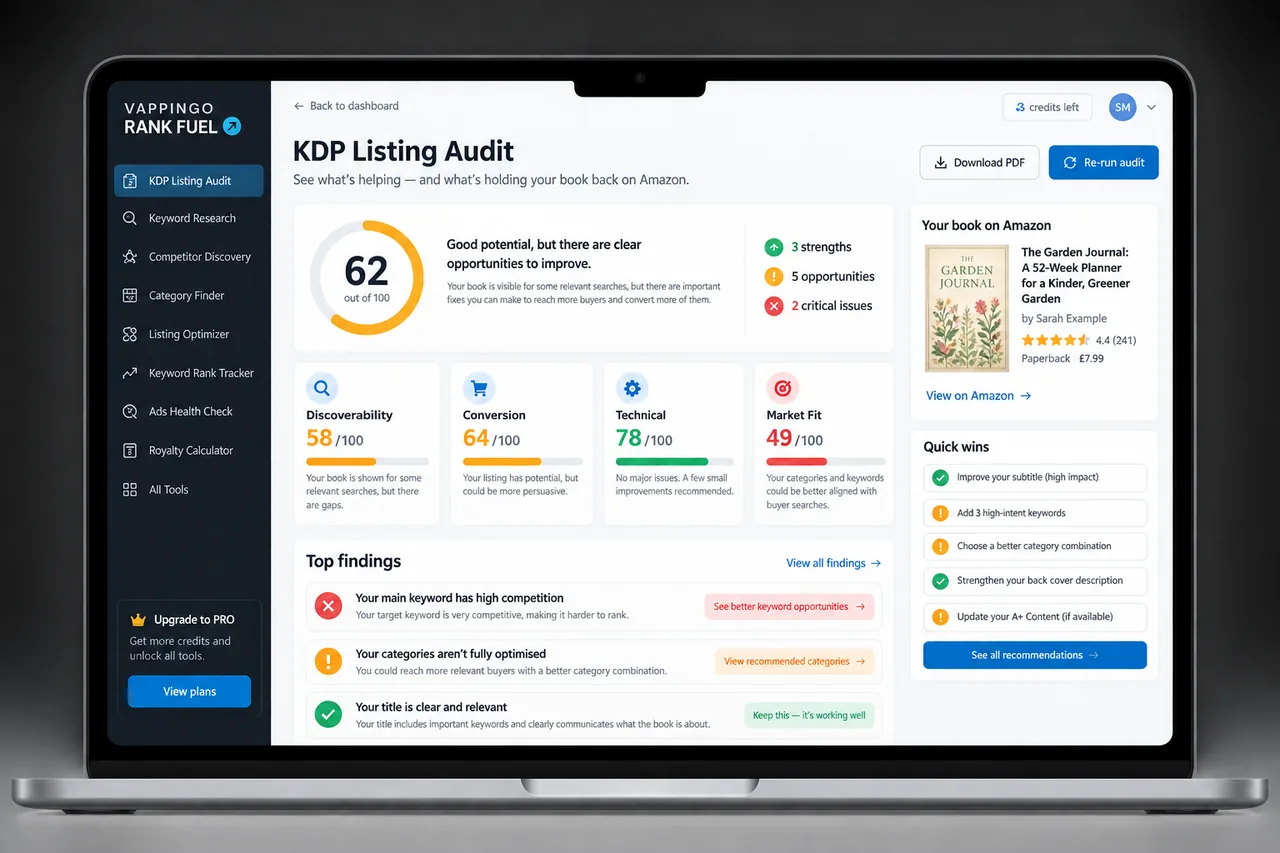
KDP Rank Fuel can support keyword, category, rank, and market research. Its scores and estimates are research aids; Amazon does not publish the proprietary formulas behind search placement or exact sales thresholds.
Metadata can help the right reader find a book, but the listing and manuscript still have to earn trust. Vappingo provides professional manuscript proofreading by qualified human editors.
Practical Review Framework 1
Use one live title as a worked example for kdp category competition. Record the current marketplace, format, three selected categories, the date, and the comparable books that made each category look defensible. For every category, write one sentence explaining the reader fit and one sentence explaining the competition evidence. If you cannot write both sentences without stretching the truth, the category has not earned a slot.
Then separate what you control from what Amazon controls. You control the categories you select, the accuracy of the metadata, and when you make an update. Amazon controls taxonomy changes, merchandising, the category ranks it displays, and the relative movement of competing books. Keeping those layers separate prevents normal rank volatility from being misread as a secret category rule.
Finally, schedule a review only when there is a reason: a taxonomy change, a repositioning, a new edition, a persistent mismatch, or stronger market evidence. Save the before state, change as little as possible, allow the update window to pass, and compare again. This creates a useful category history instead of a trail of unexplained edits.
Practical Review Framework 2
Use one live title as a worked example for kdp category competition. Record the current marketplace, format, three selected categories, the date, and the comparable books that made each category look defensible. For every category, write one sentence explaining the reader fit and one sentence explaining the competition evidence. If you cannot write both sentences without stretching the truth, the category has not earned a slot.
Then separate what you control from what Amazon controls. You control the categories you select, the accuracy of the metadata, and when you make an update. Amazon controls taxonomy changes, merchandising, the category ranks it displays, and the relative movement of competing books. Keeping those layers separate prevents normal rank volatility from being misread as a secret category rule.
Finally, schedule a review only when there is a reason: a taxonomy change, a repositioning, a new edition, a persistent mismatch, or stronger market evidence. Save the before state, change as little as possible, allow the update window to pass, and compare again. This creates a useful category history instead of a trail of unexplained edits.
Practical Review Framework 3
Use one live title as a worked example for kdp category competition. Record the current marketplace, format, three selected categories, the date, and the comparable books that made each category look defensible. For every category, write one sentence explaining the reader fit and one sentence explaining the competition evidence. If you cannot write both sentences without stretching the truth, the category has not earned a slot.
Then separate what you control from what Amazon controls. You control the categories you select, the accuracy of the metadata, and when you make an update. Amazon controls taxonomy changes, merchandising, the category ranks it displays, and the relative movement of competing books. Keeping those layers separate prevents normal rank volatility from being misread as a secret category rule.
Finally, schedule a review only when there is a reason: a taxonomy change, a repositioning, a new edition, a persistent mismatch, or stronger market evidence. Save the before state, change as little as possible, allow the update window to pass, and compare again. This creates a useful category history instead of a trail of unexplained edits.
Frequently Asked Questions
How many KDP categories can I choose?
KDP currently lets authors choose up to three categories. Availability can vary by marketplace and format, and category updates can take up to 72 hours to appear.
Do my three selected categories equal the three category ranks shown on Amazon?
Not necessarily. Your selections are metadata inputs; Amazon controls which Best Seller Category ranks it displays and says customer activity influences those rankings.
Can I contact KDP Support to get ten categories?
That is legacy advice from the older category workflow. The current author-facing process is to select up to three categories directly in KDP.
Can a keyword unlock an extra hidden category?
KDP does not publish a stable keyword-to-category unlock list. Use keyword fields for relevant reader searches and choose categories through the live KDP workflow.
How should I compare category competition?
Compare current relevant books, relative BSR, price, review context, format, and reader fit across more than one observation where possible. Treat sales estimates as ranges, not Amazon guarantees.
Make the Metadata Easier to Defend
The strongest KDP metadata strategy is easy to explain: every category accurately describes the book, every keyword represents a plausible reader search, every change has a reason, and no part of the plan depends on a retired support workflow or an undocumented ranking formula. That standard makes the listing safer, clearer, and easier to improve as Amazon changes.