KDP Ghost Categories: How to Identify Stale or Unhelpful Category Paths
Learn what authors mean by KDP ghost categories, why category visibility can change, and how to verify a live category path before treating it as valuable discovery inventory.
Understanding what ghost categories are, how to recognise them, and how to avoid them before you commit your category slots is straightforward once you know what to look for. This guide covers all of it.
Amazon changes metadata, taxonomy, and merchandising systems. This article reflects the September 2026 workflow, but the live KDP interface and help pages remain the final authority.
What Makes a Category a “Ghost”
“Ghost category” is author shorthand, not an official KDP classification. It usually describes a category path that appears stale, hard to browse, unavailable for the relevant format or marketplace, or disconnected from useful current merchandising. Because Amazon changes category taxonomy over time, the same path can behave differently from one marketplace or period to another.
Avoid fixed claims such as “27% of KDP categories are ghosts.” A percentage measured from one historical category file can become obsolete as soon as Amazon updates the taxonomy. The reliable question is whether the path is useful now for the exact edition and marketplace you are publishing.
What Ghost Categories Cost You
An unhelpful category can cost opportunity because one of your three selected slots is not creating a clear route to the right audience. The cost is not necessarily literal zero visibility; Amazon can merchandise books in ways that are not obvious from one browse page. The problem is that you have weaker evidence that the selected category is doing a useful classification job.
That opportunity cost matters most when you have another accurate category with clearer current reader relevance. Replacing a dubious path with a well-supported alternative gives you a metadata choice you can defend, monitor, and revisit later.
How to Identify Ghost Categories Before Selecting Them
Start in the live KDP category selector for the correct format and primary marketplace. Confirm that the category exists and accurately describes the book. Then inspect Amazon itself: search for current relevant books, follow visible category/rank links where available, and check whether comparable titles appear consistently in that context.
Use third-party category databases as research aids rather than final authority. A tool can help you discover candidate paths quickly, but the current Amazon store remains the source you should verify before committing a slot. Save the category name and date of your check because taxonomy changes make historical notes useful later.
How to Identify Ghost Categories After Selecting Them
After publishing or changing categories, allow the update time to pass before deciding the path failed. KDP says category updates can take up to 72 hours to display. Once the change has propagated, inspect the detail page, relevant category surfaces, and comparable titles rather than relying on a single rank screenshot.
If the category cannot be found in the current selector, appears materially different from the one you chose, or consistently fails the relevance checks you documented, replace it with a stronger accurate option. Record the change so you can compare the before and after state without confusing ordinary rank volatility with the category edit.
Ghost Category Myths
| Myth | Better rule |
|---|---|
| A fixed percentage of KDP categories are ghosts. | Taxonomy changes; verify the live marketplace. |
| A ghost always gives zero visibility. | “Ghost” is informal shorthand for weak or questionable utility. |
| Special keywords reliably unlock hidden nodes. | KDP does not publish a stable keyword-to-category trigger list. |
| An easy category is automatically valuable. | Relevance and real reader demand matter before ease. |
The common thread is verification. Static lists are useful starting points, but they become dangerous when treated as permanent Amazon rules.
A Five-Minute Category Verification Routine
For every candidate category, check the live KDP selector, the correct Amazon marketplace, the book format, and a handful of current comparable titles. Follow any visible category or rank links and note what you can actually reach as a shopper. If the path exists only in an old spreadsheet, has no relevant current titles, or cannot be reconciled with the live taxonomy, downgrade its confidence. The point is not to prove a category is “ghost” with certainty; it is to avoid spending one of three selections on a path you cannot substantiate.
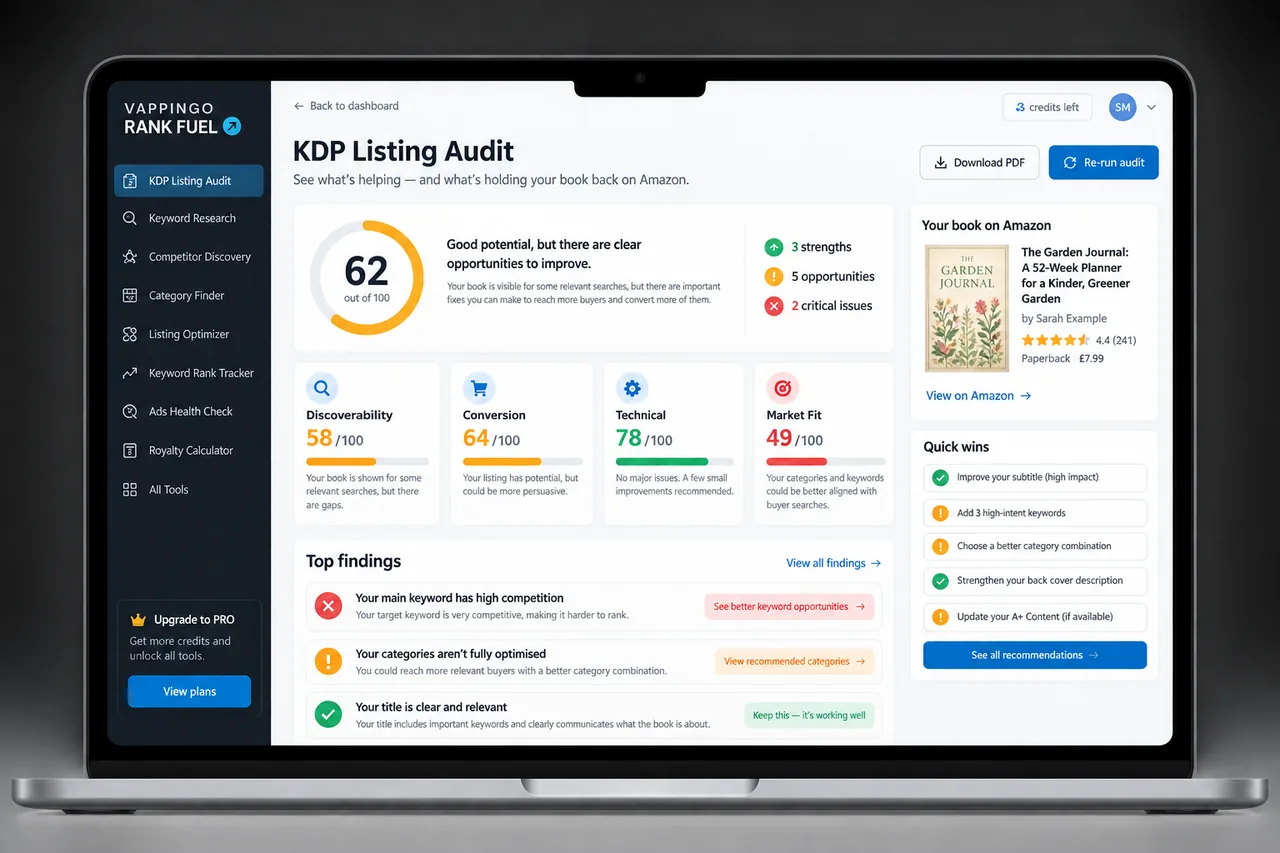
KDP Rank Fuel can support keyword, category, rank, and market research. Its scores and estimates are research aids; Amazon does not publish the proprietary formulas behind search placement or exact sales thresholds.
Metadata can help the right reader find a book, but the listing and manuscript still have to earn trust. Vappingo provides professional manuscript proofreading by qualified human editors.
Practical Review Framework 1
Use one live title as a worked example for kdp ghost categories. Record the current marketplace, format, three selected categories, the date, and the comparable books that made each category look defensible. For every category, write one sentence explaining the reader fit and one sentence explaining the competition evidence. If you cannot write both sentences without stretching the truth, the category has not earned a slot.
Then separate what you control from what Amazon controls. You control the categories you select, the accuracy of the metadata, and when you make an update. Amazon controls taxonomy changes, merchandising, the category ranks it displays, and the relative movement of competing books. Keeping those layers separate prevents normal rank volatility from being misread as a secret category rule.
Finally, schedule a review only when there is a reason: a taxonomy change, a repositioning, a new edition, a persistent mismatch, or stronger market evidence. Save the before state, change as little as possible, allow the update window to pass, and compare again. This creates a useful category history instead of a trail of unexplained edits.
Practical Review Framework 2
Use one live title as a worked example for kdp ghost categories. Record the current marketplace, format, three selected categories, the date, and the comparable books that made each category look defensible. For every category, write one sentence explaining the reader fit and one sentence explaining the competition evidence. If you cannot write both sentences without stretching the truth, the category has not earned a slot.
Then separate what you control from what Amazon controls. You control the categories you select, the accuracy of the metadata, and when you make an update. Amazon controls taxonomy changes, merchandising, the category ranks it displays, and the relative movement of competing books. Keeping those layers separate prevents normal rank volatility from being misread as a secret category rule.
Finally, schedule a review only when there is a reason: a taxonomy change, a repositioning, a new edition, a persistent mismatch, or stronger market evidence. Save the before state, change as little as possible, allow the update window to pass, and compare again. This creates a useful category history instead of a trail of unexplained edits.
Frequently Asked Questions
How many KDP categories can I choose?
KDP currently lets authors choose up to three categories. Availability can vary by marketplace and format, and category updates can take up to 72 hours to appear.
Do my three selected categories equal the three category ranks shown on Amazon?
Not necessarily. Your selections are metadata inputs; Amazon controls which Best Seller Category ranks it displays and says customer activity influences those rankings.
Can I contact KDP Support to get ten categories?
That is legacy advice from the older category workflow. The current author-facing process is to select up to three categories directly in KDP.
Can a keyword unlock an extra hidden category?
KDP does not publish a stable keyword-to-category unlock list. Use keyword fields for relevant reader searches and choose categories through the live KDP workflow.
How should I compare category competition?
Compare current relevant books, relative BSR, price, review context, format, and reader fit across more than one observation where possible. Treat sales estimates as ranges, not Amazon guarantees.
Make the Metadata Easier to Defend
The strongest KDP metadata strategy is easy to explain: every category accurately describes the book, every keyword represents a plausible reader search, every change has a reason, and no part of the plan depends on a retired support workflow or an undocumented ranking formula. That standard makes the listing safer, clearer, and easier to improve as Amazon changes.