How to Study Bestseller Book Descriptions Without Copying Them
The fastest way to understand description conventions is to study several successful books that compete for the same reader.
The fastest way to understand description conventions is to study several successful books that compete for the same reader. The important word is several: one bestseller can be an outlier, and sales do not prove which element of the page caused the result.
Amazon changes metadata, search, and merchandising systems. This guide reflects the September 2026 workflow; the live KDP interface and current Amazon help pages remain the final authority.
Why Studying Bestsellers Works
Bestselling books in any genre on Amazon have passed the most rigorous test available: actual readers browsed the description and decided to spend money. The description contributed to that decision. By studying descriptions that are demonstrably converting readers into buyers, you are studying the output of a real-world conversion test conducted at scale across thousands of purchases. This is more reliable than any theoretical framework because it reflects what actually works with the actual readers in your actual market , not what should work in principle. Genre conventions shift. Reader expectations evolve. What worked five years ago may not be optimal today. Studying current bestsellers gives you current data.
How to Find the Right Descriptions to Study
You need descriptions from books that are genuinely selling in your specific subcategory , not just any popular books. The more precisely you can match the comparison set to your own book’s exact niche, the more applicable the lessons. How to build your study set:
- Go to Amazon and navigate to the most specific subcategory that fits your book , not “Mystery” but “cozy Mystery > British Detectives” or whatever your precise niche is.
- Sort by Best Sellers. Note the top 20 titles.
- Also look at the “Also bought” and “Customers also viewed” sections of books that are similar to yours , these surface books your specific readers are actually buying alongside comparable titles.
- Collect the full descriptions of the top 10-15 books. Copy them into a document where you can annotate them.
- Focus on books that have been in the top 20 consistently for weeks or months , sustained bestsellers rather than one-day spikes from a promotion.
The Analysis Framework
For each description in your study set, work through the following questions:
- What is the opening hook? What type is it , a contradiction, a character in extremis, a stakes-first opening? How many words before the reader knows the genre?
- How is the protagonist introduced? Name, title, or no name at all? How many words? What details are included?
- How is the conflict stated? Is it direct or oblique? Specific or general? What tense?
- What are the stated stakes? Are they explicit or implied? Personal, communal, or both?
- What is the call to action? Is there one? What form does it take?
- What is the length? Count the words.
- What formatting is used? Paragraphs, bold, lists?
- What specific language or phrases appear? Write down any words or phrases that feel genre-specific.
Identifying Patterns Across Descriptions
Once you have analyzed 10-15 descriptions individually, look across them for patterns. The patterns that appear consistently across the bestselling descriptions in your subcategory are the conventions your target readers have been conditioned to expect and respond to. Common patterns you might find: all descriptions are under 200 words (or all are over 250); nearly all use present tense; most introduce the protagonist by first name only; all state the central conflict in sentence three or four; nearly all use a specific closing phrase structure. These are not coincidences , they are the genre’s implicit description contract.
Capturing Language Patterns
As you read through the descriptions, note specific words and phrases that appear repeatedly. These fall into several categories: The specific vocabulary that marks a book as belonging to a particular subgenre. cozy mysteries use words like “village,” “amateur sleuth,” “charming,” “recipe,” “cat.” Psychological thrillers use “unreliable,” “nothing is as it seems,” “who can she trust.” These are not clichés to avoid , they are the language your readers have learned to use when looking for your type of book. Words that establish the emotional tone , “gripping,” “heart-warming,” “devastating,” “propulsive.” Note which emotional register words appear in the bestsellers and which do not. This tells you what emotional experience readers in your genre are promised and apparently rewarded for choosing. Common sentence patterns , “What she doesn’t know is…”, “But when…”, “With time running out…” These are the load-bearing phrases of the genre’s description grammar. Using them signals genre competence; avoiding them entirely can make your description feel tonally foreign to genre-trained readers.
Structural Patterns to Look For
Beyond language, look for structural patterns across the descriptions:
- Where the protagonist appears: In the first sentence, second sentence, or not until the second paragraph?
- Comp title placement: In the opening, closing, or not at all?
- Series information: In the header, first line of description, or closing CTA?
- Paragraph count: Two paragraphs, three, four? Does paragraph length vary or stay consistent?
- Heat level signaling (for romance): Explicit tag or embedded in tone?
- Spoiler avoidance: How much of the plot is revealed? Where does the description cut off?
Applying What You Find
The goal of this research is not to copy the bestselling descriptions , it is to understand the conventions so thoroughly that you can write within them while still making your specific book distinctive. After your research, write your own description with the following in mind: your opening hook should use the same type of hook that the bestsellers in your category favour; your word count should sit within the range established by the bestsellers; your language should feel tonally at home alongside the descriptions you studied; your structural sequence should follow the genre’s typical pattern. Within those conventions, your description should be entirely specific to your book , no borrowed phrases, no generic placeholder language, no content that could describe any other book in the category.
What Not to Copy
Studying bestseller descriptions is not a license to copy them. Direct copying is ethically wrong and strategically weak because a description that sounds like another book is not doing the job of positioning your specific title. Take structural and tonal patterns from the research, not another author’s distinctive language. Avoid copying hooks or opening sentences, borrowing character or plot details, or imitating phrasing closely associated with a living author. The goal is to understand the conventions readers recognize while making the final description unmistakably about your book. Once you have mapped those conventions, KDP Rank Fuel can help turn your own book details into a structured draft that you can refine against what the research taught you. The manuscript still has to deliver on that promise, so Vappingo’s manuscript proofreading service is the appropriate final quality-control step when the book itself needs professional preparation.
Turn observations into a description brief
After studying several close comparables, reduce your notes to a brief rather than a swipe file. Record the typical hook length, the amount of setup before conflict or promise, the type of proof used in nonfiction, the emotional temperature, the level of specificity, and the closing move. Then write your own description from your own book facts. This method keeps the useful market learning while reducing the temptation to imitate language too closely. It also makes your research reusable: the brief can guide an editor, an AI drafting tool, or a future series description without carrying over another author’s wording.
Frequently Asked Questions
Does Amazon use my book description as a backend keyword field?
KDP does not document the description as an additional backend keyword field. Its current help separates the reader-facing description from the dedicated keyword entries, and its description rules prohibit keyword or book-tag phrase lists.
How long can a KDP book description be?
KDP currently allows up to 4,000 characters, including any HTML tags used for formatting.
Can I use AI to draft my description?
AI can be useful for options and first drafts, but verify every book fact, remove generic or invented claims, and make sure the final copy complies with KDP description rules.
Should I copy the structure of bestselling descriptions?
Study patterns across several close comparables, but do not copy wording. A bestseller has many reasons for selling, so its description is an example to analyze, not proof of a universal formula.
What matters most in a description?
Clarity, reader fit, a compelling premise or promise, accurate expectations, and professional writing. Use search research to understand reader language, then write the copy for humans.
Put the Evidence Into Practice
The strongest publishing workflow is easy to defend later: each metadata choice has a clear reason, each estimate is labeled as an estimate, and each change is recorded so you can learn from the result. That discipline survives platform changes better than any secret-algorithm shortcut.
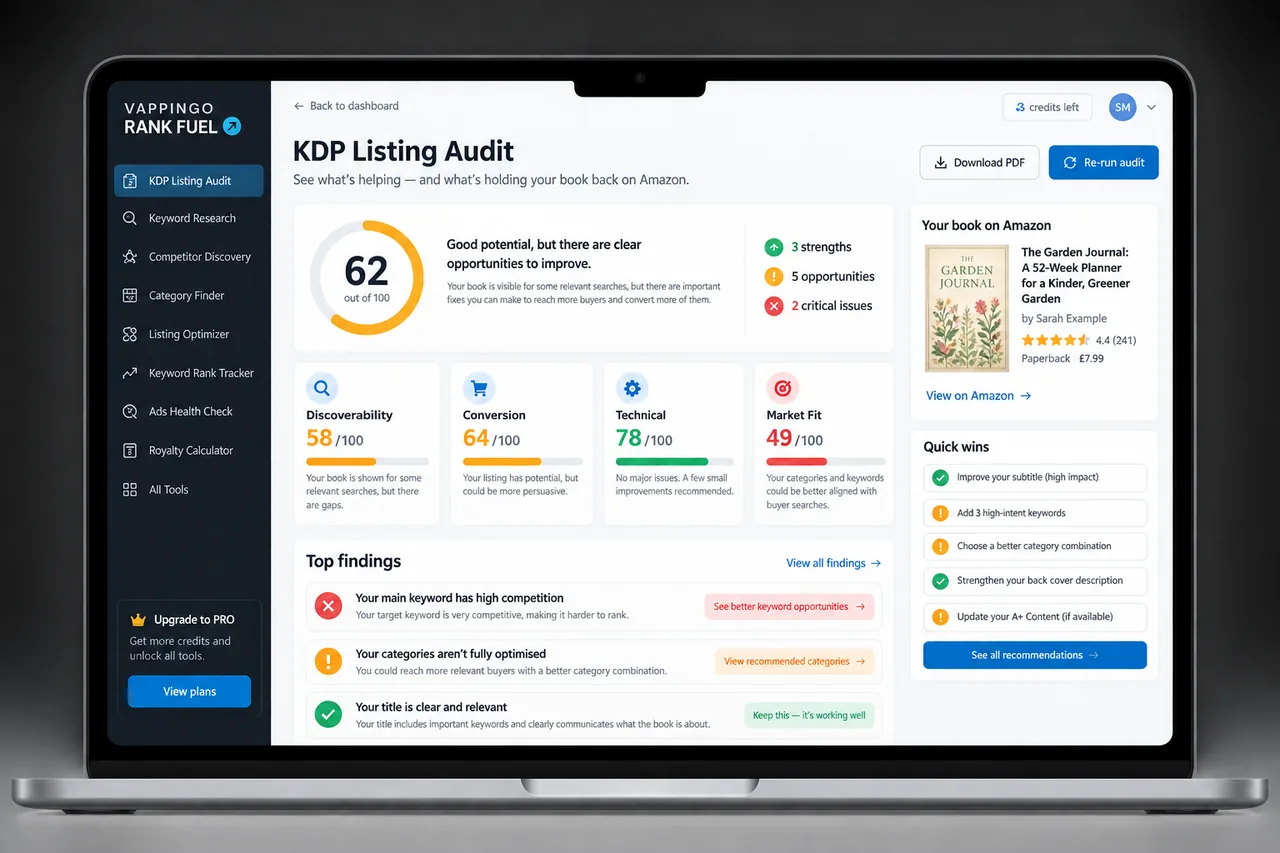
KDP Rank Fuel connects book-centered keyword, competitor, category, listing, advertising, and performance workflows. Treat search figures and scores as research aids, and verify important decisions against the live Amazon market.
Vappingo provides professional manuscript proofreading by qualified human editors for self-publishing authors.