Amazon Book Description Templates by Genre
A template can solve the structure problem without solving the writing problem.
A template can solve the structure problem without solving the writing problem. Use these genre frameworks to organize the sales argument, then replace every generic line with details only your book can provide.
Amazon changes metadata, search, and merchandising systems. This guide reflects the September 2026 workflow; the live KDP interface and current Amazon help pages remain the final authority.
How to Use These Templates
Each template below uses bracketed placeholders such as [HOOK], [SETUP], [STAKES], and [CLOSE]. Replace every placeholder with details that belong specifically to your book. The template supplies a sequence, not finished copy, so the strongest results come from rewriting until the description sounds natural rather than assembled.
- Replace every placeholder with something specific to your book , never leave a placeholder vague or generic
- Read the completed template aloud , if any sentence feels awkward or forced, rewrite it naturally
- Adjust length as needed , the templates are structured for approximately 150-250 words, but your book may need slightly more or less
- Add HTML formatting before pasting into KDP , wrap paragraphs in
<p>tags, bold your hook - The template is a skeleton , your specific language, voice, and detail is the flesh
Thriller Template
[HOOK: protagonist + immediate danger or impossible problem]
[SETUP: one or two sentences establishing what has changed]
[ESCALATION: reveal the force working against them without explaining the resolution]
[STAKES: state what is lost if they fail]
[CLOSE: a genre-appropriate invitation to start reading, without competitor-name or promotional metadata]
Keep the verbs active, the stakes concrete, and the unresolved question visible. A thriller description should create pressure without summarizing the entire plot.
cozy Mystery Template
cozy MYSTERY TEMPLATE In [CHARMING SETTING , be specific: the village, the bakery, the craft shop], [PROTAGONIST NAME] [BRIEF PERSONALITY DETAIL , her habit of, his tendency to]. Life is [NORMAL STATE] , until [BODY/CRIME/DISRUPTION]. Now [PROTAGONIST] finds [herself/himself/themselves] [DRAWN INTO / INVESTIGATING] a mystery that [COMPLICATING FACTOR , implicates someone she trusts / turns the village upside down / involves a secret from the past]. With [SECONDARY STAKE , the wrong person about to be convicted / the village’s reputation at risk / her own past catching up with her], [PROTAGONIST] must [SOLVE THE PUZZLE] before [CONSEQUENCE]. [BOOK NUMBER IN SERIES if applicable.] [CTA , “Perfect for fans of [COMP AUTHOR]. Scroll up to start.”] The setting should feel like a place readers want to visit. The protagonist’s personality detail should make her feel like good company. The tone should be warm even in the stakes sentence , this is not a thriller.
Romance Template
[HOOK: the relationship problem or collision]
[LEAD 1: desire, wound, or reason to resist]
[LEAD 2: what they want and what makes the match difficult]
[OBSTACLE: the emotional or external force keeping them apart]
[STAKES AND TONE: signal heat, subgenre, and emotional promise accurately]
[CLOSE: invite the reader into the relationship arc without naming unrelated authors as metadata]
Both leads should feel specific. The obstacle needs enough weight to sustain the romance, and the description should set accurate expectations about tone and heat level.
Fantasy / Science Fiction Template
FANTASY / SCI-FI TEMPLATE [WORLD-ESTABLISHING HOOK , one sentence that signals the world and the protagonist’s place in it without over-explaining.] [PROTAGONIST NAME] has [LIVED WITH / BELIEVED / FOUGHT FOR] [ESTABLISHED STATUS QUO]. Until [INCITING INCIDENT , the discovery, the betrayal, the call to action] changes everything. Now, [PROTAGONIST] must [QUEST/MISSION/IMPOSSIBLE TASK] , [COMPLICATION: with an enemy they don’t trust / against a power they don’t understand / before a deadline that cannot be missed]. [STAKES , what is lost if they fail? Personal stakes are more powerful than world-level stakes alone.] [SERIES POSITION if applicable.] [CTA , “For fans of [COMP AUTHOR]. Scroll up to begin.”] The world-establishing sentence should be evocative, not encyclopaedic. One sentence of world context is usually enough , the story carries the rest. Personal stakes should accompany any large-scale stakes.
nonfiction Template
nonfiction TEMPLATE [EMOTIONAL PROBLEM STATEMENT , the reader’s specific pain, in their own language. Not the surface problem, but the feeling of living with it.] Most [CATEGORY OF ADVICE/APPROACH] tells you to [COMMON ADVICE]. But [WHY THAT APPROACH FAILS for your reader]. [AUTHOR CREDENTIAL , one sentence, most relevant to this specific topic.] In this book, you’ll discover: [SPECIFIC BENEFIT 1 , framed as outcome, not chapter content] [SPECIFIC BENEFIT 2] [SPECIFIC BENEFIT 3] [SPECIFIC BENEFIT 4] [READER QUALIFICATION , who specifically this is for.] [OUTCOME PROMISE , what their situation looks like after reading.] [CTA] Every bullet must be a benefit (what the reader gains) not a feature (what the chapter covers). The problem statement must use the reader’s own language, not the author’s framing.
Self-Help Template
SELF-HELP TEMPLATE [PATTERN INTERRUPT OPENING , a statement that challenges a belief your reader holds, or names their pain in a way that creates instant recognition.] If you’ve [TRIED THE OBVIOUS APPROACH] and still [SPECIFIC ONGOING PROBLEM], it’s not because you lack [WILLPOWER/DISCIPLINE/MOTIVATION]. It’s because [ROOT CAUSE THIS BOOK ADDRESSES]. [AUTHOR: one sentence of relevant credibility , professional background, personal transformation, or research basis.] [BOOK TITLE] gives you [SPECIFIC FRAMEWORK/SYSTEM/APPROACH] to [SPECIFIC OUTCOME], without [COMMON OBJECTION , e.g. overhauling your entire routine / spending hours on complicated systems]. [READER QUALIFICATION STATEMENT] [OUTCOME VISION , one sentence of what life looks like after.] [CTA]
Memoir Template
MEMOIR TEMPLATE [UNIVERSAL TRUTH HOOK , a statement about human experience that resonates beyond the author’s specific story.] For [TIME PERIOD], [AUTHOR NAME / “she” / “he”] [SPECIFIC SITUATION , what they were doing, who they were being, what they were carrying]. Then [DISRUPTION / TURNING POINT / CHOICE]. [BOOK TITLE] is the account of [WHAT THE MEMOIR IS REALLY ABOUT , the internal journey, not just the external events]. It is [EMOTIONAL DESCRIPTION , honest / unflinching / surprising / darkly funny] about [UNIVERSAL THEME]. [READER QUALIFICATION , “For anyone who has ever…” creates powerful identification.] [CTA , warm, brief, direct.]
What to Do After Filling in the Template
Once you have filled in every placeholder, work through these editing steps before the description is ready to publish:
- Read it aloud , any sentence that sounds stilted or unnatural needs rewriting
- Replace every remaining vague word (“something,” “everything,” “difficult”) with a specific detail
- Check the first sentence works as a standalone hook , could it appear as a pull quote and still create interest?
- Verify the tone matches your genre and the voice of your book
- Confirm the CTA is present and direct
- Add HTML formatting: wrap paragraphs in <p> tags, bold your opening hook, add <ul><li> tags for any bullet lists
- Check the word count , aim for 150-300 words for fiction, 200-350 for nonfiction
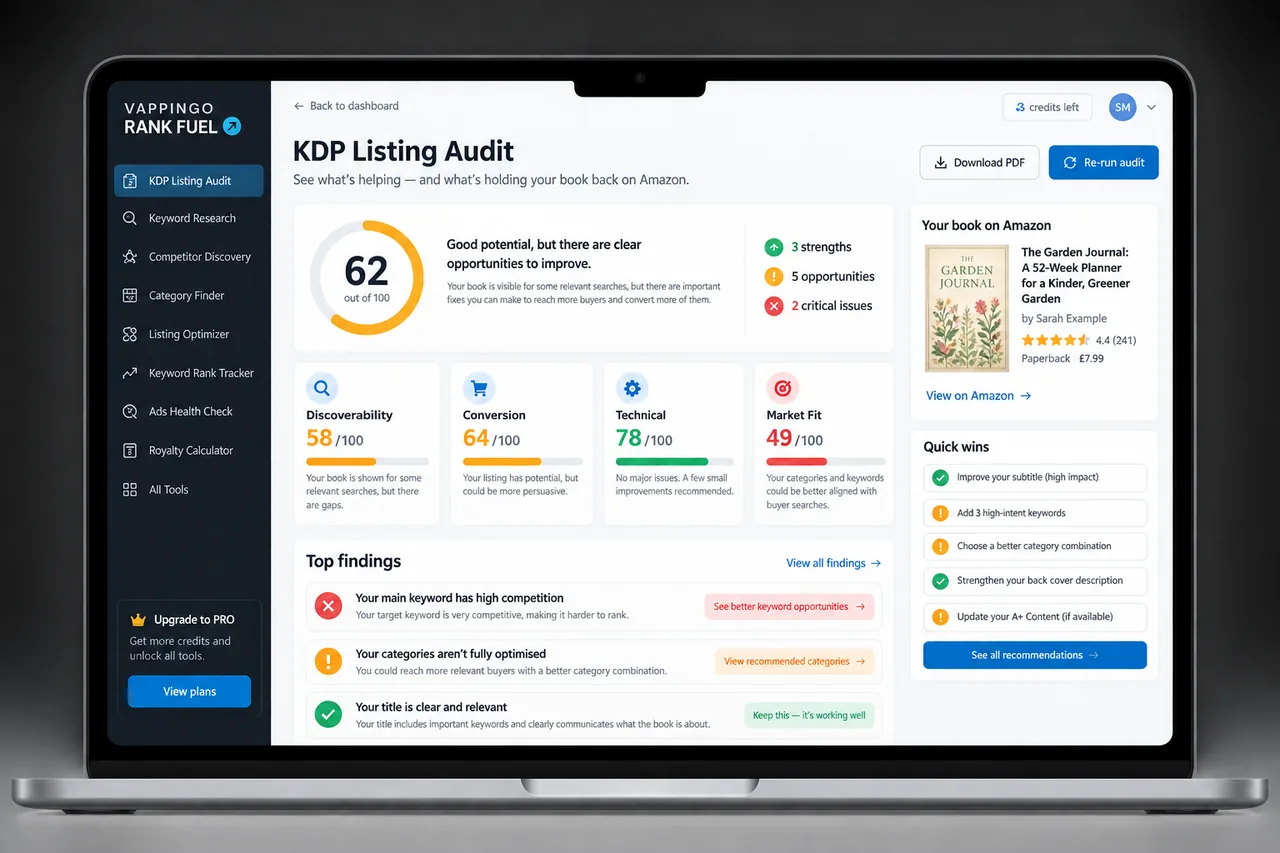
If the template feels constraining after you have produced a workable draft, that is usually a sign that you understand the structure well enough to move beyond it. Use the framework to get the first version onto the page, then edit freely until the description sounds like your own natural voice describing this particular book. If you want a faster starting point, KDP Rank Fuel can generate a book-specific listing draft from the details you provide, which you can then refine using the genre frameworks in this guide. Once the description is attracting the right readers, make sure the manuscript delivers what it promises. Vappingo’s manuscript proofreading service helps polish the book itself to the same standard as the sales copy.
How to stop a template sounding templated
After filling a template, underline every sentence that could describe another book in the same genre. Those are the sentences to rewrite first. Add a named conflict, unusual setting, concrete consequence, distinctive method, or sharply defined reader problem. Generic structure is acceptable; generic content is what makes a description disappear into the category. Then read the result without the headings. It should sound like a coherent sales argument, not five boxes completed in order. Move or delete any sentence that exists only because the template asked for it.
Frequently Asked Questions
Does Amazon use my book description as a backend keyword field?
KDP does not document the description as an additional backend keyword field. Its current help separates the reader-facing description from the dedicated keyword entries, and its description rules prohibit keyword or book-tag phrase lists.
How long can a KDP book description be?
KDP currently allows up to 4,000 characters, including any HTML tags used for formatting.
Can I use AI to draft my description?
AI can be useful for options and first drafts, but verify every book fact, remove generic or invented claims, and make sure the final copy complies with KDP description rules.
Should I copy the structure of bestselling descriptions?
Study patterns across several close comparables, but do not copy wording. A bestseller has many reasons for selling, so its description is an example to analyze, not proof of a universal formula.
What matters most in a description?
Clarity, reader fit, a compelling premise or promise, accurate expectations, and professional writing. Use search research to understand reader language, then write the copy for humans.
Put the Evidence Into Practice
The strongest publishing workflow is easy to defend later: each metadata choice has a clear reason, each estimate is labeled as an estimate, and each change is recorded so you can learn from the result. That discipline survives platform changes better than any secret-algorithm shortcut.
KDP Rank Fuel connects book-centered keyword, competitor, category, listing, advertising, and performance workflows. Treat search figures and scores as research aids, and verify important decisions against the live Amazon market.
Vappingo provides professional manuscript proofreading by qualified human editors for self-publishing authors.