Amazon Book Description Conversion: Turn Browsers Into Readers
Improve Amazon book-description conversion with a clear hook, genre-aware structure, supported HTML, reader-focused proof, and a testing process tied to the whole sales page.
The Amazon description sits inside a larger conversion system: cover, title, price, reviews, sample, format options, and A+ Content all shape the decision. The description’s role is to turn initial curiosity into a clearer reason to buy or read the sample.
Amazon’s own guidance emphasizes simple, compelling, professional copy. This article focuses on how to achieve that while staying inside KDP’s current description rules.
The Conversion Mindset: What a Description Is Actually For
Most authors write their book description to summarise their book. That’s the wrong job. A reader who has clicked your listing and is reading your description doesn’t need a summary – they need to feel something. They need to feel the pull of the story, the promise of the transformation, the sense that not reading this book would be a loss. A description that informs doesn’t convert. A description that evokes does. Amazon readers in 2026 make purchase decisions faster than ever. Internal Amazon data suggests shoppers on mobile devices decide within roughly four seconds of the page loading whether to continue reading or scroll back to search results. The critical decision window is the first 150–200 characters of your description – the text that appears above the “Read more” fold on mobile and the “See more” fold on desktop. Everything above that fold needs to create enough pull to make the reader want to see more. Everything below needs to sustain that pull and close the sale. The practical consequence is that your description can’t save the best material for the end. Your hook – your single most compelling sentence about the book – goes in sentence one or sentence two, not after three paragraphs of setup.
The Hook: Sentence One Is Everything
Your opening sentence is the most valuable real estate in your entire listing. It needs to do one thing: create an emotional response strong enough to make the reader want to continue. For fiction, this typically means establishing the stakes, the protagonist’s situation, or the core conflict in a way that creates immediate curiosity or identification. For nonfiction, it typically means naming the reader’s problem precisely – the problem this book exists to solve – in a way that makes them feel seen. Compare these two openings for the same cozy mystery: “When Clara Whitmore agrees to cater a dinner party at the grandest house in the village, she doesn’t expect to find a body in the pantry – or to become the prime suspect before the first course is served.” Versus: “This is the first book in the Whitmore Village Mystery series. Clara Whitmore is an amateur sleuth who runs a catering business in a small English village.” The first creates immediate narrative tension, an immediate sense of the protagonist’s predicament, and a question (how will she clear her name?) that demands an answer. The second describes the series premise with no tension and no pull. Strong fiction hooks typically do one or more of: establish an unexpected situation with immediate stakes, introduce a protagonist at a moment of crisis or decision, create a question the reader desperately wants answered, or signal a specific emotional experience (fear, longing, excitement) that the reader craves. Weak hooks describe characters or settings neutrally, summarise the plot from outside rather than inside the emotional experience, or lead with credentials and context before establishing any narrative tension.
Structure for Fiction: The Three-Part Framework
After the opening hook, a fiction description that converts typically follows a three-part structure. The first part (one to two sentences) establishes the protagonist and their world at the moment the story begins – who they are, what they want, what’s at stake. The second part (two to three sentences) introduces the central conflict and raises the stakes – what happens to disturb or challenge the protagonist’s world, and why it matters. The third part (one to two sentences) creates the decision point or central tension the story turns on – often ending with a question or a cliff-hanger statement that makes the reader need to know what happens next. The total word count of a strong fiction description is typically 150–250 words – long enough to develop emotional pull, short enough that readers on mobile can absorb it in 30–60 seconds. Descriptions longer than 300 words tend to lose reader attention before reaching their most compelling elements. If you find your description running long, the first thing to cut is anything that could be summarised as “here is what happens in chapter two” – plot summary that doesn’t serve emotional engagement. Genre signals matter within the description as much as in your title and keywords. A cozy mystery description should use words like “amateur sleuth”, “village”, “unlikely detective”, “charming” – the vocabulary that cozy mystery readers recognise as markers of their genre. A paranormal romance description should use words that signal the genre’s tropes: “fated mates”, “forbidden love”, “the last thing she expected”. These signals reassure genre readers that this is exactly the kind of book they’re looking for, removing uncertainty and reducing purchase hesitation.
Structure for Nonfiction: Problem–Promise–Proof
Nonfiction descriptions convert best when they follow a problem–promise–proof structure. Open by naming the reader’s specific problem or situation in terms that make them feel precisely understood – “If you’ve tried every budgeting app on the market and still can’t make your money last to the end of the month” is more effective than “This book is about personal finance.” Move immediately to the promise: what specific outcome does this book deliver? Not “learn about personal finance” but “a simple six-step system that frees up £300 per month without giving up anything that matters.” Then provide concise proof of credibility – your relevant experience, credentials, or the results your approach has produced – and close with a specific, concrete description of what readers will be able to do after reading the book. Nonfiction readers skim aggressively. They check the table of contents, read the description, and skim the first chapter before deciding. Your description needs to make the book’s specific value proposition unmistakably clear in the first two sentences so that even a skim read captures it. Vague promises (“change your life”, “transform your mindset”) convert worse than specific ones (“reduce your morning routine from 45 minutes to 15 without skipping anything important”) because specific promises are believable and falsifiable – they tell the reader exactly what they’re committing to.
Formatting Your Description: HTML and Visual Hierarchy
KDP’s description editor supports basic HTML and a visual text editor. Current supported elements include paragraph and line breaks, bold, italics, underline, lists, and headings from h4 to h6; h1, h2, and h3 are not supported in the description field.
Use formatting to improve scanning rather than decorate every sentence. One short bold hook, clean paragraph breaks, and a restrained bullet list for nonfiction are usually more useful than multiple heading levels and heavy emphasis.
KDP also restricts description content. Do not include website URLs, contact details, reviews or testimonials, requests for customer reviews, time-sensitive promotional information, price or availability claims, or keyword/tag stuffing. If you need richer visual merchandising, use the A+ Content guide instead of forcing the description to do everything.
Testing and Iterating Your Description
Test descriptions as part of the whole sales page. If the cover is wrong for the genre or external traffic is poorly targeted, rewriting one paragraph may produce no measurable change even when the copy itself improves.
Record the date of a description change and avoid stacking it with several other major changes if you want to learn from the result. Watch relevant evidence such as paid units, ad conversion, sample engagement where available, and overall listing performance rather than expecting Amazon to provide a direct description conversion-rate report.
The "Look Inside" Feature and First Pages
Amazon’s “Look Inside” feature allows browsers to read the first 10–15% of your book before purchasing. For most books this means the first chapter or two. Readers who engage with Look Inside have already moved past the cover and description stages of the decision funnel – they’re seriously considering the purchase but want confirmation that the writing quality and opening hook live up to what the description promised. The first page of your book is therefore almost as important as your description for conversion. A Look Inside that opens with a strong, engaging first line, a clear sense of voice, and immediate pull into the story or the subject reinforces the description’s promise and tips undecided browsers toward purchasing. A first page that is slow, confusing, or poorly written – with typos or formatting errors visible in the very first paragraphs – cancels out the work your description has done and sends browsers back to the search results. Format your first chapter to look its best in the Kindle preview. Ensure the first line appears prominently at the top of the preview page rather than being buried after extensive front matter. Check that your chapter formatting, font rendering, and paragraph spacing look clean and professional in the digital preview. Some authors deliberately craft their opening line to function as both a first line of the novel and a compressed hook for the Look Inside experience – a sentence that makes a browser think “I need to find out what happens next” within three seconds of seeing it.
Frequently Asked Questions
Does KDP allow HTML in book descriptions?
Yes. KDP supports basic HTML including paragraphs, line breaks, bold, italics, underline, lists, and h4–h6 headings.
Can I put testimonials in my KDP description?
No. KDP’s current description restrictions prohibit reviews, quotes, and testimonials.
Can I ask readers for reviews in the description?
No. Requests for customer reviews are prohibited in the description field.
Should fiction and nonfiction descriptions use the same structure?
No. Fiction usually sells the emotional premise and conflict, while nonfiction usually needs a clearer problem, promise, outcome, and credibility path.
Should I rewrite a description if sales are low?
Only after checking the rest of the funnel. Low sales can come from weak discovery, cover, price, reviews, sample, or traffic quality as well as description copy.
What to Do Next
Read the description beside the cover, price, reviews, and sample, then ask one question: does the right reader understand the promise quickly enough to keep going? Fix the largest source of uncertainty before adding more formatting or keywords.
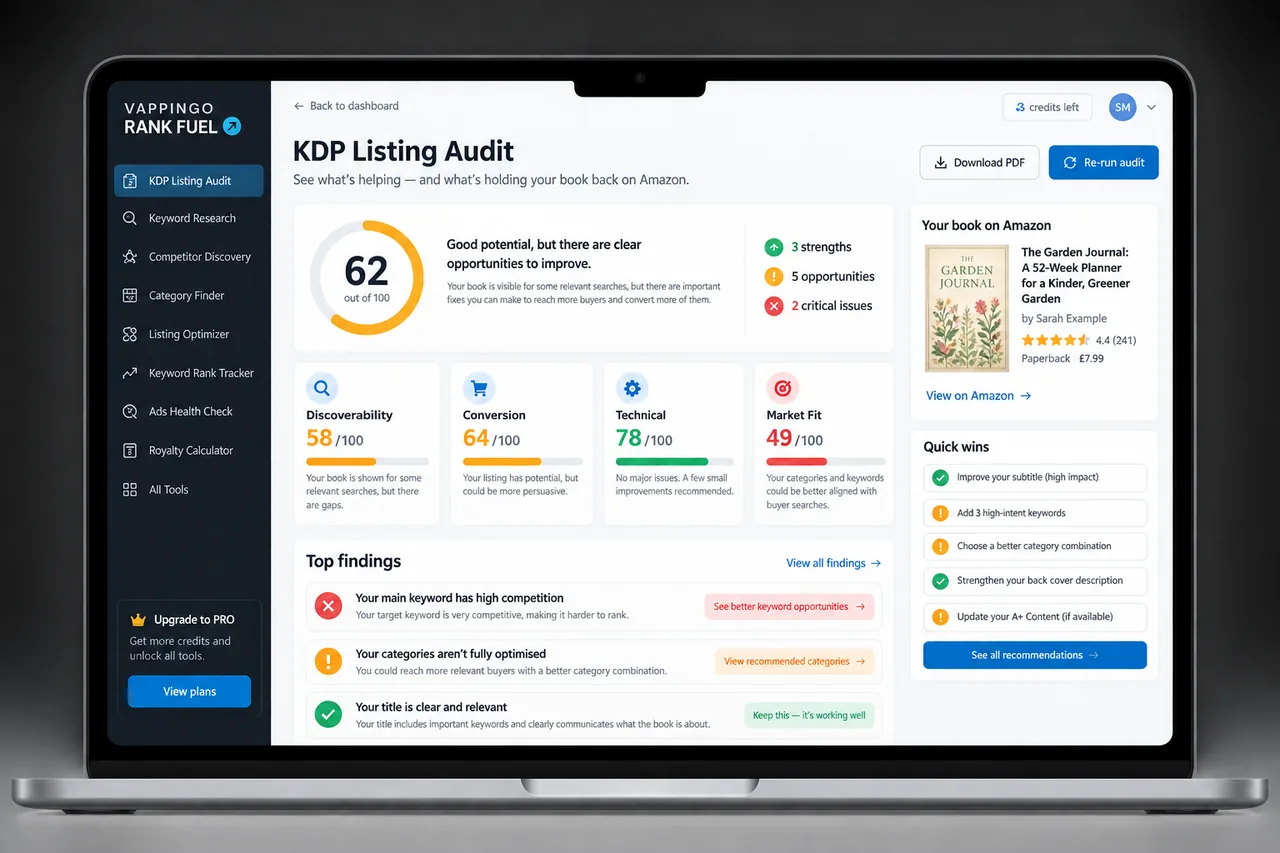
Rank Fuel’s Listing Generator creates a complete listing for a new book, while Listing Audit and Listing Optimizer help diagnose and strengthen a live one.