How to Write a Book Description When You Hate Marketing
Many authors dislike description writing because it feels like turning a book into hype.
Many authors dislike description writing because it feels like turning a book into hype. A better approach is to treat the description as a matching tool: help the right reader recognize the experience, problem, or outcome the book genuinely offers.
Amazon changes metadata, search, and merchandising systems. This guide reflects the September 2026 workflow; the live KDP interface and current Amazon help pages remain the final authority.
Why Writers Resist Description Writing
The resistance most authors feel toward writing their own description typically comes from one or more of three places: You have lived inside your book for months. You know every character, every subplot, every decision that led to the ending. Reducing that to 200 words feels like a betrayal of the work. What to include? What to leave out? How do you summarise something that felt unsummarisable when you were writing it? Many writers came to writing precisely because they value authenticity, precision, and honesty , and they associate marketing with the opposite. Phrases like “gripping,” “page-turning,” and “you won’t be able to put it down” feel like hyperbole at best and dishonesty at worst. Writing that way about their own book feels like wearing someone else’s clothes. For many authors, particularly those from cultures or backgrounds where self-promotion is discouraged, saying “my book is good and you should read it” , which is essentially what a description does , creates genuine psychological resistance. All three of these are real and valid responses. None of them mean you cannot write an effective description. They mean you need a different way of thinking about what the description actually is.
The Reframe That Makes It Easier
The most useful reframe for marketing-averse authors: a book description is not a boast. It is a service. Amazon is a vast catalog of books. A reader browsing your category is looking for something specific , a particular kind of story, a specific emotional experience, the solution to a concrete problem. Your description’s job is to tell that specific reader, as clearly and honestly as possible, whether your book is the thing they are looking for. If your book is not what they are looking for, a well-written description will tell them that too , and they will move on without purchasing. This is not a failure. It is the description working correctly. The reader who buys your book because your description accurately represented it will have a better experience, leave a better review, and recommend it more enthusiastically than the reader who bought it based on misleading hype. Honest, accurate, specific description writing is not manipulative. It is the opposite of manipulative , it is giving readers the information they need to make a good decision. This is a service you are performing for them.
You Are Not Selling , You Are Matching
Reframe the goal from “selling my book” to “finding the readers my book was written for.” These sound similar but produce completely different internal states when writing. “Selling my book” requires you to persuade people to want something. It positions you as an adversary trying to extract money from a resistant target. No wonder it feels uncomfortable. “Finding my readers” requires you to describe your book accurately enough that the people who will love it recognize it. It positions you as a guide helping a specific group of people find something they are already looking for. The readers of your genre are actively searching for new books to read. They want to find your book , they just don’t know it exists yet. Your description introduces them. From this perspective, an unclear or vague description is not modest or humble , it is a failure to serve the readers who would have loved your book, by making it impossible for them to find it.
The Honest Description Approach
For authors who struggle with marketing language, the honest description approach produces better results than attempting to write in a style that feels inauthentic. The honest approach:
- Describe the book accurately. What actually happens? What kind of experience does a reader have? What questions does the book raise? What emotions does it produce? Write these things down plainly.
- Avoid adjectives you would not use in the book itself. If you would not write “gripping,” “heart-pounding,” or “unputdownable” in your actual prose, do not write them in your description. Use your own vocabulary.
- Describe who the book is for. Not in marketing language , just accurately. “If you have ever felt…” or “Written for readers who…” is a simple, honest statement of intended audience.
- End with a plain, direct invitation. “Scroll up to start reading” is honest. You are inviting someone to read your book. That is not manipulative. That is what you want , readers reading your book.
The Five Questions Method
If the blank page approach is not working, answer these five questions about your book in plain prose. Do not try to write a description , just answer the questions honestly. Then edit the answers into a description.
- Who is the main character, and what is their situation at the start of the book? (One or two sentences.)
- What happens that changes everything for them? (One sentence , the inciting incident.)
- What is the hardest part of the situation they face? (One sentence , this is your conflict and stakes.)
- What kind of person would love this book? (One sentence , your reader qualification.)
- Why did you write it? (One sentence , this often contains the book’s core appeal, stated honestly.)
Your answers to these five questions, lightly edited for flow and formatted into paragraphs, will produce a functional, honest description. It may not be as finely crafted as a description built through the full process in our guide , but it will accurately represent your book to the right readers, which is the minimum requirement.
Borrowing From Your Readers
If you have any readers , beta readers, early reviewers, people who have read the book , ask them one question: “How would you describe this book to a friend who you thought would love it?” The language readers use to recommend books to other readers is often the most natural, accurate, and conversion-effective description language available. It is free of marketing jargon, authentically enthusiastic about what the book actually does well, and calibrated to the reader’s experience rather than the author’s intentions. Collect three or four of these informal descriptions. Look for the phrases that appear repeatedly , these are the things your book reliably delivers to readers. Build your description around those phrases, in the structure from our templates, and you will have something honest and effective.
The Minimum Viable Description
If you genuinely cannot write a description that feels authentic to you, write the minimum viable description: one clear, honest paragraph that tells the reader who the book is for, what it is about, and why they might want to read it. No marketing language, no hyperbole, no phrases you would be embarrassed to have attributed to you. This will not be your best possible description. But it will be honest, it will be findable, and it will serve the readers your book was written for better than no description or a description written in a voice that is not yours. You can always improve it later, once you have reader feedback and a clearer sense of how your actual readers describe the book to others.
When to Use Tools
For authors who find description writing genuinely difficult regardless of their approach, a purpose-built tool removes much of the friction. by Vappingo generates a structured, genre-appropriate description from your book details , giving you something well-built to react to rather than requiring you to produce it from scratch. Editing a draft is almost always easier than writing from nothing, and the draft it produces applies the correct structural framework automatically. The tool does not eliminate the need for your specific details , you still need to replace any generic placeholders with accurate, book-specific content. But it removes the blank page problem and the structural uncertainty that make description writing so difficult for many authors. Whatever approach you use, the description’s job is to find the readers your book was written for. Your manuscript’s job is to reward those readers for choosing it. ensures the content your description promises is error-free and reader-ready , so the readers you worked hard to find stay, recommend, and return.
Use a low-hype editing pass
If sales language makes you uncomfortable, write the first draft as answers to factual questions: Who is this for? What changes? What problem or conflict drives the book? What experience or outcome should the reader expect? What should the reader know before deciding? Then convert those answers into smooth prose without adding claims you would not say in conversation. A second pass can add energy through verbs, specificity, and stakes rather than superlatives. “A practical six-week plan for first-time managers” is more persuasive than “the ultimate life-changing leadership system” because the first line tells the reader what the book actually is.
Frequently Asked Questions
Does Amazon use my book description as a backend keyword field?
KDP does not document the description as an additional backend keyword field. Its current help separates the reader-facing description from the dedicated keyword entries, and its description rules prohibit keyword or book-tag phrase lists.
How long can a KDP book description be?
KDP currently allows up to 4,000 characters, including any HTML tags used for formatting.
Can I use AI to draft my description?
AI can be useful for options and first drafts, but verify every book fact, remove generic or invented claims, and make sure the final copy complies with KDP description rules.
Should I copy the structure of bestselling descriptions?
Study patterns across several close comparables, but do not copy wording. A bestseller has many reasons for selling, so its description is an example to analyze, not proof of a universal formula.
What matters most in a description?
Clarity, reader fit, a compelling premise or promise, accurate expectations, and professional writing. Use search research to understand reader language, then write the copy for humans.
Put the Evidence Into Practice
The strongest publishing workflow is easy to defend later: each metadata choice has a clear reason, each estimate is labeled as an estimate, and each change is recorded so you can learn from the result. That discipline survives platform changes better than any secret-algorithm shortcut.
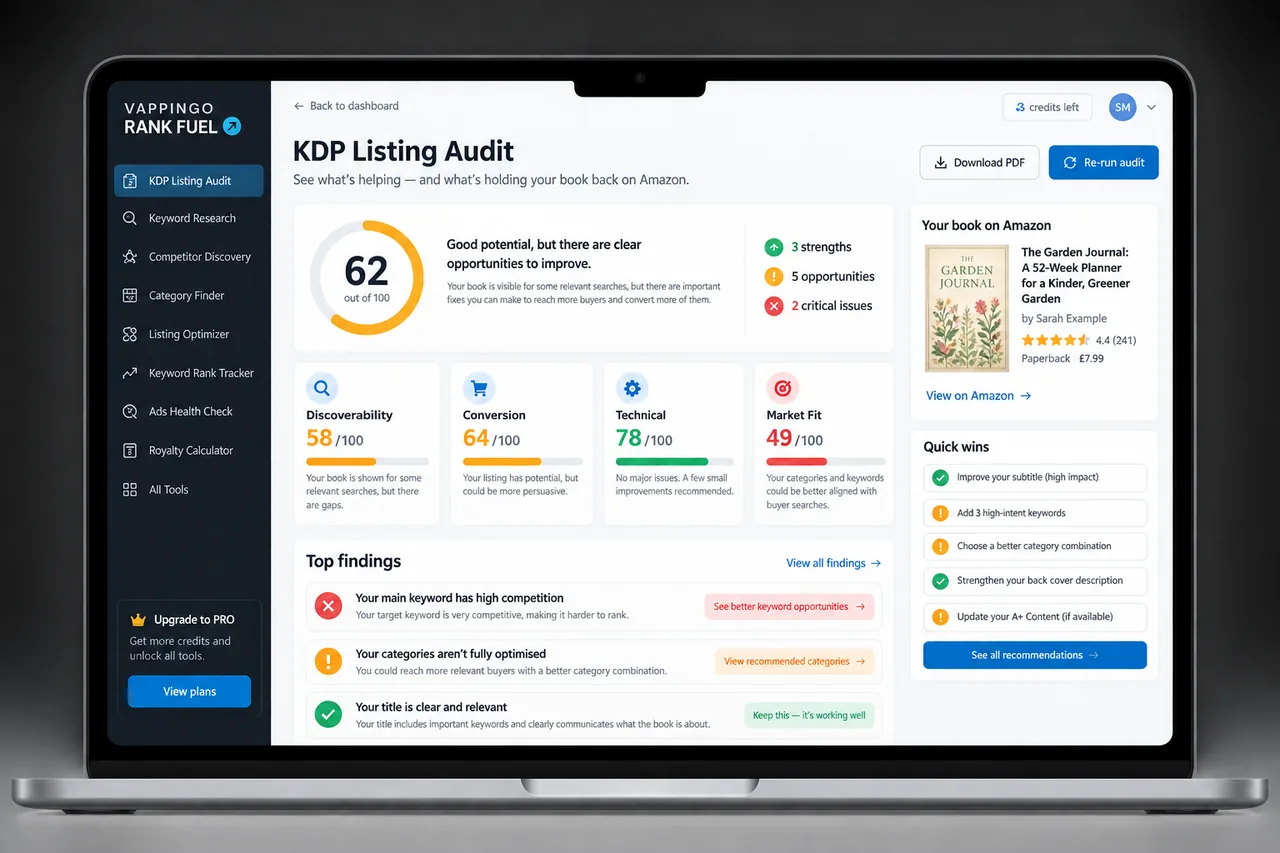
KDP Rank Fuel connects book-centered keyword, competitor, category, listing, advertising, and performance workflows. Treat search figures and scores as research aids, and verify important decisions against the live Amazon market.
Vappingo provides professional manuscript proofreading by qualified human editors for self-publishing authors.