Why Is My KDP Book Not Selling? A 12-Point Diagnostic
A KDP book can fail at availability, discovery, click-through, or conversion. Use this 12-point diagnostic to find the first broken gate before you rewrite the whole listing.
When a KDP book is not selling, almost every possible fix sounds plausible.
The keywords could be wrong. The cover could be weak. The price could be too high. The description could be flat. The categories could be poor. The temptation is to change several of them at once because doing something feels safer than waiting.
That is usually how the evidence gets destroyed. A useful KDP book not selling diagnostic works in the opposite direction: narrow the problem first, then make the smallest change that addresses the stage where the sale is actually breaking.
Why Is My KDP Book Not Selling?
A useful KDP book not selling diagnostic should separate four different problems before you change anything:
Availability
Can the correct shopper actually find and buy the correct format in the correct marketplace?
Discoverability
Is Amazon placing the book for searches and categories that match the real buyer?
Search-result appeal
Does the cover, title, subtitle, price and visible proof make the book easy to choose beside competitors?
Conversion
Once the shopper reaches the product page, does the listing confirm enough value and trust to earn the sale?
The earliest broken stage matters most. There is little value in rewriting the description if the book is not yet searchable, and no amount of keyword research can rescue a product page that gives the right shopper no reason to buy.
1. Is My KDP Book Live and Available to Buy?
Start with the technical basics. Confirm the exact format you are diagnosing is Live in the KDP Bookshelf and use View on Amazon to open the correct storefront directly.
KDP currently says a newly published book can take up to 72 hours after it goes Live to appear in search results. Print detail-page timing can differ by marketplace, and low-content books can take longer.
2. Is My KDP Book Showing in Amazon Search?
If the book is Live, test searchability before you diagnose ranking. Search the exact title in the correct department and marketplace. KDP recommends using Books for paperback/hardcover and Kindle Store for eBooks when troubleshooting.
If the exact-title search works, Amazon can return the book for a highly identifying query. If a buyer phrase does not, the problem has moved from basic availability into relevance and ranking.
Exact title works: the book is searchable.
“Year 8 math workbook” does not bring the book near the top: now investigate buyer fit and ranking rather than publication status.
3. Am I Checking the Right Marketplace, Format, and Territory?
A book can be available in one Amazon store and unavailable or differently surfaced in another. Confirm the territory rights and marketplace for the format you are testing.
This matters especially when authors compare search behavior across Amazon.com, Amazon.co.uk, Amazon.ca and other stores. Category paths, availability and competitive results can differ.
Use the KDP Bookshelf’s store links as the starting point instead of assuming that a missing result in one storefront means the listing itself is broken.
4. Are My KDP Keywords Matching Real Buyer Intent?
KDP currently allows up to seven keywords or short phrases and advises publishers to use accurate language that reflects what customers actually search for.
Amazon also recommends avoiding vague terms and information already covered elsewhere in the book’s metadata or categories. That means the seven boxes should extend the search context rather than repeat the title mechanically.
Broad topic: “math workbook”
Closer buyer fit: “Year 8 math practice tests with answers”
The second phrase is more useful only if that reader, level and format genuinely match the book.
For the deeper process, use the Amazon KDP Keyword Research Guide.
5. Is My Book Ranking for Searches With Useful Demand?
Ranking is only useful when the search itself has commercial value. A book can rank well for a phrase that very few shoppers use, or for a broad phrase that attracts several different buyer intentions.
Do not use one universal BSR, review-count or ranking-position threshold to decide whether the keyword is “good.” Compare estimated demand, buyer fit, competing books and ranking stability together.
6. Are My KDP Categories Accurate and Commercially Relevant?
KDP currently allows authors to select three categories and says the goal is to place the book where potential readers will shop. Amazon recommends balancing relevance and popularity rather than choosing a category simply because it looks easier.
Compare the category with the books your actual buyer would consider. If the category is full of different audiences, formats or promises, the book may technically belong there while still being commercially misplaced.
Use the free KDP Category Finder to compare relevant category paths, but treat category fit as part of discovery, not as a shortcut to a badge.
7. Does My KDP Cover Work at Thumbnail Size?
Once the book is entering relevant search territory, the next question is not whether the cover looks attractive in isolation. It is whether the cover communicates fast enough beside the competing books.
At thumbnail size, check whether the title remains legible, the genre or format feels recognizable, the visual style fits the audience and the book can be distinguished without looking misplaced.
Place your cover beside six relevant competitors at roughly Amazon thumbnail size. Can a stranger tell what type of book it is and who it appears to be for without reading the description?
8. Do My KDP Title and Subtitle Make the Book Easy to Understand?
The title and subtitle form part of the search-result decision. They should help the shopper confirm what the book is, who it is for or why this version is relevant before the description has to do any work.
A clever title can work if the subtitle supplies the missing context. A descriptive title can work with a shorter subtitle if the important information is already obvious. The problem is when both fields leave the shopper guessing.
See KDP Title Mistakes That Stop Buyers Clicking and How to Write a KDP Subtitle That Helps Amazon and Readers.
9. Is My KDP Price Harder to Justify Than Competitors’?
Price is part of the search-result and product-page comparison. A lower price is not automatically better, and a higher price is not automatically the problem.
Ask what the shopper receives for the money relative to nearby alternatives: page count, format, interior quality, specialization, authority, bonuses, review strength and perceived usefulness.
| Compare | Question to ask |
|---|---|
| List price | Is the difference obvious enough to matter to this buyer? |
| Page count / format | Does the physical or digital product look substantial enough for the price? |
| Reviews | Is a similar-priced competitor offering much more social proof? |
| Visible differentiation | Can the buyer see why this version deserves its position? |
10. Is My KDP Book Description Giving the Buyer a Reason to Care?
KDP currently allows up to 4,000 characters in the book description, but the limit is capacity, not a target. A shorter description that clearly explains the fit and value is stronger than a padded description that simply fills the field.
The description should confirm the promise implied by the search, title and cover. Translate important features into buyer value rather than reproducing the table of contents.
Feature: 50 mixed-skills tests.
Buyer meaning: 50 short checks that help reveal where more practice is needed before small gaps become bigger ones.
Use Why Your KDP Book Description Is Not Selling Your Book if this looks like the main conversion leak.
11. Does Read Sample Support the Promise of the Listing?
The sample is where the buyer can test the sales promise against the actual product. A strong cover and description can create interest, then lose the sale if the opening pages look thin, cluttered, badly matched to the advertised level or difficult to use.
Does the interior look polished and usable?
Does the sample deliver the level, format and experience the listing promised?
Can the buyer see enough substance to understand what they are paying for?
Remember that Read Sample has its own KDP timeline. Do not assume it updates at the same speed as keywords, categories or price.
12. Do Reviews and Other Proof Give the Buyer Enough Confidence?
Reviews matter because they reduce uncertainty, but there is no universal review-count threshold that decides whether a book can sell.
Compare the review landscape in context: how many reviews nearby books have, how recent they are, what buyers repeatedly praise or criticize and whether newer titles can still gain traction.
Also look beyond reviews. Author expertise, interior quality, series credibility, a clear sample and a tightly matched promise can all strengthen confidence when a book is relatively new.
How Do I Diagnose a KDP Book Without Destroying the Evidence?
Record the baseline before you change anything. At minimum, note:
- marketplace and format
- searches where the book currently appears
- important keyword positions
- selected categories
- price
- review count and recent review pattern
- current description and keyword boxes
- Amazon Ads data if ads are running
Then fix the earliest broken stage you can prove. Make one controlled change where practical and compare the evidence afterward.
Use the current KDP timeline for the exact field you changed. Amazon currently lists 48 hours for eBook description/keyword metadata updates, 72 hours for category changes, 24 hours for eBook list-price changes, and longer windows for Read Sample and some print updates. Those timelines can change, so check the live KDP guidance before judging the result.
Which Rank Fuel Solutions Help Diagnose a KDP Book That Is Not Selling?
Use the solution that matches the stage you are investigating. The useful sequence is diagnosis first, then the specific fix, then tracking.
| Solution | Use it when… |
|---|---|
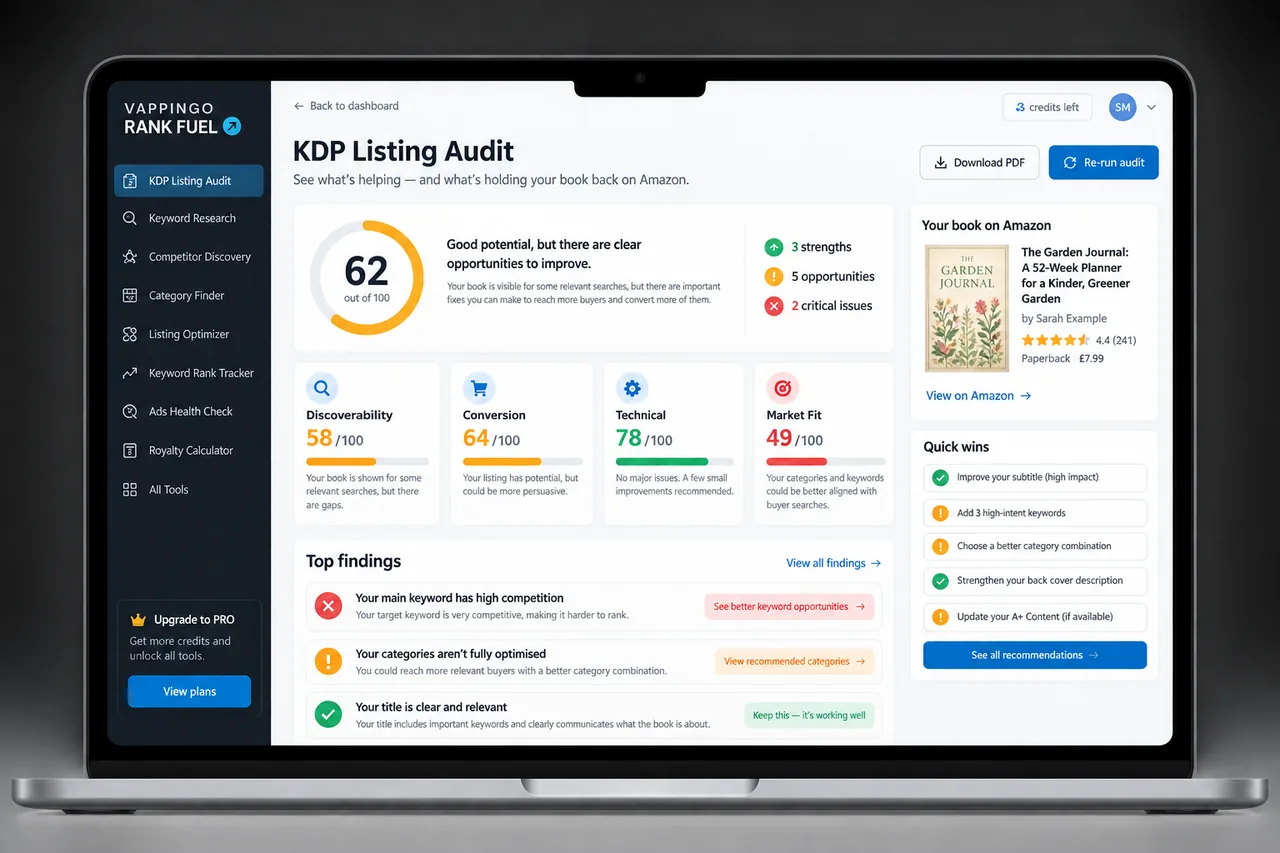
| Listing Audit | You want a structured review of the live title, subtitle, description and keyword setup before changing random fields. |
| Keyword Research | The discovery stage looks weak and you need stronger Amazon.com buyer-search opportunities. |
| Competitor Discovery | You need to identify the books sharing the same search territory and build the comparison around the actual market. |
| Keyword Rank Tracker | You need a baseline and later snapshots to see whether important Amazon.com keyword positions improve, hold or slip. |
| Listing Optimizer | The editable live description and keyword boxes need improvement after the diagnosis, while important searches can be protected. |
Frequently Asked Questions About KDP Books That Are Not Selling
What should I fix first when my KDP book is not selling?
Fix the earliest problem you can prove: availability first, then discoverability, then search-result appeal, then conversion. This prevents you from rewriting later-stage copy when the real problem happens earlier in the buying path.
Should I use all 4,000 characters in my KDP description?
No. KDP allows up to 4,000 characters, but the description should be only as long as necessary to communicate fit, value and important details clearly.
Should I repeat title words in my seven KDP keyword fields?
KDP advises avoiding information already covered elsewhere in the metadata and categories. Use the keyword boxes to add accurate buyer-search context rather than repeating title language mechanically.
How long should I wait after changing KDP keywords?
KDP’s current Timelines page lists 48 hours for eBook description and keyword metadata updates. Other formats and fields can follow different timelines, so check the live guidance for the exact change you made.
Does a high BSR mean my KDP listing is good?
No. BSR is a relative sales/activity rank, not a direct quality score for the listing. Use it as one piece of evidence in context.
Should I change my KDP title if the listing is weak?
Not as the first response. Kindle eBook titles are locked after publication. For paperback and hardcover books, KDP currently allows title/subtitle changes only within 72 hours of initial publication once the title is no longer In Review; after that, a new edition is required.
Can I tell if organic shoppers are seeing my book but not clicking?
Not from standard KDP Reports alone. Organic search impressions and clicks are not exposed as a universal KDP funnel. If Amazon Ads is running, use the separate ad impressions/clicks data for that paid traffic.
How Do I Stop Guessing Why My KDP Book Is Not Selling?
A book that is not selling does not automatically need more optimization. It needs a clearer diagnosis.
Confirm the book can be bought. Confirm Amazon can find it. Check whether the search language and categories match the right buyer. Then judge the search-result package and, finally, the product page.
The smaller the diagnosis becomes, the smaller and more defensible the next change becomes too.