International KDP Keywords: Researching Amazon Beyond the US
Research international KDP keywords by marketplace, spelling, reader language, and local search behavior rather than assuming US phrases transfer unchanged.
Most KDP keyword guides are written from a US perspective, which leaves non-US authors , particularly UK authors, who make up a significant proportion of the KDP publishing community , without the market-specific guidance they need. This article covers how keyword strategy should adapt for non-US Amazon marketplaces. For the full keyword framework, see our
Amazon changes metadata, taxonomy, and merchandising systems. This article reflects the September 2026 workflow, but the live KDP interface and help pages remain the final authority.
One Keyword Set, Multiple Marketplaces
KDP uses a single set of keyword fields for all Amazon marketplaces simultaneously. You cannot set different keywords for Amazon.com and Amazon.co.uk , the same seven fields apply across all English-language marketplaces where your book is available. This creates a strategic question for non-US authors: do you optimize for the US market (Amazon.com , by far the largest), the UK market (Amazon.co.uk , the second largest English-language market), or both? The answer depends on where your primary readership is and where your sales data shows the most traction. For most English-language authors outside the US, the practical answer is to optimize primarily for Amazon.com , where the total search volume is greatest , while ensuring your keyword strategy does not actively exclude UK and other English-speaking market readers. In most cases, this is achievable without compromise because the genre vocabulary is largely shared, with specific spelling and terminology differences to navigate.
Spelling Differences That Matter
The most significant practical difference between US and UK keyword strategy is spelling. Amazon’s search algorithm does not automatically treat “cozy” and “cozy” as equivalent , they are different strings of characters. A reader on Amazon.co.uk searching for “cozy mystery” and a reader on Amazon.com searching for “cozy mystery” are making different searches. The most commonly divergent spellings in book keyword contexts:
US spelling UK spelling Relevance cozy mystery cozy mystery Very high , major genre term humor humour Moderate , mood descriptor neighbor neighbour Low , rarely a standalone keyword color / colored colour / coloured Moderate , coloring books organizer organizer Moderate , planner/journal keywords skeptic sceptic Low For the cozy/cozy distinction specifically: if you write cozy mysteries and most of your readers are UK-based, prioritize “cozy mystery” in your keywords. If your readership splits across UK and US, use one field for “cozy mystery” and another for “cozy mystery.” Both spellings are common enough to warrant separate keyword field allocation if space allows.
Keyword Strategy for UK Authors
UK authors face a specific opportunity and a specific challenge. The opportunity: UK-specific settings, cultural references, and genre vocabulary represent lower-competition keyword territory than equivalent US-focused terms. “English village mystery,” “British detective fiction,” “Cotswolds cozy mystery,” “Yorkshire Dales crime novel” , these are searches made predominantly by UK readers and international readers who specifically seek British fiction. Competition for these terms is meaningfully lower than for equivalent generic terms. The challenge: the US market is substantially larger, and US readers also actively seek “British” fiction , making UK-specific terms cross-market in a way that US-specific terms are not. “British detective series” has appeal in both the US and UK; “Texas ranch romance” has predominantly US appeal. UK authors can often capture both markets simultaneously with UK-specific terms.
UK-Specific Keyword Opportunities
High-value keyword territory that UK authors are particularly well-placed to exploit:
- Regional British settings: “Cotswolds mystery,” “Yorkshire Dales thriller,” “Scottish Highlands romance,” “Welsh village cozy mystery,” “Lake District detective fiction” , all represent specific, searchable terms with real audiences and lower competition than generic equivalents
- British cultural specificity: “village fete murder mystery,” “English tea shop cozy mystery,” “vicar mystery series,” “Women’s Institute mystery” , these culture-specific terms are searched by readers who specifically want British-flavoured fiction
- UK nonfiction terms: “personal finance UK beginners,” “investing ISA guide UK,” “UK tax self-assessment guide” , for nonfiction targeting UK readers, market-specific terms are essential
Researching Non-US Marketplaces
Autocomplete research should be conducted on the specific marketplace you are targeting. Amazon.co.uk’s autocomplete produces different suggestions from Amazon.com for the same initial phrase , because the reader populations and their search habits differ. Conduct your autocomplete research on both Amazon.com and Amazon.co.uk if you are optimising for both markets. Note the phrases that appear on both (high-value cross-market terms) and the phrases unique to each (market-specific opportunities). For the full autocomplete methodology, see our article on how to use Amazon autocomplete for keyword research .
Genre Language Differences by Market
Beyond spelling, some genre vocabulary differs between markets:
- “Crime fiction” is more commonly used in UK publishing; “mystery fiction” is more US-dominant , both should be covered
- “Literary fiction” is a widely used term in both markets, but UK readers may also search “Booker Prize style” or “literary prize shortlisted”
- For romance, heat level vocabulary is largely shared, but UK readers may search “romance novel” where US readers search “romance book”
Which Market to Prioritize
For most English-language authors: prioritize Amazon.com keywords (US market) as your primary strategy, ensure the cozy/cozy variant is covered if relevant, and include at least one UK/regional-specific phrase if your book has a clear British identity. This approach maximizes total addressable search volume while capturing the UK market’s lower-competition opportunities.
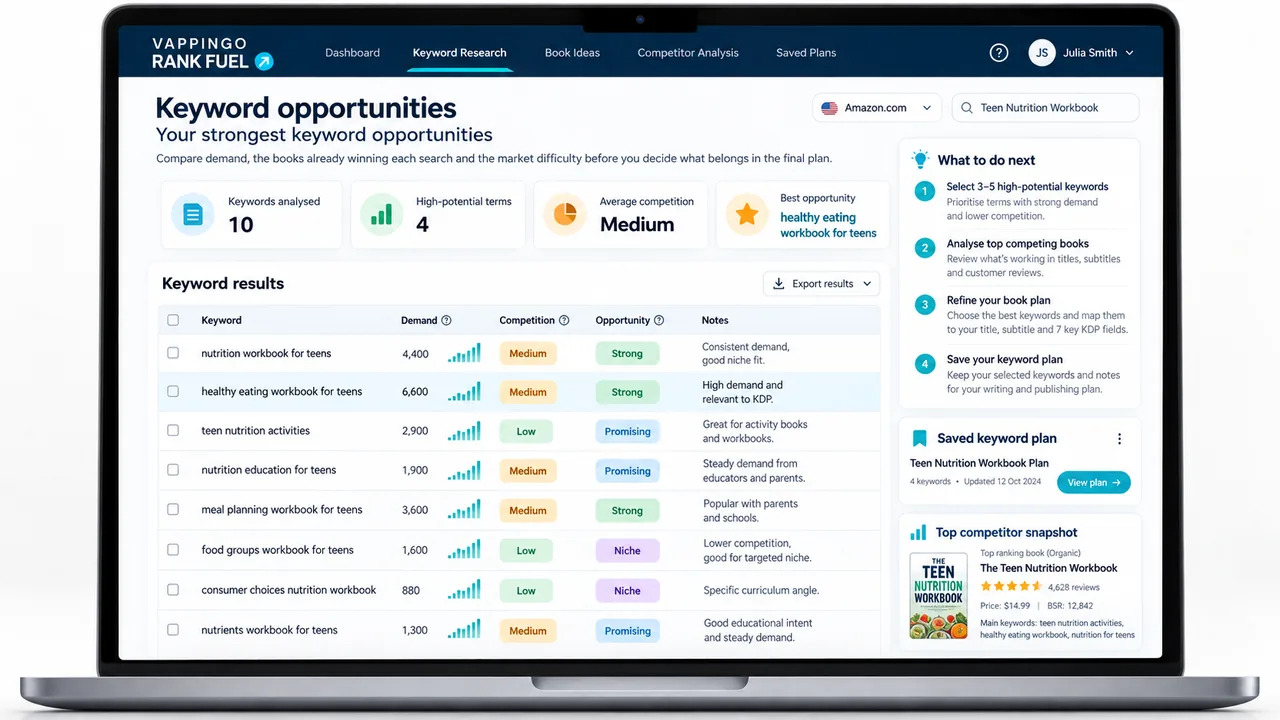
‘s Keyword Research generates keyword ideas calibrated to your book’s specific genre and market positioning , including regional and market-specific variants that standard keyword lists miss. For UK authors in particular, the quality standard that UK readers expect , polished, professionally prepared prose , is non-negotiable. from Vappingo is run by UK-based editors who understand British English conventions as well as the standards Amazon’s international audience expects.
Research the Store You Want to Rank In
Open the target Amazon marketplace and repeat your keyword research there rather than translating the US set mechanically. Record local autocomplete language, comparable titles, spelling, genre vocabulary, price norms, and which phrases appear to be used by actual shoppers. For a language you do not speak confidently, use a native speaker or qualified translator for validation. A literal translation can be grammatically correct and still be the wrong way local readers search for that kind of book.
KDP Rank Fuel can support keyword, category, rank, and market research. Its scores and estimates are research aids; Amazon does not publish the proprietary formulas behind search placement or exact sales thresholds.
Metadata can help the right reader find a book, but the listing and manuscript still have to earn trust. Vappingo provides professional manuscript proofreading by qualified human editors.
Frequently Asked Questions
How many KDP keyword fields are there?
KDP currently provides up to seven keyword fields. Use them for relevant keywords or short phrases and avoid padding the set with duplicate or prohibited language just to fill space.
Should I repeat my title or categories in the keyword fields?
Usually no. KDP advises against repeating metadata already covered elsewhere. Use the limited keyword fields to add distinct reader search language.
How often should I change KDP keywords?
There is no required refresh schedule. Change them when research, positioning, marketplace behavior, or post-launch evidence gives you a clear reason, and keep a record of what changed.
Can I use competitor author names or book titles as keywords?
KDP warns against unauthorized references to other authors, books, or trademarked terms. Use compliant reader language and verify the current metadata rules before publishing.
Do KDP keywords guarantee a search ranking?
No. Keywords are metadata inputs, not guaranteed positions. Search visibility also depends on relevance, shopper behavior, competition, listing quality, and Amazon-controlled systems.
Make the Metadata Easier to Defend
The strongest KDP metadata strategy is easy to explain: every category accurately describes the book, every keyword represents a plausible reader search, every change has a reason, and no part of the plan depends on a retired support workflow or an undocumented ranking formula. That standard makes the listing safer, clearer, and easier to improve as Amazon changes.