KDP International Categories: How Marketplace and Format Change the Options
KDP categories differ across Amazon marketplaces and formats.
Amazon’s category trees are not globally identical. KDP explicitly says categories differ by marketplace and format, and its help page links to separate Kindle and Books category stores for the US, UK, Canada, Australia, Germany, France, Italy, Spain, Brazil, India, Japan, and other marketplaces.
The important correction is that authors should not assume they can maintain an independent set of three KDP category choices for every international store. The KDP selector is tied to the primary marketplace, so international strategy begins with the best primary-market fit and then moves into monitoring.
How the Primary Marketplace Affects Category Selection
KDP requires a primary marketplace and uses it when presenting category choices. Amazon describes the primary marketplace as the store where you expect most sales. It is also connected to list-price setup, so changing it on an existing title can have pricing implications.
Choose the primary marketplace for the real commercial center of the edition, not simply because another store appears to have easier categories. Then select the most accurate categories available in that marketplace.
Category Trees Differ by Store
A US category path may have no exact UK, German, Japanese, or Australian equivalent. Even when the names look similar, the depth and competing books can differ. Amazon warns authors that unavailable categories vary by marketplace and recommends focusing on the primary marketplace when choosing categories.
For international research, save the actual store URL and category path you inspected. Do not assume a category name copied from Amazon.com identifies the same node on Amazon.co.uk.
Kindle and Print Add Another Layer
Within the same marketplace, eBook and print categories can differ. KDP’s category page provides separate links to Kindle Store and Books Store categories for multiple marketplaces. That means international comparisons need both store and format in the label.
Record “Amazon.co.uk / Kindle / Romantic Suspense” rather than simply “Romantic Suspense.” The extra context prevents you comparing ranks from different competitive fields as though they were the same list.
How to Check International Visibility
Open the book’s detail page in the marketplace you want to inspect, confirm the edition is available, and note any Best Seller Category ranks shown in Product Details. Then follow the category links where available and record the local category path. The displayed ranks can differ by store because customer activity and competing books differ.
Do not use a US rank converter to declare an exact UK sales level. Amazon says rankings are relative, and the underlying customer activity differs by marketplace.
Pricing, VAT, and Availability Affect the Context
International performance cannot be separated from price and availability. A book may be competitively positioned in one store and priced awkwardly in another after currency conversion or VAT treatment. Print availability and delivery times can also change the buying proposition.
When a market underperforms, check the complete detail page before blaming categories. Price, format availability, reviews, description localization, and cover expectations can matter as much as the shelf.
Non-English Markets Need More Than a Category Translation
If you publish a translated edition, treat it as a market-specific publishing product. Localized title, description, keywords, category choice, and reader expectations all matter. A literal translation of the US category label is not a substitute for checking the actual store taxonomy.
For professional wide distribution, international subject standards such as Thema may also matter outside the KDP workflow. Keep retailer category strategy separate from industry metadata standards.
What Rank Fuel Can and Cannot Do Internationally
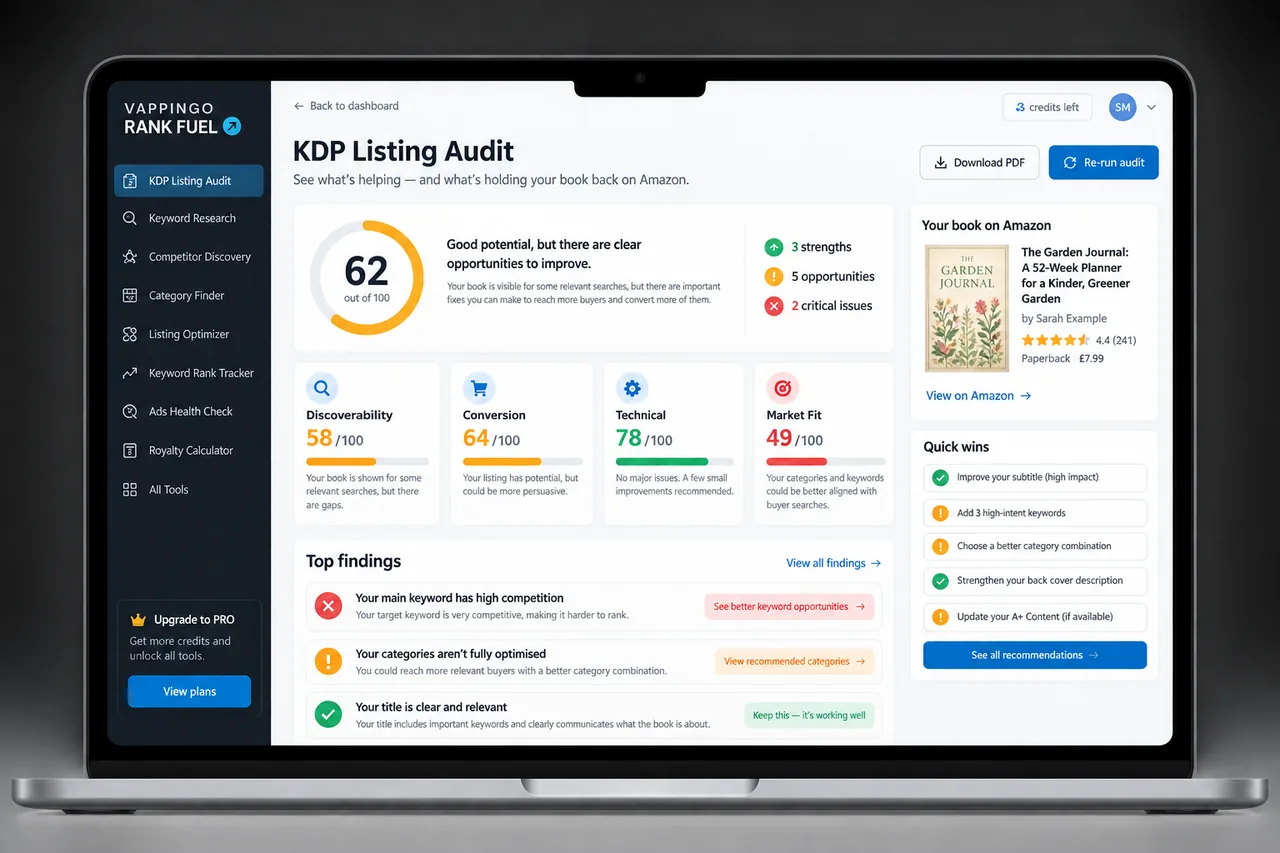
Rank Fuel’s current public category tools are designed to help authors research category paths and directional competition evidence. Public copy should not promise broad international category coverage that the current implementation has not verified. Use the live Amazon store and KDP selector as the authority for marketplace-specific availability.
Research category paths, then verify in KDP
Use Category Finder for a research shortlist and confirm the final path in the marketplace and format you are actually publishing.
Use a Marketplace Localization Sheet
For each important marketplace, record the store, format, current browse path, local list price, language, and a few direct comparable books. The exercise is especially useful when a US category name appears to have a close UK, German, or Australian equivalent. The wording can look similar while the neighboring books and competitive depth differ substantially.
Do not turn the sheet into a claim that KDP gives you three independently controlled categories in every country. The practical purpose is to understand how the book is being presented beyond the primary marketplace and to spot obvious mismatches. If an international store becomes commercially important, review its live taxonomy and reader expectations as part of broader localization, including description, pricing, advertising availability, and language.
Frequently Asked Questions
How many KDP categories can I choose?
KDP currently allows up to three categories during title setup or editing. The available choices depend on the book’s primary audience, primary marketplace, and format.
Can I choose three completely separate categories for every Amazon marketplace?
KDP category selection is based on the primary marketplace you choose. Do not assume you have an independent three-slot editor for every international store.
Can my book have different category ranks in the US and UK?
Yes. Rankings are relative to customer activity and competing books in the relevant store and category.
Are Kindle and print category trees the same internationally?
No. Amazon says categories can differ by format as well as marketplace.
Should I change my primary marketplace just to access another category?
The primary marketplace also affects pricing setup. Choose it for the market where you expect most sales, not as a category hack.
Label Every International Observation With Store and Format
International category analysis becomes much clearer when every rank and path includes the marketplace and format. That stops you comparing unlike lists and keeps the primary KDP category decision grounded in the store where the book is meant to perform best.
Use other marketplaces as additional evidence and opportunity, not as copies of the US taxonomy.