Amazon Book Descriptions and Search: What KDP Actually Documents
Amazon search advice becomes unreliable when community labels such as A9 or A10 are presented as published KDP specifications.
Amazon search advice becomes unreliable when community labels such as a community algorithm label or a community algorithm label are presented as published KDP specifications. This guide separates current Amazon documentation from assumptions authors cannot verify.
Amazon changes metadata, search, and merchandising systems. This guide reflects the September 2026 workflow; the live KDP interface and current Amazon help pages remain the final authority.
What Amazon Actually Documents About Search
Authors still use labels such as a community algorithm label or a community algorithm label when discussing Amazon search, but Amazon does not publish a KDP ranking specification under either name. What KDP does publish is practical guidance on the metadata authors control: title and subtitle accuracy, descriptions, up to seven keywords, categories, audience information, and other book details. Treat those public rules as evidence; treat detailed weighting diagrams, percentages, and secret-factor lists as speculation. For book descriptions specifically, KDP describes the field as customer-facing copy that appears on the detail page and helps entice readers. It separately provides the keyword fields for discoverability. That is a more useful foundation than trying to reverse-engineer an undocumented algorithm.
What the Description Is For
A clear description helps a shopper decide whether the book matches what they want. It can naturally state genre, setting, audience, problem, method, or outcome, but KDP does not tell authors to use the description as an extra keyword bank. In fact, its current metadata rules say descriptions cannot contain keyword or book-tag phrase lists. That means relevance should be expressed as meaningful prose. If your book is a small-town cozy mystery, say so where it helps the reader. If it is a workbook for adults with ADHD, explain that audience and purpose. Do not repeat variants simply to chase a presumed search signal.
Why Shopper Response Still Matters
Amazon does not give KDP authors a public organic detail-page conversion-rate report, so claims that a particular conversion percentage directly changes organic rank are not verifiable from KDP data. What you can observe is the commercial sequence: search or merchandising creates an impression, the cover and title earn a click, and the description helps the shopper decide whether to buy or read further. A weak description wastes traffic regardless of the ranking mechanism behind it. Improve it because better communication can improve the customer’s decision, not because an unpublished threshold supposedly activates a ranking boost.
What KDP Says About Description vs Keywords
KDP’s public help pages do not document independent description indexing in the way they document the seven keyword entries. They tell authors that keywords help make books easier to find and that the description should focus on the book’s content. That is the distinction this article follows. Amazon search may use many catalog and behavioral inputs internally, but authors cannot inspect that system or prove which words from a description were indexed for a particular query. If a search term matters, place it in compliant, relevant keyword metadata rather than relying on the description to carry it.
Why Keyword Density Is the Wrong Target
There is no useful KDP keyword-density target for a book description. The current rules point in the opposite direction: write a simple, compelling, professional description and do not add keyword or tag lists. Repeating a phrase three, five, or ten times does not create a documented advantage and can make the page look spammy. Use normal language, vary wording for readability, and keep search optimization in the fields designed for it. Accuracy beats density because inaccurate metadata can confuse customers and can breach KDP’s guidelines.
How to Evaluate Description Updates
KDP lets authors update descriptions after publication, subject to its normal review and update timelines. Amazon does not publish a guaranteed ranking response, indexing delay, or reset period after a description edit. If you change copy, measure outcomes you can actually observe: ad click-to-order performance, sales direction, customer feedback, and whether the new version communicates the book more clearly. Keep a dated change log and avoid changing the description, price, cover, and keywords at the same time. A controlled edit gives you a better chance of learning what helped.
A Practical Metadata Split
The practical strategy is straightforward. Use the title and subtitle only for the actual title information allowed by KDP. Use the seven keyword entries for compliant search terms. Use categories for accurate browse classification. Use the description to persuade and inform the shopper. Those layers should tell the same story without duplicating one another mechanically.
- Open with the premise or reader problem.
- Signal genre or audience naturally.
- Build conflict, stakes, proof, or outcomes in readable paragraphs.
- Keep prohibited promotional, testimonial, contact, and keyword-list content out.
- Use supported KDP HTML only when formatting genuinely improves scanning.
What Authors Cannot Verify
No outside guide can tell you the exact weight Amazon assigns to a description, keyword, click, order, review, or sales event in organic search. Amazon changes systems continuously and does not expose the formulas. A claim that one field is worth a specific percentage, or that an edit will move rank after a fixed number of hours, should be treated skeptically unless Amazon publishes it. The durable advantage is to control what you can verify: accurate metadata, relevant keywords, a clear description, a professional product page, strong book quality, and disciplined measurement after changes.
Build an evidence hierarchy
When you hear a new algorithm claim, rank the evidence before changing a listing. A current KDP help page or Amazon announcement is strong evidence. A repeatable observation from your own account is useful but local. A vendor score is a research aid. A screenshot, forum post, or unexplained percentage is a hypothesis until stronger evidence appears. This hierarchy makes optimization calmer. You can act quickly on documented policy changes while avoiding unnecessary rewrites every time a new “ranking factor” circulates in author groups.
Frequently Asked Questions
Does Amazon use my book description as a backend keyword field?
KDP does not document the description as an additional backend keyword field. Its current help separates the reader-facing description from the dedicated keyword entries, and its description rules prohibit keyword or book-tag phrase lists.
How long can a KDP book description be?
KDP currently allows up to 4,000 characters, including any HTML tags used for formatting.
Can I use AI to draft my description?
AI can be useful for options and first drafts, but verify every book fact, remove generic or invented claims, and make sure the final copy complies with KDP description rules.
Should I copy the structure of bestselling descriptions?
Study patterns across several close comparables, but do not copy wording. A bestseller has many reasons for selling, so its description is an example to analyze, not proof of a universal formula.
What matters most in a description?
Clarity, reader fit, a compelling premise or promise, accurate expectations, and professional writing. Use search research to understand reader language, then write the copy for humans.
Put the Evidence Into Practice
The strongest publishing workflow is easy to defend later: each metadata choice has a clear reason, each estimate is labeled as an estimate, and each change is recorded so you can learn from the result. That discipline survives platform changes better than any secret-algorithm shortcut.
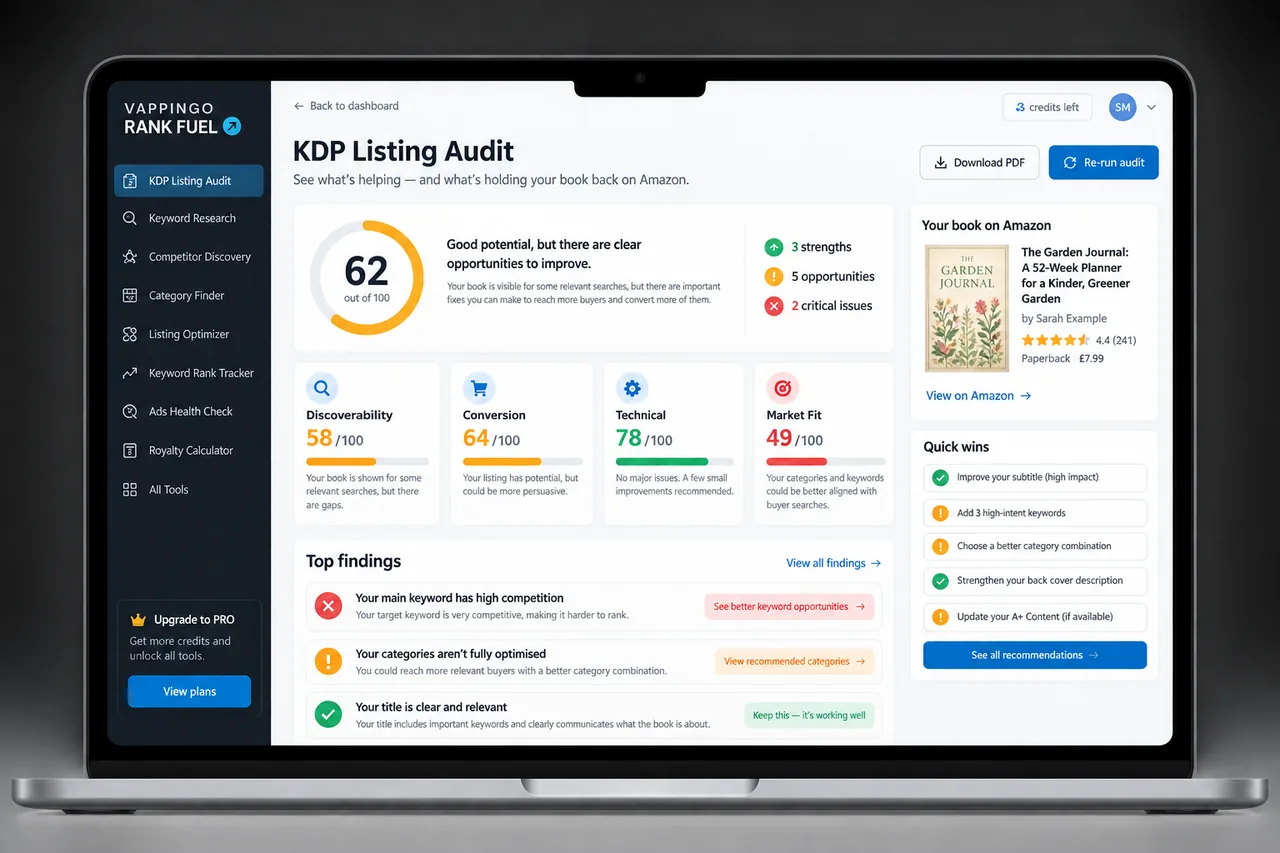
KDP Rank Fuel connects book-centered keyword, competitor, category, listing, advertising, and performance workflows. Treat search figures and scores as research aids, and verify important decisions against the live Amazon market.
Vappingo provides professional manuscript proofreading by qualified human editors for self-publishing authors.