How Amazon Search Uses KDP Keywords: What Is Documented
KDP publishes useful keyword guidance, but it does not publish a complete organic search formula.
KDP publishes useful keyword guidance, but it does not publish a complete organic search formula. Authors get better decisions by working from documented metadata rules and observable market evidence than from invented a community algorithm label weightings.
Amazon changes metadata, search, and merchandising systems. This guide reflects the September 2026 workflow; the live KDP interface and current Amazon help pages remain the final authority.
What Amazon Actually Documents
Amazon does not publish a KDP search algorithm called a community algorithm label with a documented list of weights. The label is common in seller and author communities, but it should not be used as if Amazon has released a technical specification. KDP’s own guidance is simpler: relevant keywords can improve placement in search results, and factors such as sales history and Best Sellers Rank also matter. For authors, the defensible strategy is to optimize the metadata Amazon exposes instead of guessing at hidden percentages. Use accurate title information, up to seven relevant keywords, appropriate categories, a strong description, and a book that satisfies the audience you target.
Documented Relevance Inputs
KDP explicitly tells authors to choose keywords that accurately portray the book and reflect words customers may use when searching. It also uses title, author, categories, audience, and other book details to create the catalog record customers see. Amazon may use additional internal signals, but KDP does not provide authors with a complete list. Relevance therefore starts with consistency. A book positioned as a historical mystery should have title, categories, keyword metadata, description, cover, and content that all support that expectation. Conflicting or misleading metadata can create poor customer experiences and can breach KDP policy.
What KDP Says About Performance
KDP’s keyword guidance names sales history and Best Sellers Rank as examples of factors that can sit alongside relevant keywords in search placement. Beyond that, authors should be cautious. Amazon does not publish an organic formula for click-through rate, conversion rate, review velocity, advertising activity, external traffic, or Kindle Unlimited pages read. You can still measure commercial performance for your own decisions. Use ad reports, sales direction, rank trends, and customer feedback as evidence about the book, but do not convert those observations into universal Amazon rules.
Why There Is No Public Weighting Table
There is no public KDP weighting table showing that title is worth one percentage, backend keywords another, and description another. KDP does say titles are a frequently used search attribute, that keywords can improve discoverability, and that categories help place books in relevant sections of the store. Those qualitative distinctions are useful; invented percentages are not. Use each field for its intended purpose. Keep the title accurate to the cover, use keywords for search language, use categories for browse fit, and use the description for reader-facing persuasion. A coherent listing gives both the customer and Amazon cleaner information.
Why Traffic Quality Still Matters
A keyword can create an opportunity to be discovered, but it cannot rescue a listing that the target reader does not want. That is the practical reason conversion matters, even though KDP does not publish a formula saying conversion ‘beats’ keywords. If an ad or search term drives relevant traffic but orders remain weak, investigate the cover, positioning, price, description, sample, and competitive set rather than simply adding more metadata.
What to Expect After a Keyword Update
KDP publishes update timelines for book details, but it does not promise that a keyword becomes searchable after a fixed 24-, 48-, or 72-hour indexing cycle. Search results can also vary by marketplace, customer context, device, and Amazon’s own systems. After a keyword change, allow the published update to process and then evaluate over a sensible observation window rather than checking one search result repeatedly. Keep screenshots or rank-tracking records if a phrase is strategically important. The goal is to see direction over time, not to prove a hidden indexing clock.
Practical Implications for Keyword Strategy
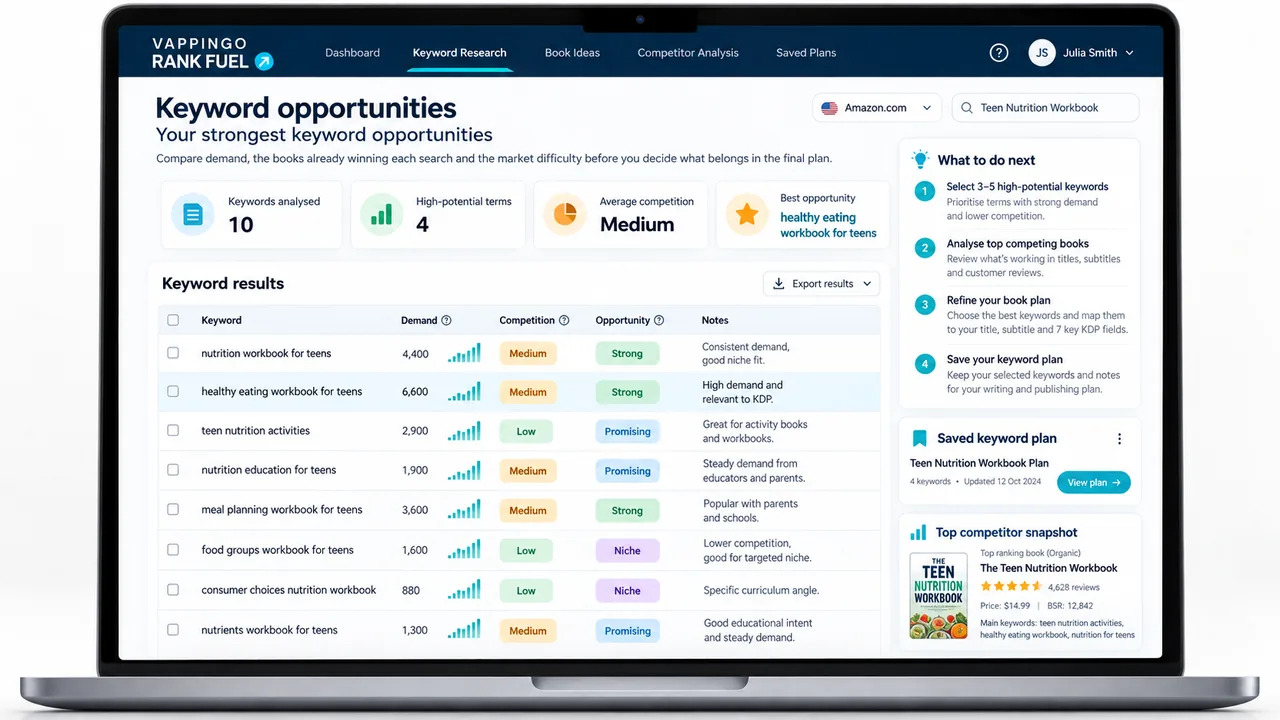
Build a candidate pool from reader language, autocomplete suggestions, comparable books, advertising search-term data, reviews, and research tools. Filter for relevance first, then specificity and market evidence. Use the seven entries to cover distinct search intents instead of repeating the title or generating minor variants. KDP Rank Fuel’s current Keyword Research workflow surfaces book-specific keyword candidates and presents Amazon search figures as estimates for comparison. Treat those estimates as research evidence, then pressure-test promising phrases against the live market and competing books before changing a listing.
How to test a keyword without pretending to know the algorithm
Choose a phrase for a clear reason, record the current listing and any rank observations, make the metadata change, and allow KDP’s published update process to complete. Then observe over time rather than refreshing one personalized search result. If you run ads, search-term reports can provide additional evidence about shopper response to related language. A test can tell you whether a change was useful for your book. It cannot prove the weight Amazon assigns to the field across every title. Keep that distinction in your notes.
Frequently Asked Questions
How many KDP keywords can I add?
KDP currently allows up to seven keyword entries for a title. Use accurate words or short phrases that represent plausible customer searches.
Does KDP require a fixed character target in every keyword entry?
KDP’s current public keyword guidance emphasizes relevance and short, specific phrases rather than a strategy of filling every field to an old character target. Use the live KDP interface for any technical limit.
Can I use competitor author names as keywords?
KDP prohibits misleading or unauthorized references to other authors, books, brands, sales rank, promotions, and unrelated content. Use compliant reader language instead.
Do keyword tools show exact Amazon search volume?
Treat third-party search figures as estimates unless Amazon explicitly publishes them. They are useful for relative comparison, not as exact official totals.
How often should I change KDP keywords?
There is no required refresh schedule. Change them when new research or performance evidence gives you a clear reason, and keep a record of what changed.
Decision Journal: What to Record
A useful research process leaves an audit trail. Record the phrase or copy change you considered, the evidence that supported it, the marketplace you checked, the competing books or customer language you reviewed, and the exact reason the idea was accepted or rejected. This is especially important when several people work on the same catalog because it prevents an estimate or inference from being repeated later as if Amazon had published it.
For a live book, add the date of any metadata change and the observations you plan to watch afterward. Keep search visibility, advertising evidence, sales direction, and listing-conversion questions separate. A change in one metric does not automatically prove a cause, but a clean record helps you build better hypotheses over time. The aim is not to create more administration. It is to avoid losing the reasoning behind decisions once the market moves or the KDP interface changes.
Use the same journal when you decide not to change anything. Stable performance is evidence too. If a keyword, description, or positioning choice still fits the reader and there is no stronger evidence for a replacement, leaving it alone can be the most disciplined optimization decision.
Put the Evidence Into Practice
The strongest publishing workflow is easy to defend later: each metadata choice has a clear reason, each estimate is labeled as an estimate, and each change is recorded so you can learn from the result. That discipline survives platform changes better than any secret-algorithm shortcut.
KDP Rank Fuel connects book-centered keyword, competitor, category, listing, advertising, and performance workflows. Treat search figures and scores as research aids, and verify important decisions against the live Amazon market.
Vappingo provides professional manuscript proofreading by qualified human editors for self-publishing authors.