KDP Category Keywords: What Keywords Can and Cannot Do
KDP says categories and keywords help Amazon shelve books, but there is no published category-anchoring formula. Learn how to use keywords accurately without sacrificing search intent.
The older version of this strategy treated certain backend terms as “category anchors” that could lock a book into a browse node or trigger extra placements. Amazon does not publish such a mechanism. That makes the useful 2026 approach simpler and safer.
KDP says categories and keywords help tell Amazon where to shelve a book, and its category help specifically suggests using keywords when a precise category is unavailable. Use that guidance literally: describe the book accurately with useful search language, without pretending a keyword can force a specific node.
What Amazon Actually Says About Keywords and Categories
KDP describes categories as store sections where readers can find books and says categories, together with keywords, tell Amazon where to “shelve” a title. It also says keywords can be more specific when the exact category you want is unavailable. That is the strongest public basis for connecting the two systems. See KDP Categories.
Amazon does not publish a list of backend phrases that map one-to-one to browse nodes, nor does it promise that repeating a category name in a keyword field will keep the book in that category. Treat any such mapping table as an observation that can change, not a rule.
Do Not Waste Keyword Fields Repeating Your Category Names
Your seven fields are valuable discovery space. If a category label already describes the book but readers are more likely to search with a specific trope, problem, audience, or use case, the search phrase may be the better keyword. Redundancy is especially costly when the repeated phrase adds no new meaning.
KDP’s keyword guidance also discourages information already covered elsewhere and subjective or generic claims. Build a set of phrases that expands Amazon’s understanding of the book rather than copying the same broad words into every metadata field.
Use Category Language When Readers Use It Too
Some category labels are also natural search language. “Cozy mystery,” “romantic suspense,” “intermittent fasting,” and “small business accounting” can be useful because readers may genuinely type them. Their value comes from relevance and search intent, not from a published category-locking rule.
If the phrase describes the book and reflects how the audience searches, it can do double duty. If it exists only because you hope Amazon will infer a browse placement, use the field for a stronger reader-facing search phrase instead.
Use Keywords When the Selector Is Too Broad
This is the situation KDP itself points to. If you cannot find the exact category that captures a narrow subject, choose the closest accurate category and use specific keywords to describe the narrower topic. The keyword gives Amazon additional metadata; it does not create a guaranteed new category slot.
A specialized history book may need a broader history category in KDP while its keyword fields identify the precise period, region, people, or event readers are likely to search for.
Do Not Try to Engineer Automatic Category Moves
Amazon says it can change category placement when categories are inaccurate or when its category options change. That does not mean authors have a reliable formula for causing beneficial automatic moves. Statements such as “use one anchor per category” or “this audience word triggers an extra node” go beyond Amazon’s published guidance.
Build the Seven Fields Around Search Intent
Start with the phrases a qualified reader could reasonably type: genre plus trope, problem plus audience, subject plus level, or use case plus format. Avoid stuffing unrelated synonyms into a field just to fill characters. The strongest set usually covers distinct ways the right reader might describe the book.
For the full process, use Vappingo’s Amazon KDP keyword research guide. Category decisions should then be made separately in the KDP selector.
A Safer Metadata Example
Imagine a historical mystery set in 1920s London with a woman detective. The category choices might include the closest historical-mystery and women-sleuth paths available in the current KDP selector. The keyword fields can then cover real searches such as “1920s London mystery,” “female detective historical fiction,” “British amateur sleuth,” and other phrases supported by the book.
Notice what the strategy does not claim: it does not promise that one phrase will create an extra category or preserve a particular node. It simply gives Amazon and readers a more precise description of the title.
Build a Category-and-Keyword Matrix
Before entering metadata, create two columns. In the first, list the three category jobs: the broad genre or subject, the most useful subgenre or specialty, and an audience or use-case angle where one is genuinely relevant. In the second, list the search language readers use to express those ideas. This makes it easy to see where a keyword adds specificity and where it merely repeats a category label.
For example, a beginner watercolor workbook might use an accurate art or watercolor category, while backend phrases capture “watercolor exercises for beginners,” “step by step watercolor practice,” and a specific subject such as flowers or landscapes if the book actually covers it. The category organizes the shelf; the keywords describe the searches. Keeping the two roles visible reduces the temptation to sacrifice useful search phrases for supposed category-trigger words.
Frequently Asked Questions
How many KDP categories can I choose?
KDP currently allows up to three categories during title setup or editing. The available choices depend on the book’s primary audience, primary marketplace, and format.
Can keywords put my book in extra categories?
KDP says keywords can help determine where a book is shelved, especially when the category selector is not specific enough. Amazon does not promise a specific extra placement or publish a trigger formula.
Should I use one keyword field for each category?
No fixed allocation is required. Use the seven fields for distinct, accurate reader searches and subject language rather than following an invented one-field-per-category rule.
Can keywords stop Amazon moving my book?
There is no published guarantee. Accurate, coherent metadata is good practice, but Amazon can change category placements and category availability.
Does Rank Fuel have a category-keyword secret?
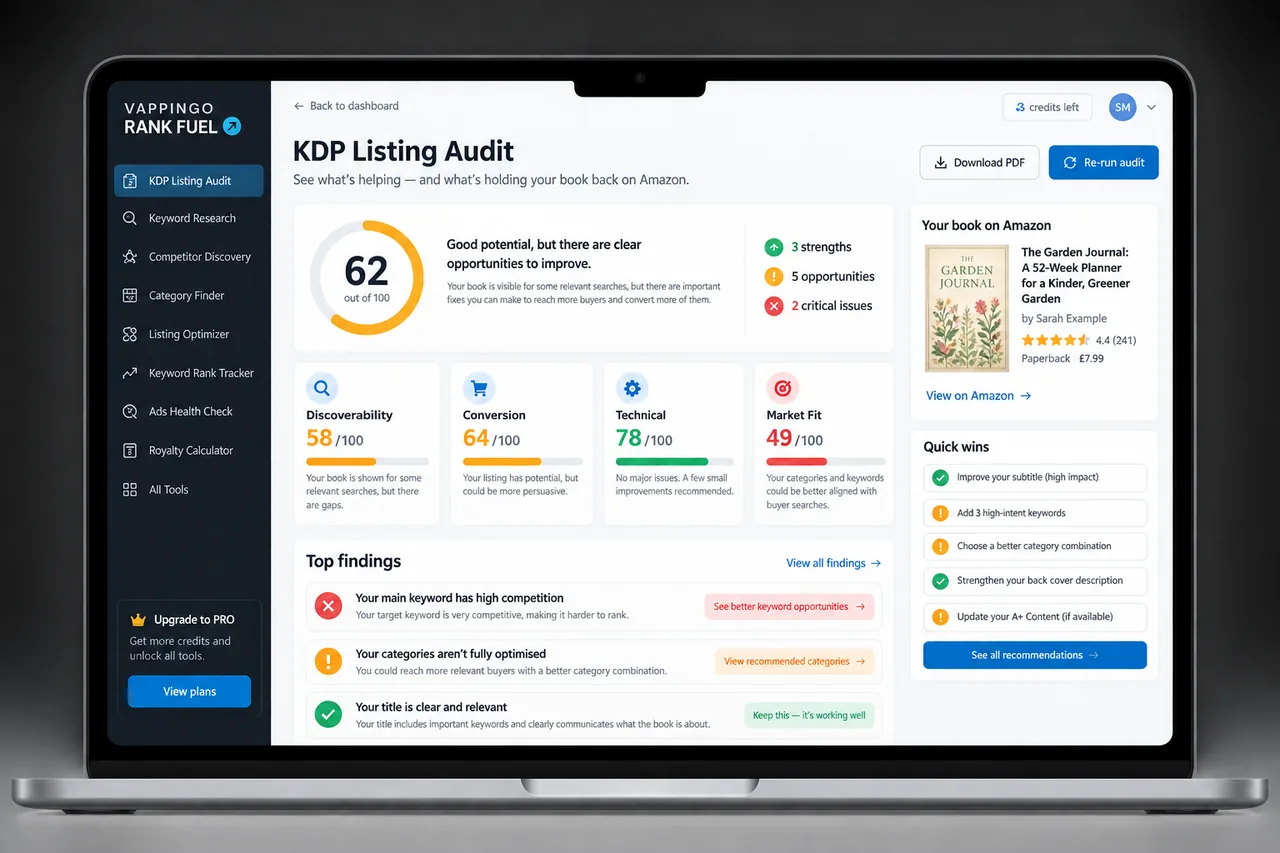
No public Rank Fuel copy should imply a secret Amazon mapping. Its Keyword Research tools can help compare search opportunities; category selection remains a separate judgment.
Treat Keywords as Description and Discovery, Not Hidden Commands
The durable strategy is to choose accurate categories directly, use backend keywords for real search intent and specificity, and verify what Amazon displays. That gives you a metadata system grounded in Amazon’s published guidance rather than a fragile category-hacking theory.
Research searches and categories separately
Use Keyword Research for buyer language and Category Finder for category paths, then combine the evidence in your publishing decision.