How to Choose KDP Categories for a Nonfiction Book
A practical framework for choosing three accurate KDP categories for nonfiction books that cross subjects, audiences, and use cases.
Nonfiction category selection is less about finding a single perfect genre and more about identifying the book’s subject, the problem it solves, the audience it serves, and the context in which readers will use it. A leadership book can also be a communication book, a career book, or an organizational psychology book, but those labels are only useful when they reflect substantial content.
KDP currently allows up to three category selections and advises authors to balance relevance with discoverability. Amazon also notes that the available categories differ by primary marketplace and format, so the final decision should be made against the live KDP selector rather than an old static list. See Amazon’s current category guidance.
Classify the Book by Subject, Problem, and Reader
Start with three separate questions: what is the book about, what does it help the reader do or understand, and who is it for? Those answers often point to different but legitimate category branches. Keeping them separate prevents a common nonfiction mistake in which authors choose three near-identical subject labels and miss a meaningful audience or application category.
A book about personal finance for freelancers, for example, has a subject area in finance, an audience in self-employment, and a practical use case around budgeting or business money. You do not need to force all three categories into the Finance branch if the book genuinely serves readers browsing elsewhere.
A book on managing anxiety at work might legitimately fit a mental-health shelf, a workplace or career shelf, and a self-help shelf if each reflects substantial content. If the work discussion is only a short chapter, however, the career category would overstate the book’s promise.
Use Multiple Hierarchies Carefully
Cross-subject placement can broaden discovery, but breadth is only useful when each category attracts a reader who will recognize the book as relevant. A health book can overlap with self-help, psychology, parenting, or aging; a business book can overlap with leadership, management, marketing, finance, or entrepreneurship.
The strongest combinations usually represent different dimensions of the same book rather than three attempts to chase the least competitive shelves. If a category requires a long explanation of why the book belongs there, it is probably too far from the core content.
- Subject: the main body of knowledge the book covers.
- Outcome: what the reader wants to achieve, change, or understand.
- Audience: the group for whom the advice is specifically written.
- Context: workplace, family, education, health, finance, spirituality, or another setting that materially shapes the content.
Research the Live Shelf, Not Just Competitors
Comparable books are useful research, but they are not a substitute for checking the live category landscape. Competitors may have been published under older category rules, may use a different primary marketplace, or may appear in categories Amazon added beyond the publisher’s own selections.
Browse the live Amazon store, inspect the books that dominate the shelf, and ask whether your book’s cover, promise, depth, and reader sophistication match what shoppers see there. A category can be factually related to your topic while still attracting the wrong kind of reader.
- Do the top books solve a similar type of problem?
- Is the audience comparable in experience and intent?
- Would your cover and title look credible beside them?
- Does the category still appear in your format and primary marketplace?
- Would a buyer understand the fit without reading your explanation?
Choose Categories That Add Different Discovery Routes
When several categories are accurate, prefer a combination that exposes the book to distinct but compatible browsing journeys. One category can represent the core subject, another the practical use case, and a third a clearly defined audience or adjacent discipline.
Avoid treating category count as coverage for its own sake. Three different labels that lead to the same reader population may add less value than two strong complementary shelves and one highly specific niche that captures a different intent.
A negotiation book for founders could use a negotiation or communication shelf, an entrepreneurship shelf, and a leadership or management shelf if the manuscript genuinely develops all three. Using three communication subcategories may look precise but could provide much less audience diversity.
Handle Credentials and High-Stakes Topics Responsibly
Health, finance, legal, scientific, and professional nonfiction deserve extra care because the category itself can imply authority. Do not use a specialist or clinical category to make a general-audience book look more authoritative than its content and sourcing justify.
The same principle applies to audience categories. A book written for consumers should not be pushed into a professional reference shelf merely because competition appears lower. Accurate positioning supports both customer trust and KDP’s requirement that categories not mislead readers.
Use Competition Data as Context
Competition research is useful when two or more categories are equally relevant. Compare the quality and activity of the leading books, how concentrated the shelf is, and whether a new title has a realistic chance to become visible with the author’s expected marketing reach.
Do not turn those observations into a fixed rule such as “avoid any category where the number-ten book has a certain BSR.” Amazon says category rank is based on relative customer activity and can change even when your own activity stays constant. Use estimated difficulty as a planning input, not a guarantee.
If you want a deeper explanation of what rank can and cannot tell you, see Amazon’s Sales Ranking guidance and Vappingo’s category-rank explainer. Both are more useful than treating one BSR snapshot as a sales forecast.
Review Categories as the Book’s Positioning Changes
Nonfiction positioning can evolve after publication. Reader reviews may reveal that buyers value a use case you underemphasized, a new edition may expand the audience, or Amazon may add a more accurate category that did not exist when the book launched.
Review categories when you have a reason, not on a fixed churn schedule. Record your current choices and performance, make one meaningful change, allow KDP’s update window to pass, and measure whether the new shelf improves discovery without weakening conversion.
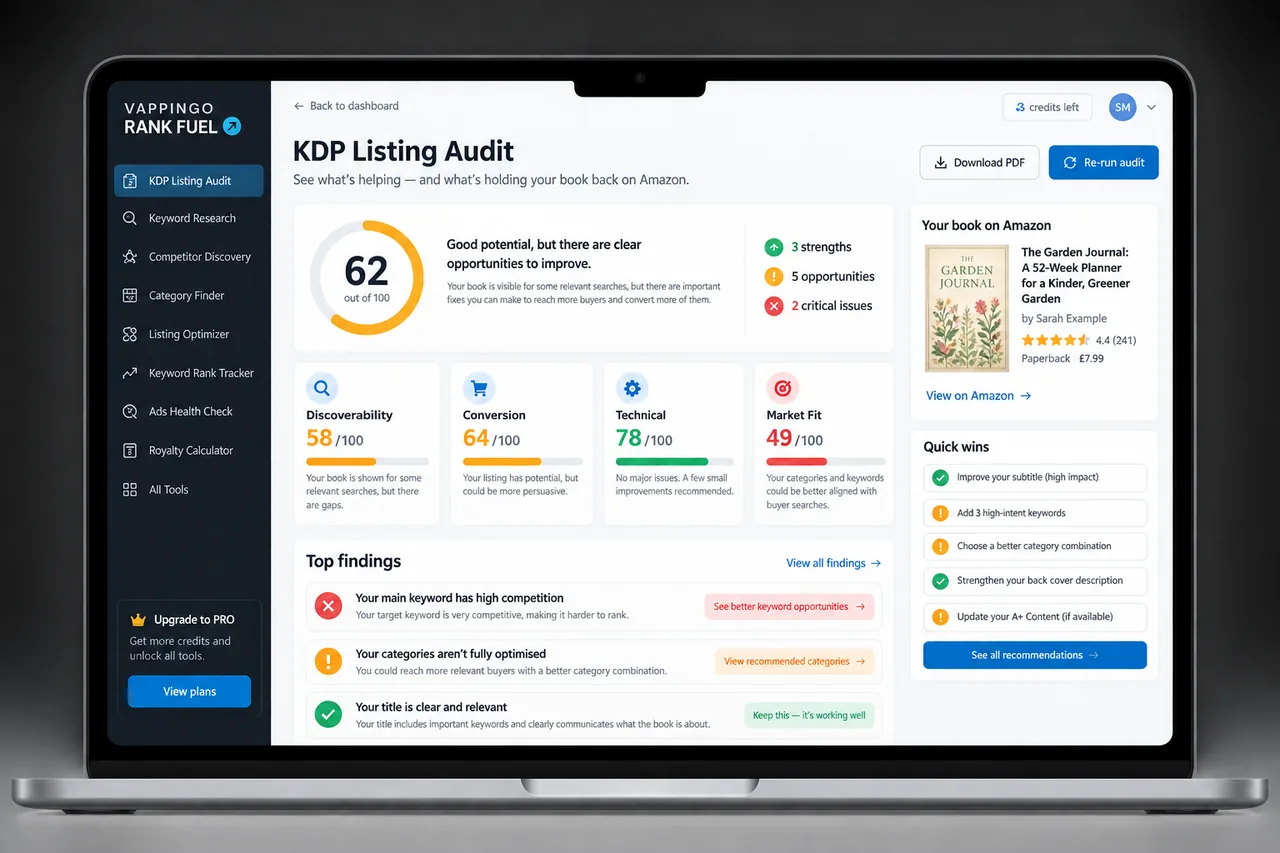
Rank Fuel’s Category Finder and Category Research can help you compare relevant paths and estimated competition. Use the results to support an accurate positioning decision, then confirm the category in KDP.
Frequently Asked Questions
Can a nonfiction book use categories from different subjects?
Yes, when the manuscript genuinely belongs in each subject area. The goal is to reflect substantial content and reader intent, not to maximize the number of unrelated shelves.
Should I choose the categories with the lowest competition?
Only after relevance. Competition can help you decide between equally accurate options, but low competition does not make a misleading category acceptable.
How many categories can I select?
KDP currently lets authors select up to three categories during book setup. Options are based on primary audience, primary marketplace, and format.
Can keywords help if KDP does not offer the exact niche I want?
Yes. KDP says keywords can add specificity and help Amazon determine how to shelve a book when the category selector does not capture every nuance.
Do I need the same categories for eBook and paperback?
No. Available category options can differ by format, so review each edition separately while keeping the core positioning consistent.
How long do category updates take?
KDP says new category placements can take up to 72 hours to display after an update.
Use Categories to Clarify the Book’s Job
A strong nonfiction category set makes the book easier to understand. It tells Amazon and the shopper what subject the book covers, what problem it addresses, and which readers should care, without stretching the metadata beyond what the manuscript can support.
Build a generous shortlist, verify the live shelves, and then use competition as a tie-breaker among accurate choices. That produces a more durable strategy than selecting the three categories that happen to look easiest on publishing day.