KDP Categories for a Book Series: Coordinate the Reader Promise, Not a Mythical Ranking Score
Series categories should create reader clarity, not chase a hidden shared authority score. Keep core positioning coherent while allowing accurate variation by book, format, and marketplace.
Series category strategy should create consistency for the reader without pretending that several books in one category build a hidden shared ‘authority score.’ Amazon does not publish a rule saying a series receives cumulative ranking power because multiple volumes use the same categories.
The practical value of coordination is simpler: readers see the books in the right browse environments, the series presents a coherent market identity, and you can compare performance across titles without every volume being positioned as a different product.
The Current KDP Category Rule
KDP currently lets authors select up to three categories when creating or editing a book. Category availability can differ by format and marketplace, so the exact choices for an ebook, paperback, or hardcover may not be identical.
Choose the primary marketplace first, then select the most accurate available placements. KDP explicitly warns against misleading categorization and reviews updates before they appear.
Choose One or Two Core Category Ideas for the Series
If every volume serves the same genre and reader, the core category logic should usually remain recognizable across the series. That helps readers encounter later books in the same broad shopping context and keeps your own reporting easier to interpret.
Do not force exact matching where a later volume genuinely changes subject or audience. A series can have a shared core and still allow one slot to reflect the distinctive topic, trope, setting, or age range of a particular book when the available category tree supports it.
Coordinate Across Formats Without Assuming the Trees Match
KDP notes that some categories are unavailable for certain formats. When the exact ebook category does not exist for print, choose the closest accurate equivalent rather than selecting an irrelevant branch simply for consistency.
The same applies across countries. Category trees differ between marketplaces, so an Amazon.com strategy cannot be copied mechanically into another store. Coordinate the reader intent, not the exact path text.
Use Keywords for Specificity the Category Tree Cannot Provide
Categories are relatively broad. Backend keywords can express setting, trope, audience, problem, tone, or other specific concepts that do not have their own browse placement. KDP itself says keywords can help determine shelving where a specific category is unavailable.
For a series, keep recurring search concepts consistent when they genuinely describe every book and reserve other keyword space for the distinctive promise of each volume. Avoid simply duplicating the category name in every backend field.
Category Strategy and the Amazon Series Page Are Different Systems
KDP series pages group books, show order and formats, and can support related content and eligible bulk buying of Kindle editions. That customer-facing series relationship does not depend on all books sharing identical categories.
Use the series page to communicate order and catalog relationship. Use categories to position each title accurately in browse. Coordinating both creates a clearer reader journey without pretending one is a ranking shortcut for the other.
Do Not Choose Categories Only for Bestseller Badges
Category sales rank can make a book visible inside a browse area, but the category should still describe the product accurately. Selecting an obscure or weakly related category only because the bestseller threshold appears lower can create a poor shopping experience and may violate KDP’s categorization rules.
A badge is a temporary outcome. Reader relevance is the durable reason to choose the category.
Manage Category Changes as Experiments
KDP says category updates can take up to 72 hours to appear, and sales-rank display after a category change can take up to a week. Record the old categories and change date before testing a new placement.
Do not rotate all three categories across every book in the series at once. Change the title where the evidence is strongest, observe whether the new browse environment actually fits, then decide whether the lesson should be applied elsewhere.
A Practical Series Category Framework
For each book, define the core genre or subject, the intended reader, the most specific accurate browse placements available, and the one aspect that differs from the rest of the series. Choose categories from that map rather than copying book one blindly.
Review the whole series after each new release. A category that made sense when book one launched may no longer describe the catalog once the series develops into a broader promise.
Where Rank Fuel Fits
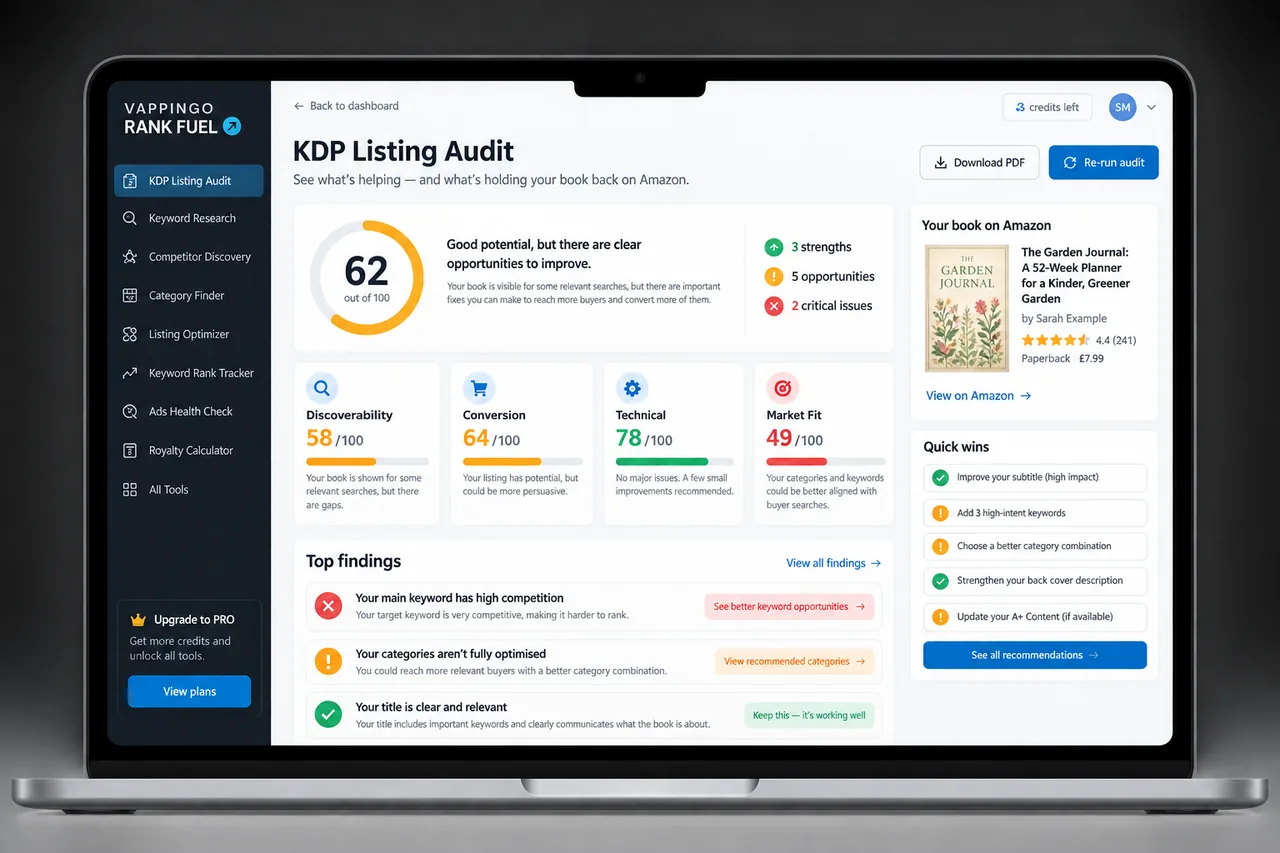
Use the tool that answers the next decision rather than opening everything at once. Keep the evidence attached to the same book so research, listing work, ranking changes, and advertising decisions build on one another.
| Tool | Use it when… |
|---|---|
| Category Finder | Find accurate category paths for each book. |
| Category Research | Compare category evidence when several placements are genuinely relevant. |
| Keyword Research | Use buyer-search evidence to add specificity the category tree cannot express. |
When One Book Deserves a Different Category
A series can evolve. A later volume may shift from romantic suspense toward courtroom thriller, move to a different age band, focus on a new professional use case, or become a companion workbook rather than a core text. Forcing the exact book-one categories onto that title can make the catalog look consistent while making the individual product harder to find.
Keep the core audience in view, then let the actual content decide. Category coordination should express genuine overlap, not erase meaningful differences between books.
Audit the Series as a Whole Twice a Year
Open every live title and compare categories, keywords, series order, covers, descriptions, and format links. Look for accidental drift caused by publishing books at different times under different versions of KDP’s category system.
Then decide whether inconsistency reflects a real product difference or old setup debt. Update only the fields where a clearer reader path or more accurate shelf is available.
Track this for every volume
- Core genre or subject
- Primary reader
- Three current category choices
- Closest equivalents for other formats
- Distinctive category need for this volume
- Recurring search concepts
- Date categories were last reviewed
Frequently Asked Questions
Should every book in a series use exactly the same categories?
Not necessarily. Shared core categories often make sense, but individual books can require different accurate placements.
How many categories can I choose?
KDP currently lets authors select up to three categories in book setup.
Are categories identical for ebook and paperback?
No. KDP says category availability can differ by book format.
Do shared categories give a series cumulative ranking authority?
Amazon does not publish a series-level category authority score or guarantee that identical categories create a ranking boost.
Does the Amazon series page require identical categories?
No. Series-page relationships and category choices are separate parts of KDP.
How long do category changes take?
KDP currently says changes can take up to 72 hours to display, while sales-rank display after a category change can take longer.
Coordinate the Reader Promise, Not Just the Category Labels
A series feels coherent when every book reaches the right reader and the catalog relationship is obvious. Category choices should support that experience, even when the exact path differs by format or volume.