How Many Keywords Does a KDP Book Need?
KDP provides up to seven keyword fields, but good metadata is about distinct reader searches, not filling every available character with extra words.
The question “how many keywords does my book need?” has a direct answer and a more useful answer. The direct answer: seven fields, each up to 50 characters. That is your allocation. The more useful answer: you should use all seven fields at or near their character limit, because every unused field is wasted discoverability potential. For the full keyword strategy, see our
Amazon changes metadata, taxonomy, and merchandising systems. This article reflects the September 2026 workflow, but the live KDP interface and help pages remain the final authority.
The Direct Answer
KDP gives you up to seven keyword fields. There is no useful universal answer such as “a book needs exactly 25 keywords” because a field can contain a relevant short phrase rather than one isolated word. The practical goal is to cover the strongest distinct reader searches you can justify without duplication or prohibited language. See KDP’s current keyword guidance.
Think in search intents rather than raw keyword count. A single phrase such as “Victorian female detective mystery” carries more reader context than four unrelated single words scattered across several fields. Seven well-researched fields can therefore represent many concepts without becoming a bag of disconnected terms.
Why You Should Use All Seven Fields
Seven fields are seven opportunities, so there is little reason to leave useful, compliant search coverage unused. The important qualifier is useful. Do not add a weak synonym, unrelated trending phrase, or promotional claim merely to avoid an empty field.
If research genuinely produces fewer than seven strong phrases, improve the research before you pad the metadata. Look at audience, problem, outcome, genre, subgenre, trope, setting, format use case, recipient, or comparable search language as appropriate to the book. Stop when the next phrase adds less relevance than risk or noise.
Why Filling Every Character Is the Wrong Goal
Do not make “fill every character” the strategy. KDP’s public guidance focuses on relevance and prohibited-term rules rather than a target character count. Write natural keyword phrases that represent how a shopper could search, and avoid cramming several weak ideas together simply because the interface accepts more text.
A useful field is easy to explain: you can point to the reader, need, trope, subject, or use case it represents. If a field contains five unrelated fragments that only exist to maximize characters, it becomes harder to evaluate after launch and easier to contaminate with low-quality terms.
Extending Coverage Beyond the 7 Fields
Title, subtitle, categories, series information, and other metadata all help Amazon understand a book, but they are not loopholes for stuffing more backend keywords. The description in particular should not be used as a keyword reservoir: KDP metadata rules prohibit keyword or book-tag phrases in descriptions. See current metadata guidelines.
Extend discoverability by improving the quality of the whole listing: accurate title/subtitle where appropriate, correct categories, a persuasive description, strong cover, relevant ads, and useful series metadata. Each element should do its own job instead of being turned into another keyword field.
Quality Over Quantity
Seven highly targeted, accurately relevant, long-tail keyword phrases will outperform seven broad, generic, or misleading keywords every time. The number of fields is fixed at seven. The quality and targeting precision of those seven phrases is where the performance difference is made. Use all seven fields. Fill them near their character limits. Make each phrase genuinely distinct. Make every phrase accurately describe your book. These four rules will make your seven-field keyword strategy as effective as it can be.
‘s produces a complete, optimized listing from a single sentence , including all seven keyword fields filled near their character limits with distinct, research-backed phrases calibrated to your specific book. Your keyword coverage brings readers in. from Vappingo ensures the book those readers find is worthy of their five-star review.
Count Search Intents, Not Individual Words
A useful audit counts distinct buyer intents rather than the number of words you typed. If seven fields all point to “cozy mystery” with minor variations, you have used seven fields to express one idea. If the fields cover subgenre, setting, protagonist type, tone, trope, audience, and a highly relevant long-tail search, the metadata contains several genuinely different discovery routes. That distinction is more actionable than chasing a universal keyword count.
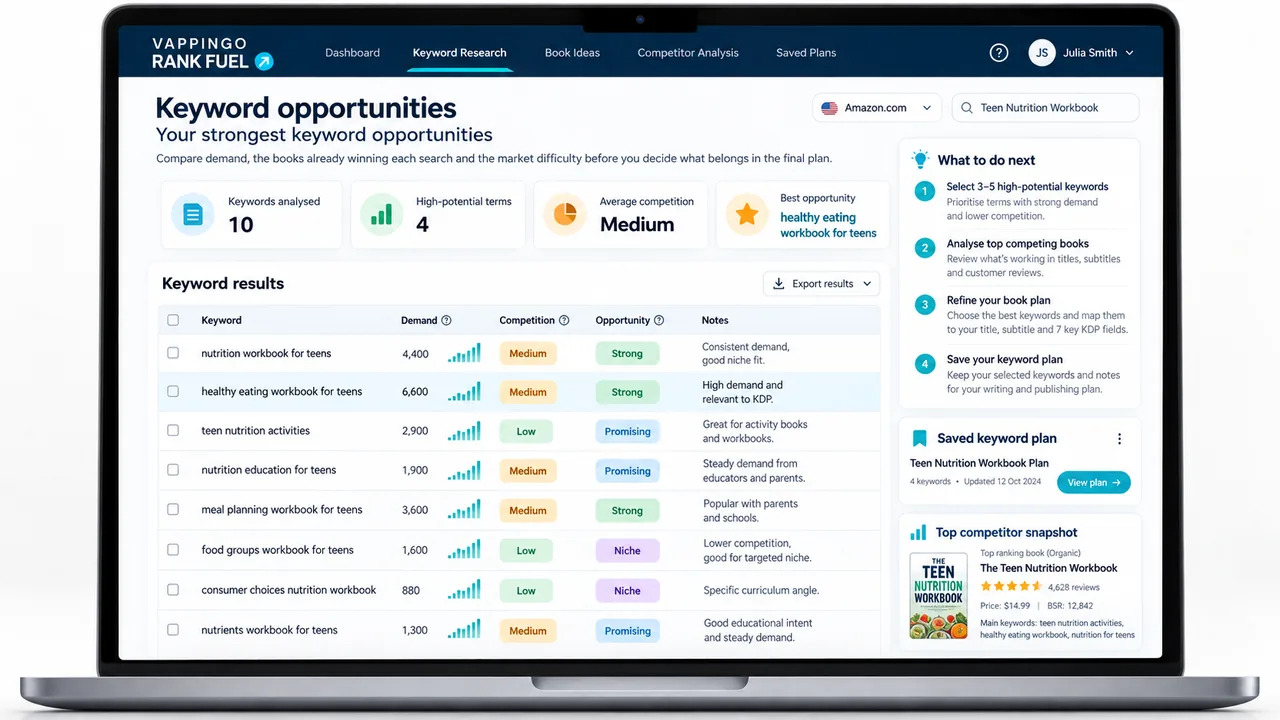
KDP Rank Fuel can support keyword, category, rank, and market research. Its scores and estimates are research aids; Amazon does not publish the proprietary formulas behind search placement or exact sales thresholds.
Metadata can help the right reader find a book, but the listing and manuscript still have to earn trust. Vappingo provides professional manuscript proofreading by qualified human editors.
Frequently Asked Questions
How many KDP keyword fields are there?
KDP currently provides up to seven keyword fields. Use them for relevant keywords or short phrases and avoid padding the set with duplicate or prohibited language just to fill space.
Should I repeat my title or categories in the keyword fields?
Usually no. KDP advises against repeating metadata already covered elsewhere. Use the limited keyword fields to add distinct reader search language.
How often should I change KDP keywords?
There is no required refresh schedule. Change them when research, positioning, marketplace behavior, or post-launch evidence gives you a clear reason, and keep a record of what changed.
Can I use competitor author names or book titles as keywords?
KDP warns against unauthorized references to other authors, books, or trademarked terms. Use compliant reader language and verify the current metadata rules before publishing.
Do KDP keywords guarantee a search ranking?
No. Keywords are metadata inputs, not guaranteed positions. Search visibility also depends on relevance, shopper behavior, competition, listing quality, and Amazon-controlled systems.
Make the Metadata Easier to Defend
The strongest KDP metadata strategy is easy to explain: every category accurately describes the book, every keyword represents a plausible reader search, every change has a reason, and no part of the plan depends on a retired support workflow or an undocumented ranking formula. That standard makes the listing safer, clearer, and easier to improve as Amazon changes.