Best KDP Keyword Research Tools in 2026: An Honest Comparison
A current comparison of Publisher Rocket, Helium 10, K-lytics, Book Bolt, Rank Fuel, and free KDP research workflows, focused on the publishing decision each tool actually helps you make.
You search for the “best KDP keyword tool” and immediately run into a problem. The products are not really doing the same job.
Publisher Rocket is a mature author-research tool with a one-time price. Helium 10 is a much larger Amazon seller platform with powerful keyword intelligence. K-lytics looks at whole Kindle markets over time. Book Bolt combines research with visual book creation. Rank Fuel tries to connect research to the book you are actually publishing and what you should do next.
Then there is Amazon itself, which gives you enough free information to make a sensible first pass if you are willing to do the work manually. So there is no useful answer to: “Which tool has the most keyword data?” The better question is: “What decision am I trying to make, and what do I need the tool to do after it gives me a keyword?”
The Quick Answer: There Is No Single Best KDP Keyword Tool for Everyone
Choose the tool around the work you actually need to do.
Publisher Rocket is excellent if you want established book-specific research for a one-time price. Helium 10 makes most sense if you already run a broader Amazon business or want enterprise-level Amazon keyword tooling. K-lytics is strongest when you are deciding whether a genre or subgenre is worth entering. Book Bolt is especially attractive when keyword research sits alongside low-content, puzzle or visual-book production. KDP Rank Fuel is designed for authors who want the research connected to listing, competitor, tracking and ads decisions.
If this is your first book and money is tight, start free. Amazon’s search results, autocomplete suggestions, category pages, book detail pages and Best Sellers Ranks can tell you a great deal before you spend anything. Paid software becomes useful when you want to do the same work faster, inspect competitor search footprints, compare more evidence at once or preserve the research so you can act on it later.
What Does a Good KDP Keyword Tool Actually Need to Do?
The previous version of this article used a three-question framework built around a supposed Amazon “Amazon ranking system semantic quality” model. That framework needs replacing.
Amazon’s current KDP guidance says you can add up to seven relevant keywords or short phrases to a book. It advises you to choose terms that accurately reflect the content and to think like a reader. Amazon does not publish a scoring model saying a keyword tool must produce copy that meets an “Amazon ranking system semantic standard”. So I would judge a keyword tool on five much more practical questions:
- Discovery: Can it help you find buyer-search language you would not have found yourself?
- Demand and competition: Does it give you evidence for deciding whether the search is worth targeting?
- Competitors: Can you investigate the books already winning those searches?
- Application: Does the research connect to the listing, categories or ads, or do you need to do that work elsewhere?
- Tracking: Can you see what happens after publication, or is the tool mainly for research before launch?
None of those five functions is mandatory. A focused research tool can be excellent without writing a listing. A market-intelligence service can be valuable without tracking a single keyword. The point is to understand where the product stops before you buy it.
The Best KDP Keyword Tools in 2026: Comparison at a Glance
| Tool | Best for | Research | Listing workflow | Keyword tracking | Current price |
|---|---|---|---|---|---|
| Publisher Rocket | Book-specific research without a subscription | Strong | Research-led, no complete listing generator verified | No dedicated tracker verified | $199 one time |
| Helium 10 | Broad Amazon seller intelligence | Very strong | AI Listing Builder | Yes | $129/mo Platinum, $99/mo annual equivalent |
| K-lytics | Genre and market-entry decisions | Market-level rather than operational keyword research | No | Market trends, not book keyword positions | Premium $37/mo; many reports $47 |
| Book Bolt | Research plus visual/templated book production | Strong | Listing tools available | No dedicated own-ASIN keyword tracker verified | $23.99/mo Pro |
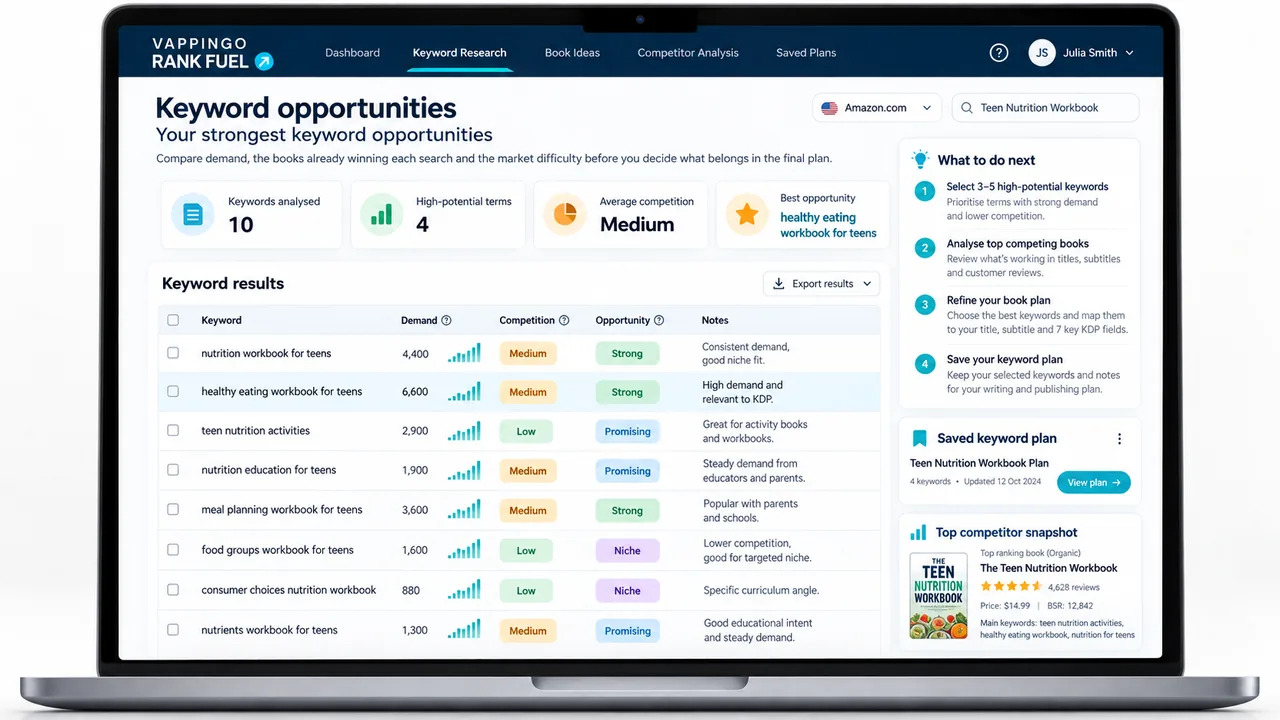
| KDP Rank Fuel | Book-specific research connected to next actions | Strong, especially competitor-led workflows | Generator, audit and optimization | Yes | Free entry; $9 Starter; $29 Pro |
Those summaries are deliberately broad. The detail matters.
Publisher Rocket: The Easy Recommendation for Focused Book Research
Publisher Rocket remains one of the easiest KDP research tools to recommend. It costs $199 once, with lifetime access and free updates. Its current core feature set includes:
- Keyword Search;
- Competition Analyzer;
- Category Search and category insights;
- Reverse ASIN;
- Amazon Ads research.
Reverse ASIN is particularly useful because you can start from a real competing book and investigate the keywords associated with it. Standard users currently receive 50 Reverse ASIN searches per month.
The advantage of Rocket is focus. You are not paying for inventory software, FBA operations or a broad e-commerce suite. You open an author-focused tool and research books.
The limitation is equally straightforward. Publisher Rocket is primarily a research product. Its current public feature set does not advertise a complete listing generator that writes the title, subtitle, description and all seven KDP keyword boxes for you, and it does not advertise a dedicated own-book keyword rank tracker.
That is not a flaw if you are good at applying the research yourself. If your preferred workflow is: Research → make my own decisions → update KDP manually then the one-time price is compelling. Read the full Publisher Rocket Review 2026 or our Publisher Rocket vs KDP Rank Fuel comparison for the detailed trade-offs.
Helium 10: The Most Powerful General Amazon Option, but Do You Need All of It?
Helium 10 is in a different weight class. Its keyword tooling is sophisticated. Current features include reverse-ASIN keyword research, seed-keyword discovery, historical trend analysis and a mature Keyword Tracker. It also has an AI Listing Builder.
So the old claim that Helium 10 offers research and tracking but “does not answer the listing-copy question” is no longer accurate. The real issue for a KDP author is fit. Helium 10 is built for Amazon and e-commerce brands more broadly. Its platform extends into:
- product research;
- listing creation;
- keyword tracking;
- advertising automation;
- inventory;
- profit reporting;
- refund operations;
- multi-marketplace seller management.
If you already run an FBA or Seller Central business, using the same subscription for your KDP research can make perfect sense. If you publish only books, you need to ask how much of the platform you will actually use.
Current Platinum pricing is $129 per month, or the equivalent of $99 per month with annual billing. Diamond is substantially higher.
So I would choose Helium 10 because you want Helium 10’s broader Amazon platform, not merely because you need seven KDP keywords. See our updated Helium 10 for KDP Authors review for the full KDP-specific analysis.
K-lytics: Not Really a Keyword Tool, and That Is the Point
K-lytics describes itself as a market intelligence service, not a keyword or niche-finding software tool. That is the right way to understand it. Instead of asking: “Which keyword should this particular book target?” K-lytics asks questions such as:
- Which Kindle genres are growing?
- How strong is demand in this subcategory?
- How intense is competition?
- What price patterns are working?
- How have sales ranks changed over months or years?
- Which narrower markets appear more attractive than the headline genre?
Some genre reports also include keyword observations and common language used by successful books. But that is not the same as a Reverse ASIN workflow or a list of seven keywords for one title.
K-lytics becomes valuable when the decision is bigger than the metadata. If you are about to spend six months writing the first book in a new series, paying for broader genre evidence can make much more sense than obsessing over one keyword.
Premium currently costs $37 per month, while many standalone current genre packages are $47. Read our K-lytics Review 2026 if you are choosing a market rather than optimizing an existing book.
Book Bolt: Research Plus Book Creation
The old version of this comparison described Book Bolt as “low-content research only”. That is badly out of date.
Book Bolt’s current research suite includes product research, keyword research, Book Scout, KDP Spy, trend-style research and category tools. More importantly, Book Bolt now connects that research to a substantial creation environment.
Book Bolt Studio can help you create:
- covers;
- journal and planner interiors;
- puzzle books;
- crosswords and Sudoku;
- colouring books;
- activity books;
- AI-assisted visual and story-book content.
It also provides listing-related tools and the Book Bolt Lister, so it is no longer fair to say it stops at research. Its clearest strength is when the keyword research is part of a research → design → publish workflow.
Book Bolt Pro currently costs $23.99 per month, or $19.99 per month on annual billing, and includes a 3-day free trial. If you create visually led KDP products and want a mature drag-and-drop design ecosystem as well as research, Book Bolt deserves serious consideration. See the updated Book Bolt Review 2026 for the full comparison.
KDP Rank Fuel: Best When You Want the Research to Turn Into the Next Action
Disclosure: Vappingo builds KDP Rank Fuel, so the Rank Fuel assessment below is first-party. Competitor pricing and features change, so check the current product page before purchasing.
Vappingo built KDP Rank Fuel, so treat this section as a product-owner description rather than an independent review. The central idea behind Rank Fuel is different from “give me the biggest possible keyword database”.
It is:
Bring us a book, a competitor or an idea. Use the evidence to decide what to do next.
The current platform includes book-specific workflows such as:
- Book Keyword Spy: start with a competitor ASIN and inspect the Amazon searches it ranks for;
- Keyword Competition Checker: inspect the books competing on a target search with BSR, review, price and estimated-sales evidence;
- Keyword Gap Finder: compare your ASIN with a competitor and find searches where the competitor ranks strongly and you do not;
- Listing Generator: create 100+ keyword ideas plus the title, subtitle, description, seven KDP keyword boxes and category recommendations;
- Listing Audit: diagnose technical, discoverability and conversion issues in an existing listing;
- Listing Optimizer: improve the description and keyword boxes around selected target searches;
- Keyword Rank Tracker: save keyword-position snapshots so you can see movement over time;
- Competitor Discovery: extend competitor research after publication;
- Amazon Ads tools: connect keyword evidence to campaign planning and report-based weekly decisions.
The current code also confirms the main plan structure: free entry with 3 welcome credits, Starter at $9 per month with 50 credits and Pro at $29 per month with 150 credits. There is one important limitation to state openly.
Some live-data tools are more US-focused than Publisher Rocket or Helium 10. If international marketplace coverage is central to your publishing business, check the exact marketplace support of the tool you need before subscribing.
Free KDP Keyword Research: More Useful Than It Sounds
If you are publishing your first book, do not assume you need software immediately. Start on Amazon.
Enter a phrase. Read the autocomplete suggestions. Look at the first page. Open the books that genuinely compete for the same reader.
Then ask:
- Are several relevant books selling, or just one?
- How strong are the review counts?
- What prices and formats dominate?
- Do the covers and descriptions look professional?
- Does the phrase describe the book you could actually create?
- Would someone using this search be pleased to find your book?
You will not get a neat search-volume number. That is fine.
You are learning whether the search represents a plausible market before you decide whether deeper paid data is worth buying. Our revised Free KDP Tools guide shows how far you can take the no-subscription route.
A Note on Search Volume, Sales Estimates and “Real Amazon Data”
Every comparison of KDP research tools needs this warning. Do not treat an estimated monthly search volume or BSR-derived sales figure as a fact Amazon has handed to you.
Tools can use different providers, datasets, modeling approaches, update schedules and estimation formulas. That is why you can run the same keyword through two products and receive different numbers.
The useful question is usually not:
“Which number is perfectly exact?” It is: “Does the evidence help me distinguish a stronger opportunity from a weaker one?”
Use estimates comparatively. If you see a keyword with apparently strong demand, inspect the actual Amazon search results before you decide it is good. Our KDP Keyword Search Volume guide explains how to interpret the number, while How to Tell If a KDP Keyword Is Too Competitive helps you read the books behind it.
Do You Need a Keyword Tool That Also Writes the Listing?
Maybe. But this is where the old comparison became too biased.
It argued that research tools which stopped at keywords were fundamentally incomplete because Amazon’s supposed Amazon ranking system model required a special semantic copywriting layer. Amazon does not publish that requirement.
A research-only product can be exactly the right product if you know how to write the listing yourself. What matters is that the listing accurately presents the book and persuades the right reader.
Keyword research helps you understand the vocabulary, buyer and competitive environment. It should inform the copy without turning the description into a search-term list.
If writing the listing is the part you repeatedly struggle with, then a connected listing generator or optimization workflow becomes genuinely valuable. If you already write strong copy, paying for that layer may add very little. Our corrected Semantic Search and KDP Listings guide separates what Amazon actually says from the Amazon ranking system folklore.
Do You Need Keyword Rank Tracking?
Rank tracking becomes more useful after you have something worth tracking. For one first book, you may be perfectly happy checking Amazon manually from time to time. For a catalog of 20 books targeting dozens of searches, manual tracking becomes a job. A keyword tracker can help you answer:
- Did the book start appearing for the target term?
- Is the position improving or slipping?
- Did a listing change coincide with movement?
- Which keywords are already strong enough that you should avoid disturbing them?
- Where does a competitor have visibility that you do not?
Helium 10 has mature keyword tracking. Rank Fuel has a KDP-specific Keyword Rank Tracker and broader trend/gap workflows. Publisher Rocket’s current public feature set does not advertise a dedicated own-book tracker, while K-lytics monitors market behavior rather than your book’s individual keyword positions.
Do not assume a ranking change proves that one metadata edit caused it. Amazon positions move for many reasons, including sales activity, competition and wider demand.
Which KDP Keyword Tool Fits Your Publishing Stage?
I would choose by the job in front of you rather than by an arbitrary number of books published.
- Start with Amazon and free tools.
- Pay only if manual research leaves an important question unanswered.
- K-lytics can be worth it unusually early if the market decision itself is expensive, such as committing to a long commercial series.
- Publisher Rocket is the obvious focused one-time-purchase candidate.
- Rank Fuel is worth comparing if you want competitor research to flow into the listing and post-publication workflow.
- Use Helium 10 if you already pay for it and the book data you need is available.
- Do not buy a second KDP tool merely because somebody says general Amazon software cannot work with books.
- Book Bolt’s research plus mature design environment is a strong combination.
- Rank Fuel is worth comparing if you prefer structured book generation tied to listing, tracking and ads workflows.
If you already have a book that is visible but not selling, stop shopping for keyword tools for a moment. The keyword may not be the problem. Read Why Your KDP Keywords Are Not Bringing Buyers before you replace your whole research stack.
Frequently Asked Questions About KDP Keyword Research Tools
What is the best KDP keyword research tool in 2026?
There is no universal winner. Publisher Rocket is excellent for focused book research at a one-time price. Helium 10 is strongest if you need a broader Amazon seller platform. K-lytics is for market-level genre intelligence. Book Bolt combines research with visual book production. Rank Fuel connects book-specific research to listings, competitors, tracking and ads decisions.
Is Publisher Rocket still worth buying?
Yes, particularly if you want mature keyword, category, competitor and Reverse ASIN research without an ongoing subscription. Its current $199 one-time price is attractive for authors who are comfortable applying the research themselves.
Can Helium 10 be used for KDP keyword research?
Yes. Helium 10 can work with Amazon ASIN and keyword data and provides sophisticated reverse-ASIN research, keyword discovery and tracking. The issue for a KDP-only author is usually price and workflow fit, not whether the platform is technically capable of researching books.
Is K-lytics a keyword research tool?
Not in the same sense as Publisher Rocket, Helium 10 or Rank Fuel. K-lytics is a Kindle market-intelligence service focused on genre performance, trends, competition and category behavior. Some reports contain keyword observations, but its main value is deciding which market deserves deeper investment.
Is Book Bolt only for low-content keyword research?
No. Book Bolt now combines product and keyword research with a broad Studio for covers, interiors, puzzles, colouring and other visual publishing workflows. Its current scope is much wider than journals and notebooks.
Do I need paid software to find KDP keywords?
No. You can begin with Amazon autocomplete, search results, competing books, category pages and BSR patterns. Paid tools become useful when you want search-volume estimates, competitor keyword footprints, historical tracking or faster analysis across many books and searches.
Which KDP tool includes keyword rank tracking?
Helium 10 has a mature Keyword Tracker, while KDP Rank Fuel includes a book-specific Keyword Rank Tracker plus gap and trend workflows. Publisher Rocket’s current public feature set does not advertise a dedicated own-book keyword rank tracker.
Do I need a special semantic keyword tool for Amazon’s ranking system?
Amazon does not publish a KDP “semantic quality” specification that keyword tools can optimize against. Use accurate keywords that reflect the book, study real buyer searches and write the public listing for the reader rather than buying software because it claims access to a secret scoring model.
Final Verdict: Buy the Workflow, Not the Biggest Keyword List
If you are still working out what you can do without a subscription, start with the free KDP tools guide. If you already have a published book, move from generic keyword discovery into the Book Keyword Spy workflow or the Keyword Gap Finder when those questions match the book you are trying to improve.
The strongest keyword tool is the one that removes the next real uncertainty in your publishing process. If you need focused research and want to pay once, Publisher Rocket is hard to dismiss.
If Amazon is a larger business for you, Helium 10 may make more sense than maintaining a separate author stack. If you are deciding what genre deserves the next year of your writing life, K-lytics is answering the more important question.
If book creation and visual design are part of the same job as research, Book Bolt is much broader than its old low-content reputation suggests. If you want competitor evidence, listing work and post-publication tracking attached to the same book workflow, that is where Rank Fuel is designed to compete.
Do not buy a keyword tool because it has more data. Buy it because it helps you make a better publishing decision.
And if Amazon itself can answer today’s question for free, keep your money until the next question is harder.