Amazon Ads and Book Pricing Strategy: How Price Shapes Campaign Economics
Understand how ebook and print pricing change Amazon Ads break-even economics, CPC tolerance, promotion strategy, and series acquisition decisions in 2026.
Pricing is the single most underrated variable in Amazon Ads performance. Most authors spend hours optimizing bids, building negative keyword lists, and tweaking targeting settings, but they set their book’s price once and never revisit it, even when their campaigns consistently lose money. The uncomfortable truth is that many unprofitable Amazon Ads campaigns aren’t caused by bad keyword choices or wrong bids. They’re caused by a price point that makes profitability mathematically impossible at any bid level. This guide examines the specific mechanics of how book pricing interacts with Amazon Ads economics. It covers how to calculate your actual royalty at different price points, how price determines your breakeven ACoS and maximum viable CPC, how price affects conversion rates, and how to use strategic pricing changes, including temporary promotions, to make your advertising work harder.
The Royalty-Price-ACoS Triangle
Amazon.com’s qualifying 70% Kindle royalty price band expanded to $2.99-$12.99 on July 7, 2026. The 35% option remains available across a much wider price range, subject to KDP’s size and marketplace rules. For print, the royalty is 50% or 60% of list price depending on marketplace and price threshold, minus printing cost.
Those rules determine the money available before advertising, but they do not tell you whether a price will convert. Use the royalty estimate for the actual format and marketplace, then compare it with observed CPC and conversion rather than applying a generic ACoS benchmark.
Estimate Your Maximum Viable CPC Carefully
A simple direct-sale estimate is royalty per sale multiplied by expected conversion rate. If a format earns $3.00 royalty and one in ten qualified ad clicks converts, the rough break-even CPC is $0.30. The formula is useful for scenario planning, not a promise that the next ten clicks will contain exactly one sale.
Use a range rather than one point estimate when you have little data. As the campaign accumulates clicks and attributed purchases, replace assumptions with your own observed conversion and keep KU or series value as a separate layer.
What $0.99 Changes
A $0.99 Amazon.com ebook normally sits in the 35% royalty option, which leaves much less direct royalty to fund paid clicks. That can make always-on acquisition difficult unless the title has valuable downstream series economics or the discount is being used as a deliberate promotion.
KDP Select promotions have separate rules. An eligible Kindle Countdown Deal can preserve the 70% royalty option during the promotional price window in supported marketplaces, while a Free Book Promotion creates no normal sale royalty. Plan the ad objective around the promotion type instead of using one break-even CPC across every price state.
There Is No Universal “Optimal” Ad Price
The current 70% band gives authors more room to test higher ebook prices than the old $9.99 ceiling allowed. That does not make $12.99 automatically better for ads. Genre expectations, book length, author reputation, format alternatives, KU enrollment, and competing prices all influence conversion.
Test price when the likely gain is economically meaningful, and avoid changing price, cover, description, and targeting simultaneously. If several variables move together, you will not know which change produced the result.
Paperback Pricing for Ads
For Amazon.com paperbacks, the 60% royalty rate currently begins at $9.99; $9.98 and below use the 50% rate. Amazon.co.uk currently switches at £7.99, and other marketplaces have their own thresholds. In every case, printing cost is deducted after the royalty-rate calculation.
That creates a real pricing discontinuity, but the shopper still sees the retail price. Check the exact KDP royalty estimate and compare your title with credible alternatives before increasing price purely to cross the royalty threshold.
Use Promotions and Price Changes as Measured Tests
A temporary lower price can increase conversion, but it also changes royalty and therefore changes the CPC you can afford. Before a promotion begins, write down the objective, promotion window, price, expected royalty, ad budget, and the metrics you will compare afterward.
Do not assume a discount automatically creates an organic ranking boost, reviews, or a lasting visibility reset. Treat any post-promotion lift as observed business evidence and compare it with the cost of acquiring that volume.
Series Pricing and Loss-Leader Strategy
A series can justify spending more to acquire a book-one reader when later books generate additional royalty. Model that with your own observed read-through or cohort sales rather than an industry benchmark. If 50% of book-one buyers eventually buy book two, that is useful; if the rate is unknown, use a range and keep the uncertainty visible.
Loss-leading is a portfolio decision. Continue only when downstream revenue is actually appearing and the series still produces a positive contribution after ad spend, discounts, and format mix.
Build a Price-Test Worksheet
Before changing price, record the current list price, KDP royalty estimate, average CPC, attributed conversion rate, direct break-even CPC, KU status, and any measured series value. Decide what outcome would justify keeping the new price. A higher royalty per sale is only a win if the loss in conversion does not erase it.
Run the test long enough to see more than day-to-day noise and avoid changing major creative or targeting variables during the same window. Compare both campaign metrics and total KDP performance because a price change affects paid and organic shoppers at the same time.
Three Pricing Scenarios to Think Through
Scenario one is a standalone ebook with no KU or series value. Here the direct royalty needs to carry most of the acquisition cost, so a price that produces a healthy royalty but weak conversion can still fail. Scenario two is a KU series starter. Direct purchases may understate the title’s economic value, but KENP and read-through must be measured from KDP rather than guessed at keyword level.
Scenario three is a print-heavy nonfiction title. The list price must clear printing cost and the current print royalty threshold while remaining credible for the subject. In each case the same ACoS can mean something different because retail sales revenue is not the same as the royalty you keep.
When a Price Change Should Be Reversed
Reverse or rethink a price test when conversion deteriorates enough to reduce contribution, when ads lose viable targets because break-even CPC falls, or when the new price creates a poor value comparison against books serving the same reader. Do not keep a price simply because it unlocks a higher royalty percentage.
Keep a record of the old and new economics. If you later change cover, reviews, series depth, or positioning, the previously unsuccessful price may become viable under different conditions.
Separate Retail Revenue From Royalty in Your Dashboard
Amazon Ads reports attributed sales revenue, which is the retail value Amazon attributes to the campaign. KDP pays royalty, not retail revenue. That distinction is why a campaign can show a 50% ACoS and still be below direct break-even if the royalty retained from those sales is much less than half of the retail price.
Add a royalty-adjusted contribution column to your own worksheet. For print, subtract printing cost through the KDP royalty estimate; for ebooks, use the actual royalty option and delivery-cost estimate; for KU, keep page-read earnings in a separate KDP column. This makes pricing decisions financially legible instead of relying on ACoS alone.
Turn the research into a repeatable ad workflow
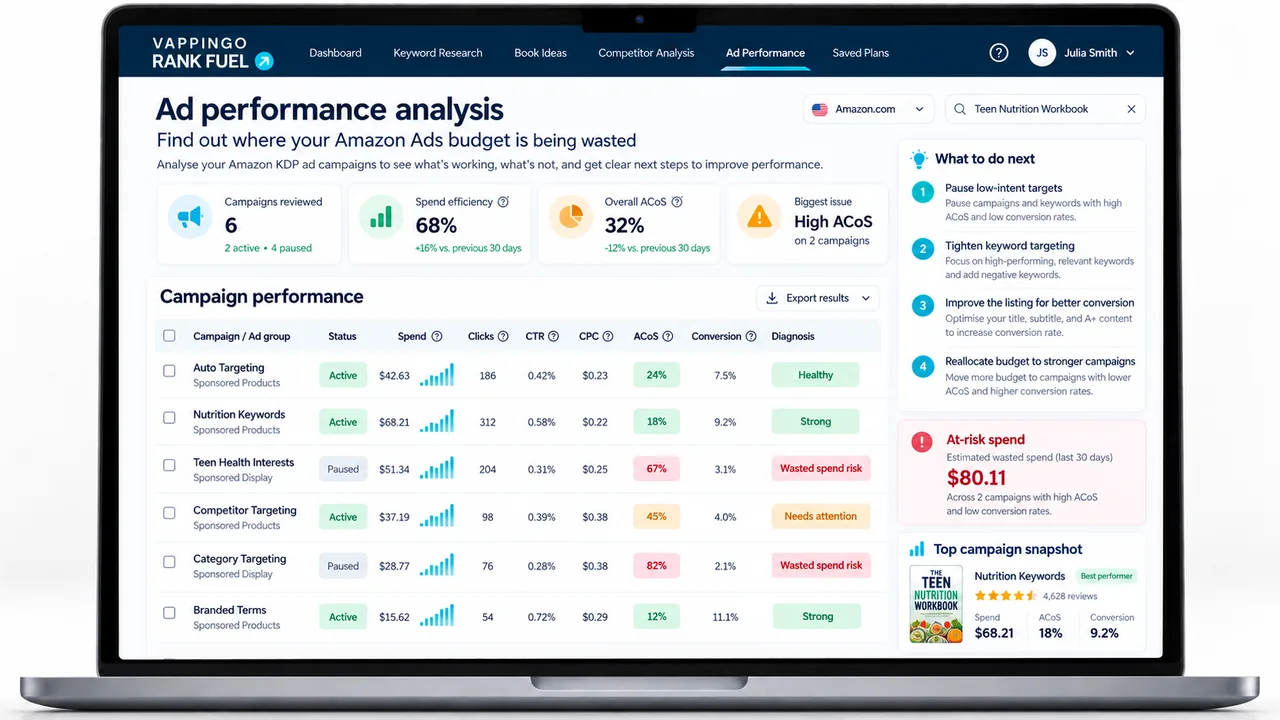
KDP Rank Fuel’s Amazon Ads Generator builds a guided five-campaign Sponsored Products plan, while Amazon Ads Weekly Coach helps turn exported reports into clear weekly decisions. Use the tools as decision support and keep your own royalty, conversion, and marketplace evidence in control.
Frequently Asked Questions
What is the current 70% Kindle price band on Amazon.com?
As of July 7, 2026, qualifying ebooks can use the 70% royalty option from $2.99 to $12.99 on Amazon.com.
What is the current US paperback 60% threshold?
Amazon.com paperbacks currently receive the 60% rate at $9.99 and above, before printing cost is deducted.
How do I estimate break-even CPC?
Multiply royalty per sale by an estimated conversion rate for a rough scenario, then replace the assumption with observed campaign conversion as data accumulates.
Is $0.99 always bad for advertising?
No, but the direct royalty is usually much smaller. It can make sense as a deliberate series-acquisition or promotion strategy when downstream value is measured.
Should I raise price just to get more royalty?
Only if the higher price still converts. Advertising economics depend on royalty and conversion together.
Price for Contribution, Not Just Royalty Rate
The winning price is the one that leaves enough contribution after royalty rules and ad spend while still converting the right shoppers. Test that relationship deliberately and document what changes.