Amazon Ads and KDP Select: Measuring Ads When Kindle Unlimited Matters
Learn how to evaluate Amazon Ads for KDP Select books when Kindle Unlimited page reads sit outside campaign sales reporting, including KENP, promotions, and series value.
If your book is enrolled in KDP Select, Amazon Ads works differently than it does for non-enrolled titles, and most guides skip over the distinction entirely. When readers borrow your book through Kindle Unlimited rather than buying it outright, a click on your ad doesn’t generate a sale. It generates a borrow, and your revenue comes from KENP (Kindle Edition Normalised Pages) read over the following days and weeks. That lag between ad spend and full revenue realisation changes how you should measure performance, set bids, and decide which campaigns to scale. Understanding the interplay between KDP Select and Amazon Ads isn’t just a technical nicety, it’s the difference between campaigns that look unprofitable on day one and are quietly generating many pages reads, and campaigns that genuinely aren’t working. This guide walks through the mechanics, the metrics, and the strategic adjustments KU authors need to make to advertise effectively in 2026.
How KDP Select Changes the Revenue Model
A KDP Select ebook can earn from direct Kindle purchases and from Kindle Unlimited pages read. Those earnings are calculated in different systems: direct ebook royalty follows KDP pricing rules, while KU earnings come from the monthly KDP Select Global Fund and eligible first-read KENP.
Advertising therefore needs two views. Amazon Ads tells you what it spent and which purchases it attributed; KDP tells you direct royalties and KU page-read earnings. Keep the sources separate before combining them into a book-level profitability view.
KENP Does Not Appear as Campaign-Level Ad Revenue
Kindle Edition Normalized Page reads are reported through KDP, not as a search-term or keyword metric in the Amazon Ads reports an author uses to optimize Sponsored Products. Amazon Ads reports attributed purchases and sales under its advertising attribution rules; KDP reports KU page reads and royalties under the KDP Select Global Fund.
That means you cannot honestly say a particular keyword produced a precise number of KENP from standard author reporting. You can compare ad activity with KENP trends at the book and time-period level, but label that as a directional relationship rather than click-level attribution.
Model KU Profitability Without Pretending You Have Click-Level Attribution
Start with what Amazon Ads reports: spend, clicks, attributed purchases, and attributed sales. Then review KDP for KU page reads and estimated royalties over the same period. The KENP rate changes monthly because the marketplace Global Fund and total eligible pages read change, so use actual or clearly labeled estimated KENP value.
For a practical book-level view, compare total ad spend with direct royalty plus KU earnings and any defensible series value. That tells you whether the title is economically healthy while ads are running. It does not prove that every KU page read was caused by advertising.
KDP Select Exclusivity and Ad Strategy
KDP Select requires 90-day exclusivity to the Amazon ecozystem. During that window your ebook cannot be sold or distributed anywhere else, no Kobo, no Apple Books, no direct sales. For advertising purposes, this has a subtle strategic implication: every reader you reach with an ad who wants your book digitally must go through Amazon.
There is no leakage to other platforms, which means your Amazon Ads are capturing your full digital audience rather than a subset of it. This exclusivity also means you can lean into KU-specific targeting strategies with confidence. Targeting the also-boughts and also-viewed products of popular KU titles in your genre makes sense because readers browsing those pages are already KU subscribers predisposed to borrow.
Similarly, targeting the product pages of well-known KU authors is often more efficient than targeting authors whose catalogs sit outside KU, because you’re reaching an audience with existing borrow habits. The 90-day renewal cycle creates natural campaign review points. When your KDP Select term approaches renewal, it’s worth auditing whether your ads have been generating profitable reads or whether the exclusivity cost (foregone wide sales) is outweighing the KU income and ad efficiency.
Authors who are borderline on KDP Select renewal can use their ad data as one input, if your KENP revenue is strong and your campaigns are efficient, renewing makes sense. If KENP is thin and CPCs are climbing, going wide might be the better move.
Ad Types and KU: Start With the Reader Journey
Sponsored Products remains the simplest direct-response ad format for a KU title because it sends a shopper to the book detail page. Sponsored Brands can support a series or author catalog when you have at least three eligible titles under the same pen name. Neither ad type reports KENP by keyword.
Choose targeting that matches the reading promise. For KU-heavy genre fiction, comparable books, series entry points, subgenre language, and precise tropes can be more useful than broad “Kindle Unlimited books” traffic. The strongest target is still the one that reaches the right reader at a cost the whole title can sustain.
Coordinate Free Book Promotions With Ads Deliberately
KDP Select lets an enrolled ebook use a Free Book Promotion for up to five days during a 90-day enrollment term, or use a Kindle Countdown Deal instead. Free downloads do not produce normal ebook royalty, so an ad campaign running during a free period is an acquisition expense rather than a direct-sale campaign.
If you advertise during free days, define the reason before spending: series entry, audience growth, or a measured launch test. Do not assume free volume automatically creates reviews, KU page reads, or a durable ranking benefit.
Kindle Countdown Deals and Ads
Eligible KDP Select ebooks can use a Kindle Countdown Deal in supported marketplaces, with the deal lasting up to seven days and the title retaining the 70% royalty option when the promotion meets KDP’s rules. The lower promotional price can change conversion and royalty per purchase at the same time.
If you advertise during the deal, recalculate the economics for the promotional price and choose a budget based on the campaign objective. There is no evidence-based rule that you should automatically double daily budget or monitor hourly. Scale only when the extra traffic is still worth acquiring.
Genre Considerations for KU Advertising
KU importance varies by genre, author, series, and audience. Romance, fantasy, mystery, thriller, LitRPG, and other binge-friendly categories can generate substantial page-read value, but do not assume a universal borrow percentage or KENP rate.
Use your own KDP reports to see how much of the title’s income comes from KU, then decide how much ad spend the whole book can support. A genre label is context; your actual earnings mix is the decision input.
Tracking and Optimization for KU Authors
Track Amazon Ads and KDP on parallel timelines. In the ad console, monitor spend, clicks, search terms, targets, placements, attributed purchases, and sales. In KDP, monitor direct orders, KENP, estimated KU royalty, and series performance where relevant.
Compare the trends, but do not turn correlation into keyword-level KU attribution. A campaign can look expensive on attributed purchase revenue while the book’s total earnings remain healthy; the correct response is a book-level profitability review, not an unsupported claim that every page read came from the ads.
Common KU Advertising Mistakes
The biggest mistakes are counting estimated KU value as if it were directly attributed, using last month’s KENP rate as a guaranteed future rate, forgetting that promotions change direct-sale economics, and allowing hoped-for series read-through to excuse unlimited acquisition cost. Keep assumptions labeled, update them as KDP reports arrive, and use a budget that remains acceptable even if the KU or read-through upside is weaker than expected.
A Practical KU Measurement Sheet
Create one monthly row per advertised title with ad spend, attributed purchases, attributed sales revenue, direct KDP orders, KENP, estimated KU royalty, and any measured series revenue you can reasonably associate with that book. Keep the Amazon Ads and KDP columns separate before calculating a combined contribution view.
This prevents two opposite errors. The first is calling a KU campaign unprofitable because the ad console cannot see page-read royalty. The second is assigning every page read in the month to advertising and making an expensive campaign look artificially strong.
Example: When the Ad Console and KDP Tell Different Stories
Suppose a KU series starter spends $120 in a month and Amazon Ads attributes $100 of retail sales. The campaign looks poor if you stop there. KDP also shows a meaningful increase in KENP and stronger book-two sales during the same period. That broader evidence justifies investigation, not automatic credit.
Compare the pattern with earlier months, other traffic sources, promotion dates, and the size of the change. If the uplift persists when the campaign scales and weakens when it stops, your confidence can increase, but the measurement still remains book-level rather than keyword-level KU attribution.
Use Promotions Without Mixing Objectives
A Free Book Promotion, Countdown Deal, normal-price acquisition campaign, and series-retention campaign are different experiments. Give each a separate date range and objective. If you change price and increase ad budget at the same time, record both so later performance is not falsely attributed to one variable.
After the promotion, check direct sales, KENP, downstream series purchases, email or follow growth where measurable, and the cost of the traffic. The promotion earns another test only if the broader economics support it.
Turn the research into a repeatable ad workflow
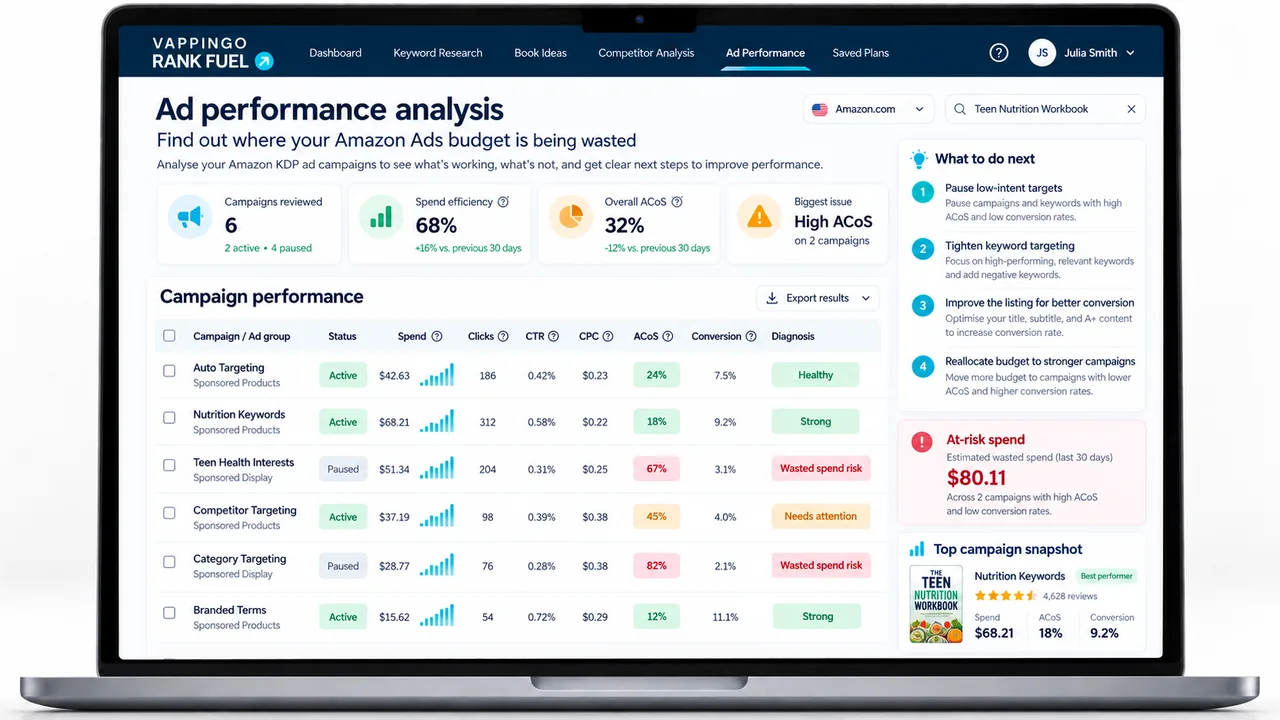
KDP Rank Fuel’s Amazon Ads Generator builds a guided five-campaign Sponsored Products plan, while Amazon Ads Weekly Coach helps turn exported reports into clear weekly decisions. Use the tools as decision support and keep your own royalty, conversion, and marketplace evidence in control.
Frequently Asked Questions
Can Amazon Ads show which keyword generated KU page reads?
Standard author ad reports do not provide keyword-level KENP attribution. KENP is reported in KDP, while ad purchases and sales are reported in Amazon Ads.
Does the KENP rate stay the same?
No. KDP says the KENP rate changes monthly based on the marketplace Global Fund and total eligible pages read.
Can I advertise a KDP Select book?
Yes. Select exclusivity concerns ebook distribution outside Amazon; it does not prevent you from using Amazon Ads.
Should I advertise during a Free Book Promotion?
Only with a defined acquisition objective and budget. Free downloads do not create normal ebook royalty, so the campaign is intentionally loss-making on direct sales.
How should I judge ads for a series in KU?
Keep ad attribution, KU earnings, and downstream series value separate, then compare them at book and time-period level using your own data.
Keep KU Earnings and Ad Attribution Separate
A KU title can be economically strong even when the ad report does not show every source of value. Measure the systems separately, then combine them at a level the data can genuinely support.