Amazon Ads for Low-Content Books: Journals, Planners, and Notebooks
Learn when Amazon Ads can make sense for low-content KDP books, including narrow print margins, listing limitations, targeting, catalog economics, and when not to advertise.
Low content books, journals, planners, notebooks, logbooks, composition books, and activity books, are among the most competitive and margin-sensitive products on Amazon KDP. Hundreds of nearly identical listings compete for the same search terms, prices are typically low (£5.99-£9.99 for paperback), and royalties are thin. A 120-page lined journal at £6.99 on Amazon.co.uk with a 60% royalty after printing costs might generate only £0.80-£1.20 in net royalty per sale. With margins that narrow, Amazon Ads can easily consume your entire profit on a single mismanaged campaign. Yet many successful low content publishers do run profitable ads. The key is understanding that the economics of low content advertising are different from those of a novel or nonfiction book, and that the strategies which work for text-heavy books will often fail, or bankrupt, a low content publisher. This guide covers the margin arithmetic, the ad types that make sense, the keyword approaches that work best, and the catalog-level thinking that makes low content advertising viable.
Understand the Margin Before You Bid
KDP low-content books are generally repetitive print interiors such as notebooks, planners, diaries, journals, log books, and similar fill-in products. Puzzle books and coloring books are generally not treated as low-content under KDP’s definition. Because these products are print books, advertising starts with print royalty, not ebook royalty.
KDP currently pays either 50% or 60% of list price on Amazon print sales, depending on marketplace and price threshold, and then subtracts printing cost. On Amazon.com the 60% paperback rate begins at $9.99; on Amazon.co.uk it begins at £7.99. Use the royalty shown in KDP for the actual page count, ink, trim size, price, and marketplace before deciding what a click can be worth.
Think in Catalog Roles, Not Guaranteed Volume
A low-content catalog can create useful portfolio economics because different covers, audiences, or use cases give you more products to test and cross-promote. That does not mean “publish more” automatically fixes weak demand. Every title still needs a defensible reader or buyer use case.
Choose a small set of commercially distinct books to advertise first. Learn which themes, formats, and prices earn clicks and sales, then use that evidence to decide where a broader catalog deserves investment.
Keyword Strategy for Low-Content Books
Target the use case and buyer rather than the blank-paper format alone. A planner can be searched by profession, goal, time period, audience, layout, gift occasion, or activity. Specificity matters because a low-margin product cannot afford many clicks from shoppers seeking a different interior or purpose.
Do not use a fixed CPC-to-list-price percentage as a rule of thumb. Calculate the actual royalty after printing and compare that with observed conversion. The same $0.25 click can be reasonable for one planner and impossible for another.
Product Targeting for Low-Content Books
Product targeting lets you test books or products that already attract the shopper you want. Choose targets with similar use case, format, price, audience, and design expectations, then let the targeting report show which ones earn worthwhile traffic.
Avoid claims that product targeting in low-content categories “usually” costs a particular CPC. Auction prices vary by marketplace, target, season, competition, and bid strategy. Your report is the benchmark that matters.
Pricing Strategy and Its Interaction With Ads
Price affects both the royalty available to fund advertising and the shopper’s willingness to buy. For low-content books, crossing a print royalty threshold can materially change the economics, but a higher price can also lower conversion. Model both sides instead of treating the 60% rate as a reason to raise price blindly.
Run the KDP royalty calculator or use the royalty shown in your Bookshelf, then compare competing products serving the same use case. The best advertising price is the one that gives the book enough margin without making the offer look poor beside credible alternatives.
Budget Management for Low-Content Catalogs
Separate experiments enough that one title does not consume the whole catalog budget, but do not fragment the account into dozens of tiny campaigns that never gather usable data. Give the most commercially credible titles enough budget to teach you something.
Review budget allocation at catalog level. A title that cannot support paid traffic after repeated tests should lose budget to a title with stronger royalty, conversion, or downstream catalog value.
Listing Quality Matters More When Margin Is Thin
A low-content book often has less sampleable intellectual content than a conventional nonfiction title, so the cover, subtitle, description, A+ Content where available, and clear explanation of the interior do more of the selling. Low-content books published without an ISBN do not currently receive Read Sample, which makes visual merchandising especially important.
Show the use case clearly and avoid making the shopper guess what is inside. If the listing cannot explain the layout, size, audience, and purpose, paid clicks will expose that weakness quickly.
When Not to Run Ads on Low-Content Books
Do not advertise simply because the book exists. Skip or pause paid acquisition when the royalty is too thin for the CPCs you can win, the listing cannot explain the interior, the use case is indistinct, or the title has shown no credible buyer demand.
Organic testing, better product design, improved A+ Content, a new price, or a more useful niche may create a better foundation. Ads are a distribution tool, not a substitute for product-market fit.
A Low-Content Break-Even Example
Suppose a planner earns $2.00 royalty after printing. At a 10% ad-click conversion rate, a rough direct break-even CPC is $0.20. At 5% conversion it falls to $0.10. Those scenarios show why tiny changes in conversion matter so much when the royalty pool is small.
Do not assume either conversion rate will be yours. Use the example to set a safe learning range, then replace it with actual clicks and attributed purchases as soon as the campaign produces enough data.
Use Product Design to Improve Ad Economics
For low-content books, conversion often depends on details that ordinary keyword research cannot solve: interior preview, page count, trim size, paper choice, dated versus undated structure, binding expectations, giftability, and whether the cover accurately signals the user. A paid click cannot compensate for a planner that hides the layout the buyer most wants to inspect.
A+ Content can be particularly useful when Read Sample is unavailable because the title was published without an ISBN. Show interior spreads clearly and accurately. Better product communication can raise conversion without raising bids.
Build a Catalog Test Matrix
Track title, use case, audience, price, royalty, primary targets, CPC, conversion, and contribution after ad spend. Group related books so you can see whether a theme or product design consistently performs better than another.
The matrix turns a catalog into evidence. Instead of publishing twenty variations and hoping volume fixes the economics, you can invest in the concepts that repeatedly show buyer demand and workable margins.
Turn the research into a repeatable ad workflow
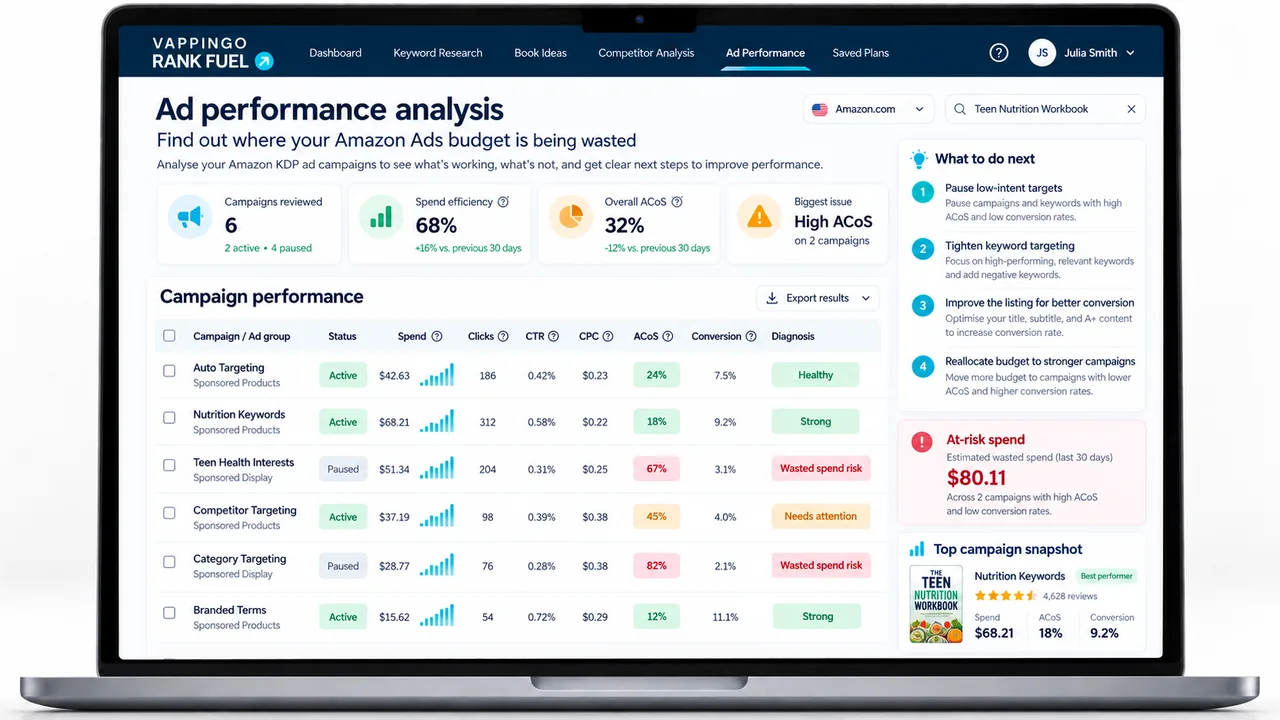
KDP Rank Fuel’s Amazon Ads Generator builds a guided five-campaign Sponsored Products plan, while Amazon Ads Weekly Coach helps turn exported reports into clear weekly decisions. Use the tools as decision support and keep your own royalty, conversion, and marketplace evidence in control.
Frequently Asked Questions
What counts as a low-content book on KDP?
KDP examples include notebooks, planners, diaries, journals, logs, and other repetitive fill-in interiors. Puzzle and coloring books generally are not treated as low-content.
Can low-content books get a free KDP ISBN?
No. KDP says low-content books can use your own ISBN or publish without one, but they are not eligible for the free KDP ISBN.
Do low-content books get Read Sample?
Low-content books published without an ISBN do not currently receive Read Sample. An owned ISBN can change sample eligibility.
What is the biggest advertising constraint?
Margin. Print royalty is reduced by printing cost, so even modest CPC can consume the contribution from a sale.
Should I advertise every journal or planner I publish?
No. Start with titles that have a clear use case, competitive listing, workable royalty, and evidence of buyer demand.
Make Margin Earn the Right to Advertise
Low-content ads can work, but only when the product has real buyer demand and enough royalty to pay for discovery. Start with the economics, then scale the titles that prove they can convert.