ACoS for Amazon Book Ads: Calculate Break-Even and Set a Real Target
Learn what ACoS means for book ads, how to calculate direct break-even ACoS from royalty economics, how KU affects the picture, and how to diagnose high ACoS.
ACoS is the first metric most authors check when they open their advertising dashboard, and the one most frequently misunderstood. Authors cut profitable campaigns because ACoS looks high. They keep running loss-making campaigns because ACoS looks acceptable when the real cost picture is more complex. Understanding exactly what ACoS measures, and crucially, what it does not measure, transforms how you make campaign decisions.
What ACoS Is and How It Is Calculated
ACoS stands for Advertising Cost of Sales. The formula is: ACoS = Ad Spend ÷ Ad Revenue × 100.
If you spent £30 on ads in a week and those ads directly generated £100 in book sales (as attributed by Amazon’s click-attribution system), your ACoS is 30%. If you spent £50 and generated £80, your ACoS is 62.5%. If you spent £20 and generated £200, your ACoS is 10%.
For author advertisers, Amazon Ads currently uses a 14-day click-attribution window for sponsored ads. That means purchases and eligible KENP reading can continue to be attributed after the click, so the most recent days in a report may still be incomplete. Use mature date ranges when judging borderline targets, and distinguish attribution lag from genuine underperformance.
This is the first and most important limitation to understand: ACoS only measures the direct return on ad spend. It says nothing about the organic sales your advertising may be generating. A campaign with “high” ACoS may simultaneously be lifting your book’s organic ranking, generating organic sales volume that far exceeds the ad spend, but none of that appears in the ACoS number.
Calculating Your Breakeven ACoS
Your breakeven ACoS is the maximum ACoS at which you neither profit nor lose on ad-attributed sales. If every sale generated by your ads is breaking exactly even, the ad spend is neutral, you are selling books at no net gain and no net loss on the advertising component.
Breakeven ACoS = Royalty per sale ÷ List price × 100. Worked examples across the formats KDP authors most commonly use:
For a direct sale, a useful break-even ACoS estimate is royalty per sale divided by attributed sales revenue, multiplied by 100. Use the actual royalty, not the headline royalty rate: Kindle delivery costs, print costs, marketplace, tax treatment, and price can change what the author keeps. This gives you a direct-sale acquisition ceiling before overhead and downstream value, not a universal campaign target.
For a direct sale, a useful break-even ACoS estimate is royalty per sale divided by attributed sales revenue, multiplied by 100. Use the actual royalty, not the headline royalty rate: Kindle delivery costs, print costs, marketplace, tax treatment, and price can change what the author keeps. This gives you a direct-sale acquisition ceiling before overhead and downstream value, not a universal campaign target.
CPC varies by marketplace, genre, target, placement, bidding strategy, season, and competition. Use Amazon’s suggested bid ranges as context, then replace generic “book ad CPC” benchmarks with your own observed CPC and conversion data. A click is affordable only when the expected value of the resulting reader can support it.
KDP paperback at £9.99: Royalty = 60% of list price minus printing cost. For a 250-page book printed in the UK, the printing cost is approximately £3.40, giving a royalty of £9.99 × 0.60 − £3.40 = £2.59. Breakeven ACoS = £2.59 ÷ £9.99 × 100 = 25.9%. Paperback breakeven ACoS is significantly lower than ebook, you need to achieve sub-26% ACoS for paperback ads to be directly profitable, which requires either a well-converting product page or very competitive CPCs in your genre.
KDP hardcover at £14.99: At UK printing costs of approximately £6.50 for a standard hardcover, royalty is approximately £14.99 × 0.60 − £6.50 = £2.49. Breakeven ACoS = 16.6%. Hardcover advertising is the most demanding for direct profitability, it requires very low CPCs or very high conversion rates to achieve below 17% ACoS.
Calculate your breakeven for every format you plan to advertise. It is different for every book and every price point. Running campaigns without knowing your breakeven means you have no meaningful target to work toward.
Setting a Meaningful Target ACoS
Your target ACoS should be below your breakeven, the gap between target and breakeven determines your profit margin per ad-attributed sale. If your ebook breakeven is 70% and you achieve 35% ACoS, half of every pound of ad-attributed revenue is net profit after both royalties and ad spend are accounted for.
Setting your initial target: a reasonable starting target for most authors is 30-40% of breakeven ACoS. For an ebook with 70% breakeven, target 21-28% ACoS. For a paperback with 26% breakeven, target 15-18% ACoS. These are not universal benchmarks, they are starting reference points. Your actual target should reflect your business priorities: a launch-phase book prioritizing sales velocity has a different optimal ACoS than an established title optimized for net income.
For books in a series, your target ACoS calculation should include the estimated lifetime value from series readthrough, not just the royalty from the first book. If 40% of readers who buy Book 1 in your series go on to buy Books 2 and 3 at the same price, the effective value per Book 1 ad-attributed sale is 1 + (0.4 × 1) + (0.4 × 0.4 × 1) = 1.56 book-equivalents. Your breakeven ACoS for Book 1 advertising, accounting for series readthrough, is effectively 1.56 times the Book 1 royalty divided by its price. Series readthrough makes Book 1 advertising far more profitable than ACoS alone suggests, this is the main reason successful series authors can sustain higher ACoS on Book 1 than standalone book authors.
ACoS During a Launch Window
Running above breakeven ACoS deliberately, for a defined period, is a legitimate and often correct strategy during a book launch. The logic: increased ad spend drives sales velocity, which improves your book’s BSR (Best Sellers Rank) in its category, which improves its visibility in Amazon’s organic ranking algorithms. This organic visibility generates sales that are not counted in your ACoS, they are organic sales, invisible to the ad metric but very visible in your KDP royalties.
The risk is running above-breakeven ACoS indefinitely without ever checking whether the organic rank benefit is materialising. If you are spending above breakeven and your organic rank is not improving, if TACoS is flat or rising rather than falling, then you are paying for sales without building organic position, which is a money-losing proposition with no upside.
If you choose a launch-phase above-breakeven ACoS strategy: define the window explicitly (4-8 weeks is typical), identify the organic ranking milestone you expect to achieve by the end of it (top 20 in your primary category, for example), and check TACoS weekly to see whether the organic traction is real. If at week six you are still at 75% ACoS and TACoS is unchanged, the strategy is not working and the window should close.
What High ACoS Actually Means
High ACoS can mean several different things, each requiring a different response. Diagnosing which situation you are in before cutting bids or pausing campaigns saves considerable money.
High ACoS during the learning phase (weeks 1-3): Normal. Amazon’s systems is calibrating. The campaign has not had enough time to find its most efficient placements. Do not make significant bid cuts during this window, you are seeing noise, not signal. Wait for 14 days of complete attribution data before drawing conclusions.
High ACoS due to poor product page conversion: The most common cause of persistently high ACoS on an established campaign. If your conversion rate (visible in the advertising console under the product performance view) is below 2-3%, ads are generating clicks that your product page cannot convert. A cover, description, or review count problem. Fixing the product page will improve ACoS more than any bid adjustment can. See the diagnosis section below for how to identify this.
High ACoS due to poor keyword targeting: Keywords that are vague (too broad), wrong genre, or appear in irrelevant contexts generate clicks from readers who are not your target audience. These clicks will not convert regardless of how strong your product page is. The fix is keyword pruning, add non-converting spend to negatives, tighten match types, remove off-genre keywords from manual campaigns.
High ACoS due to overly high bids in competitive positions: If you have applied aggressive top-of-search modifiers or use dynamic up-and-down bidding on competitive terms, you may be paying premium CPCs that your conversion rate cannot justify. Reduce placement modifiers and switch to dynamic down-only bidding.
CPC varies by marketplace, genre, target, placement, bidding strategy, season, and competition. Use Amazon’s suggested bid ranges as context, then replace generic “book ad CPC” benchmarks with your own observed CPC and conversion data. A click is affordable only when the expected value of the resulting reader can support it.
ACoS vs TACoS: Why You Need Both
ACoS measures your direct advertising efficiency. TACoS (Total Advertising Cost of Sales) measures your advertising’s effect on your total business.
TACoS = Ad Spend ÷ Total Revenue × 100. Total revenue includes both ad-attributed and organic sales. If you spent £50 on ads and had £400 total revenue (£150 ad-attributed + £250 organic), your TACoS is 12.5%, even if your ACoS is 33%.
The relationship between ACoS and TACoS tells you whether your ads are building organic traction. If ACoS is constant and TACoS is falling over time, your organic sales are growing faster than ad spend, the ads are building compound organic value. If ACoS and TACoS are both constant over six months, your advertising is maintaining steady sales without building organic position. If ACoS is falling but TACoS is flat or rising, you have cut productive ads and organic sales are falling. For full detail on TACoS, see our dedicated TACoS guide for KDP authors .
ACoS for Kindle Unlimited Authors
If your books are enrolled in KDP Select (Kindle Unlimited), your advertising console’s ACoS calculation is systematically underestimating your actual ad profitability. Here is why: when a KU reader clicks your Sponsored Products ad and borrows your book, that action generates KENP (Kindle Edition Normalized Pages) reads tracked in your KDP dashboard, not a “sale” in the advertising console. The ad console’s “Orders” column shows zero for that click. Your ad spend for that click is counted in the numerator of the ACoS calculation, but the revenue it generated (KENP royalties) is invisible to the ad console.
To calculate your real ACoS for a KU title: estimate the average KENP reads per ad-driven borrow (from your KDP dashboard during advertising periods) × current KENP rate (approximately £0.0042 per page in the UK). Add this to your ad-console revenue figure, then recalculate ACoS. For a 300-page book with 60% completion rate, the average ad-driven borrow generates approximately 180 pages × £0.0042 = £0.76 in KENP royalties. This is invisible to your ACoS calculation but very real to your P&L.
The practical impact: many authors with KU books have been pausing “unprofitable” campaigns based on ACoS when those campaigns were actually profitable once KENP revenue was factored in. If your campaigns show borderline ACoS, close to but slightly above your target, and your books are in KU, calculate the KENP-adjusted ACoS before making pausing decisions.
ACoS by Format: Ebook vs Paperback
Running separate campaigns per format, ebook and paperback, is important in part because their ACoS targets are completely different. A campaign that runs ebook and paperback ads mixed into the same budget is being evaluated against a single ACoS figure that blends two incompatible targets. Separate the formats, separate the budgets, and evaluate each against its own breakeven.
For most KDP authors, ebook advertising is more forgiving on ACoS because the 70% royalty tier gives a high breakeven. Paperback advertising requires more rigorous conversion quality to achieve the lower ACoS targets its smaller net margin demands. Hardcover advertising, with the smallest absolute royalty after printing costs, requires the lowest ACoS of all, meaning it typically only makes direct sense at very competitive CPCs or with a strong series readthrough multiplier.
Diagnosing an ACoS Problem
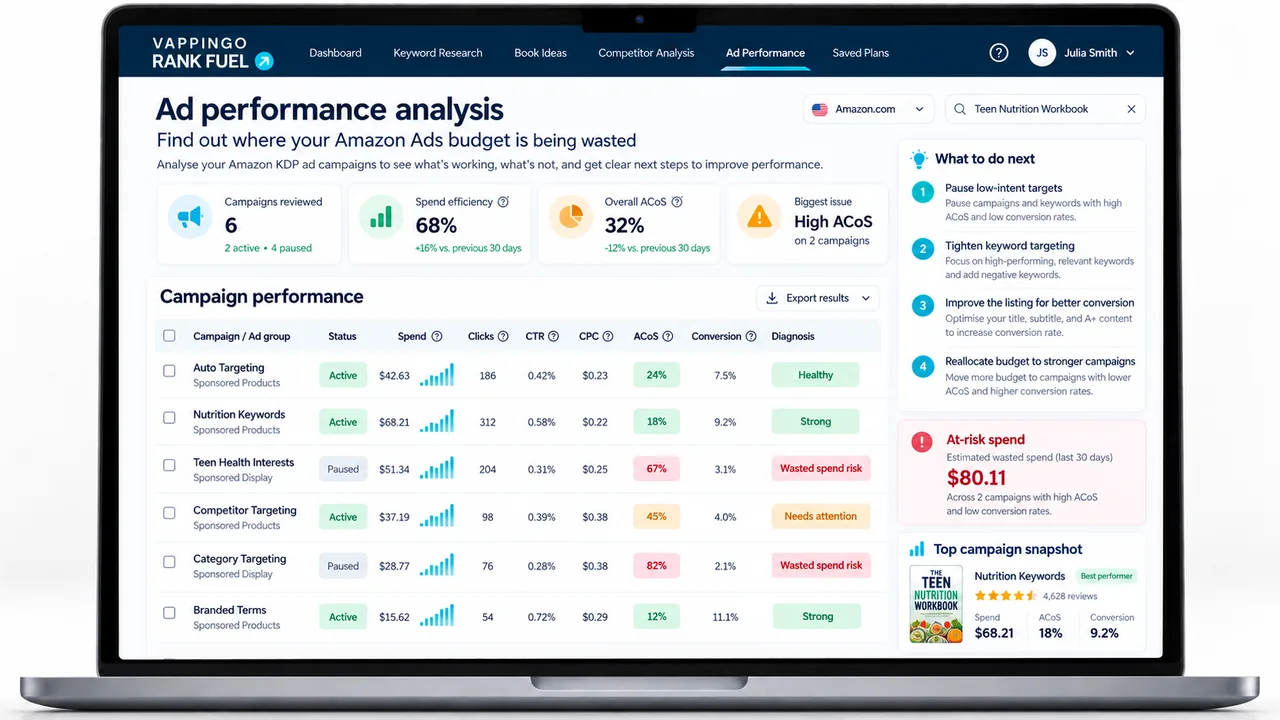
When ACoS is above target on an established campaign (one that has run for 30+ days with regular optimization), the problem is in one of three places: the product page, the keyword targeting, or the bid level. Cutting bids without diagnosing the source treats the symptom while ignoring the disease.
Step 1, Check conversion rate. In the Amazon Ads console, your product’s conversion rate is visible under the product performance section. A conversion rate below 3% on a reasonably priced book (£2.99+) with 10+ reviews is a product page signal. The issue is not your ads, it is your cover, description, or review count. No bid adjustment will fix a 1.5% conversion rate; a professional cover redesign or description rewrite might.
Step 2, Check your Search Term Report. A campaign spending 60% of its budget on terms with zero orders is a keyword quality problem. Pull the 14-day Search Term Report, sort by spend, and count how much total spend went to terms with zero orders. If it is above 40% of total campaign spend, your negative keyword list needs urgent attention.
Amazon says Sponsored Products delivery depends on the bid and the relevance of the ad to the shopper’s query or context. It does not publish an author-facing “quality score” formula that lets you calculate a hidden multiplier. Treat listing quality as a conversion and relevance issue: a professional, clearly positioned detail page can make paid traffic more valuable, but do not claim that a review count or conversion rate feeds a documented numeric quality score.
How to Improve ACoS Without Just Cutting Bids
Cutting bids is the least effective ACoS improvement lever and the most commonly used one. It reduces spend but often reduces sales proportionally, leaving ACoS unchanged or worsening it if bid cuts push your ad out of converting positions. The higher-impact levers are:
Improve conversion rate. A cover upgrade, description rewrite, or price reduction that moves conversion from 3% to 5% reduces your effective CPA (cost per acquisition) by 40% without touching a single bid. This is the highest-leverage ACoS improvement available to authors with good campaigns but poor product pages.
Build your negative keyword list. Eliminating budget drain from non-converting searches directly improves ACoS by redirecting spend to searches that do convert. Regular Search Term Report review is more impactful than bid management for many campaigns.
Promote proven keywords to exact match. Graduating converting terms from broad or phrase match to exact match reduces the noise around those terms, improving their individual ACoS and concentrating budget on the most precise and highest-converting interpretation of each keyword.
Pause non-converting keywords rather than just lowering their bids. A keyword with 50 clicks, zero orders, and £18 spent over two 14-day review periods is not a keyword to bid-optimize, it is a keyword to pause and redirect that budget elsewhere. There is no optimal bid for a keyword that does not convert at any bid level.
Realistic ACoS Benchmarks for Book Advertising
Generic ACoS benchmarks are usually less useful for books than a title-specific target. A low-margin paperback, a higher-priced nonfiction ebook, and book one in a high-read-through KU series can rationally support very different acquisition costs. Build the target from the real royalty economics and the job of the campaign, then compare it with observed conversion.
Generic ACoS benchmarks are usually less useful for books than a title-specific target. A low-margin paperback, a higher-priced nonfiction ebook, and book one in a high-read-through KU series can rationally support very different acquisition costs. Build the target from the real royalty economics and the job of the campaign, then compare it with observed conversion.
Generic ACoS benchmarks are usually less useful for books than a title-specific target. A low-margin paperback, a higher-priced nonfiction ebook, and book one in a high-read-through KU series can rationally support very different acquisition costs. Build the target from the real royalty economics and the job of the campaign, then compare it with observed conversion.
Generic ACoS benchmarks are usually less useful for books than a title-specific target. A low-margin paperback, a higher-priced nonfiction ebook, and book one in a high-read-through KU series can rationally support very different acquisition costs. Build the target from the real royalty economics and the job of the campaign, then compare it with observed conversion.
Generic ACoS benchmarks are usually less useful for books than a title-specific target. A low-margin paperback, a higher-priced nonfiction ebook, and book one in a high-read-through KU series can rationally support very different acquisition costs. Build the target from the real royalty economics and the job of the campaign, then compare it with observed conversion.
Generic ACoS benchmarks are usually less useful for books than a title-specific target. A low-margin paperback, a higher-priced nonfiction ebook, and book one in a high-read-through KU series can rationally support very different acquisition costs. Build the target from the real royalty economics and the job of the campaign, then compare it with observed conversion.
Generic ACoS benchmarks are usually less useful for books than a title-specific target. A low-margin paperback, a higher-priced nonfiction ebook, and book one in a high-read-through KU series can rationally support very different acquisition costs. Build the target from the real royalty economics and the job of the campaign, then compare it with observed conversion.
Build an ACoS Target from the Book, Not a Benchmark
Start with one format. Record list price, actual royalty per sale, and any printing or delivery cost already reflected in that royalty. Divide royalty by sale price to estimate direct-sale break-even ACoS. Then ask whether the campaign is expected to do more than create that one sale. For a KU title, review attributed KENP separately. For book one in a series, estimate downstream value from observed read-through rather than assuming every new reader completes the series.
Now create three decision levels: a comfortable target, a test ceiling, and a stop-and-diagnose level. The target is where you are happy to buy more traffic. The test ceiling is a temporary range you will tolerate while a relevant target gathers evidence. The final level is where additional spend no longer makes sense without a specific reason. These are management thresholds you create for the title, not Amazon rules.
Turn the article into a repeatable Amazon Ads workflow
KDP Rank Fuel’s current Amazon Ads Generator builds a guided five-campaign Sponsored Products plan, while Amazon Ads Weekly Coach helps turn exported reports into clearer recurring decisions. Use the tools as decision support and keep the live Amazon Ads console as the authority on eligibility, settings, and final changes.
Frequently Asked Questions
What does ACoS mean?
ACoS is ad spend divided by attributed sales revenue, multiplied by 100. It measures advertising efficiency against the sales Amazon attributes to the campaign.
What is break-even ACoS for a book?
A useful direct-sale estimate is royalty per sale divided by sales revenue per sale. Use the actual royalty after delivery or printing costs rather than a headline royalty percentage.
Does ACoS include KU page-read royalties?
Standard ACoS uses attributed sales revenue. Amazon separately reports eligible KENP Read and estimated KENP Royalties for authors, which can be included in a broader profitability analysis.
What is a good ACoS for authors?
There is no universal number. A standalone print book and book one in a long KU series can support very different acquisition costs.
How is TACoS different?
TACoS compares ad spend with total sales revenue, not just ad-attributed sales. It helps show how dependent the total sales engine is on advertising.
Let the Book Set the ACoS Target
A useful ACoS target starts with royalty and reader value, not an internet benchmark. Once the number has an economic reason behind it, high ACoS becomes a diagnosis problem you can solve instead of a red warning you react to blindly.