Amazon’s search and ranking algorithm determines which books appear in which positions when a reader searches. Most authors learned to optimise for A9 — a system built around keyword presence and sales velocity. That system has been replaced by A10, which evaluates descriptions through a fundamentally different lens. Understanding what A10 actually reads changes how you write. For the complete description writing guide, see our complete book description guide.
What Changed From A9 to A10
A9 was a lexical matching system — it compared the words a reader typed against the words present in your metadata and ranked results based on keyword presence, sales velocity, and advertising spend. A description that contained the right keywords in the right density performed well algorithmically, regardless of how well it read as prose or how accurately it described the book.
A10 replaced this with semantic understanding. Instead of asking “does this description contain the words the reader typed?”, A10 asks “does this book match what the reader actually wants?” The distinction sounds subtle but has profound consequences for description writing. A10 uses Natural Language Processing — the same class of technology that makes voice assistants understand conversational questions — to evaluate your description as a piece of language rather than a collection of indexed terms. It understands relationships between words, recognises genre conventions from contextual signals, and assesses whether your description’s overall meaning is coherent and relevant to the searches it’s appearing for.
The practical result is that A9-era descriptions — built around keyword repetition, exact-match density, and rigid structural formulas — now perform worse than naturally written descriptions that accurately and specifically describe the reading experience your book delivers. The algorithm has, effectively, become a more sophisticated reader.
How A10 Reads Your Description Semantically
A10’s semantic layer means that genre relevance can be communicated through demonstrated specifics rather than labelled categories. Under A9, writing “this cosy mystery is set in a small town” was the reliable approach — the algorithm matched the exact string “cosy mystery” and “small town” to relevant searches. Under A10, a description that says “when a retired librarian discovers a body in the village tea shop she’s been running for twelve years, the close-knit community she thought she knew looks very different” communicates “cosy mystery,” “small town setting,” and “amateur detective” to the algorithm’s semantic layer — without any of those phrases appearing verbatim.
This does not mean you should avoid using genre terms in your description. It means that using them naturally — once, in context, as part of a specific and accurate description — is sufficient and more effective than using them repeatedly in forced constructions. A10’s NLP layer reads natural prose more accurately than keyword strings, because natural prose is what it was trained on.
The algorithm also reads your description for semantic coherence: do the different parts of the description tell a consistent story about what this book is? A description that opens by promising “a heartwarming cosy mystery” and then describes graphic violence in the plot synopsis creates a semantic mismatch that A10’s evaluation registers as a quality signal problem — the listing is misrepresenting the book’s content. This mismatch is not just a conversion problem; it is a ranking signal problem.
The Rufus Layer: A Second Reader You Can’t See
Amazon’s Rufus shopping assistant — increasingly prominent in the Amazon interface throughout 2025 and now a standard feature of the discovery experience in 2026 — adds a second evaluation layer that A9 never had. Rufus reads your description, synthesises it alongside your reviews and Q&A content, and uses that combined understanding to answer conversational shopper queries: “what should I read if I loved [popular series]?” or “is this romance clean?” or “does this thriller have a satisfying ending?”
Rufus does not use keyword matching. It reads for meaning. A description that provides specific, accurate, naturally written information about your book — its tone, pacing, emotional register, genre conventions, comparable books — gives Rufus more to work with when a reader’s query is a good match for your book. A description built around keyword strings gives Rufus very little useful information to synthesise into a confident recommendation.
There is also a Rufus override problem that authors need to understand. Rufus treats your review content as more reliable evidence of your book’s character than your description copy. If your description claims “a fast-paced thriller” but your reviews consistently describe “slow burn” and “methodical pacing,” Rufus will weight the review characterisation over your description when making recommendations. This is why description accuracy — writing what your book genuinely is rather than what you want readers to think it is — has become both a conversion strategy and a recommendation strategy simultaneously.
Why Conversion Rate Still Matters Most
Everything that was true about conversion rate under A9 remains true under A10 — and the weighting has if anything increased. A10’s customer-satisfaction model evaluates your listing’s performance based on how well it delivers on its promises: the proportion of browsers who purchase, the return rate on those purchases, the review sentiment from the resulting readers. A description that converts a high proportion of visitors sends a strong quality signal. A description that generates clicks but poor conversion — because it attracted the wrong readers or overpromised the reading experience — generates a negative quality signal that suppresses ranking over time.
This means the single most important thing your description can do for your Amazon ranking is convert the right readers accurately. Not the most readers. The right readers — the ones for whom the book genuinely delivers on what the description promised. A description that converts 8% of visitors who then leave consistently positive reviews outperforms one that converts 12% who then leave mixed reviews, both in terms of immediate revenue and in terms of the long-term ranking signal it generates. Never sacrifice description accuracy for conversion optimisation tricks. The readers a misleading description attracts are worse for your long-term ranking than the readers a specific, honest description attracts.
Your Description Promises. Your Manuscript Delivers.
A10 evaluates the gap between what your description promises and what readers experience when they open the book. A manuscript that delivers on that promise — free from errors that break immersion, consistent in voice and quality — is what closes that gap and turns clicks into five-star reviews. Vappingo’s manuscript proofreading service ensures the book behind your description is ready for the readers it attracts.
Engagement Depth: The Signal Beyond the Click
A10 introduced a category of ranking signal that A9 did not evaluate: engagement depth. The algorithm monitors not just whether a reader purchased, but how deeply they engaged with your listing before purchasing or leaving. Time spent on the product page, whether the Look Inside preview was opened, how far through the preview the reader scrolled before closing or purchasing — these behavioural signals feed into A10’s quality assessment of your listing.
Your description is directly connected to engagement depth in a specific way: a description that earns the scroll — that opens with a compelling hook that makes the reader want to continue, that builds through a conflict, stakes, and tone, and that closes with a call to action that makes the purchase feel like the obvious next step — generates longer page dwell times and higher Look Inside open rates than a description that loses the reader above the fold. These engagement signals reinforce your listing’s relevance score and, over time, contribute to improved organic ranking independently of your sales volume.
This is why description writing is now a ranking activity as well as a conversion activity. The description that makes a reader spend three minutes on your product page, open the Look Inside, and then purchase is generating more A10 ranking signal per visit than the description that produces a ten-second scroll and a quick add-to-cart.
Keyword Stuffing: Now Actively Counterproductive
Under A9, keyword stuffing was a diminishing-returns tactic — it provided less benefit than its practitioners claimed, but it wasn’t actively harmful. Under A10’s semantic evaluation, it is actively counterproductive. A10’s NLP layer recognises unnatural language patterns. A description structured around keyword repetition — “this cosy mystery novel is a cosy mystery for fans of cosy mysteries set in a cosy small-town setting” — does not read as natural prose. The algorithm’s semantic assessment of such a description is that it is keyword-optimised rather than reader-oriented, which correlates negatively with the quality signals A10 rewards.
The practical consequence: a keyword-stuffed description generates weaker semantic relevance signals than an equivalently keyword-dense but naturally written description, because the algorithm can distinguish between the two. It also converts worse, which compounds the ranking damage. There is no scenario in 2026 where keyword stuffing in a book description improves your Amazon ranking. The authors who practice it are paying a double penalty — weaker algorithmic relevance and worse conversion — in exchange for a tactic that no longer provides any offsetting benefit.
This applies to subtitles too, not only descriptions. A subtitle formatted as a keyword string — “A Cosy Mystery Thriller Suspense Novel with Amateur Detective and Bakery Setting” — creates a semantic mismatch that A10’s NLP layer reads as a manipulation signal. Natural subtitles that describe the book accurately in readable language perform better under A10 on every dimension: semantic relevance, engagement, and Rufus recommendation confidence.
How Description Updates Affect A10 Ranking
When you update your book description, Amazon re-indexes the new version. Re-indexing typically takes 24–72 hours, during which your book may still rank for terms associated with your previous description. Give any description change at least seven to ten days before drawing conclusions about its impact — A10’s decay-weighted ranking model means position changes from a listing update accumulate gradually rather than appearing immediately.
A10’s semantic evaluation means that a description update’s impact on ranking is also more multidimensional than under A9. Under A9, adding a keyword to your description would produce a relatively predictable relevance increase for that keyword’s searches. Under A10, a description rewrite that improves semantic coherence, genre specificity, and natural language quality may improve positions across a range of related search terms simultaneously — not just the specific terms you added. The guide to rewriting a failing book description covers this holistic rewrite approach in detail, including how to assess whether a description update is producing the intended results.
Frequent description changes create noise in your performance data, making it harder to attribute changes in your keyword positions or conversion rates to specific edits. If you’re testing description copy, change one significant element at a time and allow sufficient time — at least two weeks — to observe the impact before changing again. The A/B testing guide covers the structured approach to description testing that produces attributable results.
Practical Implications for Description Writing
Translating A10’s evaluation framework into concrete writing guidance:
Write your genre signal in the first 150 characters. Amazon shows approximately 150 characters of your description before the “Read more” fold on mobile — the majority of search browsers see only this before deciding to continue or scroll past. The first 150 characters must communicate your genre clearly and create enough pull to earn the click-through. This is both a conversion requirement and an A10 engagement depth requirement — a description that loses readers above the fold generates poor engagement signals.
Use the natural language of your genre, once and in context. The trope vocabulary, setting descriptors, and emotional register language that your genre’s readers use in search — “enemies to lovers,” “slow burn,” “small-town romance,” “unreliable narrator” — belongs in your description because it accurately describes the reading experience. Include it naturally, in sentences that demonstrate the genre rather than label it. Do not repeat it for algorithmic purposes; one natural mention is sufficient for A10’s semantic indexing.
Write for Rufus as well as for the search results page. Every sentence of your description should be something Rufus can extract and use to answer a reader’s conversational question about your book. Specific claims (“set in a fictional Cornish village during a summer heatwave”), specific dynamics (“rivals forced to share a lake house for one catastrophic week”), and specific emotional promises (“for readers who want the slow burn of will-they-won’t-they stretched across a full novel”) are all usable Rufus inputs. Vague claims (“a heartwarming story of love and redemption”) are not.
Prioritise accuracy over aspiration. The description that honestly describes your book attracts readers who are genuinely right for it and generates the satisfied reviews that reinforce A10’s quality signals. The description that promises more than the book delivers attracts mismatched readers and generates disappointed reviews that undermine your ranking regardless of how many sales the misleading copy generates initially.
Keep descriptions current. Language evolves in every genre, and search behaviour changes with it. A description written in 2022 using the trope vocabulary of 2022 may be missing the search terms that genre readers now use. Quarterly reviews of your descriptions — checking whether the language still matches current genre search patterns — maintain the semantic relevance that A10 rewards.
What the Algorithm Cannot Do
Understanding A10’s limits is as important as understanding its capabilities. The algorithm cannot assess the quality of your writing. It cannot determine whether your book delivers on its description’s promise. It cannot evaluate whether a reader who purchases will enjoy the book or leave a positive review. These outcomes are determined by your manuscript — and they feed back into A10’s ranking model through return rates, review sentiment, and Rufus’s synthesis of your review content.
A perfectly optimised description on a poorly written or inadequately proofread book will generate initial sales and then the negative reviews that A10 registers as quality failures. The algorithm amplifies what is already there: a strong, well-produced book with an accurate, well-written description becomes more visible over time. A weak book with a strong description surfaces its weaknesses through review performance — and A10’s customer-satisfaction model then reduces its visibility accordingly.
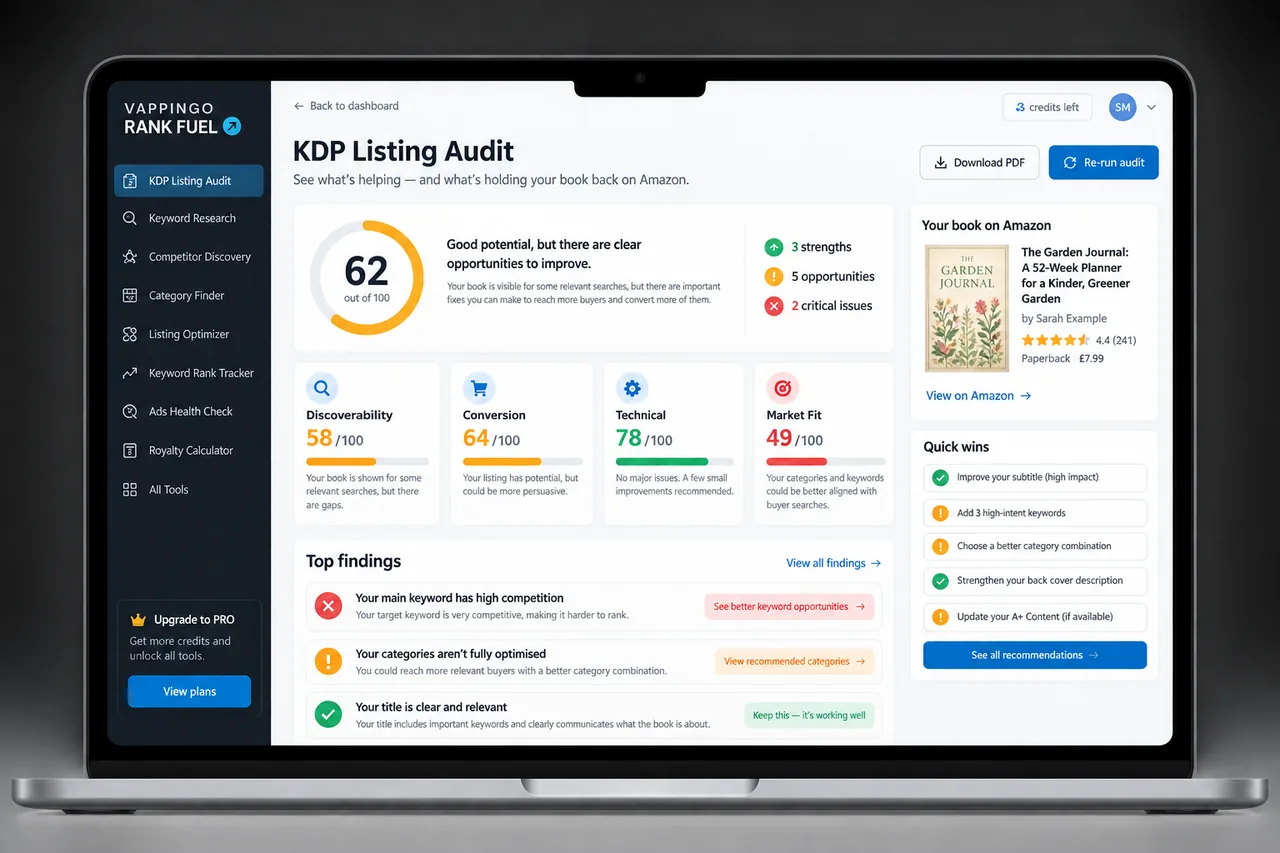
Optimising your description and your manuscript are both necessary and neither is sufficient alone. KDP Rank Fuel handles the description and metadata side — research-driven listing generation that applies Vappingo’s 15+ years of KDP copywriting expertise to produce descriptions built for A10’s semantic standards. Vappingo’s manuscript proofreading service handles the manuscript quality side. Both close different parts of the gap between a book that gets found and a book that gets found and earns the reviews that keep it visible. The Alliance of Independent Authors covers the relationship between listing quality and reader satisfaction at allianceindependentauthors.org — useful supplementary context on how the A10 quality signals discussed in this article sit within the broader self-publishing environment. Jane Friedman’s analysis of Amazon’s evolving algorithm and its implications for self-published authors at janefriedman.com provides additional independent perspective on the changes covered in this article.