How to A/B Test Your Amazon Book Description
KDP authors still do not have a native description split-testing tool. A clean sequential test changes one variable at a time and allows for the normal update delay before judging results.
Your first book description is a hypothesis. It represents your best guess, before you have any data, about what will make your specific book appealing to your specific audience. Testing it, systematically replacing one element at a time and measuring the result, is how you replace that hypothesis with evidence. For the complete foundation, see our complete book description guide.
Why Testing Matters
A description improvement of even a few percentage points in conversion rate has a compounding effect on every piece of traffic that reaches your product page, organic search, Amazon Advertising clicks, external links, social media referrals. If your page currently converts 3% of visitors into buyers and you improve that to 5%, you have generated 67% more sales from the same traffic without spending an additional penny on advertising.
Description testing is one of the highest-leverage activities available to a KDP author, and one of the most neglected. Most authors write a description once, publish, and never revisit it. This is leaving systematic improvement on the table.
KDP Has No Native Description A/B Test
KDP authors still do not have a native split-testing control that sends simultaneous traffic to two book-description variants and reports a winner. Amazon Seller Central does have Manage Your Experiments for eligible Brand Registry seller content, but that is a different seller tool and should not be confused with a KDP author description experiment.
For a KDP title, the practical method remains sequential testing: establish a baseline, change one meaningful variable, allow the listing update to propagate, then compare a sufficiently long period. Record advertising, price, review, and seasonality changes that could distort the result so the comparison is not falsely precise.
The Manual Testing Methodology
The most reliable approach for description testing on KDP is a simple repeatable sequence. Use the same process for every test so results are easier to compare over time. Follow the sequence below.
- Establish a baseline period. Run your current description unchanged for at least three weeks before making any changes. Record your average weekly sales, KU page reads, and if you are running advertising, your click-through rate and conversion rate. Three weeks is a minimum; longer is better.
- Change one element only. This is the most important rule. If you change the opening hook, the body, and the call to action simultaneously, you will not know which change drove any improvement or decline. Change one element, ideally the element you are most uncertain about, and hold everything else constant.
- Run the new version for the same duration. At least three weeks, ideally matching the baseline period exactly. Make sure your advertising spend and targeting during this period are equivalent to the baseline period.
- Compare the same metrics. Compare weekly sales average, KU pages read average, and advertising conversion rate. Account for any seasonal effects, a test run in the pre-Christmas period versus the post-January period is not a clean comparison.
- Keep the better version. If the new version outperforms the baseline, make it your new baseline. If not, revert and test a different element.
What Signals to Read
KDP does not show you a description conversion rate directly. The signals available to you:
Sales velocity: Your KDP dashboard shows units sold. An increase in sales velocity, with stable or reduced advertising spend, suggests your description is converting better. A decrease with stable traffic suggests the new version is underperforming.
Amazon Advertising data: If you are running Sponsored Products ads, your advertising dashboard shows impressions, clicks, and orders. Clicks divided by impressions is your click-through rate (influenced by your cover and title as well as description). Orders divided by clicks is your conversion rate, this is your most direct proxy for description performance, since it captures what happens after someone has engaged with your listing.
Page reads: For KDP Select authors, a change in KU page reads alongside stable advertising can indicate a description change affecting browsing behavior, though the signal is noisy.
What to Test First
Not all description elements have equal impact on conversion. Start with the parts most likely to change whether a shopper keeps reading, then move to lower-impact refinements. Use the order below.
- The opening hook. The single highest-impact element. A better hook increases the “Read more” click rate and establishes the right emotional tone for the rest of the description. Test a completely different opening framing, not just word swaps, but a different structural approach.
- The call to action. The closing sentence directly precedes the purchase decision. Test different CTA formulations: direct instruction vs. comp-title reference vs. audience identity statement.
- The stakes paragraph. If your description has weak stakes, strengthening them, making the cost of failure more specific and emotionally resonant, is often the highest-conversion change available.
- Description length. Test a significantly shorter version (cutting the least essential paragraph) against your current version. Many authors discover that shorter converts better.
- Point of view. Some fiction descriptions convert better in a more intimate close-third-person voice; others perform better with a slightly more distant narrator framing. Test if you suspect your current POV is not working.
Using Ads to Accelerate Testing
One of the challenges of organic testing is volume, at low sales velocities, you need longer test periods to generate statistically meaningful data. Running a low-budget Amazon Advertising campaign during your test periods gives you a larger, more consistent stream of traffic to your product page, which makes changes in conversion rate visible more quickly.
If you run ads, keep the same campaign active, with the same budget and targeting, during both your baseline and test periods. This controls for the advertising variable and isolates the description as the changing element. For guidance on running effective campaigns while you test, see our Amazon Ads for authors guide.
Keeping Records
Keep a simple document, spreadsheet, or plain-text file for every test. A consistent record prevents later changes from being judged from memory alone. Record the items below for every test.
- The full text of each description version you test
- The dates it was active
- The average weekly sales during that period
- The average weekly KU page reads
- Your advertising metrics if running ads (CTR, conversion rate)
- Any external factors that might have affected performance (a promotion, a BookBub feature, a social media mention)
Without records, testing is wasted effort. With records, you build an evidence base that compounds over the life of your book, knowing what has already been tested and what worked informs every future decision about the book’s marketing.
How Often to Test
Set the test length from the amount of usable data rather than an arbitrary calendar rule. A book with steady ad clicks and orders can often produce a readable comparison sooner than a low-traffic title; a quiet book may need a much longer observation period. The key is to avoid changing the description again before there is enough evidence to judge the current version.
Do not stack multiple uncontrolled changes together. If price, cover, ad targeting and description all move at once, any sales change becomes difficult to attribute. Record the date and the other variables, make one meaningful description change, then leave it in place long enough to compare like with like.
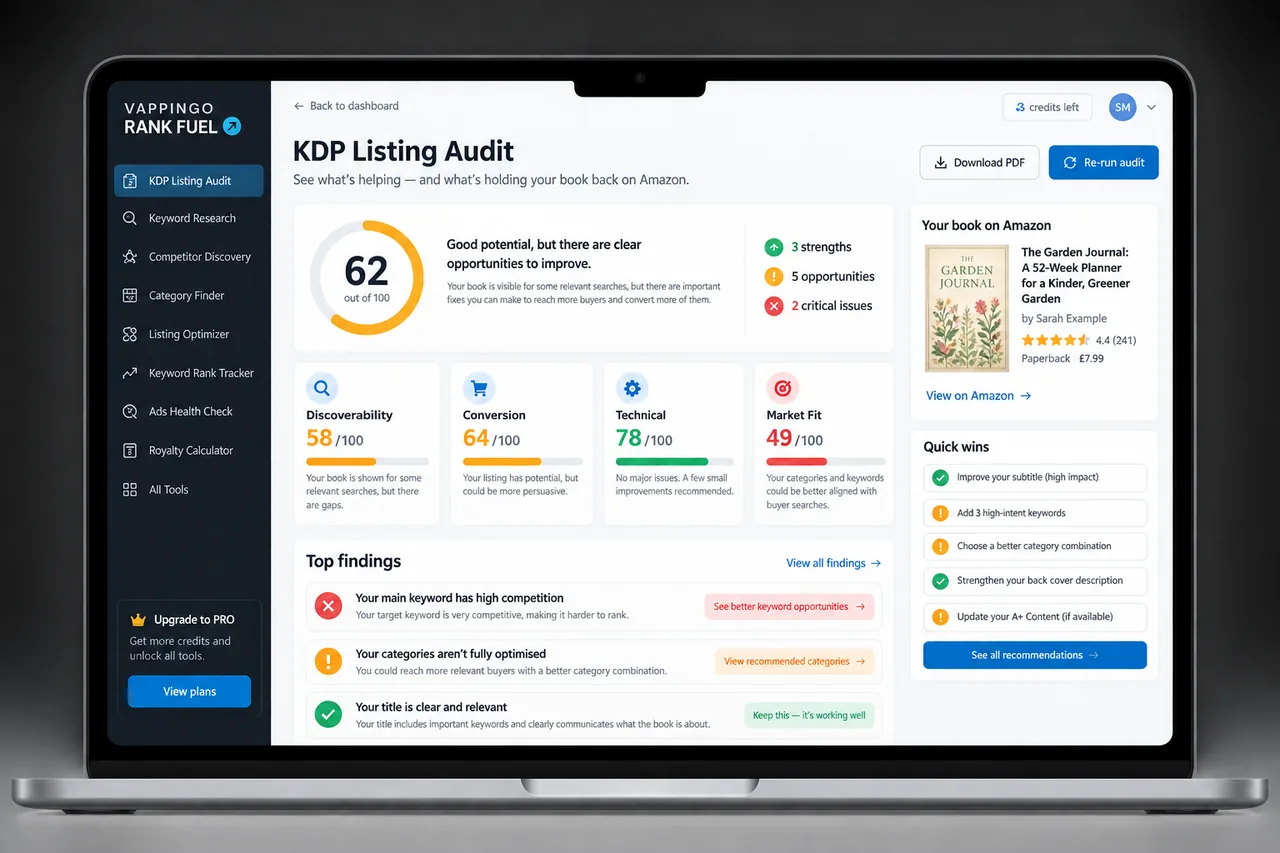
When a second version is needed, KDP Rank Fuel can help create or optimize an alternative listing while preserving the book’s important positioning and keyword evidence. That gives the test a purposeful challenger rather than a rewrite made only to be different.
Continue Reading · Book Descriptions
Current KDP Rules to Recheck
Amazon changes KDP pricing, metadata, and distribution rules, so this guide has been checked against current KDP Help rather than relying on older self-publishing conventions. Recheck the official source before changing a live title. The most useful references for the topics covered here are listed below.
- eBook royalty options and list-price requirements
- print royalty and printing-cost calculations
- book details, keywords and categories
- book description and formatting rules
Where a decision affects a live book, check the help page again before publishing. Marketplace thresholds and eligibility details are more important than memorizing an old rule from a blog post.
Frequently Asked Questions
Do KDP rules change often enough to recheck before publishing?
Yes. Royalty thresholds, file rules, metadata guidance and feature eligibility do change. Use current KDP Help for the final decision, especially when pricing or changing metadata on a live book.
Should I optimize for Amazon or for readers first?
Both matter, but they do different jobs. Metadata helps the right shoppers discover and understand the book, while reader-facing copy has to make a credible case for the click and purchase. Do not damage clarity by forcing keywords into persuasive copy.
How should I decide what to change first on an underperforming book?
Start with evidence. Check whether the book is being found for relevant searches, whether the cover and title earn the click, whether the description communicates value, and whether price and reviews create a competitive offer. KDP Rank Fuel is designed to connect those research and listing decisions rather than treating them as unrelated tools.
Can I change metadata after publication?
Many fields can be updated, but some book details are restricted after publication and changes can take time to appear. Make deliberate changes, keep a record of what changed and avoid judging the result before the update has propagated.
When should I get professional editorial help?
If the manuscript, description or publishing copy is difficult to assess objectively, a qualified editor can identify clarity, structure and language problems before marketing spend amplifies them. Vappingo offers book editing and professional proofreading for authors who want a human editorial review.