Using Social Proof in Your Amazon Book Description
A strong description makes the right reader understand the promise of the book quickly, without stuffing the field with material Amazon does not allow.
Why the old “put reviews in the description” advice is now wrong
Social proof still matters in book marketing, but KDP’s current Description rules are explicit: the description cannot contain reviews, quotes, or testimonials. That means a sentence lifted from an Amazon customer review, an ARC quote, a testimonial from a reader, or a block of star ratings does not belong in this field. The same restriction applies even when the quote is genuine and flattering.
This changes the strategy rather than eliminating social proof. Your description should persuade through the premise, problem, stakes, benefits, genre fit, and voice. Proof from other people should be moved to Amazon surfaces that are designed to carry it, or to your off-Amazon marketing.
Use Author Central Editorial Reviews where the feature is available
Amazon Author Central currently allows authors to add Editorial Reviews for books in the United States. This is a better home for legitimate editorial endorsements because it separates third-party praise from the sales description and gives the source appropriate context.
Editorial reviews are not the same as customer reviews. Think established publications, recognized reviewers, professional endorsements, or other editorial commentary you have permission to use. Keep the attribution exact and do not rewrite a weak quote until it says something the source never actually said.
Use A+ Content carefully for endorsements
A+ Content has its own rules. Amazon does not permit customer reviews or quotes from private individuals there, but its current guidelines allow a limited number of quotes or endorsements from well-known publications or public figures when they are properly attributed. That makes A+ useful for selected professional proof, not for recycling ordinary Amazon reviews.
A+ can also provide visual credibility without quoting anyone: professional design, comparison modules for a series, clear benefit summaries, author positioning, or imagery that reinforces the promise of the book. Keep every claim supportable and avoid time-sensitive promotional language.
What the description should do instead
When testimonials are removed, many authors worry that the description will feel less convincing. Usually the stronger answer is better specificity. Fiction descriptions can signal trope, setting, emotional tone, central conflict, and stakes. Nonfiction descriptions can identify the reader’s problem, establish relevant author credibility, explain the method or scope, and show the practical outcome the reader is buying.
That kind of evidence is intrinsic to the book rather than borrowed from somebody else’s opinion. It also survives even when review counts change, awards age, or a promotional claim becomes stale.
Comp titles are positioning, not testimonials
Comparative positioning can help a reader identify the experience quickly, but it should be used as ordinary descriptive language rather than as a fabricated endorsement. A phrase such as “for readers who enjoy intimate found-family fantasy” communicates audience fit. Referencing a specific comparable author or title can be useful when the comparison is accurate and not misleading, but it should not imply sponsorship or approval.
Choose comps for the trait that matters: tone, subgenre, pace, structure, or reader experience. The more famous the comparison, the more important it is that the similarity is real rather than aspirational.
Awards, bestseller claims, and sales numbers need caution
Older marketing advice often recommends filling a description with awards, bestseller badges, launch dates, sales milestones, or “over 50,000 readers” claims. KDP’s Description restrictions also prohibit promotional and time-sensitive material, so the safest strategy is to keep the Description focused on the book itself and use approved Amazon marketing surfaces or external channels for changing promotional proof.
If an award or credential is central to understanding the work, verify the current KDP and A+ rules for the surface where you plan to place it. Never inflate numbers, imply a broader bestseller status than the ranking actually supported, or turn a brief category position into a permanent credential.
Social proof for a new author
A new author does not need fake proof to compensate for a small review count. The first job is to make the product page coherent: professional cover, accurate category and keyword choices, polished description, a strong sample, and a book that delivers what the listing promises. Early reviews can then accumulate naturally without being copied into a field where Amazon prohibits them.
For nonfiction, relevant qualifications and lived experience can be explained as part of the author’s credibility when they genuinely help a reader evaluate the book. For fiction, reader confidence often comes from clear genre signals and a polished presentation more than from a paragraph telling them that other people liked it.
Build a social-proof system around the description, not inside it
Think of the Amazon detail page as a group of surfaces with different jobs. The Description explains the book. Customer reviews remain in Amazon’s review system. Editorial endorsements can be managed through Author Central where available. A+ Content can add approved visual and editorial material under its own guidelines. Your Author Page adds biography and catalog context.
That separation produces a cleaner page and is easier to maintain. It also prevents a common compliance mistake: treating every persuasive element as if it belongs inside the Description field. The description should still be excellent, but it no longer has to carry every form of proof by itself.
Use this page as part of a complete description workflow
Writing the description is easier when each page has one job. Start with the complete Amazon book description guide for the overall structure, then use the specialist guides for genre, hooks, formatting, series copy, length, or diagnosis. If a live listing is underperforming, compare the description with the broader KDP Listing Audit process so you do not rewrite copy when the real bottleneck is the cover, positioning, keywords, or price.
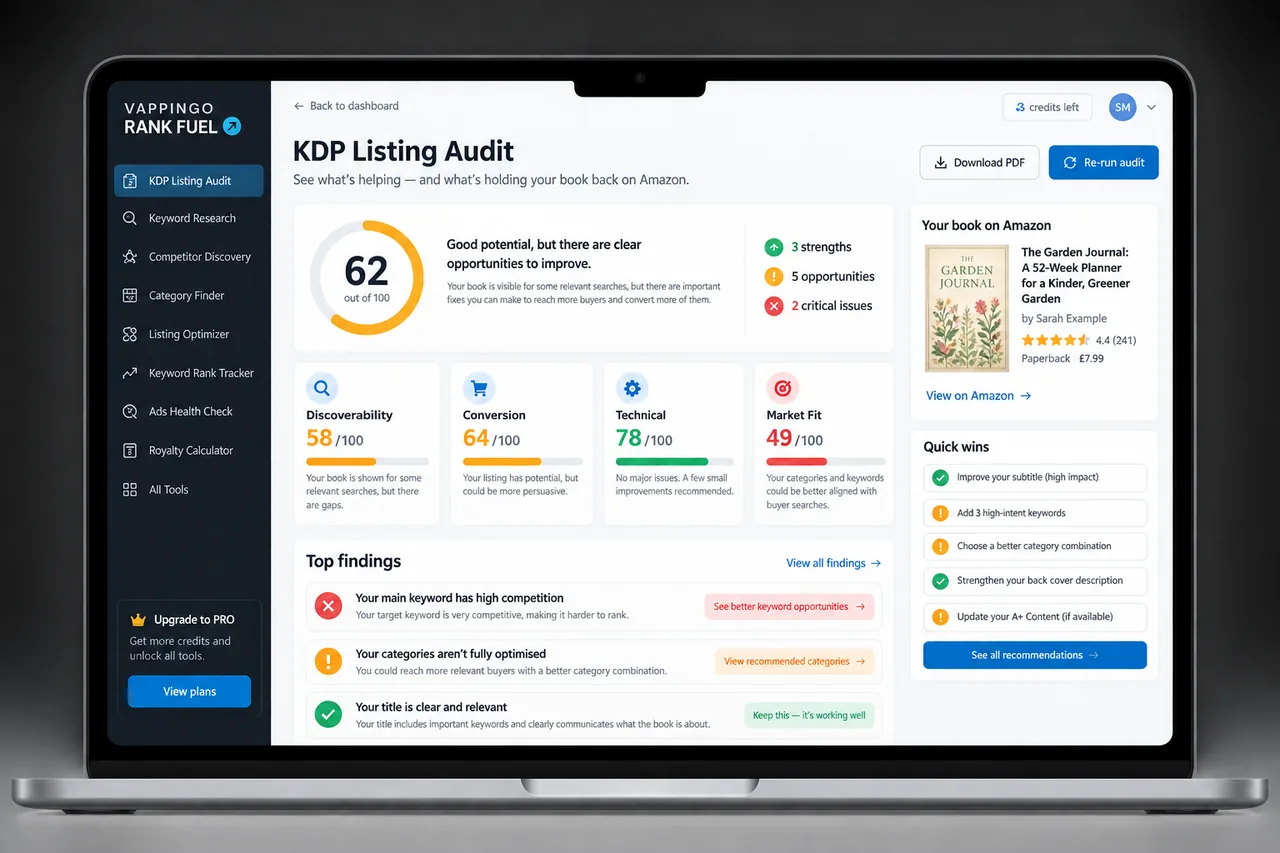
For authors who want a more structured listing workflow, Rank Fuel’s current Listing Generator helps create a complete Amazon listing, while Listing Audit identifies the areas most likely to need attention. Treat those tools as drafting and diagnosis aids, then apply human judgment to the final promise, tone, and accuracy.
Practical editing pass before you publish
Read the description once as a shopper rather than as the author. In the first pass, check whether the opening immediately establishes the type of book and the reason to continue. In the second, remove background that matters to you but does not affect the buying decision. In the third, check every claim against the manuscript so the copy does not promise a tone, outcome, trope, or level of detail the book does not deliver.
Then inspect the page in context. A strong description cannot compensate indefinitely for a cover that attracts the wrong audience, a title/subtitle that confuses the promise, or metadata that brings irrelevant shoppers to the page. Conversely, changing several elements at the same time makes diagnosis difficult. Keep a dated copy of the old description, record the reason for the change, and give the new version enough exposure before deciding whether it helped.
Finally, proofread the exact text you will paste into KDP, including the Source view if you use HTML. Check line breaks, list tags, character count, unsupported material, and the closing sentence. The goal is a page that feels deliberate from the first line through the final buying cue, with no compliance problem hidden inside otherwise persuasive copy.