Scaling Amazon Ads Profitably: Increase Spend Without Losing Control
Scale profitable Amazon book ads by identifying real constraints, testing budgets and bids separately, expanding targets carefully, and protecting an efficiency floor.
Scaling Amazon Ads is not simply increasing your daily budget. Spend more on poorly structured campaigns and you get more poorly structured results at higher cost. Spend more before your listing converts reliably and you amplify inefficiency. Spend more on keywords that are already reaching their conversion ceiling and you pay increasingly expensive CPCs for diminishing returns. Profitable scaling is a specific skill that requires understanding what is actually constraining your results before adding money.
Why Scaling Amazon Ads Is Harder Than It Looks
Amazon’s ad auction is a competitive bidding environment. As you increase your bids to capture more impression share on your best-performing keywords, you inevitably enter more competitive auction positions, paying more per click for the additional traffic. The economics that made a keyword profitable at £0.35 CPC may not hold at £0.55 CPC if conversion rate does not increase proportionally. This is the fundamental scaling tension: more spend requires higher bids, higher bids mean higher CPCs, and higher CPCs compress margin unless conversion rate improves at the same pace. There is also a keyword supply ceiling. If you are already capturing the majority of available searches for your best genre keywords, adding budget simply exhausts more quickly without generating proportionally more revenue. At some point, the available market for any specific keyword set is saturated, and further spend requires either new keywords, new markets, or new ad types to find incremental scale.
Conditions That Need to Be True Before Scaling
Before scaling, confirm three things: the traffic is relevant, the conversion and reader economics can support more acquisition, and you know what is currently limiting useful volume. Profitability can be one objective, but a launch or series-entry campaign can also scale deliberately above direct break-even if the expected reader value and loss limit are explicit.
A campaign does not need to hit its daily budget cap before it can scale. If a proven target is bid constrained, more budget will not help; if a valuable campaign is genuinely budget constrained, more budget is the appropriate lever. Likewise, you do not need four to six weeks of history when a high-volume campaign has already produced enough mature evidence.
Check the detail page before adding large amounts of traffic. Reviews can influence confidence, but there is no minimum review count for scaling. Conversion, cover fit, price, sample, availability, and audience match are the better readiness questions.
Impression Share: The First Scaling Signal
Search-term impression share can show whether a Sponsored Products query still has available ad inventory, but there is no universal share at which you should raise or stop raising bids. Combine impression share with conversion, CPC, budget status, and marginal profitability. A low share is only an opportunity if the additional impressions are worth buying.
Scaling Budget vs Scaling Bids
These are distinct actions with different effects. Increasing bids on existing keywords generates more impressions per keyword, potentially at higher CPC, it scales reach within your current keyword set at potentially higher cost. Increasing campaign daily budget without changing bids allows campaigns that hit budget caps to run for longer each day, it scales duration of exposure without changing CPC. Both are needed at different times; understanding which constraint you are removing is important. If campaigns hit budget cap early in the day (you can check this in the pacing report), increase daily budget first, this is the most cost-neutral scaling action, as you are simply buying more of the same traffic at the same cost. If campaigns do not hit budget caps but you want more volume, increase bids on your best performers, this generates more impressions but potentially at higher CPC. The bid increase is a more expensive lever and should be used only after the budget lever has been exhausted.
Adding More Keywords to Scale
Keyword expansion is useful when the existing target set has limited supply and the book still has adjacent buyer language to explore. Start with the Search term report, Keyword Research, Book Keyword Spy, autocomplete, and the vocabulary of genuinely comparable books. Organize new candidates by reader intent rather than adding hundreds of rows at once.
Give new targets a separate testing role if they are meaningfully less proven than the existing winners. That keeps the economics of expansion visible instead of diluting a mature exact campaign with speculative terms. Product targeting can also expand supply when comparable-book pages represent the same reader better than another keyword does.
Expansion is successful when the marginal targets produce useful readers at an acceptable cost. A larger keyword list is not a scaling result by itself.
Expanding to New Campaign Types
Use additional campaign types only when they solve a constraint. Sponsored Brands can expand catalog-level visibility for eligible authors with at least three unique titles under one pen name. Product targeting can add new inventory inside Sponsored Products. Schedule bid rules can change time-based bidding when you have evidence for a pattern.
Do not assume Sponsored Display is the next KDP-author phase. Current author guidance does not offer display through the standard author route. Seller, vendor, publisher, or managed-service accounts can have different options, but eligibility must be verified in the actual account.
Every new campaign type adds reporting and budget complexity. Define the incremental audience or placement it is supposed to reach before funding it.
Expanding to New Amazon Marketplaces
International expansion can add target supply when the book is available and commercially relevant in another Amazon store. Do not assume the new marketplace will have cheaper CPCs or easier competition. Reader demand, language, price, reviews, ad inventory, and local competition all change by store.
Localize the retail proposition before you copy the campaign. Check currency and price, cover expectations, description language, review carryover, availability, and whether the keywords mean the same thing to local shoppers. Launch a controlled test and compare local CPC and conversion rather than importing a benchmark from Amazon.com. Use the international Amazon Ads guide for the marketplace setup and reporting workflow.
How Fast to Scale
Scale at a pace that keeps marginal performance readable. Change one main lever, such as budget, bid, target supply, or marketplace, then wait for enough new traffic and mature attribution to compare the incremental result. There is no universal 10%, 20%, or weekly increase that protects ACoS.
Large changes can be appropriate when a campaign is severely budget constrained and far inside its economic limit. Smaller changes are safer when the target is already close to break-even. The decision should reflect how much room you have for CPC or conversion to deteriorate before the additional traffic stops being worthwhile.
Record the baseline before the scale test. Without a baseline, a larger sales number can look like success even when the extra sales cost more than they are worth.
Setting an Efficiency Floor
Define an efficiency floor from the book’s economics and the campaign’s role. If marginal spend pushes the campaign beyond that floor for a sustained period, reverse or narrow the scaling test. The exact percentage is title-specific; the discipline is to decide the floor before the excitement of more traffic changes your standards.
Reinvestment vs Profit-Taking Decisions
Once advertising is producing useful readers, decide explicitly how much cash to reinvest and how much to retain. The answer depends on catalog depth, release schedule, working capital, series economics, and whether the current campaigns still have profitable headroom. Reinvestment is not automatically the highest-return choice simply because a book is new, and more ad spend does not guarantee durable BSR or organic-ranking gains.
Model at least two scenarios. In the first, keep spend near the current level and retain more cash. In the second, fund a controlled scaling test against the actual constraint: budget, bid, target supply, or marketplace expansion. Estimate the additional spend, the CPC and conversion required to justify it, and the downside if marginal traffic is weaker than current traffic.
Then compare the advertising opportunity with alternative uses of the money. A new cover, editing, a stronger book-two launch, another title, email-list growth, or simply preserving runway may produce more value than squeezing more volume from a saturated campaign. Revisit the decision after the test period with actual marginal performance rather than choosing the scenario that produces the prettiest projected TACoS.
Knowing When to Stop Scaling a Specific Book
Every title has a practical audience and acquisition-cost limit. Stop or slow scaling when additional budget, bids, keywords, or marketplaces repeatedly produce weaker marginal economics and the available alternatives no longer solve that constraint.
Look for evidence such as high impression share on the best proven searches, new targets that are relevant but consistently uneconomic, budget increases that add little incremental revenue, or CPC rising faster than conversion value. None of those signals has a universal numeric threshold, and a niche book can reach its ceiling much earlier than a broad commercial title.
At that point, maintain the profitable core and compare the next advertising dollar with other uses of capital: a new title, stronger series continuation, listing improvement, email audience, or simply retained cash. Scaling is successful when the business becomes stronger, not when the campaign reaches the largest possible spend.
A Four-Way Scaling Diagnosis
Budget constrained: a campaign converts well and repeatedly runs out of budget. Test more budget before changing bids. Bid constrained: highly relevant proven targets have low delivery or impression share and the economics leave room for a higher CPC. Test bids. Target constrained: the existing targets are saturated but the book still has adjacent buyer language or comparable products to explore. Expand targeting. Conversion constrained: additional clicks are available but the detail page is not converting them. Stop scaling media and fix the offer.
Separating these constraints prevents the classic scaling mistake of raising bids and budget at the same time. If performance deteriorates, you cannot tell whether the problem was more expensive auctions or simply more volume. Scaling is easier to reverse when each test has one dominant variable.
Turn the article into a repeatable Amazon Ads workflow
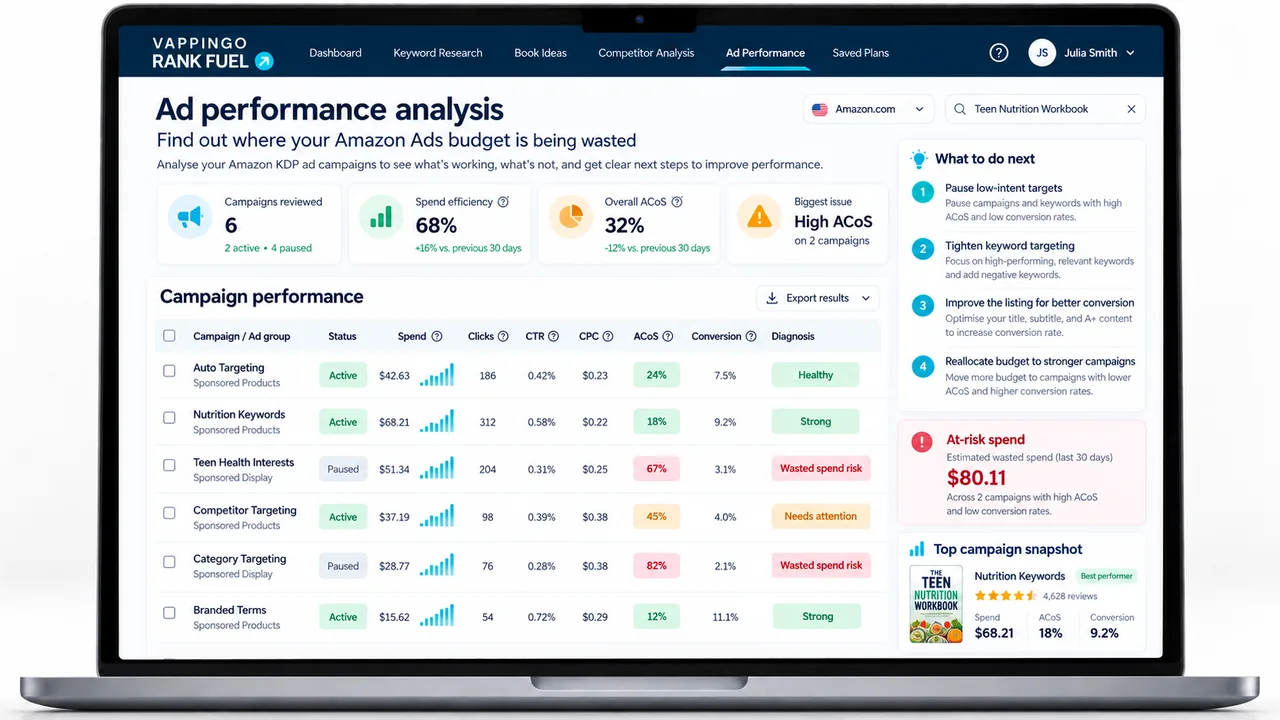
KDP Rank Fuel’s current Amazon Ads Generator builds a guided five-campaign Sponsored Products plan, while Amazon Ads Weekly Coach helps turn exported reports into clearer recurring decisions. Use the tools as decision support and keep the live Amazon Ads console as the authority on eligibility, settings, and final changes.
Frequently Asked Questions
When is an Amazon Ads campaign ready to scale?
When it has repeated evidence of useful traffic and conversions, the book economics leave room for more acquisition, and you can identify the actual constraint limiting growth.
Should I raise budget or bids first?
Raise budget when a valuable campaign is budget constrained. Raise bids when relevant targets are losing useful delivery and the economics can support a higher CPC.
What is search-term impression share?
It estimates your share of ad impressions for a search term and can show available headroom. It is useful only when the additional impressions are worth buying.
How quickly should I scale?
There is no universal weekly percentage. Make a controlled change, record the baseline, and judge marginal performance after enough new traffic arrives.
Should I add more marketplaces to scale?
Only after checking local price, availability, language, reader demand, and campaign economics. A proven US campaign does not guarantee cheaper or better traffic elsewhere.
Scale the Constraint, Not the Whole Account
More spend is useful only when you know what is limiting a campaign and why additional traffic should still be valuable. Identify the constraint, change one lever, and judge the marginal result before you scale again.