KDP Keywords for Low-Content Books: Journals, Planners, and Logs
Research KDP keywords for genuine low-content products such as journals, planners, notebooks, and logs using function, audience, theme, and gifting intent.
Low-content and no-content books , journals, planners, notebooks, coloring books, activity books, puzzle books , have a distinct keyword landscape from conventional books. Their buyers often behave more like gift shoppers than book readers, and their keyword strategy must reflect this difference. For the full keyword foundation, see our
Amazon changes metadata, taxonomy, and merchandising systems. This article reflects the September 2026 workflow, but the live KDP interface and help pages remain the final authority.
Why Low-Content Keywords Are Different
Most book buyers are searching for content , a story, information, guidance. Low-content book buyers are searching for a functional object with a specific visual or thematic identity. The keyword strategy that works for a novel or a business book does not transfer directly. Low-content buyers search primarily along three axes:
- Function: What the object does. “Lined notebook,” “weekly planner,” “dot grid journal,” “sudoku puzzle book.”
- Theme/aesthetic: How it looks or what it is about. “Floral notebook,” “cat journal,” “wildflower planner,” “mindfulness coloring book.”
- Gifting occasion or recipient: Who it is for and when. “Teacher gift journal,” “mum birthday gift notebook,” “retirement gift planner,” “Christmas gift coloring book.”
An effective low-content keyword set covers all three axes explicitly, because different buyers are searching from each angle simultaneously. The emphasis should still follow the strongest buyer motive for the specific product rather than forcing equal coverage of every possible angle.
The Gifting Search Pattern
Gifting can be an important search route for journals, planners, and notebooks, especially when the design is clearly aimed at a recipient or occasion. Do not assume every low-content market is gift-led, though. Validate gifting language against the product concept, season, and marketplace before it uses one of the seven keyword fields.
- “[Recipient] gift [function]” , “teacher gift journal,” “nurse gift notebook,” “gardener gift planner”
- “[Occasion] gift [function]” , “birthday gift journal,” “Christmas gift coloring book,” “retirement gift notebook”
- “gifts for [recipient]” , “gifts for book lovers notebook,” “gifts for dog mum journal”
Be careful with the label low-content. KDP lists notebooks, planners, diaries/journals, prompt journals, logs, coupon books, score cards, crafting templates, and blank sheet music as common examples, while puzzle books and coloring books generally are not treated as low-content. Research keywords according to the product KDP actually classifies, because publishing rules and reader intent differ. See KDP low-content guidance.
Journals and Notebooks
The journal and notebook space is extremely competitive. Differentiation through specificity is essential , generic “lined journal” targets millions of options. Specific themed journals find their exact audience.
High-value patterns
“anxiety journal prompts mental health,” “gratitude journal daily practice,” “bullet journal dot grid large,” “cat lover notebook lined gift,” “reading log journal book tracker,” “dream journal notebook prompts.” The examples illustrate increasing specificity; only use wording that accurately reflects the interior, cover, audience, and intended use of the product.
Planners and Organizers
Planner buyers search by time period, layout style, and use case. Cover all three in your keyword set.
High-value patterns
“weekly planner undated habit tracker,” “academic planner 2025 2026 student,” “meal planning weekly organizer,” “homeschool planner yearly undated,” “small business planner monthly budget,” “fitness workout planner gym log.” Time period, layout, and use case can be combined in different ways, so test the combinations that best match the actual planner rather than treating these examples as a fixed template.
Products KDP Does Not Treat as Low-Content
Be careful with the label low-content. KDP lists notebooks, planners, diaries/journals, prompt journals, logs, coupon books, score cards, crafting templates, and blank sheet music as common examples, while puzzle books and coloring books generally are not treated as low-content. Research keywords according to the product KDP actually classifies, because publishing rules and reader intent differ. See KDP low-content guidance.
High-value patterns
Be careful with the label low-content. KDP lists notebooks, planners, diaries/journals, prompt journals, logs, coupon books, score cards, crafting templates, and blank sheet music as common examples, while puzzle books and coloring books generally are not treated as low-content. Research keywords according to the product KDP actually classifies, because publishing rules and reader intent differ. See KDP low-content guidance.
The Competition Challenge
Low-content publishing has become highly competitive because the barriers to entry are low. Many low-content books are generic designs with minimal differentiation. To succeed in this environment, keyword specificity is even more important than in conventional publishing , your keywords must reach the exact buyers whose specific aesthetic or functional requirements your book meets, rather than competing for generic high-volume terms.
Building a Low-Content Keyword Strategy
For a low-content book, a balanced seven-keyword set:
- 1-2 function + theme combinations (core product description)
- 1-2 gifting keywords (recipient + occasion)
- 1 use-case keyword (what specifically it is used for)
- 1 format/specification keyword (size, page count, binding type)
- 1 seasonal keyword (rotated by season)
‘s is particularly useful for low-content publishing , identifying the least competitive categories for your specific product type and the category path to enter in KDP, which is often more complex for low-content books than for conventional titles. Low-content books still benefit from professional quality. from Vappingo covers any instructional content, prompts, or introductory text your low-content book contains.
A Low-Content Keyword Worksheet
For a genuine low-content product, create four lists: function, user, theme, and occasion. A teacher planner might combine planning function with teacher audience, academic-year context, and a design theme; a hiking log can combine tracking function with hikers, trail context, and gifting language where it genuinely fits. Keep only combinations that accurately describe the physical product. This prevents a common failure mode in low-content publishing: using attractive high-volume phrases that promise an activity or interior the book does not actually contain.
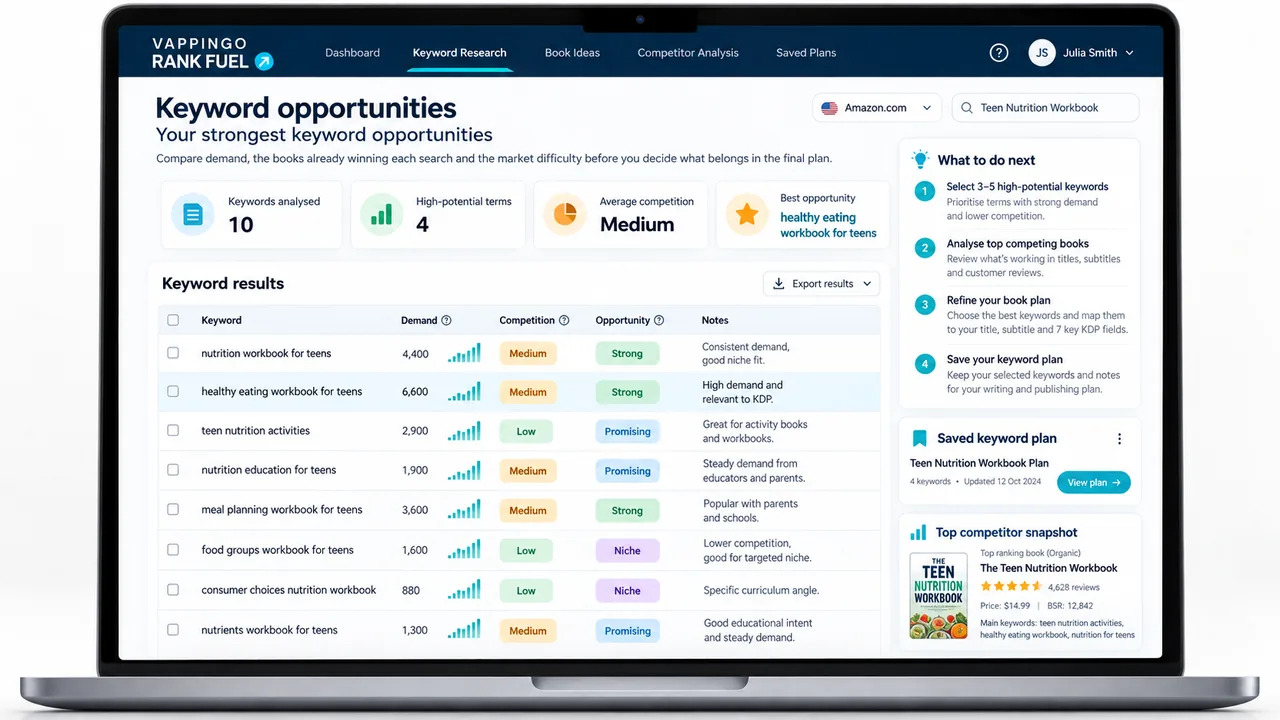
KDP Rank Fuel can support keyword, category, rank, and market research. Its scores and estimates are research aids; Amazon does not publish the proprietary formulas behind search placement or exact sales thresholds.
Metadata can help the right reader find a book, but the listing and manuscript still have to earn trust. Vappingo provides professional manuscript proofreading by qualified human editors.
Frequently Asked Questions
How many KDP keyword fields are there?
KDP currently provides up to seven keyword fields. Use them for relevant keywords or short phrases and avoid padding the set with duplicate or prohibited language just to fill space.
Should I repeat my title or categories in the keyword fields?
Usually no. KDP advises against repeating metadata already covered elsewhere. Use the limited keyword fields to add distinct reader search language.
How often should I change KDP keywords?
There is no required refresh schedule. Change them when research, positioning, marketplace behavior, or post-launch evidence gives you a clear reason, and keep a record of what changed.
Can I use competitor author names or book titles as keywords?
KDP warns against unauthorized references to other authors, books, or trademarked terms. Use compliant reader language and verify the current metadata rules before publishing.
Do KDP keywords guarantee a search ranking?
No. Keywords are metadata inputs, not guaranteed positions. Search visibility also depends on relevance, shopper behavior, competition, listing quality, and Amazon-controlled systems.
Make the Metadata Easier to Defend
The strongest KDP metadata strategy is easy to explain: every category accurately describes the book, every keyword represents a plausible reader search, every change has a reason, and no part of the plan depends on a retired support workflow or an undocumented ranking formula. That standard makes the listing safer, clearer, and easier to improve as Amazon changes.