How Specific Should a KDP Keyword Be? Broad vs Long-Tail Buyer Intent
The best KDP keyword is not simply the longest one. Add specificity only while it makes the buyer, product or need clearer without shrinking useful demand away.
signals of a well-targeted keyword
checks after keyword fit
sweet spot between vague and tiny
How specific should a useful KDP keyword be?
It is tempting to answer that question with a word count. Plenty of KDP advice tells you to go long-tail: add more detail, make the phrase narrower and assume the extra specificity will make the keyword easier to rank for.
The problem is that length tells you very little on its own. A long keyword can still attract almost no useful demand, point toward the wrong product format or describe a reader so narrowly that the market disappears. A shorter phrase can sometimes reveal the buyer and product perfectly well.
The better test is whether the phrase describes a recognizable buyer, product and need clearly enough to guide a publishing decision while still representing demand worth competing for. That balance, rather than maximum length, is what useful KDP long-tail keywords are trying to achieve.
The Quick Answer: Specific Enough to Reveal Intent, Broad Enough to Preserve Demand
A useful KDP keyword becomes more valuable as it removes ambiguity. Compare fitness, exercise for seniors and chair yoga book for seniors. Each step gives you more information about the likely buyer and the product they expect to find.
But specificity has a limit. Continue narrowing the phrase to something such as large print 15 minute chair yoga workbook for women over 73 with knee pain and you may have described a very clear product for a very small search population.
The sweet spot sits somewhere between those extremes. A strong keyword usually gives you enough detail to understand the search intent, audience and product format without narrowing the market until hardly anyone remains.
Amazon’s own KDP guidance supports the underlying principle. KDP allows up to seven keywords related to the content of the book and specifically recommends avoiding vague terms in favor of more useful, relevant wording. See Amazon’s current keyword guidance.
1. Does the Phrase Sound Like Someone Looking for a Book?
Start with buying intent. Some keywords describe an enormous topic but tell you almost nothing about what the searcher wants to purchase.
Take anxiety. The person searching could want symptoms, treatment information, a podcast, a therapist, a definition, medication advice or a book. The phrase tells you the subject, but not the buying intention.
Now compare it with anxiety workbook for teens. The search has become much more useful because it contains a recognizable product format and audience. You can picture the type of book that would satisfy the query.
| Keyword | What it tells you | Buyer intent |
|---|---|---|
| anxiety | Topic only | Unclear |
| teen anxiety | Topic + audience | Still unclear |
| anxiety workbook for teens | Topic + product + audience | Much clearer |
That does not mean every useful KDP keyword needs to contain the word book or workbook. Searches such as easy sudoku for seniors large print can still describe a recognizable book-buying need because the format is strongly implied.
That is why buyer intent is the first signal in this guide’s five-part specificity check. A keyword becomes more useful when the search sounds like someone who could plausibly want the kind of book you plan to make.
2. Does the Keyword Imply a recognizable KDP Product?
A topic can have strong interest without translating neatly into a book purchase. This is one reason broad keywords can look attractive during research and disappoint later.
Compare healthy habits with healthy habits journal for teens. The first phrase could lead to articles, videos, apps, habit trackers or general advice. The second points towards a recognizable KDP product.
The same distinction appears across many niches:
| Broad topic | Clearer product phrase |
|---|---|
| dog training | dog training workbook for kids |
| budgeting | budget planner for couples |
| gardening | vegetable gardening planner for beginners |
| mindfulness | mindfulness journal for teenage girls |
Product format is the second signal in the specificity check. Journals, word searches, coloring books, activity books, planners and workbooks are examples of terms that can make the intended product easier to understand.
This does not mean you should mechanically bolt a format word onto every keyword. It means you should ask whether the phrase gives Amazon shoppers a clear reason to expect a book like yours.
3. Is the Audience Clear?
Audience language can transform a broad search into a commercially useful one because it reduces the number of products that could plausibly satisfy the query. Consider the progression memory games → memory games for seniors → large print memory games for seniors: each step tells you something new about the buyer or the product.
The first phrase identifies the activity, the second identifies the reader, and the third adds a feature that may matter particularly to that reader. The extra detail is useful because it makes the search easier to interpret, not because a longer phrase is automatically better.
The useful test is whether the extra detail improves the match between searcher and product. Adding an audience term because it sounds niche is not enough. The phrase should describe a real group whose needs affect the book you intend to create.
Audience clarity is the third signal. A useful phrase often tells you whether the intended reader is a child in a particular age range, a teen, a beginner, an older adult or another recognizable group whose needs affect the book.
This can influence the book far beyond metadata. A product aimed at ages 8 to 12 may need different language, challenge level, illustration style, trim size and cover treatment from one aimed at adults. A keyword that clarifies the buyer can therefore improve the product decision itself.
4. Is the Search Intent Specific Enough?
Broad searches often hide several different reasons for searching. The more possible interpretations a phrase has, the less confidently you can design a book around it.
Take gardening book. That could describe beginner instruction, vegetable growing, houseplants, children’s gardening, an allotment planner, a gift book, a reference guide or a gardening journal.
Now compare vegetable gardening planner for beginners. The likely product is much clearer: a practical planning book for people starting to grow vegetables.
This is one of the main reasons long-tail keywords can be useful. Their advantage is not that Amazon rewards longer phrases simply for being longer. Their advantage is that additional words can reduce ambiguity.
A long-tail keyword earns its extra words only when those words reveal something useful about the buyer’s intent, the product they expect or the audience the book is meant to serve.
Specificity itself is the fourth signal. The useful question is whether the phrase resolves enough uncertainty to make the opportunity easier to assess without narrowing the market for no good reason.
5. Does Specificity Create Room to Stand Out?
Two keywords can be equally clear while offering very different competitive opportunities.
For example, large print word search for seniors is highly specific. It tells you the product format, accessibility feature and audience. But the market may already contain many strong books built around that exact promise.
Adding an angle such as gardening word search for seniors large print can create a more distinctive proposition. The extra specificity has changed the product, not merely lengthened the keyword.
There is still a point where this stops helping. A phrase such as British wildflower gardening word search for left-handed women over 70 large print may be wonderfully descriptive and commercially tiny.
Differentiation is the fifth signal. Specificity is most useful when it sharpens the proposition or exposes a clearer reason for the book to exist, rather than becoming an exercise in adding more modifiers.
The KDP Keyword Specificity Curve
One useful way to think about keyword research is as a curve; At the left, searches are so broad that intent is weak. Move towards the center and the phrase becomes clearer, more actionable and easier to match with a specific product. Continue too far and the audience can become so narrow that useful demand starts to disappear.
| Stage | Example | Main issue |
|---|---|---|
| Too broad | puzzles | Almost no useful product intent. |
| Topic | word search | Large range of possible products and audiences. |
| Product | large print word search | Format is clearer, but audience is still broad. |
| Audience | large print word search for seniors | Clear product and reader. |
| Angle | gardening word search for seniors large print | Clear product, reader and theme. |
| Over-specific | British gardening word search for women over 70 large print gift | Intent is clear, but demand may be fragmented. |
The useful middle of the curve is not a fixed word count. It is the point where each extra detail makes the buyer’s intent clearer without narrowing the phrase so far that meaningful demand disappears.
That is why rules such as “always use four-word keywords” are not very useful. Sudoku for seniors contains three words and can be highly specific. A much longer phrase can still describe a vague need.
Bring Search Volume Back Into the Decision
Specificity solves one problem and can create another. As you narrow a phrase, the number of people searching for that exact need often declines.
Imagine the following illustrative progression; these figures are not live Amazon data.
| Keyword | Illustrative estimated monthly searches | Intent clarity |
|---|---|---|
| activity books | 40,000 | Low |
| activity books for seniors | 4,800 | Moderate |
| large print activity books for seniors | 1,300 | High |
| large print travel activity books for seniors | 170 | Very high |
The highest-volume phrase is not automatically best because it tells you very little about the product. The smallest phrase is not automatically best because the market may be too narrow. You are looking for the point where demand remains useful and the intent becomes substantially clearer.
This is why keyword specificity and search volume should never be researched separately. If you have not already read it, KDP Keyword Search Volume: How Much Is Actually Enough? explains how to judge demand without treating the biggest number as the winner.
Specific Does Not Automatically Mean Easy
Another common assumption is that long-tail automatically means low competition. Sometimes it does. Sometimes it simply describes a very crowded niche more precisely.
A phrase such as chair yoga workbook for seniors can have clearer buyer intent than chair yoga, but you still need to inspect the books occupying page one. If the narrower search is dominated by established titles with strong BSR, large review counts and polished products, specificity has not removed the competitive wall.
The reverse can also happen. A lower-volume search can be attractive because it combines clear intent with a more accessible market and evidence that newer books are gaining visibility.
A useful sequence is keyword fit → estimated demand → page-one competition → publishing decision. Specificity earns its place only when it improves the fit without making the remaining demand too small or the competition too difficult.
Our guide to KDP keyword competition explains the competition side in more depth, while How to analyze Page One of Amazon Before Publishing a KDP Book brings those signals into a complete market check.
How to Test Keyword Specificity in KDP Rank Fuel
KDP Rank Fuel’s current Keyword Research workflow is built around the same practical problem: finding buyer searches that are specific enough to fit the book without narrowing the market until useful demand disappears.
Start by describing the book or idea, including the subject, audience, age or level and format where those details matter. Rank Fuel uses that description to keep the research anchored to the product you are actually considering rather than drifting towards a broader search simply because the broad term has more volume.
Start with the book, not a one-word keyword
This matters because specificity is contextual. Math workbook may be too broad for a Year 8 revision product, while year 8 maths workbook captures the level, subject and format without adding unnecessary qualifiers. A completely different book would need a different level of specificity.
Rank Fuel then identifies relevant Amazon buyer searches and compares the strongest opportunities. The current research route is focused on Amazon.com (US), so treat the demand and market figures as US-market evidence rather than assuming they transfer unchanged to every Amazon marketplace.
Compare clarity with demand
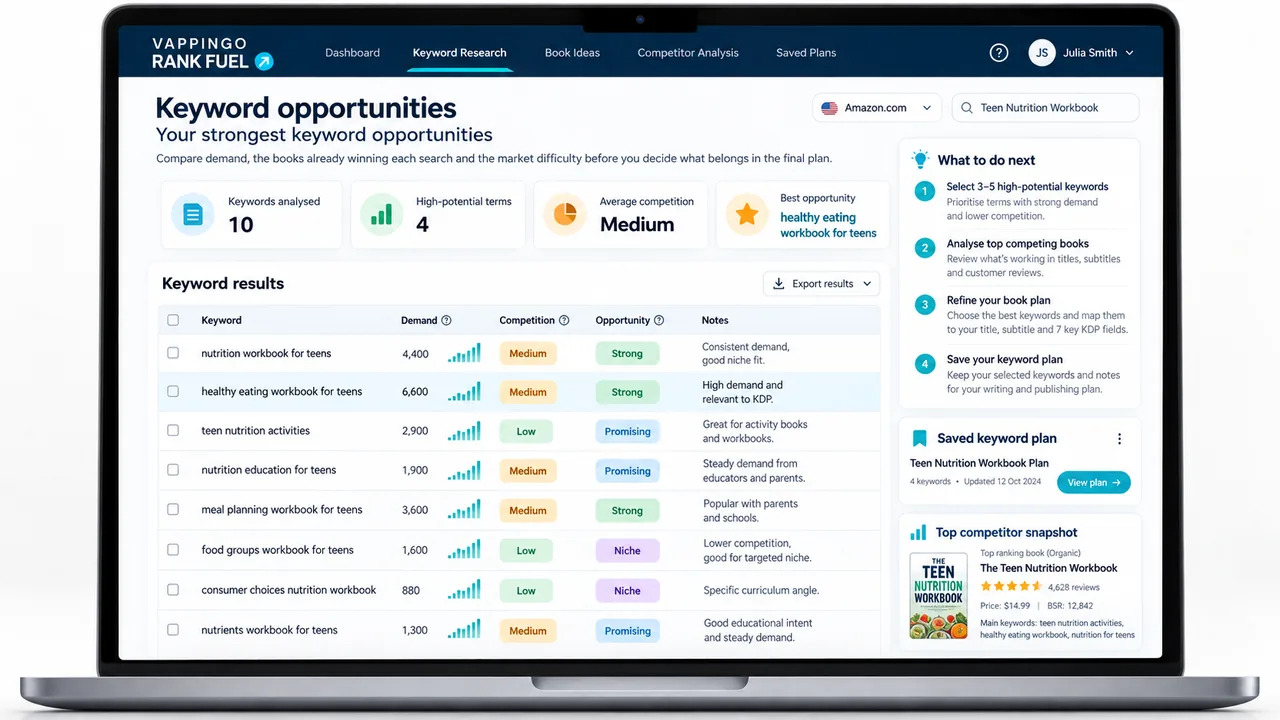
The research results let you compare estimated monthly searches across the strongest relevant phrases. This is the point where the specificity curve becomes useful in practice; a very broad phrase may have more demand but weaker fit. A narrower phrase may describe the buyer beautifully but attract too little activity to justify building a book around it.
Do not choose between those phrases on specificity alone. Ask whether the extra detail has improved the match enough to justify any loss in demand.
Then check the market behind the keyword
Rank Fuel also brings competition and earning evidence into the same comparison. The current results can include competing-book counts, pricing, page counts, estimated earning activity, a Competition assessment and an Opportunity read for the strongest keyword markets.
That produces a better sequence than “find the longest keyword”:
Fit → demand → competition → publishing decision
First make sure the phrase describes the right buyer and product. Then check whether enough demand exists, whether the market is realistically accessible and whether the opportunity still makes sense for the book you want to create.
Your first Keyword Research run currently costs 3 credits. Free users see the three strongest analyzed opportunities from that first search. Rank Fuel Pro unlocks all ten analyzed opportunities and future Keyword Research runs.
Worked Example: From a Vague Topic to a Useful KDP Search
Suppose the starting idea is simply dog puzzles. The phrase tells you the topic but leaves several questions unanswered, including whether the buyer wants puzzles about dogs, puzzle toys for dogs, children’s activities or adult word searches.
That phrase tells you the topic but leaves several questions unanswered. Is the buyer looking for puzzles about dogs, puzzle toys for dogs, children’s activities, adult word searches or something else?
A specificity progression might look like this:
| Keyword | What becomes clearer | Remaining question |
|---|---|---|
| dog puzzles | Topic | Product and audience unclear |
| dog puzzle book | Product | Audience unclear |
| dog puzzle book for kids | Product + audience | Format and age range still broad |
| dog activity book for kids ages 8 to 12 | Audience + age + product format | Theme still broad |
| golden retriever activity book for kids | Niche theme + audience + format | Exact activity type still open |
| golden retriever word search for kids ages 8 to 12 | Theme + format + audience + age | Now validate demand and competition |
The final phrase is far easier to interpret than dog puzzles, but that does not make it commercially superior automatically. It still needs demand.
If the broad term attracts thousands of searches and the very specific phrase attracts almost none, you may need to move slightly back up the curve. Perhaps dog word search for kids or dog activity book ages 8 to 12 offers a better balance.
Then competition has to be checked. If the clearer phrase has useful demand but page one is dominated by strong incumbents, try a different angle. If demand is useful, the competitive set looks accessible and the product proposition is clear, the keyword has earned further consideration.
That is the sequence worth repeating: make the intent clearer, check what happens to demand, then test the market.
Frequently Asked Questions About KDP Long-Tail Keywords
Are long-tail keywords better for Amazon KDP?
They can be, because additional detail often makes buyer intent, audience and product format clearer. They are not automatically better. A very specific term can have too little demand or still face strong competition, so long-tail keywords need to be evaluated alongside search volume, relevance and page-one market strength.
How many words should a KDP keyword have?
There is no ideal word count. A short phrase can be highly specific and a longer phrase can still be vague. Focus on whether the keyword clearly describes a recognizable buyer, product, need or outcome while preserving enough demand to matter.
Can a KDP keyword be too specific?
Yes. Specificity becomes unhelpful when each additional qualifier fragments the audience without adding meaningful product clarity. If estimated demand collapses as the phrase becomes more detailed, move back towards a broader version and compare the trade-off.
What is buyer intent in KDP keyword research?
Buyer intent describes how strongly a search suggests that the person is looking for a product like the book you plan to publish. A broad topic such as “anxiety” has weak book-buying intent, while “anxiety workbook for teens” describes a much clearer product need.
Should I target the highest-volume KDP keyword?
Not automatically. High volume can come with vague intent, mixed search results or intense competition. A smaller search can be commercially more useful when the buyer need is clearer, the product fits naturally and page one leaves a realistic route to visibility.
Does a specific keyword mean lower competition?
No; Specific searches can still be dominated by established books. After finding a clear long-tail keyword, inspect page-one reviews, BSR, estimated sales, prices and newer entrants before deciding that the market is accessible.
How does Rank Fuel help me judge keyword specificity?
Rank Fuel Keyword Research starts with the book or idea you describe, finds relevant Amazon buyer searches and compares the strongest opportunities using estimated demand and market evidence. Use the results with the five-signal specificity check in this guide rather than treating any single score as the answer.
What does Keyword Research cost in Rank Fuel?
Your first Keyword Research run currently costs 3 credits; Free users see the top three analyzed opportunities from that search. Pro unlocks all ten analyzed opportunities and lets you run future Keyword Research searches.
Aim for Clarity, Not Maximum Length
The best KDP keyword is not the broadest phrase with the biggest search number, and it is not the longest phrase you can construct. Both extremes can hide weak commercial logic.
A useful keyword gives you a clear picture of the buyer and the product they expect to find. It describes enough of the audience, format, outcome or use case to reduce ambiguity, while leaving enough demand for the market to matter.
That is the real value of long-tail research. Specificity helps when it turns a vague topic into a recognizable buying need. Once it begins shrinking the audience without making the product meaningfully clearer, you have probably moved too far.
When you want to test that balance across multiple searches, run the idea through KDP Rank Fuel Keyword Research, compare the strongest opportunities across fit, estimated demand and market strength, then decide which direction deserves the book.