Why Is My KDP Book Not Selling?
A KDP book can fail at visibility, click-through, or conversion. Diagnose which gate is breaking before you change keywords, lower the price, or spend more on ads.
vg-modern-guide
Your KDP book is live. Amazon is showing it. Maybe you are even paying for clicks. And still, the sales dashboard barely moves.
That is when the panic fixes begin. Change the keywords. Drop the price. Add more ads. Rewrite the description. Switch categories. Blame the algorithm. You find yourself typing my KDP book is not selling into Google, doing something feels better than waiting.
But more traffic can make the wrong problem worse. If shoppers are already seeing the book and deciding not to click, extra impressions simply expose the weak packaging to more people. If they are clicking and not buying, higher ad spend sends more paid visitors to a page that is failing to convert.
Before you change everything, find the broken gate. Is Amazon failing to show the book to relevant buyers? Are shoppers seeing it but choosing another title? Or are they reaching the product page and still deciding not to buy? Those are three different problems, and each needs a different fix.
The Quick Answer: Your Book May Not Have a Traffic Problem
Most authors respond to weak sales by trying to create more visibility. That only works when visibility is the problem. If the book is already being seen, the more useful question is what happens after the impression.
A weak title, vague subtitle, unconvincing cover, poor search-result fit or generic description can turn extra traffic into extra evidence that buyers are not persuaded. Before you spend more money attracting visitors, work out which of the three sales gates is failing.
That is why “my KDP book is not selling” is not one problem. It is usually one of three problems:
- Amazon is not showing the book to enough relevant buyers – a visibility problem.
- Buyers are seeing the book but not clicking – a click-through problem.
- Buyers are clicking but not purchasing – a conversion problem.
The distinction matters because the fixes are different. If visibility is weak, investigate indexing, keywords, categories and market demand. If buyers see the book but do not click, look first at the cover, title, subtitle, price, reviews and search-result fit. If they click but do not purchase, the product page has to justify the promise through the description, sample, positioning, reviews and overall value. Diagnose the gate before you rebuild the listing.
The Three Different KDP Sales Problems
A sale has to survive three decisions in sequence: Amazon must show the book, the shopper must choose to open it, and the product page must give them enough reason to buy. If you do not know which decision is failing, almost any optimization can become guesswork.
Gate 1: Visibility
Visibility means Amazon is putting the book somewhere a relevant shopper can encounter it: search results, category pages, sponsored placements, recommendation modules or competitor pages. If impressions are extremely low, the book may not be indexed as expected, the keywords may be weak, the category may be too difficult, or the niche may simply have little demand. Start with the no-impressions diagnostic or the book-not-showing-in-search guide.
Gate 2: Click-through
Click-through begins after the impression. The shopper sees the cover, title, subtitle, review count, price and format beside competing books and decides whether yours deserves a closer look. If impressions are healthy but clicks are weak, the description is probably not the first thing to fix because the buyer may never be reaching it.
Gate 3: Conversion
Conversion begins once the shopper opens the product page. Now the description, A+ Content, Look Inside, reviews, price justification, author credibility and overall promise have to turn interest into a purchase. Clicks without sales are therefore a very different signal from impressions without clicks.
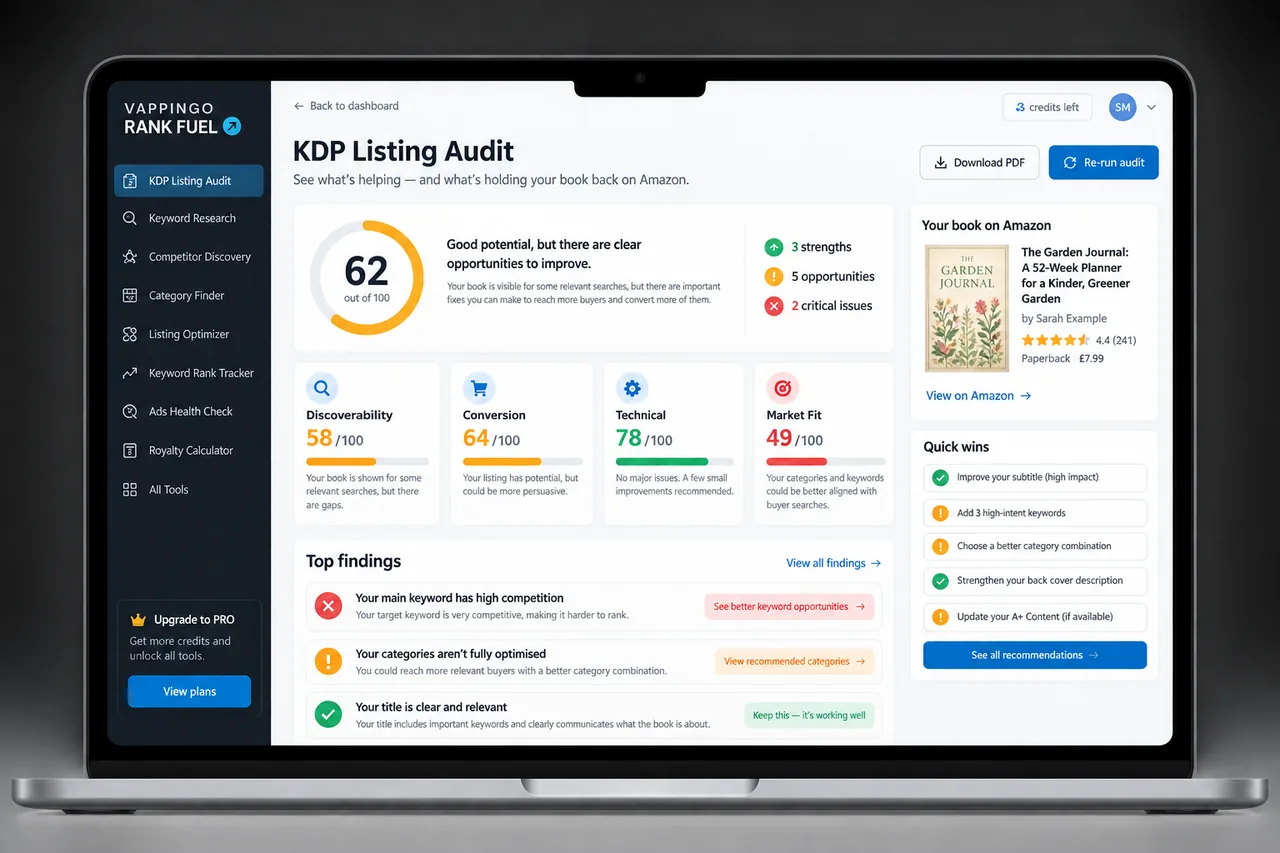
See the KDP Listing Audit in Action
The difficult part is seeing the listing as a stranger sees it. Authors already know what the book is, why it exists and what is inside, so weaknesses in the buyer-facing message can feel invisible from the inside.
The KDP Listing Audit is designed to examine the title, subtitle, description and listing promise as a sales page. Before you change keywords, lower the price or spend more on ads, use it to identify the parts of the listing that may be weakening the buyer’s decision.
Watch how the listing audit works
This short demo shows how the tool reviews an Amazon book listing and identifies areas that may be stopping browsers from becoming buyers.
Once you have seen how it works, run your own listing through the audit below.
Why Authors Fix the Wrong Thing First
Authors are often too close to their own books to diagnose the listing accurately. You already know the subject, the audience, the contents and the reason the book matters. The buyer arrives with none of that context.
You know what the book is about. You know who it is for. You know why you wrote it. You know what is inside. You know why a reader would benefit from it.
A stranger on Amazon is making a fast decision with limited information. They do not read your listing like an editor. They scan it like a shopper. They compare it with nearby books. They decide whether it feels relevant, credible, useful, interesting, and worth the price.
This is why a listing can look “fine” and still fail. Fine is not enough. The listing has to answer the buyer’s silent questions:
A stranger scans the page like a shopper, not an editor. They compare the book with nearby alternatives and make fast judgments about relevance, credibility, usefulness and value. A listing can therefore look perfectly “fine” to the author while failing the questions the buyer is silently asking:
- Is this book for me?
- Does it solve the problem I have?
- Does it match the kind of book I was searching for?
- Does it look credible?
- Is it better, clearer, more useful, or more appealing than the other books on this page?
- Do I understand what I am getting?
- Is there enough reason to buy it now?
If those answers are not obvious quickly, the shopper does not need to solve the puzzle. Amazon gives them plenty of other books to click.
Seven Listing Problems That Can Stop a KDP Book Selling
Most weak listings do not fail because of one catastrophic mistake. They lose the sale through small points of friction that make another book easier to understand, trust or choose. The seven problems below are the places I would check first.
Problem 1: The Title Is Clever but Not Clear
A clever title can be memorable, but cleverness becomes expensive when the shopper cannot immediately tell what the book is. On Amazon, the title often has to communicate before the description ever gets a chance.
That is a problem because Amazon buyers are usually comparing options quickly. If the title does not immediately signal the topic, promise, genre, age group, use case, or emotional hook, the book may lose the click before the description has a chance to help.
This is especially important for nonfiction, children’s activity books, workbooks, journals, puzzle books, low-content books, self-help, educational resources, and practical guides. A buyer should not have to work out what your book is. The listing should make the answer obvious.
Problem 2: The Subtitle Is Wasted Space
The subtitle is valuable because it can do the explanatory work the title cannot: identify the reader, clarify the benefit, signal the format, define the level or make the outcome more specific. When it merely repeats the title or disappears into generic language, that space is doing very little selling.
- They repeat the title without adding useful information.
- They stuff in keywords in a way that feels unnatural.
- They sound vague and could apply to almost any book in the niche.
A strong subtitle helps Amazon understand the book, but it also helps humans decide whether to click. The best subtitles do both.
Problem 3: The Description Explains the Book but Does Not Sell It
A description can be completely accurate and still fail to sell the book. The problem appears when the copy tells the shopper what is inside but never connects those contents to the reason they came looking in the first place.
That may be accurate, but accuracy is not the same as persuasion. A buyer does not only want to know what is in the book. They want to know why it matters.
For nonfiction, that might mean showing the problem the book solves, the transformation it offers, or the practical outcome the reader can expect. For activity books, workbooks, puzzle books, or educational books, it might mean explaining who the book is for, what skill it builds, how it is structured, and why it is easier, clearer, more enjoyable, or more useful than similar options. For fiction, it means creating enough tension, atmosphere, character interest, and genre promise to make the reader want to begin.
If your description only says what the book contains, it may not be giving buyers enough reason to choose it. The complete guide to writing an Amazon book description covers the structure of description copy in more detail, and the rewriting-a-failing-description guide covers how to fix an existing listing rather than starting from scratch.
Problem 4: The Listing Is Aimed at the Author, Not the Buyer
Authors naturally describe a book from the inside out: why they wrote it, what they included and what they believe makes it special. Buyers usually approach from the opposite direction. They arrive with a problem, a desire, an age group, a level or a specific kind of experience in mind.
From the author’s side, the emphasis often falls on:
- Why they wrote the book
- What they included
- What they care about
- What they think makes it special
From the buyer’s side, the questions are closer to:
- I need help with this problem.
- I want this kind of experience.
- I am buying for this age group.
- I need something at this level.
- I want a book that feels trustworthy, relevant, and easy to use.
A listing that focuses too much on the author’s intention can miss the buyer’s motivation. That does not mean your story, credentials, or purpose do not matter. It means they need to be framed in terms of the reader’s benefit.
Problem 5: The Keywords Attract the Wrong Kind of Visitor
Not all traffic is useful. A broad or poorly matched keyword can create impressions and even clicks from shoppers who were never likely to buy this particular book.
That can lead to impressions without clicks, clicks without sales, or ad spend that goes nowhere. For example, a book may rank for a broad phrase but fail to convert because the buyer actually wants something more specific, more advanced, more visual, cheaper, longer, shorter, newer, easier, or more clearly positioned.
This is where keyword quality matters more than keyword quantity. The goal is not to appear for as many searches as possible; it is to appear where the book is a strong answer to the buyer’s intent. Use Book Keyword Spy to inspect a strong competitor’s search footprint, and use Keyword Research and the Competition Checker when you need to test fit, demand and accessibility more deliberately.
Problem 6: The Listing Does Not Match the Competitive Set
Amazon shoppers rarely judge a book in isolation. Your listing is being compared with the other covers, promises, prices, review profiles and formats sitting around it, whether you intended those books to be competitors or not.
Your listing sits next to other books in search results, category pages, sponsored placements, and recommendation panels. If competing books make their value clearer, look more credible, have stronger titles, use sharper subtitles, or explain the reader benefit faster, your book can lose even if the content itself is good.
This does not mean copying competitors. It means understanding what buyers in that niche already expect. Ask:
- What promise do the best-selling books make?
- What words appear repeatedly in successful titles and subtitles?
- How do they describe the reader problem or outcome?
- What features do they highlight?
- What does their pricing suggest?
- How many reviews do buyers seem to expect in this niche?
The Competitor Discovery tool can help identify the books competing for the same shoppers so you can judge your click and conversion strength against a more realistic comparison set.
Problem 7: Ads Are Exposing the Listing Problem Faster
Ads do not fix a weak listing. They simply send more people to it, which means paid traffic can expose a conversion problem much faster than organic traffic does.
If your book gets ad clicks but few sales, the ads may not be the only issue. The listing may not be converting the traffic you are paying for.
That is why it is risky to scale ads before checking the listing. More traffic to a weak product page usually means more wasted spend.
Before increasing the budget, changing bids or creating more campaigns, audit the listing. Once the page is stronger, the Amazon Ads Weekly Coach and Amazon Ads Generator can help you make better use of the paid traffic.
How to Diagnose What Kind of Sales Problem You Have
The fastest way to stop random optimization is to match the symptom to the gate. Start with what you can actually observe, then investigate the smallest set of causes that could explain it.
| What you see | Likely problem | What to check first |
|---|---|---|
| Almost no impressions | Visibility | Keywords, categories, indexing, niche demand |
| Impressions but few clicks | Click-through | Cover, title, subtitle, price, reviews, search-result fit |
| Clicks but no sales | Conversion | Description, buyer promise, Look Inside, positioning, reviews |
| Sales are occasional but do not grow | Momentum | Ranking movement, conversion rate, review growth, seasonal demand |
If people are reaching the product page but not buying, start with the KDP Listing Audit. If Amazon is barely showing the book, investigate keyword, category and indexing problems first. If paid traffic is generating clicks without sales, strengthen the listing before you increase ad spend.
What to Fix First If Your KDP Book Is Not Selling
Do not change the title, subtitle, description, keywords, categories, price and ads all at once. Even if sales improve, you will not know what fixed the problem. Start with the most likely bottleneck and make the smallest useful change.
Step 1: Check whether the listing is clear
Can a stranger understand what the book is, who it is for, and why they should care within a few seconds? If not, your first job is clarity.
Step 2: Check whether the description sells the outcome
Does your description simply list features, or does it explain the benefit of those features? A stronger description connects the contents of the book to the buyer’s problem, desire, identity, or goal.
Step 3: Check whether your keywords match buyer intent
Do your keywords describe what real buyers are likely to search for, or are they broad phrases that only loosely relate to the book? If the keywords are attracting the wrong people, better traffic may matter more than more traffic.
Step 4: Check your competitive position
Look at the books around yours. If they are clearer, more polished, better reviewed, more specific, or more compelling, your listing needs to work harder.
Step 5: Check whether your ads are sending traffic too soon
If you are paying for clicks before the listing is ready, you may be buying evidence that the page does not convert. Fix the listing before scaling the traffic.
Which Rank Fuel Tools Fit This Problem?
Rank Fuel works best when the tool follows the diagnosis. The point is not to run everything against an underperforming book; it is to answer the next question that could change what you do.
| Tool | Use it when… |
|---|---|
| Listing Audit | Diagnose whether the live page is losing shoppers before you start changing random elements. |
| Listing Optimizer | Improve the editable copy and positioning of a live listing when conversion is the weak gate. |
| Keyword Research | Check whether the book is targeting Amazon.com searches with meaningful demand and relevant buyer intent. |
| Competitor Discovery | Find the books competing for the same shoppers so you can judge click and conversion strength in context. |
| Keyword Rank Tracker | Track whether the book is becoming easier or harder to find for the searches that matter. |
Final Thought: Do Not Send More People to a Weak Listing
If my KDP book is not selling is the problem you are trying to solve, resist the instinct to buy more traffic before you know what happens to the traffic you already have. Visibility is useful only when the next two gates are strong enough to turn it into a sale.
Make sure the right shopper can understand the book quickly, see why it fits their need and find enough evidence on the product page to choose it over the alternatives.
Then build traffic on top of a listing that has a chance to convert. More visitors should amplify a working sales page, not subsidize a broken one.