How to Analyze Page One of Amazon Before Publishing a KDP Book
Page one is more useful when you read it as a market rather than a leaderboard.
Would you still write the book if Amazon page one told you the market was wrong?
That is a much easier question to answer before you have spent weeks writing, paid for illustrations, designed the interior, tested covers and built the listing. Once the book starts absorbing time and money, it becomes much harder to look at weak market evidence and walk away.
Amazon page one gives you the chance to make that decision while changing direction is still cheap. It shows which books are winning visibility for the searches you care about, what buyers are currently being offered, how entrenched the competition looks and whether demand appears to extend beyond one exceptional bestseller.
The trap is to reduce all of that information to a single attractive number. A low average review count can sit beside weak sales. One enormous bestseller can make a thin market look healthy. A large search-volume estimate can mean very little if the search is vague or the books appearing for it do not resemble the product you intend to publish.
That is the purpose of an Amazon KDP competition analysis. The useful question is not “Does this keyword look promising?” but “What story does page one tell when I read the whole market?”
The Quick Answer: Read Page One as a Market, Not a Leaderboard
Before you commit to a KDP book, analyze page one of the buyer-intent searches the book would genuinely need to compete for. You are looking for five things: a coherent set of relevant products, demand spread across more than one winner, a competitive barrier you can realistically challenge, a clear standard for what buyers already expect and evidence that newer or less-established books can still gain visibility.
Amazon itself says search results are dynamic and that ordering can be influenced by factors including past sales history, availability, how long an item has been listed and popularity. It also notes that results can change from one day to the next. See Amazon’s current Search Results guidance.
Page one is therefore evidence rather than a permanent verdict. One snapshot tells you what the market looks like now; repeating the check across several closely related searches tells you whether that pattern is strong enough to influence the book you are considering.
1. Check Whether Page One Actually Matches the Search
What exactly is Amazon showing the buyer who types this search?
That needs to come before review counts, BSR or search volume because every later metric depends on the results being genuinely comparable. If you search for large print memory games for seniors, a general dementia-care guide, a tiny-print puzzle book and a children’s memory workbook may all appear somewhere in the results. They are still poor competitors if they do not satisfy the same buying need.
Read the titles, subtitles, covers, formats and visible positioning before you start collecting numbers. Does page one appear to be serving one recognizable reader and one recognizable use case, or has Amazon assembled a loose collection around ambiguous words?
- Do most visible books target the same type of reader?
- Do they solve broadly the same problem or satisfy the same interest?
- Are the formats comparable: guide, workbook, puzzle book, journal, fiction or activity book?
- Would your proposed book feel like a natural answer to the search?
- Are irrelevant results occasional outliers, or is the whole search mixed?
A mixed page is interesting, but do not rush to call it a gap. The existing products may be serving the search badly, which could create an opening. Equally, the search itself may be ambiguous and the demand too unfocused to support the product you have in mind. Irrelevance is a prompt to investigate, not proof that you have found an opportunity.
If the search itself is still uncertain, use the wider KDP Keyword Research Checklist first. Page-one research becomes much more useful once you have a shortlist of plausible buyer-intent phrases rather than a collection of broad topic words.
2. Look for Demand Across Several Relevant Books
Now ask the question that one bestseller cannot answer: Are buyers spending money across this market, or mainly on one exceptional book?
A single title with an excellent Best Sellers Rank can make a search look far healthier than it really is. It proves that one book is performing well. It does not prove that several comparable products can attract meaningful demand, which is the evidence you need if you are considering adding another one.
Compare BSR and estimated sales across several directly relevant books and look at the distribution rather than the winner. Five or six comparable titles showing meaningful activity tell a much stronger market story than one dominant bestseller surrounded by books that appear barely to move.
Amazon says Best Sellers and Category Ranks are based on a book’s customer activity relative to other books. Rankings reflect both recent and historical activity, with recent activity weighted more heavily, and Amazon explicitly warns that Sales Rank is not an accurate way to track a book’s exact activity. See Amazon’s current Sales Ranking guidance.
That is why any sales number derived from BSR should be labeled as an estimate. Use BSR and BSR-derived sales to compare books, identify outliers and understand how activity is distributed across the page. They are directional market evidence, not Amazon-reported unit sales.
This is the practical continuation of One Bestseller Is Not a Market: How to Tell If KDP Demand Is Real. The principle is simple: a market pattern deserves more weight than one spectacular listing.
3. Measure the Competitive Wall, Then Look Behind the Average
Would a new book have to beat an entire wall of established titles, or only a few intimidating outliers?
Review counts are useful here because they show how much social proof the visible books have accumulated, but averages can hide the answer. One enormous incumbent can drag the average upwards. At the other extreme, a page full of low-review books can look wonderfully accessible even when hardly any of them appear to be selling.
Look at the distribution instead. Are most meaningful positions held by books with thousands of reviews, or are titles with dozens or a few hundred reviews reaching the top of the page? More importantly, do those lower-review books also show credible demand?
One intimidating book can distort the page
Imagine five relevant books with 5,400, 240, 118, 73 and 41 reviews. The average is high because the first book dominates the calculation. The distribution tells a more useful story: several lower-review books are still visible, which is evidence worth investigating.
Average review depth is useful as a quick screening signal, but the distribution matters more than the headline number. A market can look intimidating because one enormous incumbent distorts the average, while a genuinely entrenched page usually shows strength across several relevant books.
The fuller competition decision also needs demand, relevance and market structure. What Review Counts Really Tell You About KDP Competition explains why the distribution matters, while our guide to how to tell if a KDP keyword is too competitive goes deeper into the wider decision.
4. Read the Product and Price Standard Buyers Already See
Suppose the demand looks healthy and the competitive wall looks manageable. What would your book actually have to look like to belong on this page?
This is the part the numbers cannot answer for you. Reviews, BSR and search volume can tell you a great deal about market activity, but the visible products tell you what buyers are already being trained to expect.
Look at the covers, titles, subtitles, formats and price points. What feels normal in this market? Are the strongest books polished premium products, or is the page full of generic offerings? Do buyers seem to expect a very specific promise, a recognizable format, a particular page count or a strong visual style?
Price needs the same contextual reading. A low average price can create a real economic problem for an image-heavy print book even if demand is strong. A higher-priced market may create more room for production cost, but only if buyers are clearly accepting that price for comparable products.
Rank Fuel’s current Keyword Research results include pricing evidence alongside demand and competition, which makes the broad price pattern easier to compare across keyword markets. But no market score can tell you whether a cover is convincing, a title is persuasive or the interior genuinely solves the buyer’s problem. Those remain product and editorial judgments.
5. Look for Evidence That New Books Can Enter the Market
There is one final question before you call the market attractive: Can anything new actually get in?
A market can have excellent demand and still be a poor target if every meaningful position belongs to books with years of history, thousands of reviews and entrenched brands. In that situation, the problem is not whether buyers exist. It is whether a new product has a plausible route to those buyers.
Newer books gaining visibility tell a different story. They show that shoppers are still considering fresh products and that page one is not completely frozen around its incumbents. Publication age therefore becomes much more useful when you read it alongside reviews, BSR and estimated sales.
Only then should you start looking for a gap. Repeated customer complaints, neglected audiences, weak format choices, poor presentation or missing use cases can all matter, but a gap has commercial value only when buyers care about it. A page full of mediocre products is not an opportunity if the market itself is barely moving.
If you are still validating the whole concept, return to 5 Tests Every KDP Book Idea Should Pass Before You Write. Page-one analysis is one part of the wider decision about whether the idea deserves production.
Turn the Evidence Into a Publishing Decision
What happens when you have finished checking all five signals?
You make a decision. Page-one research has very little value if it ends with a folder of screenshots, several interesting observations and no change to what you plan to do next. Classify the idea as Proceed, Investigate, Reposition or Reject, then record the evidence behind that choice.
| Signal | Encouraging | Needs investigation | Warning |
|---|---|---|---|
| Relevance | Most results serve the same buyer and product need. | Some mixed results or adjacent products. | The search is broad, confused or poorly matched to the proposed book. |
| Demand | Several relevant books show meaningful activity. | Demand is concentrated in a few titles. | Little evidence of sustained activity beyond one outlier. |
| Competition | Lower-review or less-established books can gain visibility. | Mixed competitive wall with some accessible positions. | Most meaningful positions are held by heavily entrenched titles. |
| Existing offer | Clear weaknesses or unmet needs buyers appear to care about. | Differentiation is possible but not yet sharp. | Existing products are strong and the proposed book adds little. |
| Entry | Newer books are gaining traction. | Few recent entrants, with mixed evidence. | No visible route in for newer or less-established books. |
Proceed when several independent signals point in the same direction and you can explain both why demand exists and how your book could enter. Investigate when one important part of the story is still unclear. Reposition when the market is credible but your current product would simply disappear into what is already there. Reject when weak demand, entrenched competition and the absence of a meaningful product gap combine.
How to Run the Market Check in KDP Rank Fuel
You can do the entire process manually: search Amazon, open the most relevant books and record reviews, BSR, price, publication age and product positioning. The harder part is deciding which searches deserve that level of attention in the first place.
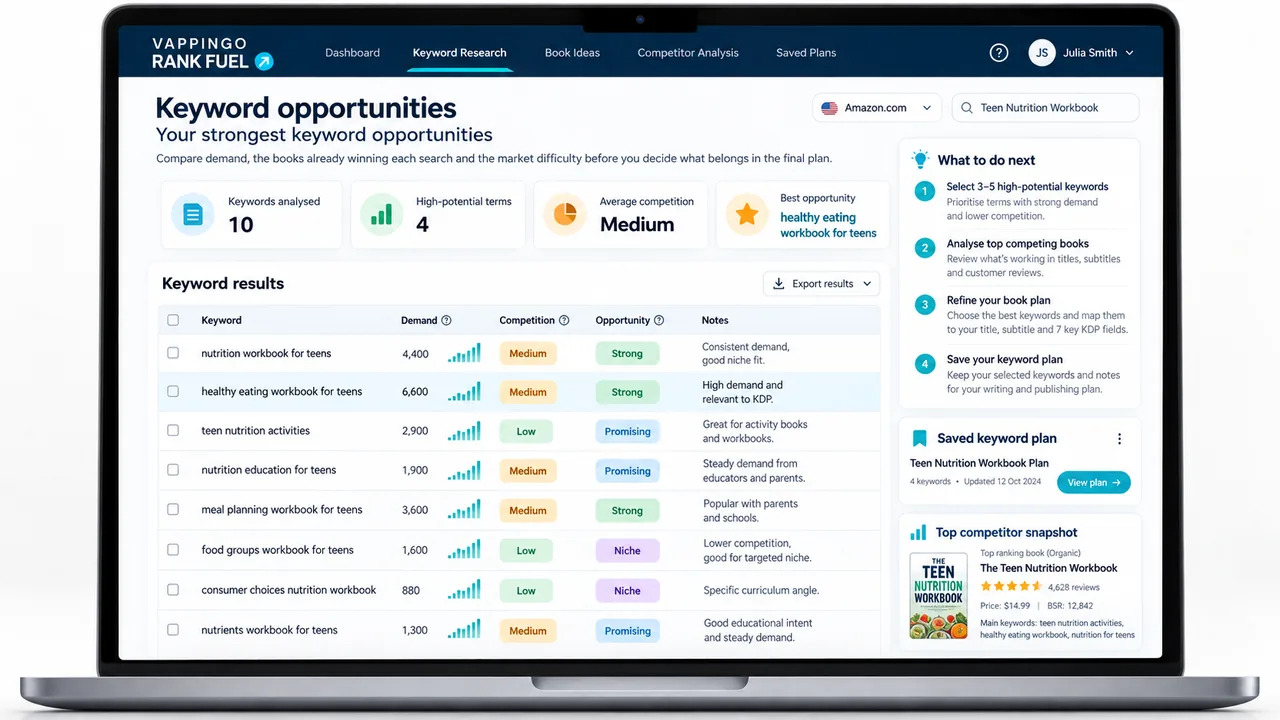
KDP Rank Fuel’s current Keyword Research workflow helps with that shortlist. Start by describing the book or idea you are considering, and Rank Fuel identifies relevant Amazon buyer searches and compares the strongest opportunities so you can see where demand, competition and earning evidence appear to line up.
1. Start with the book, not a one-word keyword
Include the details that define the product: subject, audience, age or level, format and any meaningful use case. That gives the research enough context to avoid drifting towards a broad search that has volume but does not really describe the book.
2. Compare the strongest search markets
The current results can show estimated monthly searches, competing-book counts, average price, average page count, estimated earning activity, a Competition assessment and an Opportunity read. Use those signals to shortlist the searches that deserve a manual page-one check. The current research route is focused on Amazon.com (US), so treat the market figures as US-market evidence rather than assuming they transfer unchanged to every Amazon marketplace.
3. Open Amazon and inspect the pattern behind the numbers
Rank Fuel can help you spot the searches that look promising, but the final publishing judgment still comes from looking at the actual books. Check whether the results are genuinely comparable, whether review strength is concentrated or widespread, whether newer books are gaining traction and whether the existing offer leaves a meaningful reason for your book to exist.
Then use page one for the judgment
The tool can tell you that one search has stronger demand or appears more accessible than another. The Amazon page tells you why that pattern exists and whether your proposed book has a credible route into it.
Your first Keyword Research run currently costs 3 credits. Free accounts see the top 3 complete opportunities from that included search; Pro unlocks all 10 analyzed opportunities and future Keyword Research.
Worked Example: Why the Bigger Search Can Be the Weaker Opportunity
Which would you choose: a search with an estimated 7,500 monthly searches or one with 1,200?
If volume were the only evidence, the answer would be obvious. The example below shows why page-one research can reverse that first impression. The figures are illustrative rather than live Amazon market data and are intended only to show how the signals work together.
| Signal | Search A: memory games for seniors | Search B: large print memory games for seniors |
|---|---|---|
| Estimated monthly searches | 7,500 | 1,200 |
| Average reviews | 1,340 | 180 |
| Competing-book pattern | Several entrenched titles and a broad product mix. | Lower review depth and a more consistent product format. |
| New entrants | Few recent books showing meaningful traction. | Several newer books visible among established titles. |
| Buyer intent | Broader need with more mixed interpretations. | Clearer format and accessibility expectation. |
| Research decision | Investigate carefully before committing. | Worth deeper product research. |
Search A wins comfortably on estimated demand, but almost everything else makes the decision less attractive. The competitive wall is higher, the product mix is broader and newer books appear to have less room to break through. Search B is much smaller, yet the buyer’s need is clearer and the page appears more open to newer products. On this evidence, the smaller search has earned the deeper investigation.
That still does not justify building an entire book around one keyword. A sound KDP concept normally has several plausible discovery routes. Compare a small group of closely related buyer-intent searches and look for the same market story appearing more than once.
Frequently Asked Questions About Amazon KDP Competition Research
How do I analyze KDP competition on Amazon?
Start with a specific buyer-intent keyword and inspect the first-page books for relevance, demand, review distribution, BSR, estimated sales, pricing, publication age and product quality. Then ask whether several comparable books are succeeding, whether newer books can enter and whether your proposed book has a meaningful reason to be chosen.
How many reviews are too many for a KDP niche?
There is no universal review threshold that makes a KDP market too competitive. Review counts need to be read as a distribution alongside demand and publication age. A page with one 5,000-review outlier and several visible books under 200 reviews can be more accessible than the average suggests.
What BSR should I look for when researching a KDP book idea?
A single BSR threshold is not enough to validate a market. Amazon says BSR is relative, reflects recent and historical customer activity and is not an exact sales tracker. Compare several directly relevant books and use BSR-derived sales as directional estimates rather than Amazon-reported unit sales.
How many books should I analyze on Amazon before publishing?
analyze enough of the directly relevant page-one set to see a stable pattern. Start with the strongest and most comparable books, then inspect lower-review, newer or unusual results that could change your interpretation. The aim is to understand the market shape rather than reach an arbitrary competitor count.
Does high Amazon search volume mean a KDP niche is profitable?
No. Estimated search volume indicates potential search demand, not sales or profit. Commercial value also depends on buyer intent, relevance, achievable visibility, conversion, competition, product cost and the price buyers are willing to pay. A smaller search can be more useful when the intent is clearer and the competitive route is stronger.
How do I know whether a new KDP book can reach page one?
No research method can guarantee a page-one position. Look for evidence that newer and lower-review books are already gaining visible positions, that demand is distributed across several titles and that your book can satisfy the search more clearly or effectively than some of the current results.
How should I use Rank Fuel’s Competition and Opportunity reads?
Use them to compare candidate keyword markets and decide where deeper research is most worthwhile. They are screening aids rather than Amazon ranking factors or sales predictions, so always inspect relevance, the actual books, product quality, differentiation and the economics before making the publishing decision.
The Decision to Make Before You Write
Page-one research is most valuable when it changes a decision before changing direction becomes expensive.
Do not let one spectacular bestseller, one low review count or one large search-volume estimate carry the whole case. Look for agreement across the market: relevant books, demand beyond a single winner, a competitive wall that leaves some route in, an existing offer you can improve on and evidence that buyers still consider newer alternatives.
If those signals line up, the idea has earned deeper research. If they do not, change the search, reposition the product or reject the concept before uncertainty turns into sunk cost. When you are ready to test the idea, run it through KDP Rank Fuel Keyword Research, shortlist the strongest search markets and record the page-one evidence behind your final decision.