KDP Categories and Kindle Unlimited: What Changes for KU Authors
Understand how category strategy fits with KDP Select and Kindle Unlimited without relying on unsupported claims about page reads, category boosts, or Hot New Releases formulas.
Kindle Unlimited changes how many authors earn from an eBook because revenue can come from page reads as well as direct purchases. That makes it tempting to invent a separate category strategy for KU, but Amazon does not provide a different category selector or a special set of KU category rules.
KDP Select is a free 90-day program for Kindle eBooks, and enrollment automatically includes the title in Kindle Unlimited. Categories still work through the normal KDP system, while KU performance is reported through KENP and royalties. Amazon’s KDP Select guidance is the starting point for the program rules.
KDP Select Changes Distribution, Not the Category Interface
A Select-enrolled eBook remains categorized through the same KDP Details workflow as other Kindle books. You still select up to three categories based on the primary audience and marketplace, and you should still choose categories that accurately describe what a reader is getting.
The major strategic difference is distribution. Select requires digital exclusivity for the Kindle eBook during the enrollment term, so Amazon becomes the central place where the eBook is discovered, purchased, borrowed, and read. That concentration can make Amazon-side positioning more commercially important, but it does not make inaccurate categories acceptable.
How Borrowing Activity Relates to Rank
Amazon says Sales Rank and Category Ranks are based on customer activity and explicitly warns against manipulative purchasing or borrowing activity. That tells us borrowing is part of the broader customer-activity environment, but Amazon does not publish a formula that converts a borrow, a particular number of KENP, or a completed read into a specific category-rank movement.
Avoid claims such as “every KU borrow counts like a sale” or “page reads push a book X places up a category.” Those statements sound precise but are not supported by Amazon’s published documentation. Treat KU activity as part of the evidence you observe, not as a conversion formula you can calculate in advance.
Use Amazon’s Sales Ranking guidance to understand what is known: rankings are relative, use recent and historical activity, and may change when competitors’ activity changes even if yours does not. That is enough to build a cautious measurement framework without inventing a private weighting system.
Choose Categories for the Reader, Then Evaluate the Economics
A KU-heavy romance, fantasy, thriller, or mystery book should still sit in the categories its readers expect. The fact that a genre has strong KU readership can influence the economics of publishing and advertising there, but it does not change the basic metadata test.
When comparing two equally accurate categories, you can consider whether the books on the shelf are dominated by series, rapid-release authors, established indies, or major publishers. That context can help you estimate how difficult it may be to gain visibility and how much downstream KU reading a series might generate.
For book one of a KU fantasy series, a specific fantasy subgenre may be more useful than a broad fantasy parent if it accurately describes the world and reader promise. The reason is cleaner audience fit, not a hidden KU ranking bonus attached to the category.
Do Not Build Category Strategy Around a Hot New Releases Formula
Hot New Releases lists exist on Amazon, but Amazon does not publish a universal KDP rule saying every new book receives exactly a 30-day category window or that KU activity extends or resets it. Treat these lists as merchandising surfaces you can observe, not as a documented formula you can engineer.
A launch can still benefit from concentrated early attention because the book is new, reviews and ads begin accumulating, and readers may encounter it in new-release merchandising. The practical strategy is to launch into accurate categories and track what actually happens rather than optimizing around an undocumented timer.
Separate KENP Performance From Category Performance
KENP tells you how much eligible content customers read for the first time through Kindle Unlimited. Category rank tells you how the book’s customer activity compares with other books in a category. They are related to the same commercial ecosystem but should not be treated as interchangeable metrics.
A book can have strong KENP because a smaller number of readers consume long books deeply, while another title may have more unit sales and different rank behavior. Track units, KENP, royalties, advertising, BSR, and category rank together before deciding that a category is helping or hurting.
- Units ordered
- KENP read and KU royalties
- Overall BSR trend
- Visible category ranks
- Ad spend and attributed orders
- Series read-through or downstream book performance
Category Strategy for Wide Authors Is Still Useful
Authors publishing wide are not using KU, but they still need accurate Amazon categories because Amazon remains one retail channel among several. The difference is that an Amazon category decision should be evaluated as part of a wider distribution picture rather than as the entire digital business.
Do not choose a weaker Amazon category simply because you are wide, and do not assume Select requires a special “KU category.” The same reader-positioning discipline applies in both models; what changes is how you interpret the revenue and discovery data. Keep the metadata job and the distribution-model job separate when you review performance.
Use Rank Fuel as Research Support, Not as an Amazon Rulebook
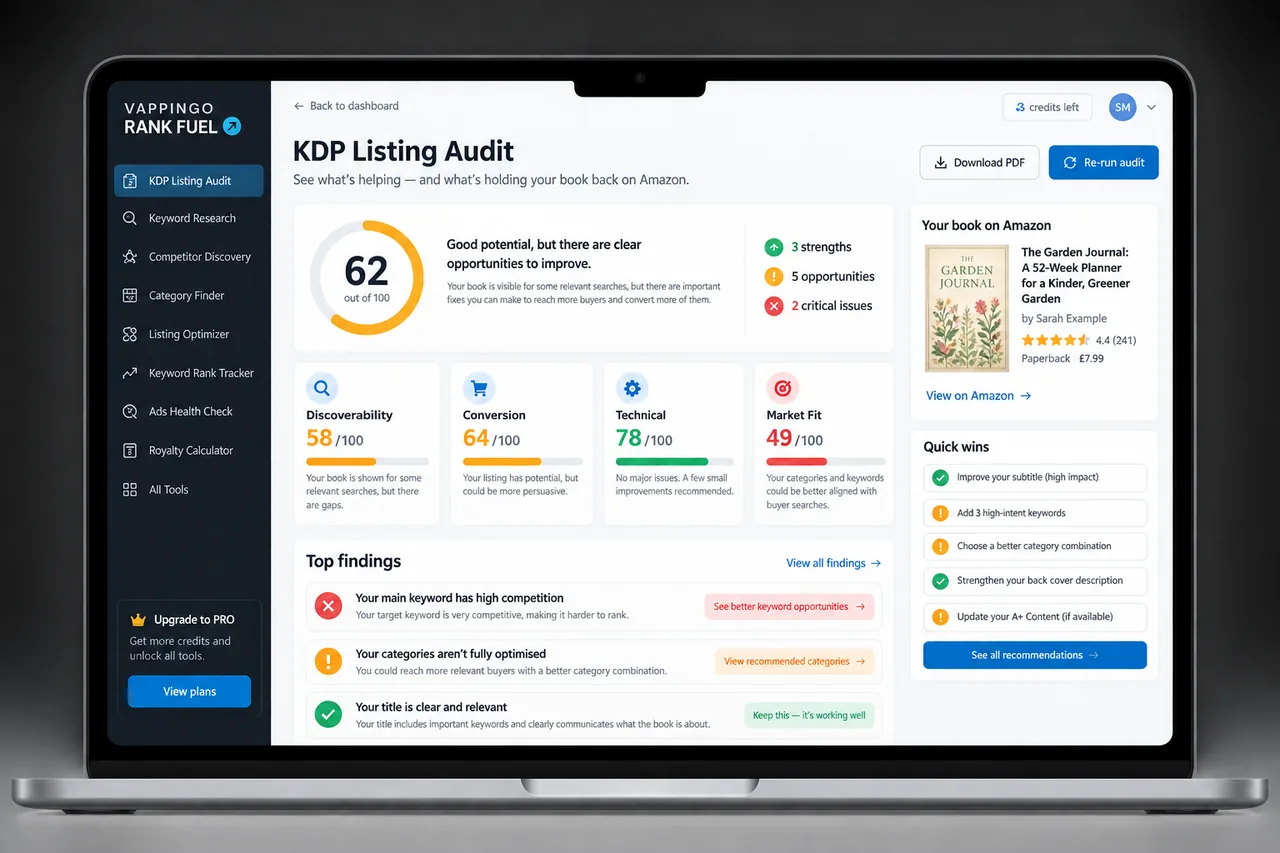
Rank Fuel can help compare category options, estimated competition, keyword relevance, and book performance, but it cannot reveal a private Amazon formula for KU or category ranking. Treat Category Finder, Category Research, Earnings Outlook, and related tools as ways to organize evidence around the book.
That distinction matters because it keeps decisions reversible. You can test an accurate category, watch the book’s real Amazon and KDP data, and change course if the evidence weakens without pretending the tool can guarantee a rank outcome.
Frequently Asked Questions
Does Kindle Unlimited have separate KDP categories?
No. Select-enrolled Kindle eBooks use the normal KDP category system.
Do KU borrows count toward category rank?
Amazon references borrowing activity in its ranking-policy guidance, but it does not publish a formula showing how a borrow or a quantity of KENP converts into rank.
Is KDP Select required for Kindle Unlimited?
Yes. Enrolling a Kindle eBook in KDP Select automatically includes it in Kindle Unlimited for the Select term.
How long is a KDP Select term?
KDP Select operates in 90-day enrollment periods.
Should KU authors choose lower-competition categories?
Choose accurate categories first. Competition can help you decide between equally relevant options, but low competition does not justify a poor fit.
Should I judge categories by KENP alone?
No. Combine KENP with units, royalties, BSR, visible category rank, advertising, and series performance.
Treat KU as an Economics Layer, Not a Category Shortcut
Kindle Unlimited can materially change how an eBook earns money, especially in long books and series, but it does not replace the fundamentals of accurate classification. Categories should still answer the shopper’s question: what kind of book is this, and is it for me?
Use KU data to understand reader behavior and revenue, then use categories to sharpen positioning. Keeping those jobs separate produces cleaner decisions and fewer myths about how Amazon ranking works.