How to Write a Book Description for Self-Help Books
A strong description makes the right reader understand the promise of the book quickly, without stuffing the field with material Amazon does not allow.
Self-help is one of the most competitive nonfiction categories on Amazon KDP, and its readers are among the most sceptical. They have bought books that promised transformation and delivered repackaged common sense. Your description must convince a reader who has been disappointed before that this time is different; and it must do it in under 300 words. For the complete foundation, see our .
What Self-Help Readers Are Actually Buying
Self-help readers are not buying information; they can find information anywhere. They are buying a specific vision of their future self: the version of themselves who has solved the problem this book addresses. Your description must make that future self vivid and credible.
This distinction reshapes every sentence in your description. Instead of “this book covers the science of habit formation,” write “you’ll finally understand why your willpower keeps failing; and what to do instead of relying on it.” The first sentence describes content. The second creates a vision of a reader who no longer struggles with the problem they came to the book to solve.
The Emotional Problem Statement
The most powerful element of any self-help description is the problem statement; specifically the problem statement. Not the surface problem (“I want to be more productive”), but the emotional experience of living with that problem (“the persistent, exhausting sense that you are always behind, always slightly failing, always promising yourself next week will be different”).
Self-help readers buy books because they are in pain. The problem statement that names their pain precisely; in language so specific that they feel recognized; creates an immediate bond between the reader and the description. They are not evaluating whether to buy a book; they are experiencing the relief of feeling understood.
The most effective research technique: read the one-star reviews of competing books in your category. One-star reviews are often the most honest articulation of what readers felt they needed but did not get. The language they use when frustrated is often the language you should use in your problem statement; because it is the language your reader uses internally when experiencing the problem your book solves.
Self-Help Description Structure
- Emotional problem statement: Name the reader’s pain in their own language, with uncomfortable precision
- Why existing solutions fail: One sentence establishing what makes your approach different from what the reader has already tried
- Author credibility: One sentence; why are you qualified to solve this specific problem?
- What’s inside (benefit-led): Three to five specific outcomes the reader will achieve, framed as benefits not features
- Who this is for: A reader qualification statement that creates identification
- Outcome promise: What the reader’s life looks like after reading and applying the book
- CTA: Direct, outcome-focused, low friction
Credibility Without Arrogance
Self-help credibility is a delicate balance. Too little and the reader has no reason to trust your advice over the thousands of other voices offering the same. Too much and the description reads as boastful, which triggers the scepticism that already runs high in this category.
The most effective credibility signals for self-help:
- Personal transformation: “After fifteen years of anxiety that no therapist, medication, or self-help book fully addressed, she finally found the approach that changed everything.” Transformation credibility feels earned rather than claimed.
- Professional results: “The framework she has used with over 300 clients to double their income in under a year.” Specific, verifiable, outcome-anchored.
- Research foundation: “Based on a decade of research into high-performance habits across 12 countries.” Works especially well for analytical readers.
- Community proof: “The system that has helped over 50,000 readers stop procrastinating and start building.” Social proof at scale.
Choose the credibility signal most relevant to your book and your reader’s primary trust concern. One well-chosen sentence of credibility outperforms a paragraph of credentials every time.
Benefit Language vs Feature Language
The distinction between features and benefits is the most important craft element in self-help description writing. Every sentence must answer: what does this give the reader, not what does the book contain.
| Feature (weak) | Benefit (strong) |
|---|---|
| Chapter 3 covers morning routines | You’ll design a morning routine that actually sticks; in 7 minutes, not 90 |
| Includes exercises and worksheets | Every concept comes with a 5-minute exercise you can use the same day |
| Drawing on cognitive behavioral therapy | The same evidence-based tools therapists charge £150/hour for; applied to your specific situation |
| Covers the psychology of motivation | Finally understand why you keep starting and stopping; and what to do about it |
Overcoming Reader Scepticism
Self-help readers arrive with their scepticism already engaged. The most effective ways to address it directly in your description:
- Acknowledge the pattern: “If you’ve tried [competing approach] and found it lacking…” shows the reader you understand their prior experience.
- Be specific about your difference: “Unlike most productivity advice, this is not about doing more; it is about doing less, better.” Specificity about what makes you different is more convincing than generic claims of uniqueness.
- Use concrete numbers: “47 readers report…” or “in under 14 days…”; specificity signals rigour.
- Avoid overblown promises: “Transform your life in 30 days” is a promise the sceptical reader has heard before and disbelieves. “A clear, actionable framework you can start applying today” is credible. The humble promise often converts better than the grand one.
By Subcategory
Emotional resonance is primary. Readers are buying a new way of seeing themselves and the world. The problem statement should go deep on the internal experience rather than the external situation.
Practicality signals matter most. Readers want to know this is actionable, specific, and time-realistic. “Simple,” “practical,” “immediately applicable” are effective; but only when backed up by specific content claims, not as generic promises.
Both the individual and the relationship’s health are at stake. Problem statements should acknowledge the impact on relationships, not just the individual. Credibility from lived experience or professional background carries significant weight.
Credibility and specificity are paramount. Financial readers are making decisions with real consequences. Vague promises are more damaging here than in any other subcategory. Specific, realistic outcomes framed in honest language convert better than aspirational claims.
Self-Help Description Checklist
- Opens with an emotional problem statement in the reader’s own language
- Acknowledges why prior solutions have failed
- Author credibility in one specific, relevant sentence
- Benefits stated; not features
- Specific outcomes named with concrete detail where possible
- Reader qualification statement creates identification without excluding
- No overblown promises; credible, realistic transformation language throughout
- Outcome vision; what the reader’s life looks like after reading
- Direct, outcome-focused CTA
Writing this from scratch for your own book; particularly the problem statement and benefit bullets; is harder when you are too close to the content. by Vappingo generates a well-structured, benefit-led self-help description from your book details, giving you a strong starting point to refine rather than a blank page.
Once your description is driving readers to your book, the content needs to deliver what it promised. Vappingo’s ensures your manuscript is error-free and consistent; exactly the standard of quality your description sets up readers to expect.
Current KDP description rules to check before publishing
Amazon currently limits the Description field to 4,000 characters, including any HTML tags you add in Source view. Its own writing guidance emphasizes three qualities: keep the description simple, make the opening compelling, and publish professional copy that has been proofread carefully. Amazon also recommends keeping the main explanation easy to scan rather than overwhelming a shopper with every plot point or feature.
The restrictions matter just as much as the copywriting. KDP says descriptions cannot contain phone numbers, postal or email addresses, website URLs, customer-review requests, reviews, quotes or testimonials, promotional or time-sensitive material, pricing or alternative-ordering information, Unicode emoji, spoilers, or keyword/book-tag phrases. Treat those as publishing constraints, then make the permitted copy do the selling work through clarity, stakes, reader fit, benefits, and voice.
Use this page as part of a complete description workflow
Writing the description is easier when each page has one job. Start with the complete Amazon book description guide for the overall structure, then use the specialist guides for genre, hooks, formatting, series copy, length, or diagnosis. If a live listing is underperforming, compare the description with the broader KDP Listing Audit process so you do not rewrite copy when the real bottleneck is the cover, positioning, keywords, or price.
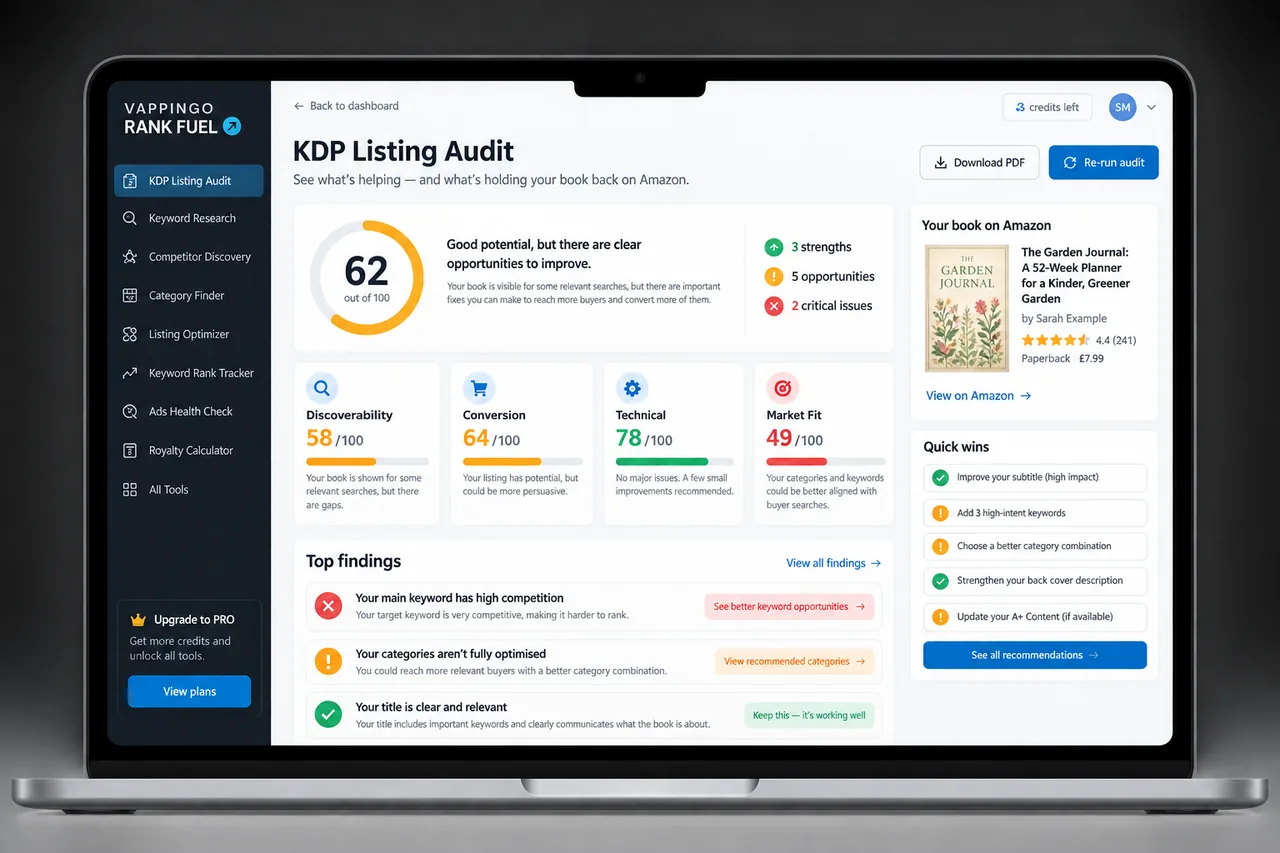
For authors who want a more structured listing workflow, Rank Fuel’s current Listing Generator helps create a complete Amazon listing, while Listing Audit identifies the areas most likely to need attention. Treat those tools as drafting and diagnosis aids, then apply human judgment to the final promise, tone, and accuracy.